Lecture 21: Non-Systems: Modalities
 Call Kai
 Learn
Learn Practice Test
 Spaced Repetition
 Match
Match Flashcards
 Knowt Play
1/61

There's no tags or description
Looks like no tags are added yet.
Name | Mastery | Learn | Test | Matching | Spaced | Call with Kai |
|---|
No analytics yet
Send a link to your students to track their progress
62 Terms
Physiological effects of general heat application: increased
- CO
- Vasodilation
- HR
- Respiratory rate
- Metabolic rate
Physiological effects of general heat application: decreased
- Muscle activity (sedentary effect)
- BP
- Blood to internal organs
- Blood flow to resting muscle
- Stroke volume
Temperature settings: hot pack
- 165-170 °F Rx temp
- 6-8 layers of toweling
- Hot pack peaks heat in first 5 minutes during this time patient is at greatest risk of burns, treatment time: 20-30 minutes
Temperature settings: paraffin bath
- Rx temp: 125-127 °F
- Rx time: 15-20 minutes
- Used on wrist and hands or feet which are irregular distal areas
Temperature settings: contrast bath
- Immerse involved limb in 100-111°F water for 4 minutes
- Then immerse involved limb in 55-65°F water for 1 minute
A PT student suffered low back pain due to excessive studying during NPTE week and is using hot packs in the PT clinic. When using hot packs, which of the following scenarios is MOST likely to result in burns?
A. Using 6 layers of toweling between the hot pack and the patient
B. A treatment time of 30 minutes
C. A hot pack heated by immersion in water heated to 205 degrees Fahrenheit
D. The patient's skin having too many hair
C. A hot pack heated by immersion in water heated to 205 degrees Fahrenheit
Max risk for burns occurs in the first 5 minutes.
Superficial thermotherapy contraindications
- Acute MSK trauma
- Arterial disease
- Bleeding or hemorrhage
- Over an area of compromised circulation
- Over an area of malignancy
- PVD
- Thrombophlebitis
Indications for iontophoresis
- Hyperhidrosis
- Analgesic
- Calcium deposits
- MSK inflammation
- Sclerotic scars
- Dermal ulcers
- Analgesic
- Fungal infections
- Edema reduction
- Muscle spasm
Iontophoresis: water
- Use: hyperhidrosis
- Polarity: +/-
- Source: tap water
Iontophoresis: salicylate
- Use: analgesic
- Polarity: -
- Source: sodium salicylate
Iontophoresis: acetate
- Use: calcium deposits
- Polarity: -
- Source: acetic acid
Iontophoresis: dexamethasone
- Use: MSK inflammation
- Polarity: -
- Source: dexamethasone phosphate
Iontophoresis: iodine
- Use: sclerotic scars
- Polarity: -
- Source: iodine
Iontophoresis: zinc
- Use: dermal ulcers
- Polarity: +
- Source: zinc oxide
Iontophoresis: lidocaine xylocaine
- Use: analgesic
- Polarity: +
- Source: lidocaine xylocaine
Iontophoresis: copper
- Use: fungal infections
- Polarity: +
- Source: copper sulfate
Iontophoresis: hyaluronidase
- Use: edema reduction
- Polarity: +
- Source: wydase
Iontophoresis: calcium & magnesium
- Use: muscle spasm
- Polarity: +/+
- Source: calcium chloride and magnesium sulfate
A physical therapist is administering iontophoresis for the management of a sclerotic scar in a patient with adhesive capsulitis. To administer this treatment, which ion and polarity should be used?
A. Zinc, negative pole.
B. Acetate, positive pole.
C. Copper, positive pole.
D. Iodine, negative pole.
D. Iodine, negative pole.
Put medicine on a pole with the same polarity because "same repels," so the pole will repel the medicine, which makes the medicine go straight into the skin.
Intensity
- Amount of current delivered per unit area
- "How much"
Frequency
How many times per time
Pulse duration
Amount of time the current is delivered
Duty cycle
On time/ (on + off time)
MVIC
Maximum voluntary isometric contraction
Electrical stimulation parameters for muscle contractions: pulse frequency
35-80 pps
Electrical stimulation parameters for muscle contractions: pulse duration
- 150-220 for small muscles
- 200-350 for large muscles
Electrical stimulation parameters for muscle contractions: amplitude
- >10% of MVIC in injured
- >50% MVIC in uninjured
Electrical stimulation parameters for muscle contractions: on:off ratio
- 6-10 seconds on
- 50-120 seconds off
- Ratio of 1:5
- May reduce off time with repeated treatments
Electrical stimulation parameters for muscle contractions: ramp time
2 seconds
Electrical stimulation parameters for muscle contractions: treatment time
10-20 minutes
Electrical stimulation parameters for muscle contractions: times per day
Every 2-3 hours when awake
A PT is developing a treatment plan for a 32-year-old male patient 4 weeks post arthroscopic debridement of the L knee joint. The PT decides to use FES to improve the strength of the quadriceps. Which of the following parameters is the MOST APPROPRIATE?
A. Pulse duration- 250-300 microsec; 10 seconds on, 50 seconds off
B. Pulse duration- 150-170 microsec; 10 seconds on, 20 seconds off
C. Pulse duration- 250-300 microsec; 10 seconds on, 20 seconds off
D. Pulse duration- 150-170 microsec; 10 seconds on, 50 seconds off
A. Pulse duration- 250-300 microsec; 10 seconds on, 50 seconds off
High voltage pulsed galvanic current: negative electrode use
Used to promote healing of the inflamed or infected wounds
High voltage pulsed galvanic current: positive electrode use
Used to promote healing of the wounds without inflammation
High voltage pulsed galvanic current: electrode placement
Placed in or around the wound area
High voltage pulsed galvanic current: treatment time
- 5 days/week
- 45-60 minutes
Electrical stimulation for inflammatory phase: polarity
Negative
Remember, infection is a NEGATIVE thing, so negative electrode.
Electrical stimulation for inflammatory phase: pulse frequency
60-125
Electrical stimulation for inflammatory phase: pulse duration
Usually press for HVPC at 40-100 microseconds
Electrical stimulation for inflammatory phase: amplitude
To produce comfortable tingling
Electrical stimulation for inflammatory phase: treatment time
45-60 minutes
Electrical stimulation for proliferative phase: polarity
Positive
Electrical stimulation for proliferative phase: pulse frequency
60-125
Electrical stimulation for proliferative phase: pulse duration
Usually press for HVPC at 40-100 microseconds
Electrical stimulation for proliferative phase: amplitude
To produce comfortable tingling
Electrical stimulation for proliferative phase: treatment time
45-60 minutes
A PT is considering implementing electrical stimulation in the patient's plan of care to promote healing duringproliferative phase of a non infected wound. Which of the following will be MOST effective for this patient?
A. High voltage pulsed waveform on positive electrode in wound, 110 PPS.
B. High voltage pulsed waveform on negative electrode in wound, 10 PPS.
C. High voltage pulsed waveform on positive electrode in wound, 10 PPS.
D. High voltage pulsed waveform on negative electrode in wound, 110 PPS.
A. High voltage pulsed waveform on positive electrode in wound, 110 PPS.
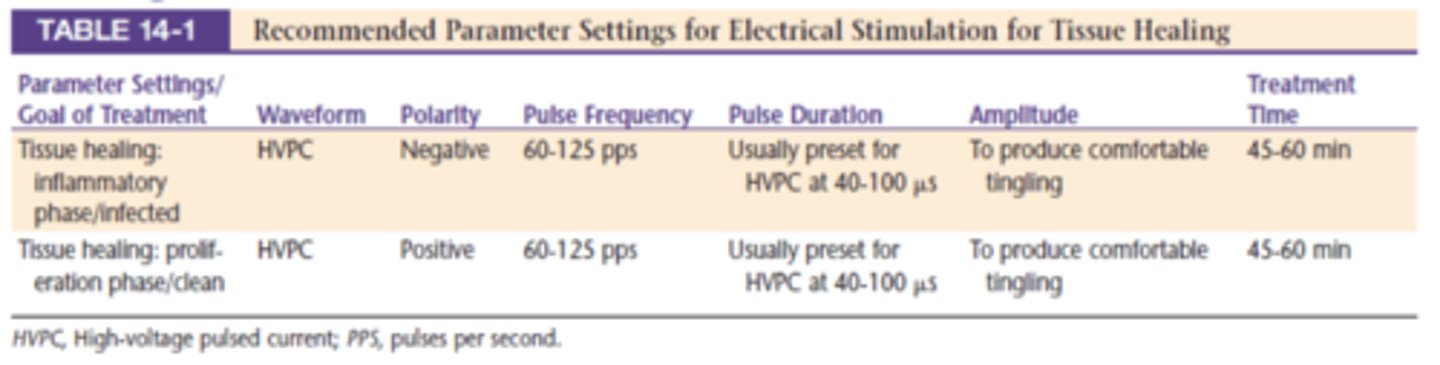
A patient presents with partial- and full-thickness burns on the chest regions. The PT decides to apply TENS before debridement to modulate pain. Which TENS mode should provide the BEST relief?
A. Acupuncture-like (low-rate) TENS.
B. Brief intense TENS.
C. Noxious TENS.
D. Conventional (high-rate) TENS.
B. Brief intense TENS.
Brief intense TENS is used to provide rapid-onset, short term relief during painful procedures. The pulse rate and pulse duration are similar to conventional TENS; however the current intensity is increased to patient tolerance.
Phonophoresis use
- Used for transdermal delivery of medication
- Anti-inflammatory
- Analgesic
- Duty cycle = pulsed
- Treatment time = 5-10 minutes
A PT is performing phonophoresis at 0.8 W/cm2, 1.0 MHz and 20% duty cycle on the distal hamstrings. During treatment, the patient reports feeling pain over distal hamstrings. The PT's FIRST appropriate course of action is to:
A. Decrease the intensity to 0.5 W/cm2 and continue moving the head at same speed
B. Keep the same intensity at 0.8 W/cm2and change the setting to 50% duty cycle
C. Increase the intensity to 2.0 W/cm2 and add more coupling medium
D. Turn off the ultrasound and immediately call the physician
A. Decrease the intensity to 0.5 W/cm2 and continue moving the head at same speed
Contraindications for ultrasound
- Acute and post-acute conditions
- Areas of active bleeding
- Area of reduced temperature sensation
- Area of reduced circulation
- DVT
- Infection
- Malignancy
- Over breast implants
- Over carotid sinus or cervical ganglia
- Over epiphyseal areas in children
- Over eyes/heart/genitalia
- Over methyl methacrylate cement or plastic
- Over a pelvic, lumbar, or abdominal areas in pregnant women
- Thrombophlebitis
- Vascular insufficiency
A physical therapist is considering the use of ultrasound to accelerate the tissue healing process of a dermal ulcer. Which of the following parameters is the MOST appropriate to achieve this goal using the non-thermal effects of the US?
A. 0% duty cycle
B. 20% duty cycle
C. 60% duty cycle
D. 100% duty cycle
B. 20% duty cycle
20% is for non-thermal
60% is for thermal
Traction: supine positioning
- Pillow under knee
- For intervertebral joints, facet joints, muscle elongation
Traction: prone positioning
For posterior disc herniation
Hip flexion + traction creates an increase in intervertebral space. To create more space at L5-S1, you need ___ to ___ deg hip flexion
45-60 deg
Hip flexion + traction creates an increase in intervertebral space. To create more space at L3-4, you need ___ to ___ deg hip flexion
75-90 deg
% body weight for disc protrusion, spasm, elongation
25%
% body weight for joint distraction
50 pounds or 50% of body weight
A patient presents to clinic with a posterior herniated nucleus pulposus at L2-3. During the traction treatment in supine, the patient reports increased localized back pain. Which of the following actions is MOST appropriate for the PT to take?
A. Change the position of the patient to side lying
B. Refer the patient back to the physician
C. Change the position of the patient to prone
D. Reduce the traction force to 15% of body weight
C. Change the position of the patient to prone
% body weight for cervical traction
7-10%
% body weight for lumbar traction
- 25-50%
- Do not go over 50
A 57-year-old male patient is having difficulty with walking. The PT documents the knee extension strength to be 2-/5 and incorporates EMG biofeedback to help increase motor recruitment. Which of the following protocol is the MOST appropriate to increase motor recruitment for the knee extensors?
A. Begin with electrodes close together and biofeedback sensitivity is low
B. Begin with electrodes widely spaced and biofeedback sensitivity is low
C. Begin with electrodes widely spaced and biofeedback sensitivity is high
D. Begin with electrodes close together and biofeedback sensitivity is high
C. Begin with electrodes widely spaced and biofeedback sensitivity is high
Weak muscles = high sensitivity = wide placement of pads. This increases motor recruitment. Using opposite of this (strong/tight muscle) = low sensitivity with close placement