StemUp: AQA A level Physics 3.2.1 Particles
 Call Kai
 Learn
Learn Practice Test
 Spaced Repetition
 Match
Match Flashcards
 Knowt Play
1/142

There's no tags or description
Looks like no tags are added yet.
Name | Mastery | Learn | Test | Matching | Spaced | Call with Kai |
|---|
No analytics yet
Send a link to your students to track their progress
143 Terms
What are the three main particles that make up an atom? (1)
The three main particles that make up an atom are protons, neutrons and electrons.
Where are the particles located within the atom? (2)
- Protons and neutrons are located in the nucleus.
- Electrons orbit the nucleus in shells.
What is meant by specific charge? (1)
Specific charge is the ratio of a particle's charge to its mass.
What is the formula for specific charge? (1)
The formula for specific charge is charge ÷ mass.
What is the charge and relative charge of a proton? (1)
+1.6 × 10⁻¹⁹ C and relative charge of +1.
What is the mass and relative mass of a proton? (1)
1.67 × 10⁻²⁷ kg and relative mass of 1.
What is the specific charge of a proton? (1)
9.58 × 10⁷ Ckg⁻¹.
What is the charge and relative charge of a neutron? (1)
0 C and relative charge of 0.
What is the mass and relative mass of a neutron? (1)
1.67 × 10⁻²⁷ kg and relative mass of 1.
What is the specific charge of a neutron? (1)
0 Ckg⁻¹.
What is the charge and relative charge of an electron? (1)
−1.6 × 10⁻¹⁹ C and relative charge of −1.
What is the mass and relative mass of an electron? (1)
9.11 × 10⁻³¹ kg and relative mass of 0.0005.
What is the specific charge of an electron? (1)
1.76 × 10¹¹ Ckg⁻¹ .
How is atomic structure written using standard nuclear notation? (1)
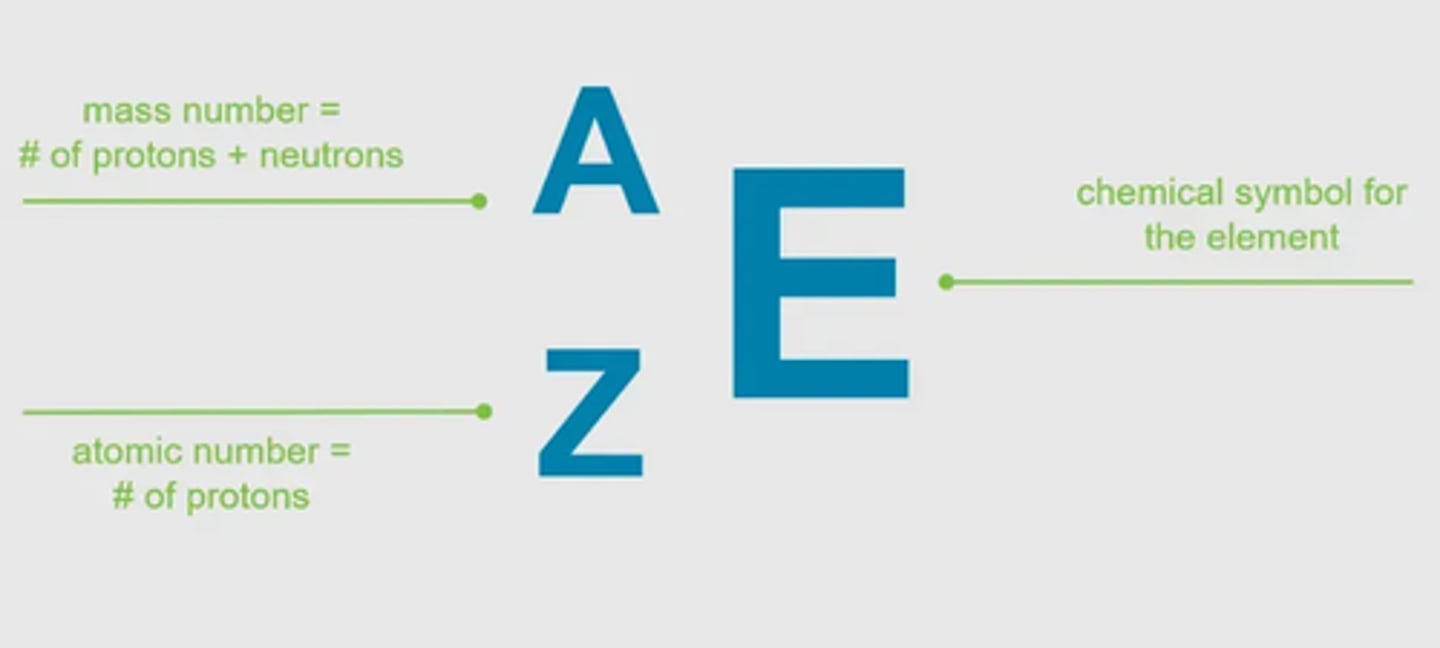
What do the values A and Z represent in nuclear notation? (2)
- A represents the number of protons and neutrons (nucleon number).
- Z represents the number of protons (proton number).
How does the nucleon number relate to an atom's mass? (2)
- Each proton and neutron have a relative mass of 1 and electrons weigh almost 0.
- So, the nucleon number is the same as the atom's relative mass.
What is an isotope? (1)
An isotope is an atom with the same number of protons but different numbers of neutrons.
How do isotopes have similar properties to their corresponding non-isotope? (1)
Both isotopes and their corresponding non-isotopes have identical chemical properties.
How do isotopes have different properties to their corresponding non-isotope? (1)
Isotopes have different properties from their corresponding non-isotopes because additional neutrons can make the nucleus unstable, leading to decay into other nuclei.
What is carbon-14? (1)
Carbon-14 is a radioactive isotope of carbon found in all living things.
How is carbon-14 used in carbon dating? (2)
- Carbon-14 is used in carbon dating by calculating the percentage of carbon-14 remaining in organic material.
- The known starting amount of carbon-14 and its half-life is then used to estimate the age.
What is the role of the strong nuclear force? (1)
Strong nuclear force keeps the nucleus stable by counteracting electrostatic repulsion between protons.
What does the strong nuclear force act on? (1)
Strong nuclear force acts only on nucleons equally (protons and neutrons).
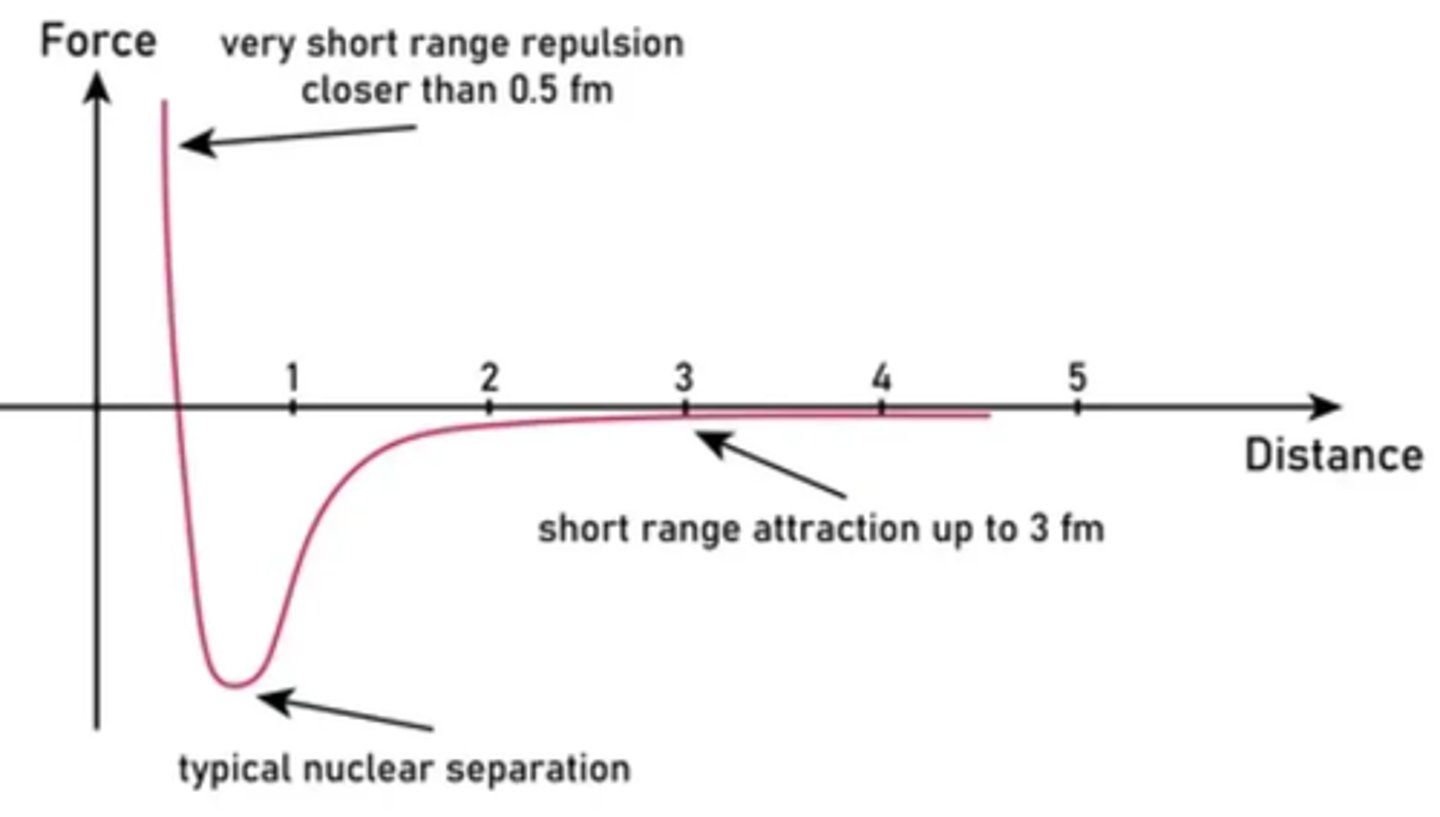
What is the range of the strong nuclear force? (1)
Strong nuclear force is attractive up to about 3 femtometres (fm), but repulsive below 0.5 fm.
What does a graph of strong nuclear force against nucleon separation look like? (2)
What causes a nucleus to become unstable? (3)
- A nucleus can become unstable if it has too many protons.
- If it has too many neutrons.
- Or too many of both.
Why does a nucleus decay when unstable? (1)
A nucleus decays when its unstable because the strong nuclear force is no longer sufficient to maintain stability.
Under what conditions does alpha decay occur? (1)
Alpha decay occurs under large nuclei with too many protons and neutrons.
What happens to the nucleon number in alpha decay? (1)
The nucleon number decreases by 4 in alpha decay.
What happens to the proton number in alpha decay? (1)
The proton number decreases by 2 in alpha decay.
What particle is emitted during alpha decay? (1)
A helium nucleus (alpha particle) (⁴₂α) is emitted during alpha decay.
When does beta-minus decay occur? (1)
In neutron-rich nuclei that contain too many neutrons, a neutron will turn into a proton.
What happens to the proton number in beta-minus decay? (1)
The proton number increases by 1 in beta-minus decay.
What happens to the nucleon number in beta-minus decay? (1)
The nucleon number stays the same in beta-minus decay.
What particles are emitted in beta-minus decay? (1)
In beta-minus decay, an electron (β⁻) and an antineutrino (ν̅ₑ) are emitted.
Why was the existence of neutrinos proposed in beta decay? (1)
The existence of neutrinos was proposed in beta decay because energy was not conserved when only electrons were observed.
What observation conflicted with energy conservation in beta decay? (2)
- The energy of the emitted electron varied from one decay to another.
- It was not constant as expected, which appeared to violate conservation of energy.
How did neutrinos resolve the issue of energy loss in beta decay? (2)
- Neutrinos accounted for the missing energy in beta decay.
- They were later observed experimentally.
What properties do neutrinos posses? (1)
Neutrinos are particles with no charge and zero (negligible) mass.
What is the relationship between a particle and its antiparticle? (2)
- Both the particle and its antiparticle have the same rest energy and mass.
- All of their other properties, such as charge, are opposite in sign.
What is the mass of both the electron and positron? (1)
The mass of the electron and positron is 9.11 × 10⁻³¹ kg.
How do the charges of the electron and positron compare? (2)
- The electron has −1.6 × 10⁻¹⁹ C
- The positron has +1.6 × 10⁻¹⁹ C.
What is the mass of both the proton and antiproton? (1)
The mass of the proton and antiproton is 1.67 × 10⁻²⁷ kg.
What is the rest energy of both the proton and antiproton? (1)
The energy of the proton and antiproton is 938.3 MeV.
What are the charges of the proton and antiproton? (2)
- The proton has +1.6 × 10⁻¹⁹ C.
- The antiproton has −1.6 × 10⁻¹⁹ C.
What is the mass of both the neutron and antineutron? (1)
The mass of the neutron and antineutron is 1.67 × 10⁻²⁷ kg.
What is the rest energy of both the neutron and antineutron? (1)
The rest energy of the neutron and antineutron is 939.6 MeV.
What are the charges of the neutron and antineutron? (1)
Both the neutron and antineutron have 0 C.
What are the mass and rest energy of the electron neutrino and antineutrino? (1)
Both the electron neutrino and antineutrino have zero mass and zero rest energy.
What are the charges of the electron neutrino and antineutrino? (1)
Both the electron neutrino and antineutrino have zero charge.
What is the nature of electromagnetic radiation at the quantum level? (1)
Electromagnetic radiation, at the quantum level, travels in discrete packets called photons.
What do photons do and what is their mass? (1)
Photons transfer energy and have no mass.
What is the equation that gives the energy of a photon? (2)
- The energy of a photon is E = hf = hc / λ
- Where E is energy (J), h = 6.63 × 10⁻³⁴ Js, f is frequency (Hz), c is the speed of light (ms⁻¹), and λ is wavelength (m).
What happens during annihilation? (2)
- During annihilation, a particle and its antiparticle collide.
- Their masses are then converted into energy.
What is produced during annihilation? (1)
During annihilation, photons (gamma photons which are high energy) are released.
Why do the photons in annihilation move in opposite directions? (1)
In annihilation, photons move in opposite directions to conserve momentum.
How is annihilation used in PET scanning? (3)
- In PET scanning, a positron-emitting radioisotope is introduced into the patient's body.
- Then, they annihilate with electrons, releasing gamma photons.
- The gamma photons are detected externally to form a 3D image.
What is pair production? (1)
Pair production is when a photon is converted into a particle and its antiparticle, this is usually electron-positron pairs due to their low mass.
What energy condition is needed for pair production to occur? (1)
The photon must have energy greater than the combined rest energy of the two particles for pair production to occur.
What happens to any excess energy in pair production? (1)
Excess energy from pair production becomes the kinetic energy of the produced particles.
How does pair production ensure momentum is conserved? (1)
The particles produced travel in a way to conserve momentum in the interaction.
What is the exchange particle for the strong nuclear force? (1)
The exchange particle for strong nuclear force is gluon.
What is the exchange particle for the weak nuclear force? (1)
The exchange particle for weak nuclear force is W⁺ or W⁻ boson.
What is the exchange particle for the electromagnetic force? (1)
The exchange particle for electromagnetic force is virtual photon (γ).
What is the exchange particle for gravity? (1)
The exchange particle for gravity is graviton.
What is another name for an exchange particle? (1)
Exchange particles are also referred to as gauge bosons.
What is the range and target of the strong nuclear force? (2)
- Strong nuclear force acts on hadrons.
- It has a range of about 3 × 10⁻¹⁵ m.
What is the range and target of the weak nuclear force? (2)
- Weak nuclear force acts on all particles.
- It has a range of about 10⁻¹⁸ m.
What is the range and target of the electromagnetic force? (2)
- Electromagnetic force acts on charged particles.
- It has infinite range.
What is the range and target of gravity? (2)
- Gravity acts on particles with mass.
- It has infinite range.
What is the relationship between the mass of exchange particles and their range? (2)
- Exchange particles with larger masses have shorter range and decay quicker, they cannot travel far in the short time they exist for.
- Particles with zero mass have infinite range.
What do exchange particles do in particle interactions? (2)
- Exchange particles carry energy and momentum between particles.
- They cause particles to experience a force, like transferring momentum with a ball.
How are exchange particles represented in particle interaction diagrams? (1)
Exchange particles are represented by squiggly lines in particle interaction diagrams.
How are non-exchange particles represented in particle interaction diagrams? (1)
Non-exchange particles are represented by straight lines in particle interaction diagrams.
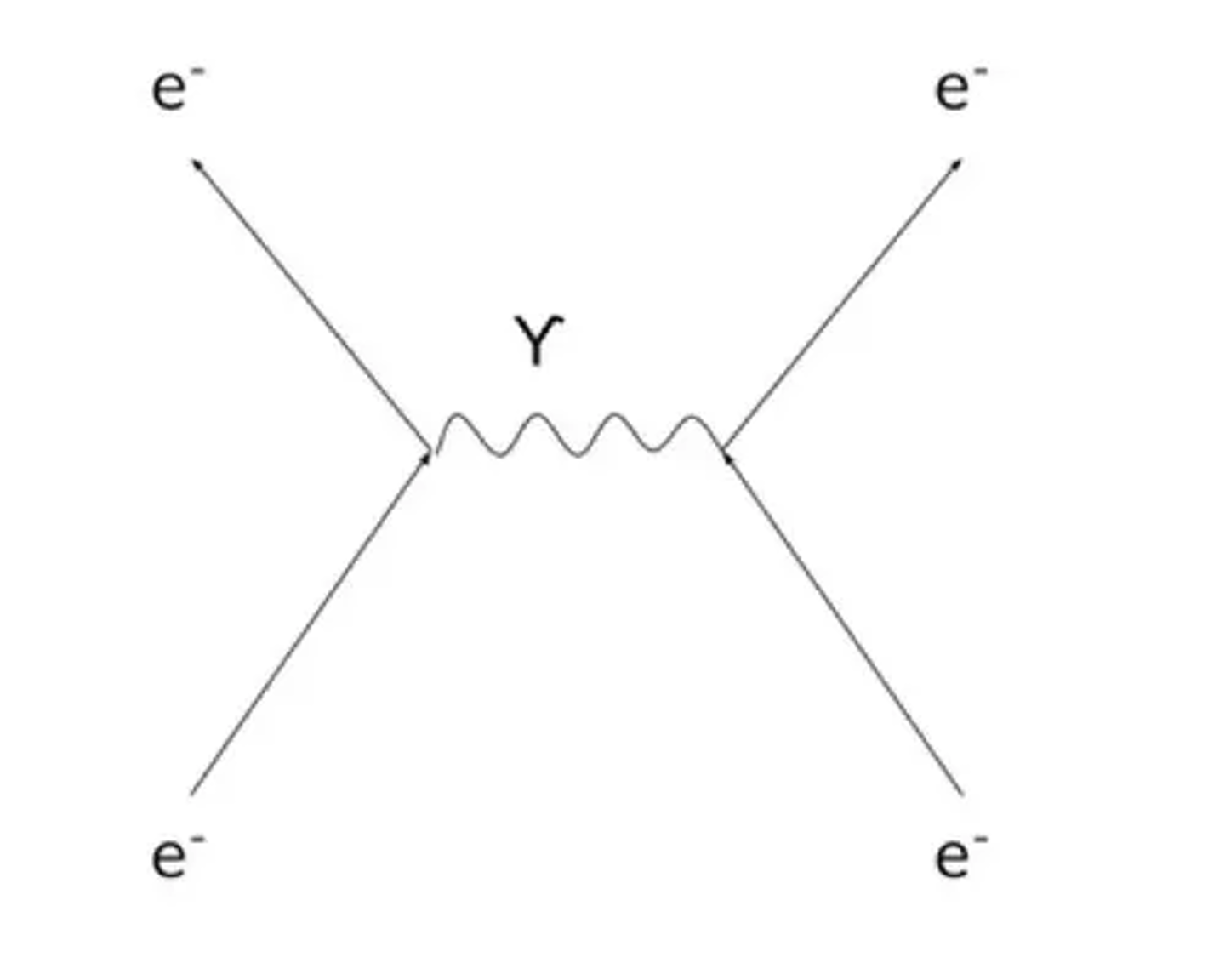
What are the rules for drawing particle interaction diagrams? (3)
- Particles must move from the bottom of the diagram to the top.
- Baryons and leptons cannot cross from one side to the other.
- Charges must balance on both sides of the diagram.
What does electromagnetic repulsion look like on a particle interaction diagram? (2)
What happens during electron capture? (2)
- A proton captures an orbiting electron and becomes a neutron.
- This emits an electron neutrino.
What does electron capture look like? (2)
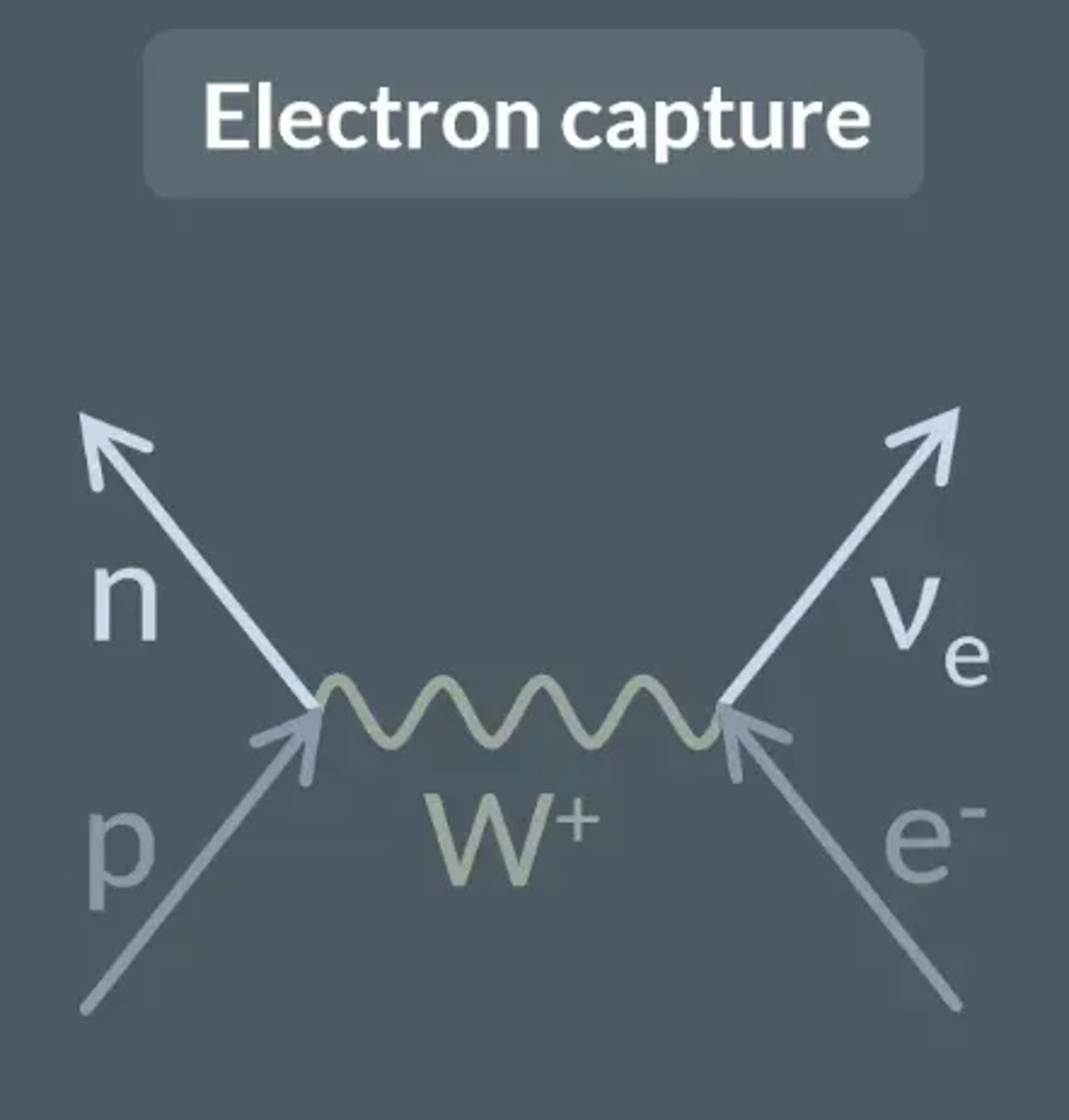
What is the exchange particle in electron capture? (1)
The exchange particle in electron capture is W⁺ boson.
What happens during an electron-proton collision? (1)
During an electron-proton collision, an electron and proton interact to form a neutron and an electron neutrino.
What does an electron-proton collision look like? (2)
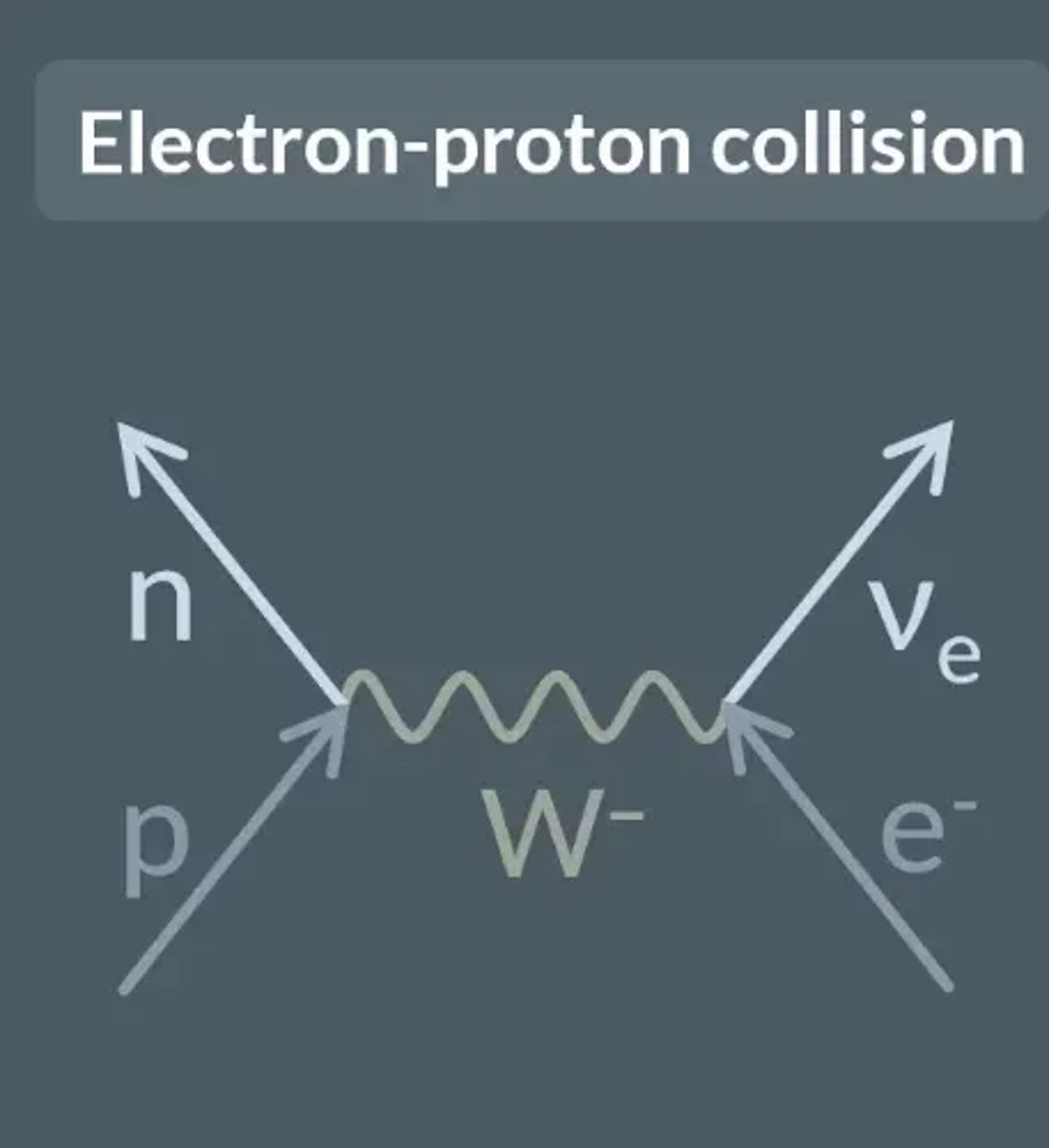
What is the exchange particle in an electron-proton collision? (1)
The exchange particle in an electron-proton collision is W⁻ boson.
What is the difference between electron capture and electron-proton collision? (1)
Both electron capture and electron-proton collision produce the same particles, but electron capture uses W⁺ and collisions use W⁻.
What is the particle equation for beta-plus decay? (1)
the particle equation for beta-plus decay is p → n + e⁺ + νₑ.
What does beta-plus decay look like? (2)
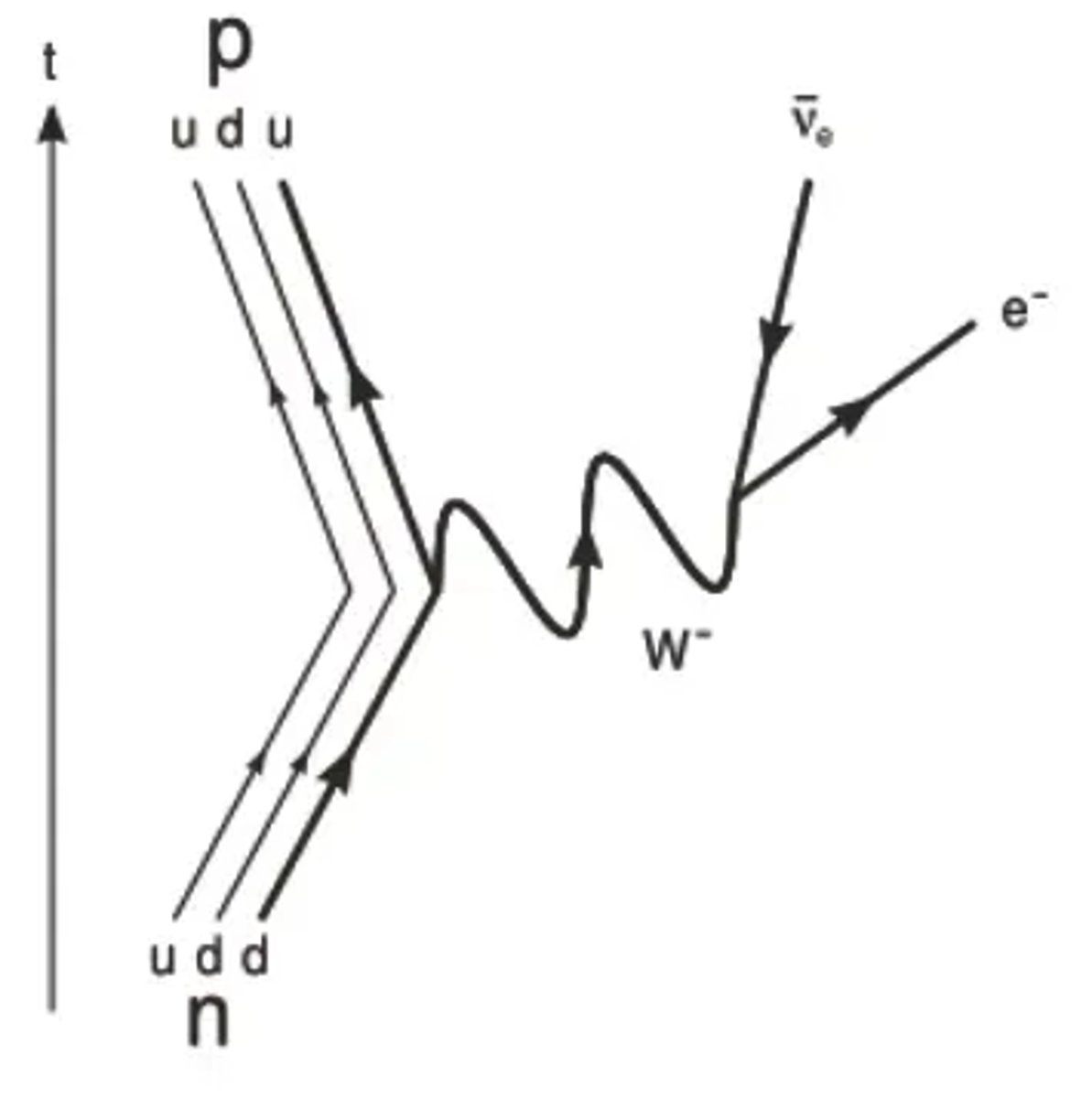
What exchange particle is involved in beta-plus decay? (1)
The exchange particle involved in beta-plus decay is W⁺ boson.
What is the particle equation for beta-minus decay? (1)
The particle equation for beta-minus decay is n → p + e⁻ + ν̅ₑ.
What does beta-minus decay look like? (2)
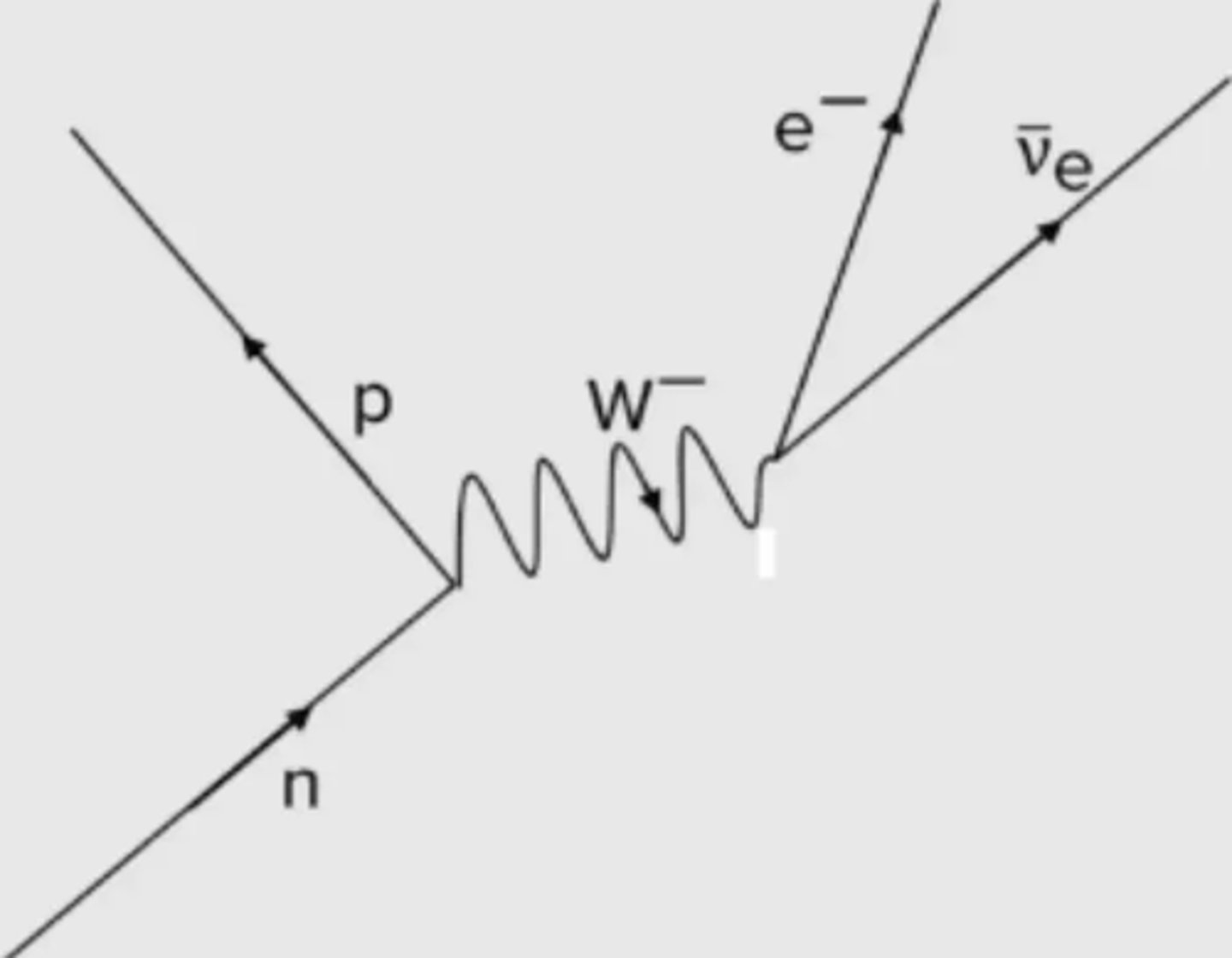
What exchange particle is involved in beta-minus decay? (1)
The exchange particle involved in beta-minus decay is W⁻ boson.
What are hadrons made of and what force do they experience? (2)
- Hadrons are composite particles made of quarks.
- They experience the strong nuclear force.
What are leptons and how do they differ from hadrons? (2)
- Leptons are fundamental particles that cannot be broken down.
- They do not experience the strong nuclear force.
What are examples of leptons? (4)
- Electron.
- Muon.
- Electron neutrino.
- Muon neutrino.
What is the equation for a neutron decaying? (2)
The equation for a neutron decaying is neutron → proton + electron + electron antineutrino.
What are baryons and antibaryons made of? (2)
- Baryons consist of three quarks.
- Antibaryons consist of three antiquarks.
What are mesons made of? (1)
Mesons are made of a quark and an antiquark.
What are examples of baryons and mesons? (2)
- Examples of baryons include protons and neutrons.
- Examples of mesons include pions and kaons.
What is the rule of conservation for baryon number? (1)
Baryon number is always conserved in particle interactions.
What values can baryon numbers take for different particle types? (3)
- +1 for baryons.
- −1 for antibaryons.
- 0 for non-baryons.
Why is the proton significant in baryon stability? (2)
- The proton is the only stable baryon.
- So all baryons eventually decay into a proton.
What is the role of the pion in the nucleus? (1)
The pion acts as the exchange particle for the strong nuclear force between nucleons.