Nutrients, Fertilizers
 Studied by 0 people
 Call with Kai
 Learn
Learn Practice Test
 Spaced Repetition
 Match
Match Flashcards
 Knowt Play
1/33

There's no tags or description
Looks like no tags are added yet.
Name | Mastery | Learn | Test | Matching | Spaced | Call with Kai |
|---|
No analytics yet
Send a link to your students to track their progress
34 Terms
Essential Plant Nutrients
The 17 chemical elements required for a plant to complete its life cycle and produce seed
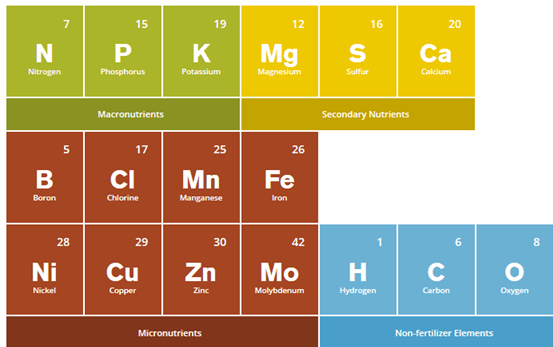
Macronutrients
Nutrients required in relatively large amounts by plants (e.g., N, P, K, Ca, Mg, S)
Micronutrients (Trace Elements)
Nutrients required in very small quantities by plants (e.g., Fe, Mn, Zn, Cu, B, Mo, Cl, Ni)
Primary Nutrients
Nitrogen (N), Phosphorus (P), and Potassium (K)
Secondary Nutrients
Calcium (Ca), Magnesium (Mg), and Sulfur (S)
Nitrogen (N) Function
A major component of proteins, hormones, enzymes, and chlorophyll
essential for rapid vegetative growth (stems and leaves)
Phosphorus (P) Function
Essential for energy transfer (component of ATP), root and seed formation, and hastening maturity
Potassium (K) Function
Necessary for sugar/starch formation, protein synthesis, and regulation of water balance by controlling stomata opening/closing
enhances plant vigor and disease resistance
Calcium (Ca) Function
Important structural component of cell walls
necessary for cell division and root health
Magnesium (Mg) Function
Key component of the chlorophyll molecule
vital for photosynthesis and aids in the translocation of starch
Sulfur (S) Function
Constituent of certain amino acids (proteins) and is involved in energy-producing processes.
gives characteristic flavor/odor to plants like onions and cabbage.
Manure
An organic substance obtained from the decomposition of vegetable and animal waste.
is a bulky soil additive
Fertilizer
An inorganic or synthetic substance manufactured in factories, concentrated in specific plant nutrients
Manure Nutrient Richness
Relatively less rich in specific plant nutrients, only removes general soil deficiency
Fertilizer Nutrient Richness
Very rich in specific plant nutrients like N, P, and K
Humus Addition (Manure)
Adds humus (organic matter) to the soil, improving soil texture and water-holding capacity
Humus Addition (Fertilizer)
Does not add humus to the soil
Absorption Speed (Manure)
Slowly absorbed by plants as it is not readily soluble in water
Absorption Speed (Fertilizer)
Quickly absorbed by plants as it is readily soluble in water
Environmental Impact (Manure)
Protects the environment and helps recycle farm waste
Environmental Impact (Fertilizer)
Excessive use causes water pollution and soil degradation.
Vermicompost
The process of converting organic waste into a valuable soil amendment using various species of earthworms (e.g., red wigglers)
Vermiculture
The rearing of worms specifically for the purpose of vermicomposting ("worm-farming")
Vermicast (Worm Castings)
The end-product of the decomposition process.
earthworm excreta that is a nutrient-rich organic fertilizer and soil conditioner
Vermicompost Nutrient Profile
Contains higher levels of water-soluble nutrients than traditional compost, including Nitrogen, Phosphorus, and Potassium (NPK)
Vermiwash
The liquid portion (leachate) obtained from vermicomposting.
contains enzymes and beneficial microorganisms (like nitrogen-fixing bacteria)
Benefit of Vermicompost
Enhances germination, improves soil structure (aeration, porosity, water retention), and suppresses plant diseases/pests
Common Vermicomposting Worm
Eisenia fetida (Red Wiggler or Tiger Worm).
 Note
Note  Flashcards (39)