Waves
 Call Kai
 Learn
Learn Practice Test
 Spaced Repetition
 Match
Match Flashcards
 Knowt Play
1/24

There's no tags or description
Looks like no tags are added yet.
Name | Mastery | Learn | Test | Matching | Spaced | Call with Kai |
|---|
No analytics yet
Send a link to your students to track their progress
25 Terms
What is a wave?
A wave is a disturbance that carries energy through matter or space without transferring matter
Two types of mechanical waves
Transverse
Longitudinal
Transverse Waves
Particles move perpendicular to the wave’s motion
Ex: Light waves, ripples in pool
Longitudinal waves
Particles move parallel to the wave’s motion
Ex: Sound waves, Earthquake waves
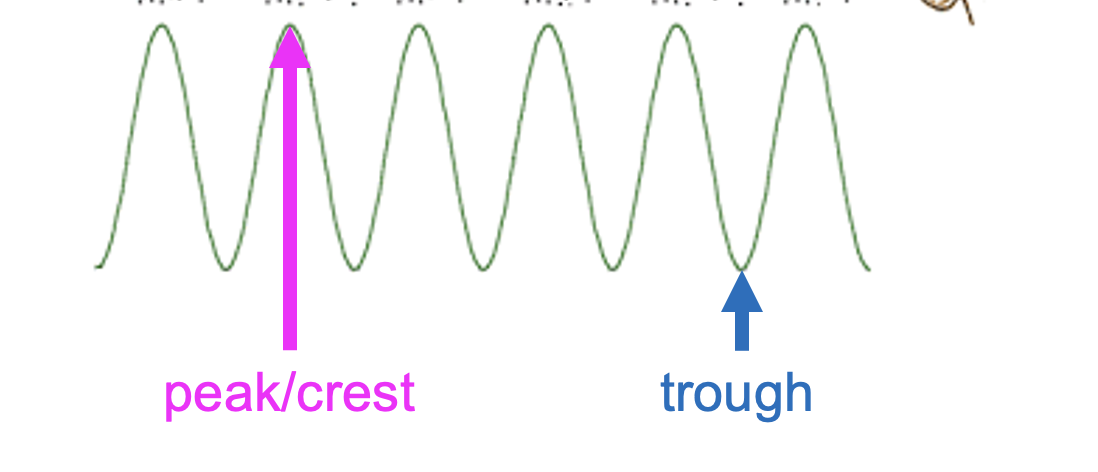
Properties of transverse waves
peak/crest, trough
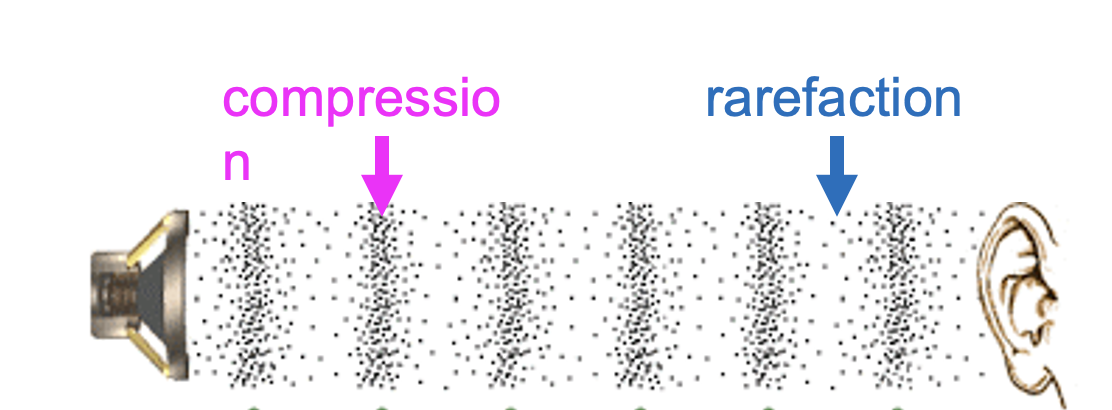
Properties of longitudinal waves
Compression, rarefaction
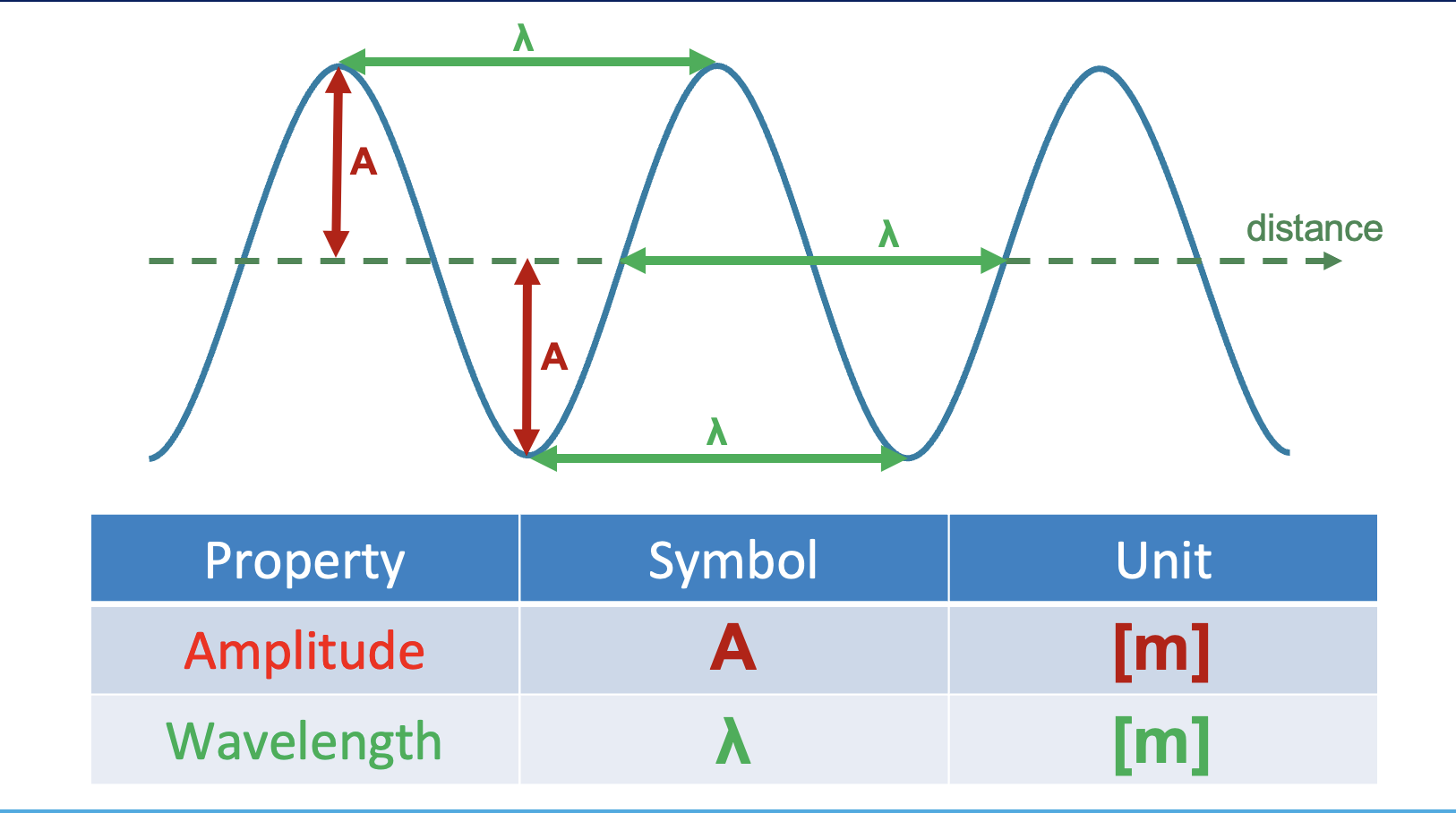
Properties of a wave
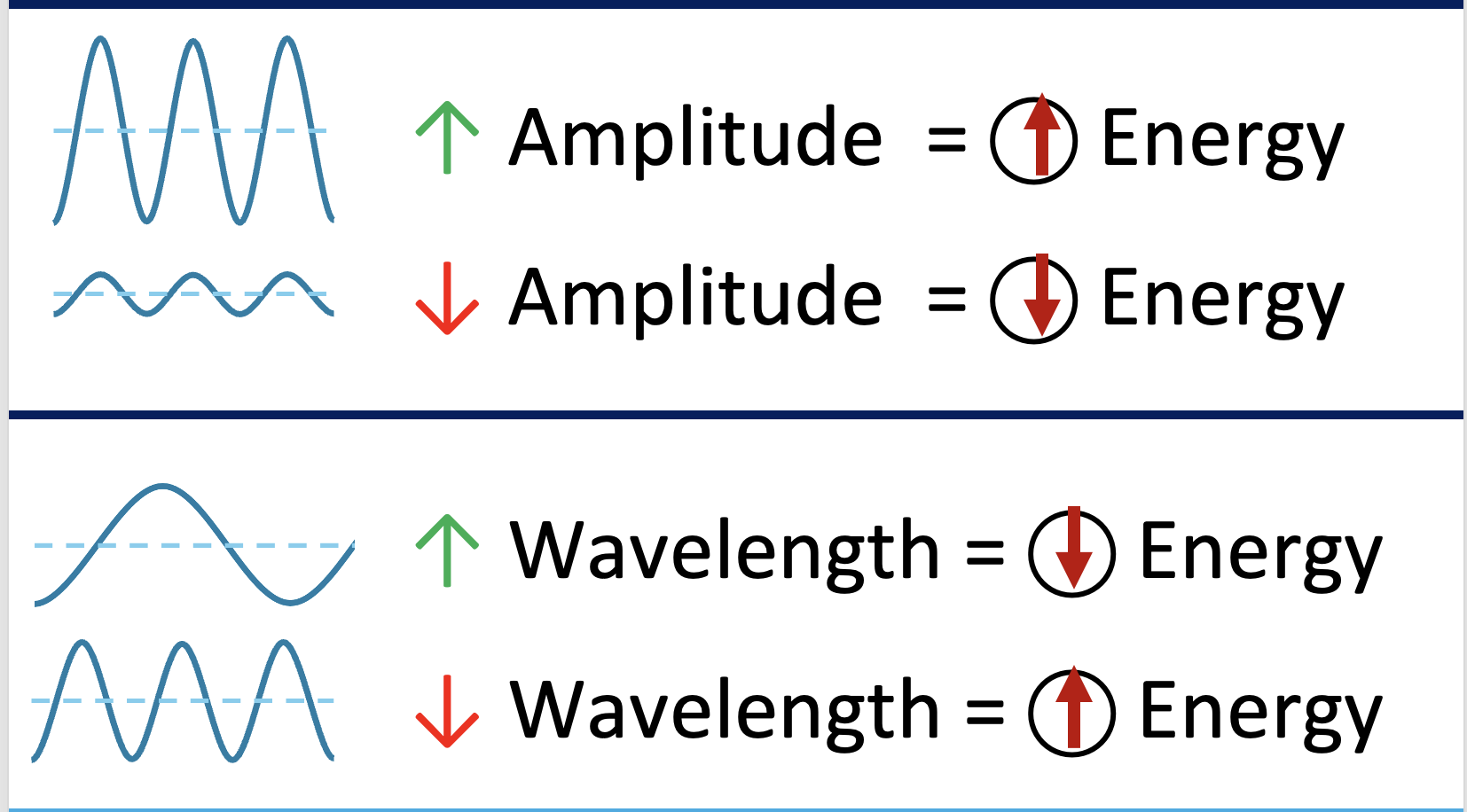
Waves and energy
Reflection
Light bounces off of a medium
The Law of Reflection
Angle of Incidence = Angle of Reflection
Clear Reflection
Smooth, Shiny surfaces have clear reflection
Diffuse Reflection
Rough, dull surfaces have a diffuse reflection. This is when light is scattered in different directions.
Refraction
Light is transmitted across a medium
Diffraction
The spreading out of waves as they pass through a gap or around an edge.
Electromagnetic Spectrum
Seven types of waves that all travel at the speed of light in a vacuum (3.0 ×10⁸ m/s).
All are transverse waves
They can travel through a vacuum (they don't need a medium like air or water).
They transfer energy from one place to another.
Electromagnetic waves
Order (Low to High Frequency): Radio, Microwave, Infrared, Visible, UV, X-ray, Gamma
Period (T)
Time taken for one full wavelength to pass a stationary point.
Units: Seconds (s)
Frequency (f)
number of waves passing a point in a given time
Units - Hertz (Hz)
Radio Waves
Uses: Radio and television broadcasting, satellite communication.
Dangers: No known significant dangers at low intensities.
Microwaves
Uses: Cooking food (vibrating water molecules), mobile phones, and WiFi.
Dangers: Can cause internal heating of body tissues if exposure is high.
Infrared (IR)
Definition: Often called "heat radiation." Emitted by all warm objects.
Uses: Remote controls, thermal imaging, night vision, and heaters.
Dangers: Can cause skin burns and eye damage (retinal burns).
Visible Light
Definition: The only part of the spectrum the human eye can detect.
Order: Red (longest λ) to Violet (shortest λ). Uses: Human vision, photography, and fiber optic communications.
Dangers: Intense light (lasers) can cause permanent blindness.
Ultraviolet (UV)
Uses: Sunbeds, security marking (fluorescent ink), and sterilizing water/equipment.
Dangers: Sunburn, premature aging of skin, skin cancer, and cataracts.
X-rays
Definition: High-energy, ionizing waves that can pass through soft tissue but are absorbed by bone.
Uses: Medical imaging (broken bones), airport security scanners.
Dangers: Ionizing radiation; can cause cell mutation and cancer. Doctors use lead shielding for protection.
Gamma Rays
Definition: The highest frequency, shortest wavelength, and highest energy waves.
Uses: Sterilizing medical instruments, killing bacteria in food, and treating cancer (radiotherapy).
Dangers: Extremely ionizing; highly dangerous, causing severe cell damage and cancer. Requires thick lead or concrete shielding.