Chemistry unit 1
 Call Kai
 Learn
Learn Practice Test
 Spaced Repetition
 Match
Match Flashcards
 Knowt Play
1/40

Earn XP
Description and Tags
41 Terms
Atom made up of …
… mostly empty space, dense nucleus (with protons and neutrons), electrons are found in the shells around nucleus.
Relative masses and relative charges of proton, neutron, electron
Proton: 1 , +1
Neutron: 1 , 0
Electron: 1/1836, -1
Difference between atomic number (proton number) and atomic mass (nucleon number)
atomic number: number of proton in the nucleus
atomic mass: number of proton and neutron
Why atomic mass is equal to mass of the nucleus
Most mass of an atom are located in the nucleus where the neutron and proton are in. Electrons have such small mass that it is negligible.
Why atom are neutral
Because number of proton = number of electrons
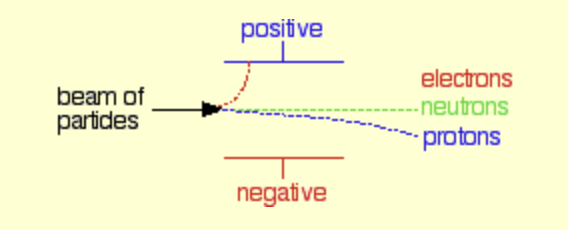
What happen when beams of protons, neutrons and electrons moving through an electric field at constant velocity?
… Because mass of electrons are lower than proton, electrons are deflected more strongly
What is atomic radius / radii
Half the distance between two atoms nuclei of the same element
Where to use metallic radii, covalent radii, Van de Waals radii
Metallic : metal
Covalent: Non-metal that covalently bonded
Van de Waals: Noble gas
The atomic radius …. as we go down the group because ….
The atomic radius …. as we go across the period because ….
The atomic radius increase as we go down the group because additional electron shells
The atomic radius decrease as we go across the period because increase in nuclear number (stronger attraction), same shielding.
The ionic radius …. as we go down the group because ….
The ionic radius …. as we go across the period because ….
The ionic radius increase as we go down the group because additional electron shells
The ionic radius decrease as we go across the period because increase in nuclear number (stronger attraction), same shielding.
[However, cation radii are smaller than anion radii because cation loss their outer shell electrons]
Radius of metal atom compare to cation
Smaller, because:
Loss of outer shell (electrons)
Less electrons, more protons=> stronger nuclear attraction
less shielding
Radius of non-metal atom to anion
Bigger, because…
Additional electrons => more repulsion
Expand the radius
Define isotope
Atoms that have the same number of protons but different number of neutrons
Why 12C, 13C, and 14C have the same chemical properties
They all have the same number and arrangement of electrons
Why 35Cl and 37Cl have different physical properties? [2 marks]
Mass: Cl-35 will be greater because it has two additional neutrons
Density: Cl-35 will be denser because it has more neutrons and protons in the same volume of space
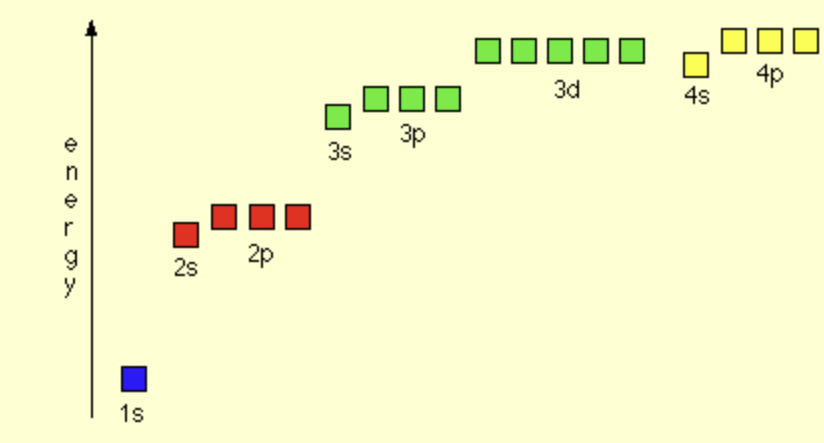
Aufbau principle [filling orbitals]
Electrons fill in orbitals that have lower energy/ closer to the nucleus first
Hund’s rule
When orbitals are at the same energy level, electrons fill the orbitals singly first before pair up with another electron to avoid electron spin pair repulsion
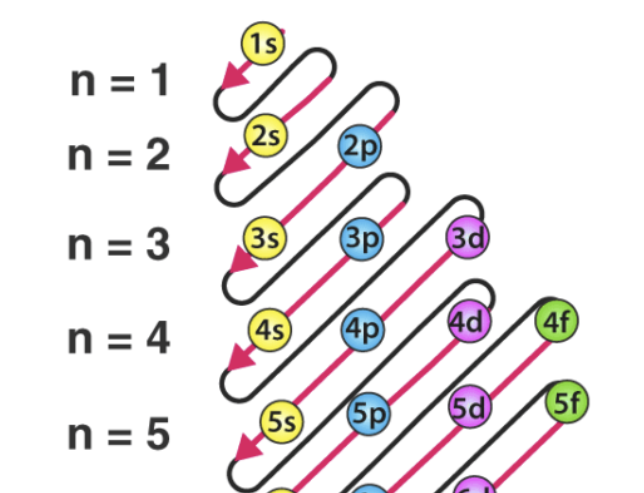
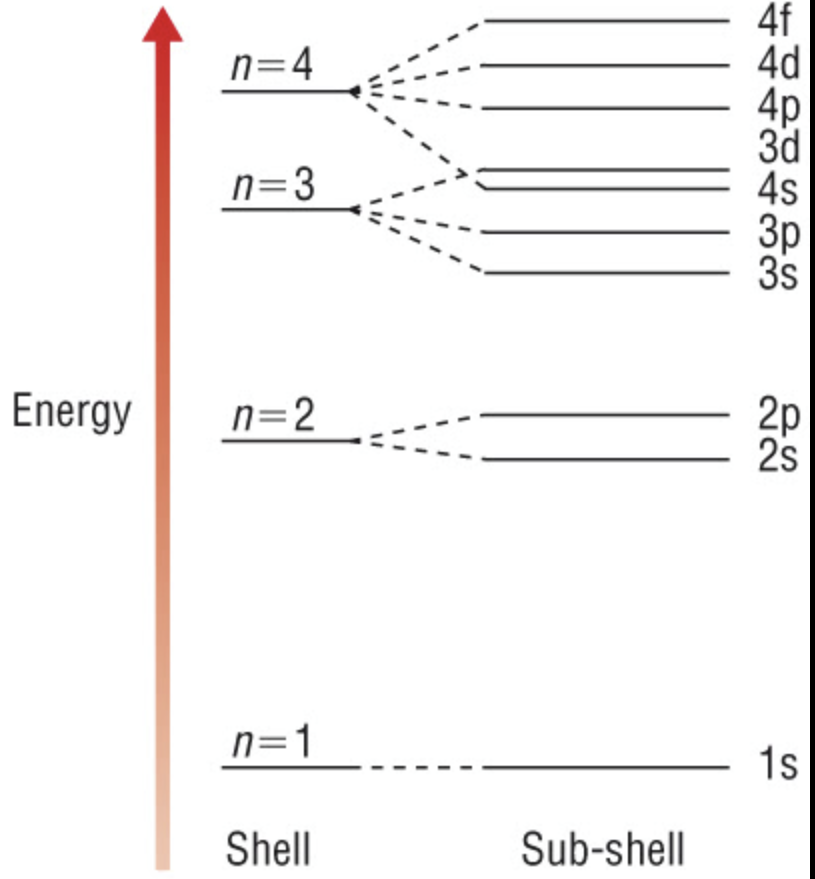
Order of filling electrons [1s to 4p from left to right]
1s², 2s², 2p6 , 3s2, 3p6, 4s2, 3d10, 4p6
Orbital
A region of space around the nucleus that has high chance (95%) of spotting an electron
How many electrons can each orbital contain
2
How many orbitals does S, P and D sub-shell has
S: 1 orbital
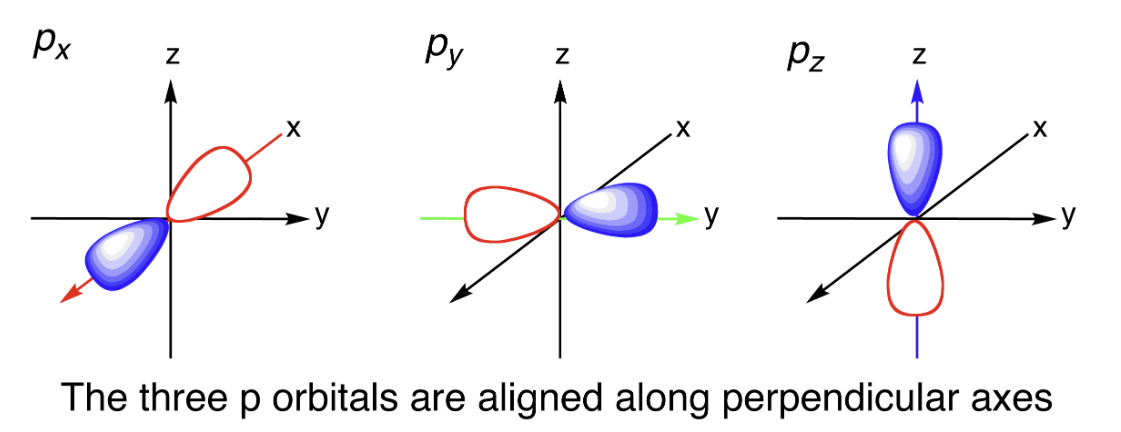
P: 3 orbitals
D: 5 orbitals
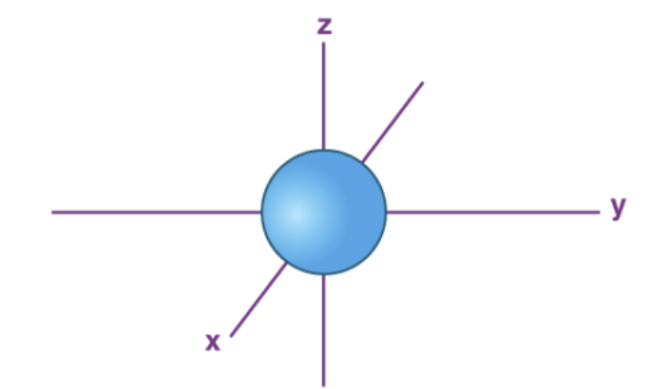
Describe S-orbitals
Sphere
Describe P-orbitals
dumb-bell shaped
Why group 1 and 2 elements are called S-block elements
Because their outer orbital is a S-orbital
Why group 13 to 18 elements are called P-block elements
Because their outer orbital is P-orbital
Two exceptions (elements) of Aufbau’s principle
Chromium (Cr) - 1s22s22p63s23p63d54s1 (avoid repulsion)
Copper (Cu) - 1s22s22p63s23p63d104s1
How to write electronic configuration for ions
Write electronic configuration for the atom
Add/ remove electrons
What to be consider when writing electron configuration of ions for D-block elements (transition metal)
The electrons in the 4S orbital always being removed first
Shell
A region that has high chance to find all electrons in a certain energy level
Sub-shells
Different regions that cover slightly different energy within a shell
Types of orbitals
Principle Quantum Number (n)
The energy level that an electron had/ located in
Ground State
The state where electron is at the lowest energy level possible
Species
Any entity (such as atom, molecule, compound, ion…)
Free radical
a species with one or more unpaired electrons
First Ionisation Energy (IE)
Energy required to remove 1 mole of electrons from 1 mole of gaseous atoms to produce 1 mole of (1+) ions
Equation for first ionisation energy
X(g) ——> X+(g) + e-
What to consider when finding ionisation energy [4 marks]
Nuclear charge (attracting electrons)
Shielding
Atomic/ ionic radius
Spin-pair repulsion
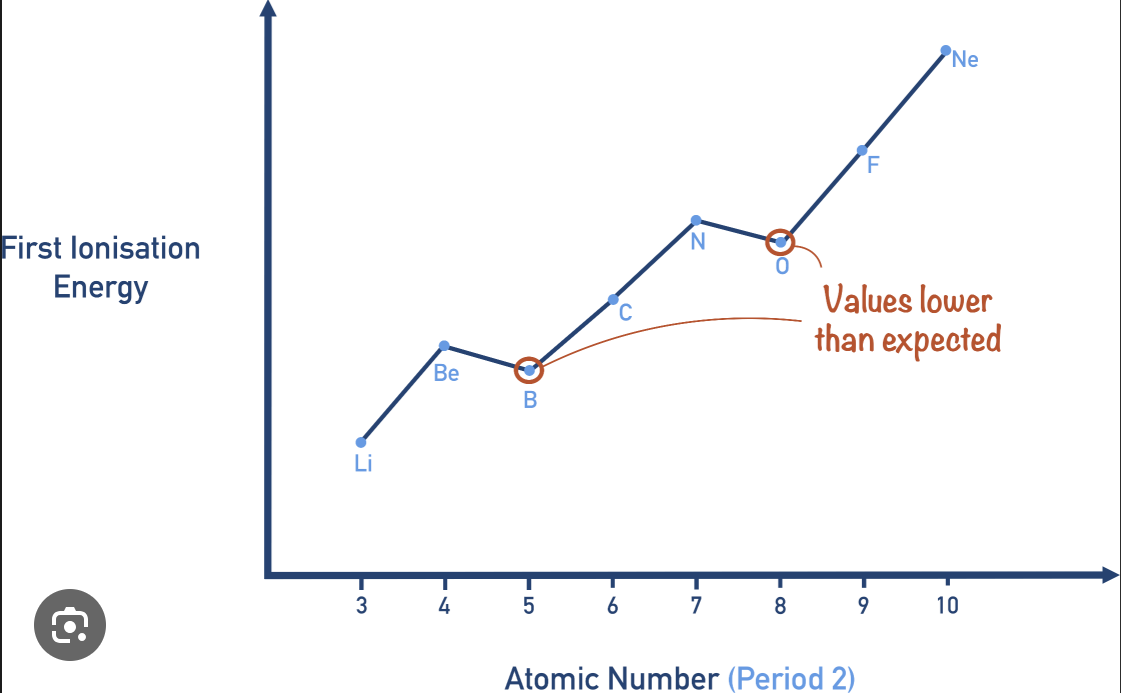
Describe the trend in the first Ionisation energy of period 2
Increase across the period due to increase in nuclear charge
Drop at Boron due to 2p orbital is further away from the nucleus than 2s orbital
Drop at Oxygen due to spin-pair repulsion
Describe the trend in First Ionisation energy when going down group
First IE decrease due to increase in atomic radius and inner electrons shielding
Define Second Ionisation Energy and its equation
Energy needed to remove one mole of electron from 1 mole of 1+ ions to produce 1 mole of 2+ ions
X+(g)——→ X2+(g) + e-
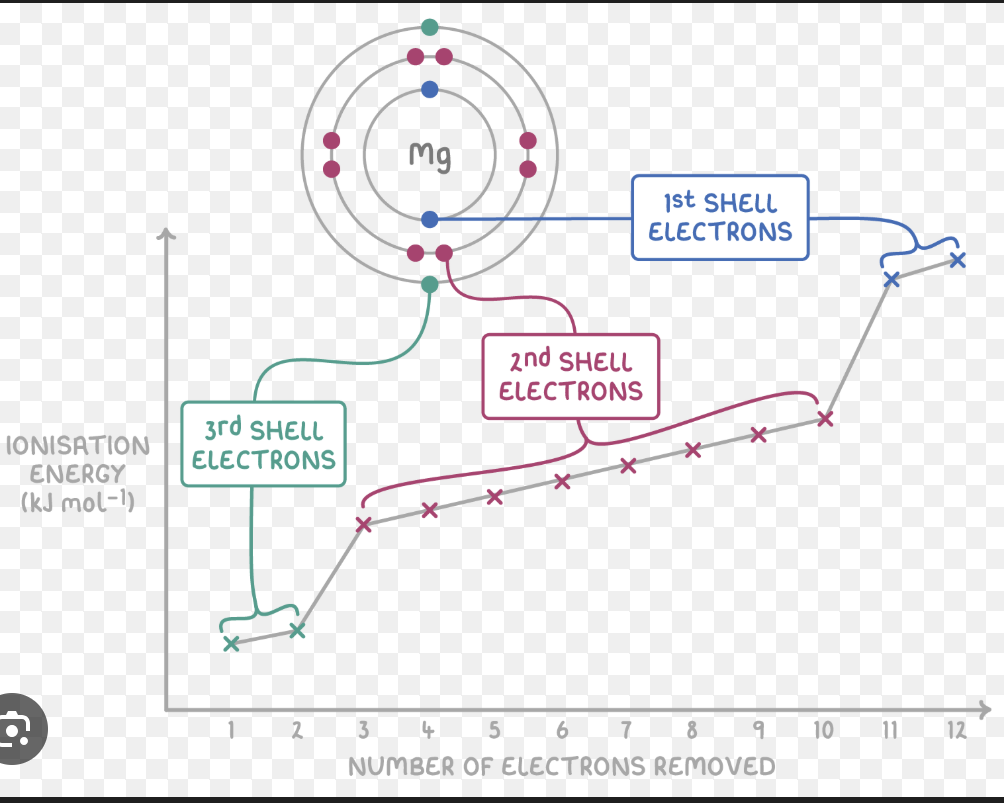
Trends in successive ionisation energy of any element
Electrons closer to the nucleus need higher Ionisation energy
There’s a big jump in IE between electron from one energy level (shell) to another