GEN CHEM 2 FINAL EXAM - (poopy dookie)
 Call Kai
 Learn
Learn Practice Test
 Spaced Repetition
 Match
Match Flashcards
 Knowt Play
1/179

There's no tags or description
Looks like no tags are added yet.
Name | Mastery | Learn | Test | Matching | Spaced | Call with Kai |
|---|
No analytics yet
Send a link to your students to track their progress
180 Terms
Activation is can be determined by____
measuring the rate constant at a series of different temperatures and making a plot of ln K against 1/T
The Arrhenius equation can be used to ____
convert the rate constant at one temperature to the rate constant at another
If the rate constants are known as two different temperatures, then the Arrhenius equation can be used to determine ______
the activation energy
Not all gas molecules in a sample will move at the _________
same speed
Maxwell Boltzman distribution describes the molecular speeds of ______
gases
Increasing the temperature increases the fraction of gas molecules which have an energy greater than the ______
activation energy
Collision Theory: For a chemical reaction to occur, __(1,2,3)
two or more atoms and or molecules must collide
with sufficient energy
in the correct orientation
Z =
collision frequency
steric factor (p) is a measure of _____
how sensitive a reaction is to the orientation of the reactants.
For reactions in the gas phase, the steric factor is a value between ____
0-1
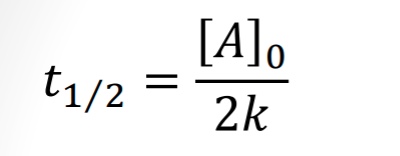
equation for half life of a zeroth order reaction
equation
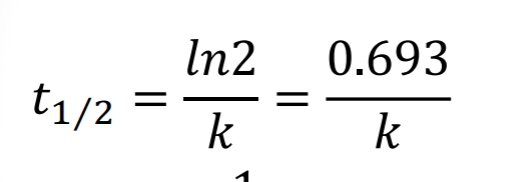
equation for the half life of a first order reaction
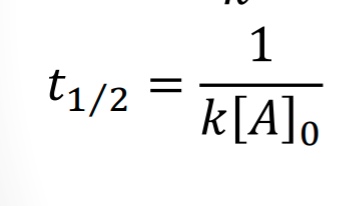
equation for the half life of a second order reaction
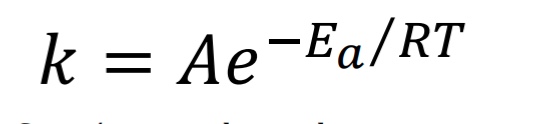
Arrhenius equation (simpler)
Arrhenius equation (two parts)
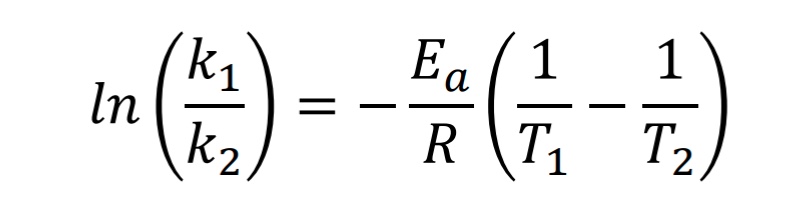
equation for steric factor
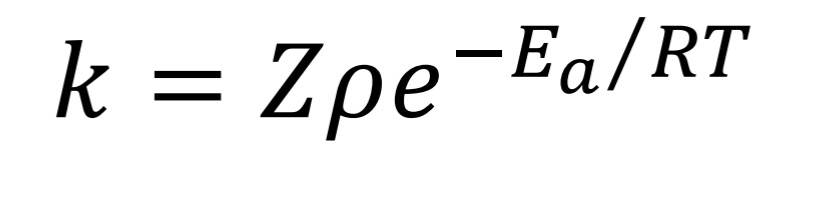
A catalyst is a _____
substance that speeds up a chemical reaction but is not consumed by the reaction (it is there at the end)
Homogenous catalyst:
means that the catalyst is in the same phase as the reactants
Heterogenous catalyst:
means that the catalyst is in a different phase than the reactants
How do catalysts work?
They provide a lower energy pathway for a reaction to occur (lowering the activation energy)
By lowering activation energy, catalysts increase _________ which have sufficient energy to react.
the number of molecules
Heterogenous catalysts are typically _______
transition metals like nickel, gold, silver + onto which the reactants are adsorbed
What is the effect of a heterogenous catalyst?
they weak the bonds in the reactant (lowering the activation energy) and hold the reactant in a particular orientation (increasing the steric factor)
units of zeroth order reaction
M/sec
units of first order reaction
1/sec
units of second order reaction
1/(MxS)
the Arrhenius equation gives activation energy in ____
joules/mol
You can change the spontaneity of reaction by changing the ____ and the ____
temperature and composition
Reaction Quotient
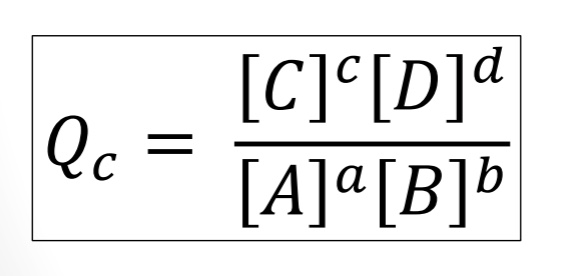
What happens if we add more reactant?
the reaction quotient decreases and G decreases (if you look at formula)
Reaction is spontaneous in the forward direction
what happens if we add more product?
the reaction quotient increases and so does G
reaction is spontaneous in reverse direction
If G=0, then we can control _______
the direction in which the reaction is spontaneous by adding reactant or product
Kc= equilibrium constant + This is_________
the mixture of reactants and products for which the Gibbs free energy change is zero
At equilibrium, the concentrations of _____ and _____ are fixed and not changing
product and reactants
At equilibrium, the rates of the _____ and ______ are the same
forward and reverse reactions
For reactions carried out in the gas phase, the concentrations in the equilibrium constant can be replaced by _____
partial pressures
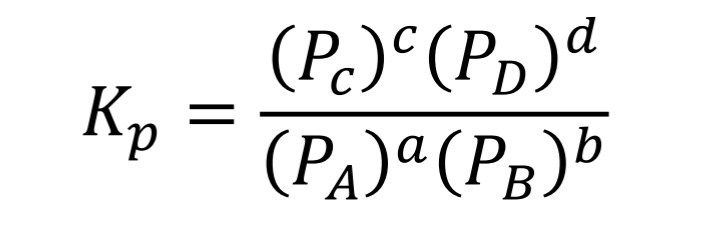
When writing out the equilibrium constant, do not include ______ or _______
solids or pure liquids
A very small equilibrium constant indicates that the concentration of the products is very _____.
small (equilibrium is on the left hand side)
An equilibrium constant that is very large indicates that the concentration of the products is very ______.
large (equilibrium is to the right side)
if all stoichiometric coefficients in a reaction are multiplied by a number, the equilibrium constant is _________
raised to the power of that number
if two reactions are added together, their equilibrium constants are _______
multiplied together
The reaction quotient Q is a measure of the relative amounts of reactants and products _______
at some point before equilibrium has been reached.
A comparison of ___ and ___ allows us to determine which direction the reaction will shift to reach equilibrium
K and Q
If Q = K, then
the system is at equilibrium
If Q>K, then
there is too high a concentration of products and the reaction is spontaneous in the reverse direction
If Q<K, then
then the concentration of products is too low, and the forward reaction is spontaneous
Le Chatelier’s Principle:
If a stress if exerted on a system in equilibrium, the position of that equilibrium will shift towards reactants or products in order to oppose the stress
What happens when you add reactant? (or remove product)
equilibrium shifts towards the products
What happens when you add product? (or remove reactant)
equilibrium shifts towards the reactants
What happens if you increase pressure?
reaction reduces pressure by reducing the number of gas molecules
reaction shifts towards side with fewer gas molecules
What happens if you decrease the pressure?
increases pressure by increasing the number of gas molecules
shift towards side with more gas molecules
What happens if you increase temperature and the reaction is exothermic?
the reaction moves in the direction which takes in heat, to reduce temperature
shifts towards reactants
What happens if you decrease the temperature and the reaction is exothermic?
the reaction moves in the direction which gives out heat, to increase temperature
shift towards products
What happens when you increase the temperature of an endothermic reaction?
the reaction moves in the direction which takes in heat, to reduce temperature
shift towards the products
What happens when you decrease the temperature of an endothermic reaction?
the reaction moves in direction which gives out heat, to increase temperature
shift words reactants
when a reaction is reversed, K is the _____
inverse of the K
exothermic reactions view heat as a _____
product
endothermic reactions view heat as _______
reactant
according to the bronsted-lowry definition of acid and bases, anything which ________ is an acid, and anything that ____ is a base
donates a proton, accepts a proton
when acid is added to water, it donates a proton to create ______
a hydrodium ion
conjugate acid:
the base after it accepts a proton
conjugate base:
the acid after it donates a proton
pH is a measure of a solutions
acidity
pH equation
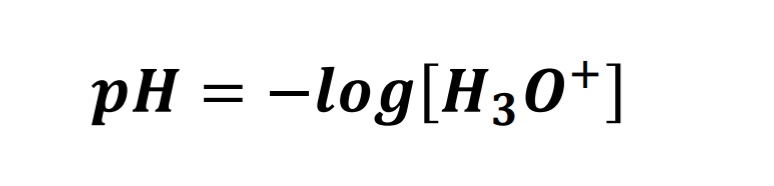
equation to calculate ion concentration from pH
or e
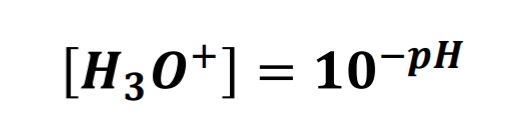
For example, pH 6 has a hydronium ion concentration of
10^-6 = 0.000001M
pH of 7 is a ____ solution
neutral solution
Water is amphoteric, meaning it is able to ________
donate a proton and accept a proton - CAN BE AN ACID AND BASE
Water can auto ionize, meaning that when two molecules of water interact….
one can act as an acid and the other can act as a base
equation Kw representing auto-ionization of water
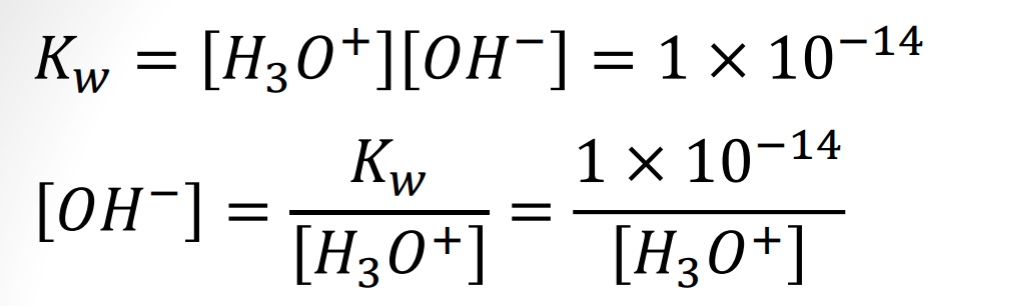
Kw is the constant for a given temperature.. depends on temp
true lol YAY YAY CA CA
When an acid is added to a solution, it establishes…….
an equilibrium
For strong acids, the equilibrium is far to the ______ and the reaction has gone to _____
right hand side , COMPLETION
_____% of strong acid molecules disassociate in a solution
100%
Strong bases are anything that has ____ and _____
OH and column one or two elements (Li, Na, K)
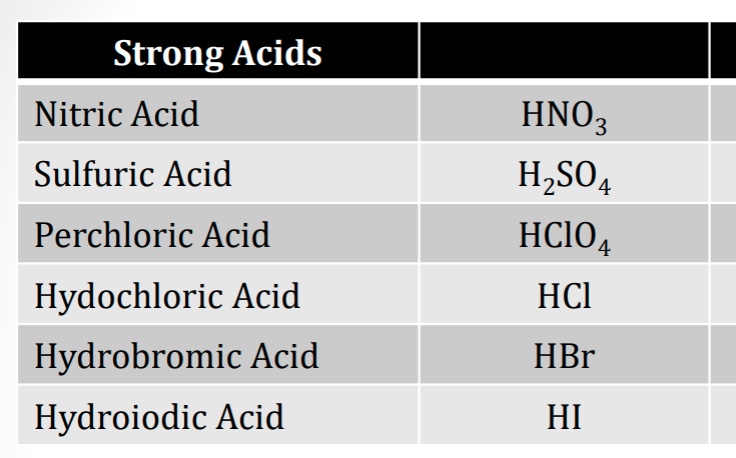
Strong acids include
Nitrate perches on the suffering of ClBrI
Weak acids are _____
anything else really
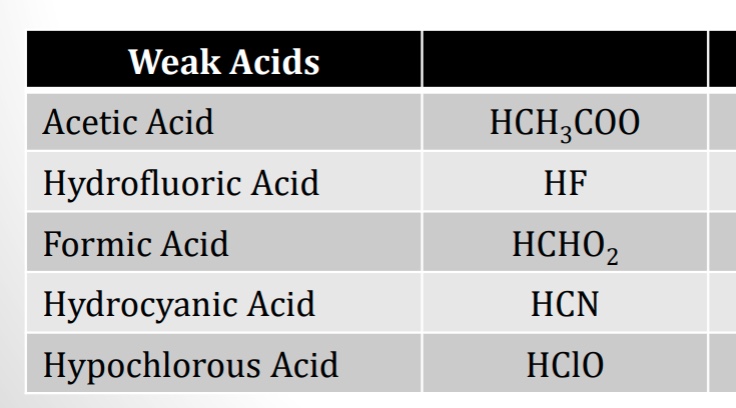
weak bases are ______
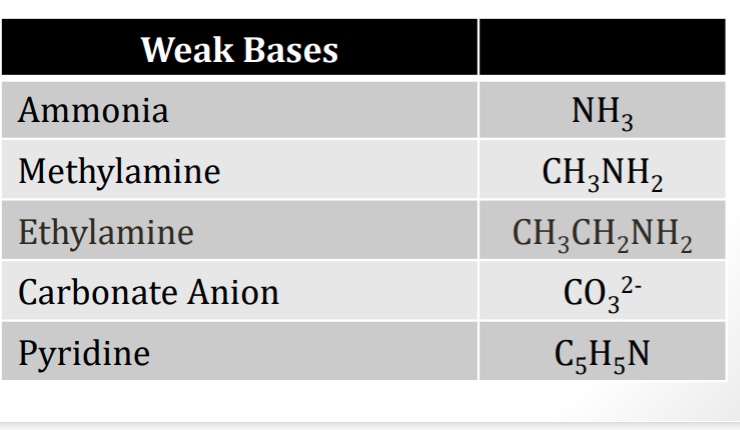
When a strong acid is involved, the pH of the solution can be determined from _____
the concentration of the acid added
When a strong base is involved, the pH of a solution can be determined from ________
the concentration of base added.
When weak acids or bases are added to water, an _____ is established
equilibrium
Ka is the equilibrium constant for weak acid added to water
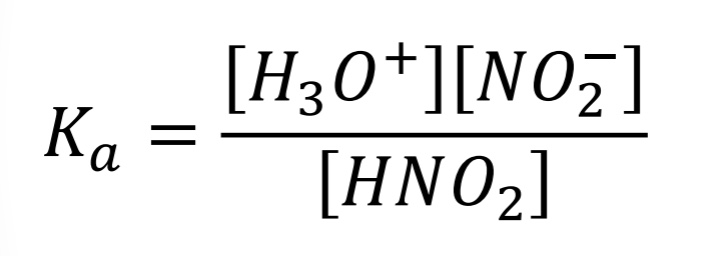
Kb is the equilibrium constant for weak base added to water
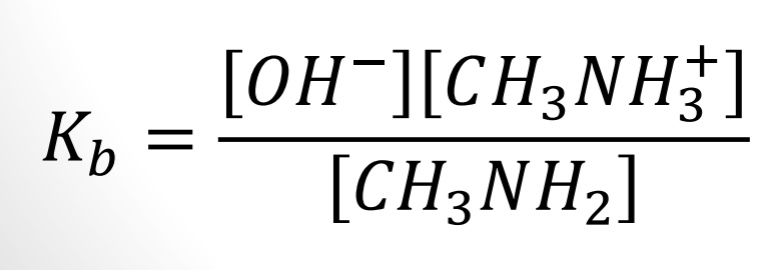
the further an equilibrium is to the right, the _____ the equilibrium constant (product side)
larger
For an acid, the further the equilibrium is to the right, the ______ the concentration of hydronium ions and the ____ the acid
higher, stronger
The larger the Ka, the ____ the pKa, and the ____ the acid
smaller, stronger
pKa formula:

For a base, the further the equilibrium is to the right, the ___ the concentration of hydroxide ions and the ___ the base
higher, stronger
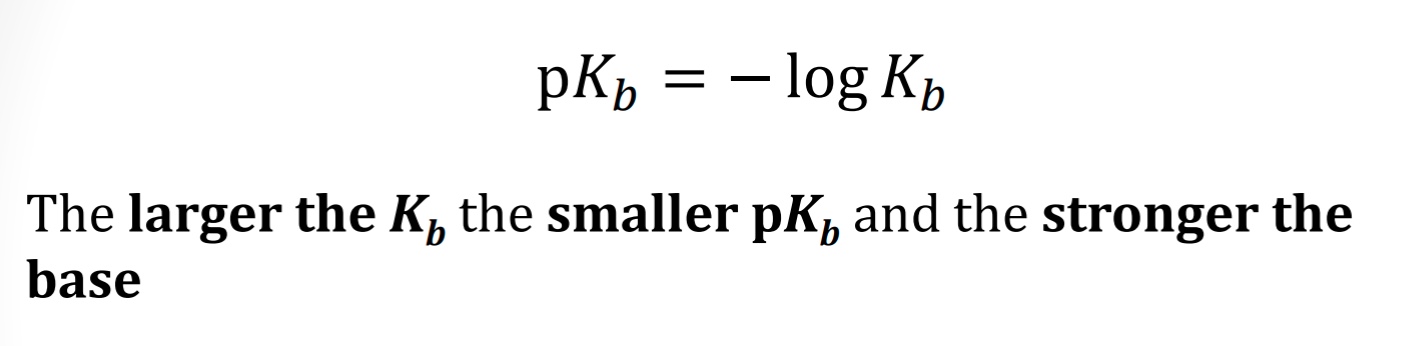
pKb formula
The Ka of a weak acid is related to the Kb of its conjugate base by the _____
equilibrium constant for the auto ionization of water Kw
Ka is related to Kb in this equation

the conjugate base of a weak acid is a
weak base
the conjugate base of a strong acid is
pH neutral
a cation that is the conjugate acid of a weak base is a ____
weak acid
a cation that is a conjugate acid of strong base is
pH neutral
The pH of an aqueous solution of a salt is a balance between the acid and the base properties of cation and anion
TRUE lol
If a salt is made up of a strong acid and a strong base, it is
pH neutral
If it is made up of a weak base and a strong acid, then it is
acidic
If a salt is made up of a weak acid and a strong base, then it is
weakly basic
If it is made up of a weak acid and a weak base, then
the pH depends on the relative strengths of the acid and base