A&P 1 - Chs 1 to 5
 Call Kai
 Learn
Learn Practice Test
 Spaced Repetition
 Match
Match Flashcards
 Knowt Play
1/31

There's no tags or description
Looks like no tags are added yet.
Name | Mastery | Learn | Test | Matching | Spaced | Call with Kai |
|---|
No analytics yet
Send a link to your students to track their progress
32 Terms
Cellular differentiation
At the beginning of development, all cells are basically the same. When these identical cells change and become specialized cells with different jobs (cellular differentiation)
One early cell can become:
A brain cell
A muscle cell
A skin cell
A liver cell
Ectoderm
The outer most layer. Cells of the ectoderm become the brain, spinal cord, nose, ears, nervous system.
Mesoderm
Middle layer. Cells of the mesoderm become reproductive organs, muscles, excretory system like your kidneys, etc.
Endoderm
Inner most layer, cells that end up here become your liver, digestive track,
respiratory system like your lungs
Humans are 3 distinct layers, when cells divide they create layers
Muscle Cell
have the ability to create force or motion, muscle cells are unique A-mitotic
cannot reproduce, they can grow larger or shrink, cannot turn into fats
All the cells in the body can be broken down or lumped into four distinct categories
Epithelial Cells
found all over the body, barriers all over the body’s surface, membranes,
secretory cells of glands, regulates transmissions, protective, reproduce quickly
All the cells in the body can be broken down or lumped into four distinct categories
Nerve Cells
have the ability to propagate a message from one point to another.
Communicating cells electrically, A-mitotic does not reproduce.
All the cells in the body can be broken down or lumped into four distinct categories
Connective Tissue Cells
function as anchors and support, reproduce quickly.
Bones, cartilage, tendons, ligaments, fats, vascular
All the cells in the body can be broken down or lumped into four distinct categories
Homeostasis
Physiological Balance.
A state of body equilibrium or stable internal environment
of the body, A process not requiring energy from the body, passive transport.
Diffusion
Random movement of particles from an area of higher concentration to an area of lower concentration until equilibrium is reached
Most predominant process to maintain homeostasis
Higher temperature makes diffusion faster / Lower temperature makes diffusion slower
Larger molecules diffuse slower than slower molecules
3 Spaces in the body where fluid exists / and has to maintain homeostasis
Extracellular fluid- outside the cell
Two types:
-intercellular (interstitial) fluid that is between the cells, 80%
-the other 20% of the fluid is plasma, fluid part of the blood
Intracellular fluid- inside the cell
60% of your body weight is water found in the cells 2/3 H2O
Negative Feedback
The initial condition that causes a response that is reversed, most
common
3 Primary Mechanisms that Regulate Homeostasis in human body
Positive Feedback
the initial condition that causes a response is enhanced or increased; child
birth is an example of positive feedback
3 Primary Mechanisms that Regulate Homeostasis in human body
Feed forward
an anticipatory response, example anticipates something before it
happens, getting cold before you go outside.
3 Primary Mechanisms that Regulate Homeostasis in human body
Osmosis
Diffusion of water
Tonicity
the way a cell reacts in a solution (fluid state)-a measure of the ability of a solution to
cause a change in cell shape or tone by promoting osmotic flow of water
Lysis
The dissolution or destruction of cells, explode, rupture of the cell
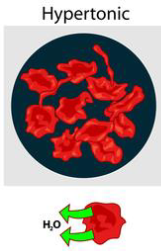
Hypertonic Solution
Cell shrinks (crenation) shrinks
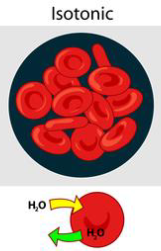
Isotonic Solution
Equal, no net movement
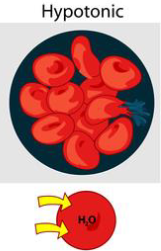
Hypotonic Solution
Cell swells (hypertrophy) enlarges
Facilitated Diffusion/Mediated Transport
A process by which substances are transported across cell membranes by means of protein
carrier molecules; also called facilitated transport
the transported substance either (1) binds to protein carriers in the
membrane and is ferried across or (2) moves through water-filled protein channels
Movement from high concentration to low concentration with help from membrane proteins.
No energy required. Example:
Glucose entering cells through carrier proteins.
Remember:
Facilitated = Helped diffusion
3 Forms of Passive Transport
Specificity: Proteins transport only certain substances
Competition: Substances may compete for the same transporter
Saturation: All transport proteins become occupied
Active transport
Movement from: Low concentration → High concentration
Requires ATP (energy). Active=requires energy
energy donated by the cell
Endocytosis
Movement from outside to inside. Cell brings materials in.
Phagocytosis : "Cell eating"
Example: White blood cells engulf bacteria.
Pinocytosis : "Cell drinking"
Cell takes in fluid.
Exocytosis
movement from inside to outside.
Cell releases materials.
Example:
Nerve cells releasing neurotransmitters.
Epithelial Transport
Movement through epithelial barriers.
Examples:
Nutrients moving through intestines
Oxygen moving through lungs
Language of Anatomy
A-before a word means without
An- before a word means without
Cyn-Blue
Cyan-blue
Scope-to look
Gram-suffix, to record
Cardia-Pertaining to the heart
Cardio-Pertaining to the heart
Pharmic-Drug
Pharmaco-Drug
Osis-condition
Ology- suffix, for the study of
Ologist- specialist in the study of
Gastro-stomach
Itis- inflammation
Chondro- cartilage
Osteo- bone
Soma- body
Arthro- joint
Gen- beginning
Acro- extremity
Cyto- cell
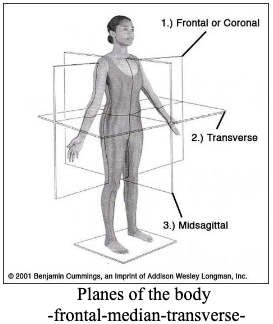
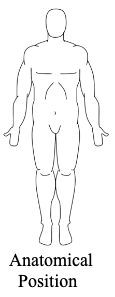
Anatomical Position
body erect, feet slightly apart, palms facing forward
Frontal (coronal) plane
longitudinal (vertical) plane that divides the body or an organ into
anterior and posterior parts (front & back
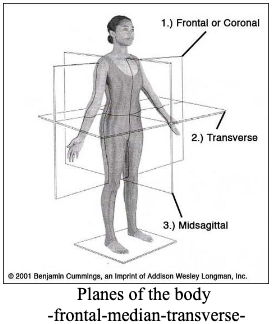
Midsagittal (median) plane
specific plane that lies exactly in the midline, equal division of right
and left half’s
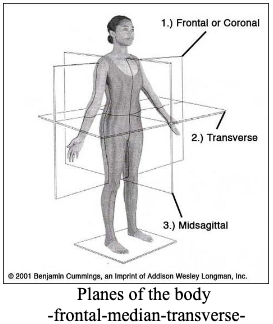
Transverse
a plane running from right to left, dividing the body or an organ
into superior and inferior parts