Lecture 1 (slide 1-75)
 Call Kai
 Learn
Learn Practice Test
 Spaced Repetition
 Match
Match Flashcards
 Knowt Play
1/105

There's no tags or description
Looks like no tags are added yet.
Name | Mastery | Learn | Test | Matching | Spaced | Call with Kai |
|---|
No analytics yet
Send a link to your students to track their progress
106 Terms
genes that regulate cell division
proto oncogene
mutated or over-expressed proto oncogenes
oncogenes
Chromosomal rearrangements
Mutations
epigenetic activation
Drie grote mechanismen van oncogene activation
Whole chromosome / segmental gain
Constitutive overexpression due to amplification
fusion/hybrid genes due to chromosomal rearrangement
constitutive overexpression due to promotor/enhancer hijacking
4 belangrijkste subtypes chromosomal rearrangements
activating mutations
promotor / enhancer mutations
mutations inhibiting degradation
oncogenic splice variants
belangrijkste mutaties die kunnen leiden tot oncogene activation
Numerical and structural rearrangements
twee types chromosomal aberrations
genomic instability
Voor welke cancer hallmark zullen Numerical and structural rearrangements zorgen?
B-cell lymphoma
Typische kanker waarbij whole chromosome gains gebeuren
c-MYC on chromosome 8
belangrijk oncogene met zijn chromosoom bij b-cell lymphoma
q24 of chromosome 8 (long arm, segment 24)
locatie c-MYC
Segmental: only a segment of the chromosome is gained or lost
wat maakt segmental chromosome gains anders dan whole chromosome gains?
pediatrische tumor van het sympathisch zenuwstelsel
ontstaat vaak in of rond de bijnier
geassocieerd met recurrente segmentale chromosomale afwijkingen
belangrijk voorbeeld: MYCN-amplificatie
Principe:
Neuroblastoma is een pediatrische tumor waarbij chromosomale gains/losses en vooral MYCN-amplificatie belangrijk zijn voor tumorbiologie en prognose.
neuroblastoma
MYCN: oncogene (N = neuronal), can be gained or amplified (on chromosome 2)
belangrijk oncogene bij neuroblastoma
1p-del
MNA
11q-del
17q-gain
typische chromosomal aberrations bij neuroblastome
small circular DNA fragments, present in the nucleus but not part of chromosomes, often highly abundant in cancer cells (can carry amplified oncogenes and contribute to high expression)
extrachromosomal DNA en kanker
chromosomal DNA
chrDNA
extrachromosomal DNA
ecDNA
chrDNA: higher order compaction
ecDNA: lower order compaction (strong expression)
chrDNA vs ecDNA op basis van compactheid en expressie
ecDNA lacks a centromere → no proper segregation during cell division → random distribution over daughter cells → can be lost
is ecDNA stabiel?
To stabilize amplification, ecDNA can re-integrate into chromosomes → forming HSR (homogeneously staining regions)
methode ecDNA om stabieler te zijn
EGFR (lung cancer)
ERBB2/HER2 (breast cancer)
MYCN (neuroblastoma)
DHFR (leukemia)
belangrijke oncogenen die vaak gelinkt zijn met ecDNA of HSR
Oncogene amplification
ecDNA draagt extra kopieën van oncogenen
Chromatin decompaction
ecDNA is vaak opener/losser verpakt → hogere expressie
Enhancer hijacking
ecDNA kan oncogenen samenbrengen met sterke enhancers
Chromosomal reintegration
ecDNA kan opnieuw integreren in chromosomen → HSR
Intra-tumor heterogeneity
ecDNA wordt ongelijk verdeeld bij celdeling → verschillen tussen tumorcellen
Drug resistance
ecDNA-copy number kan snel veranderen onder therapiedruk
Principe:
ecDNA versterkt oncogene expressie en maakt tumorcellen genetisch flexibeler, wat heterogeniteit en therapieresistentie bevordert.
6 modes of action van ecDNA
relatively simple rearrangement → duplication of a DNA segment, resulting in multiple adjacent copies of the same region (can include oncogenes)
tandem duplication
Tandem duplicator phenotype
TDP
ovarian cancer (OV)
triple-negative breast cancer (TNBC)
waar vind je de hoogste TDP rates?
reciprocal translocation
not loss or gain, but exchange of DNA between chromosomes
(no net gain or loss of genetic material)
fusion / hybrid genes
mogelijk gevaarlijk gevolg van reciprocal translocation
t(9;22)(q34;q11) translocation and the BCR/ABL1 fusion oncogene in CML (chronic myeloid leukemia)
Philadelphia chromosome
BCR and ABL close to each other, leading to loss of regulation of kinase activity, leading to constant phosphorylation. → increased proliferation and survival of leukemic cells
effect philadelphia chromosome
acute lymphoblastic leukemia
ALL
breakpoint cluster region
BCR
Abelson Murine Leukemia Viral Oncogene Homolog 1
ABL1
Chronic myeloid leukemia
(clonal hematopoietic stem cell disease )
CML
één hematopoëtische stamcel krijgt een driver-mutatie
deze kloon breidt uit en maakt te veel myeloïde cellen
in chronische fase blijven die cellen vaak nog deels functioneel
Principe:
CML start als clonale expansie van myeloïde cellen, maar kan later evolueren naar blast crisis met meer immature, minder functionele cellen
gevolg clonal hematopoietic stem cell disease
Evolvement to fatal acute leukemia through a so-called acceleration phase
additional karyotypic abnormalities (+8, i(17q), +Ph, +19) and transcriptome changes
= BLAST CRISIS
hoe van clonal hematopoetic stem cell disease naar fatal acute leukemia?
BCR-ABL1 on its own is sufficient to maintain the leukemia phenotype of CML
oncogene addiction in CML
mitogen-activated protein kinase
MAPK
Normally ABL1 shuttles between nucleus and cytoplasm, but now it stays in the cytoplasm
impaired shuttling bij BCR-ABL1
MAPK: increased proliferation
JAK-STAT pathway: impaired transcriptional activity
PI3K / AKT pathway: increased survival, proliferation
activation of c-MYC
gevolg van impaired shuttling bij BCR-ABL1 op pathways
Mitogen-activated protein kinase
MAPK
phosphoinositide 3-kinase
PI3K
gleevec
drugs dat werkt tegen BCR-ABL
goes into competition with ATP, which can’t attach to the kinase
werking Gleevec
Imatinib
Gleevec is brand name of …
40 different mutations in amino acids in the tyrosine kinase domain leading to resistance
resistentie tegen imatinib
T315I
typische puntmutatie dat zorgt voor imatinib resistance
Imatinib
dasatinib
nilotinib
ponatinib
(=> ImDaNiPo)
second generation inhibitors van BCR/ABL1 oncoprotein
can also bind to ATP-pockets of tyrosine kinase receptors with similar structural features as ABL1
extra toepassing Gleevec
germline mutations in c-KIT en PDGFRA in vormen van GIST
waar kan gleevec nog werken?
KIT Proto-Oncogene, Receptor Tyrosine Kinase
c-KIT
gastro-intestinal stromal tumors
GIST
t(15;17)(q22;q22) translocation PML-RARA oncogene in PML
fusion protein met PML
promyelocytic leukemia protein: organiser of nuclear subdomains (“PML bodies”)
PML
PML-RARA blocks differentiation of bloodcells, and lead to accumulation of immature cells
gevolg PML-RARA fusion protein
ATRA (all trans retinoic acid)
therapie tegen PML-RARA
ATRA restores differentiation by releasing transcriptional repression
ATO promotes degradation of the PML-RARA fusion protein
combined ATRA-ATO therapy
Arsenic trioxide
ATO
Arsenic trioxide induces sumoylation and ubiquitination → degradation of PML-RARA
hoe zorgt ATO voor degradatie van PML-RARA?
targeted protein degradation
van wat soort behandeling is ATRA-ATO het eerste voorbeeld?
PROTAC
latere drugs voor targeted protein degradation
Right: ligand recruiting E3 ligase
Middle: linker
Left: ligand binding the target protein (e.g. androgen receptor) → induces degradation of the target protein
onderdelen PROTAC
t(11;22) to form EWS- FLI1
fusion genes bij Ewing sarcoma
solid tumour, sarcoma in bone or soft tissue; this example in bone
Wat voor tumor is Ewing sarcoma?
EWS provides a transactivation domain
FLI1 provides a DNA-binding domain (ETS transcription factor)
Fusion → aberrant transcription factor with constitutive activity
gevolg EWS-FLI1 fusion
You’re not born with the fusion product. There is a certain window when the fusion product leads to transformation. When made too early or too late, it won’t happen
Developmental window for fusion genes driven transformation
In the experiment, in the different stages they use different promotors. They choose a promotor that is active in a specific stage, link it to the fusion gene, and check if it is transformative
Lethal: it is too early
experiment om te testen op developmental window
TMPRSS2-ERG
belangrijke fusie bij prostate cancer
androgen responsive transmembrane serine protease
TMPRSS2
kinases or transcription factors
belangrijke zaken die vaak in fusion genes zitten
many translocations forming fusion genes or mediating promotor/enhancer hijacking are pathognomonic for specific cancer (sub) entities
RNA-sequencing can detect reads spanning the fusion junction, allowing identification of fusion genes and patient classification
klinische relevantie fusion genes
finding that is highly specific for a certain cancer entity; if that fusion product is present, it strongly points to that specific diagnosis
pathognomonic
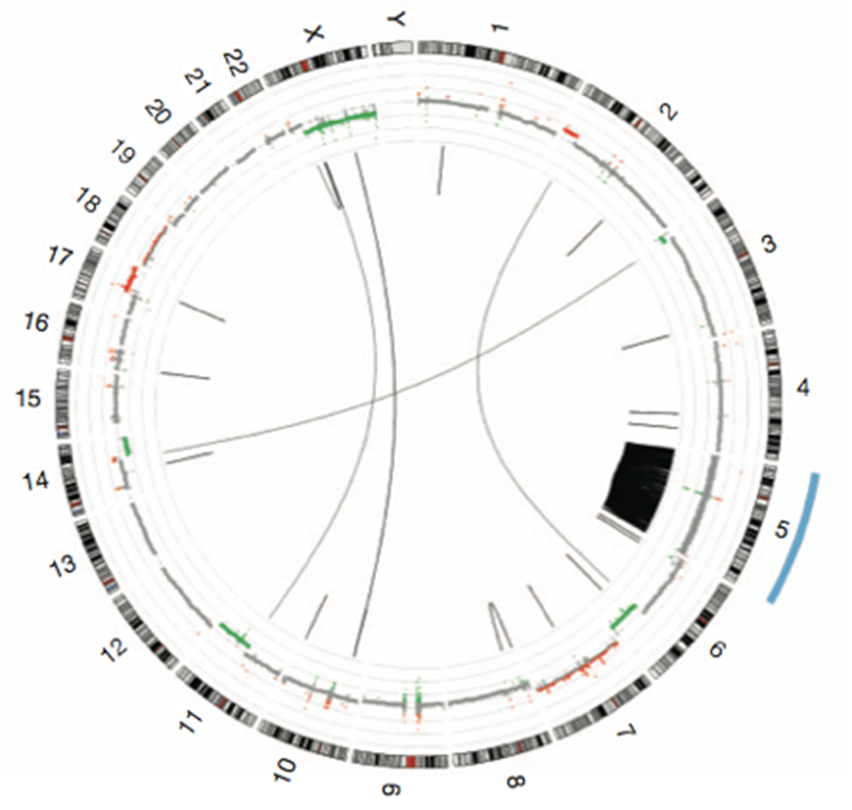
chromothripsis
a catastrophic one-time chromosomal event in which a chromosome (or part of it) breaks into many fragments and is incorrectly reassembled.
complex chained rearrangements involving multiple chromosomes
chromoplexy
circos plot
Method to comprehensively show genomic alterations in a tumor cell
wat is dit?
a strong enhancer is brought near another gene promoter, activating that gene
enhancer hijacking
TCRα/δ and TCRβ loci contain strong enhancers
Translocation brings the TLX gene close to a TCR enhancer (not a fusion protein, but enhancer hijacking)
TLX is normally not expressed in these thymic cells, but becomes highly transcribed after the translocation
gevaar bij T cell receptor (TCR) encoding loci in context van ALL
High TLX expression causes maturation arrest and drives TLX-addicted leukemia
gevolg hoge TLX expressie
IGH/BCL2 rearrangement
BCL2 stops apoptosis
belangrijke translocation bij follicular lymphoma
Intrinsic / mitochondrial pathway releases cytochrome c, forming apoptosome. This release is blocked by BCL2
hoe is BCL2 anti-apoptotic?
Tyrosine kinases (transmembrane receptors) that display kinase activity
Dimerize after ligand binding, bringing the tails close together, leading to phosphorylation of each other
The phosphorylated residues are docking sites for adaptor proteins, which activate downstream signaling
werking principe growth factor receptor signaling
PDGRF:
belangrijk voorbeeld growth factor receptor
platelet derived growth factor receptor
PDGRF
>25 yrs ago discovered as oncogenes, more recently as targets for therapy
belang growth receptors in context van kanker
strictly regulated: low conc. phosph tyrosine proteins in non-dividing cells
hoe sterk zijn growth receptors gereguleerd?
src
PI3K
belangrijke adaptor proteins bij de PDGFR
Proto-Oncogene, Non-Receptor Tyrosine Kinase
wat voor iets is SRC?
each level of regulation can be deregulated: ligand, receptor (eg more receptors), downstream signaling (also by point mutations), transcription factors, target genes
wat kan gedereguleerd worden bij de growth receptors?
Lung cancer
waar is de receptor tyrosine kinase: EGFR belangrijk?
breast cancer
waar is re receptor tyrosine kinase, ERBB2 belangrijk?
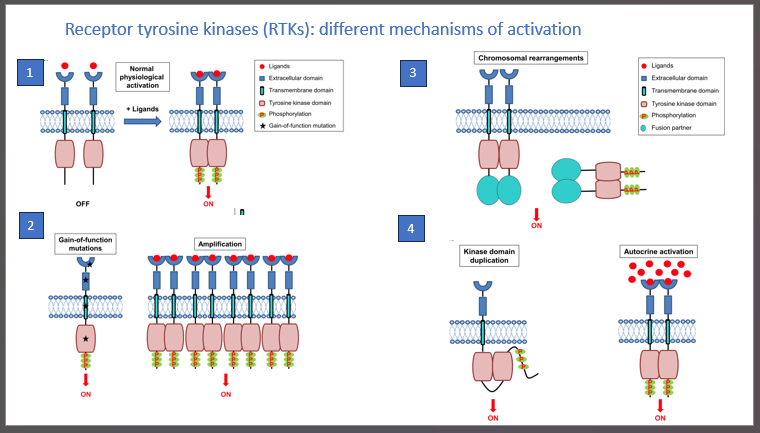
amplification of ligand, receptor or point mutations for constant activation (ligand-independent firing)
Point mutations can make the receptors dimerize / activate without ligand
Loss of the extracellular part can also cause constitutive activation
methoden van overexpressie bij growth receptors
Regulatory type mutations
mutaties in regulerende domeinen
halen de “rem” van de receptor weg
→ ligand-onafhankelijke/constitutieve activatie
Enzymatic pocket mutations
mutaties in het kinase/ATP-bindend domein
veranderen kinaseactiviteit of drug binding
→ belangrijk voor gevoeligheid/resistentie tegen TKIs
Principe:
c-KIT kan oncogeen worden door verlies van regulatie of door veranderingen in de enzymatische kinase-pocket
belangrijke klasses van (c-KIT) mutaties
EGF → EGFR → GRB2 / SOS → RAS (KRAS) → RAF → MEK → ERK → nucleus → proliferatie
belangrijke cascade dat volgt op binding van EGF op EGFR receptor (bij lung cancer belangrijk)
Signal enters the nucleus through ERK
belang ERK
Smokers: more KRAS
Non-smokers: more EGFR
=> KRAS and EGFR mutations are mutually exclusive, (so or one or the other)
resp in smokers and non-smokers
NF1 is a tumor suppressor (loss-of-function), while the others are mainly activating alterations
belangrijke drivers die gemuteerd worden bij lung cancer
maken de receptor constitutief actief, waardoor proliferatie- en overlevingssignalen blijven doorgaan.
gevolg punt mutaties / deleties in EGFR
Erlotinib
Gefitinib
Voorbeelden als therapieën bij long kanker, specifiek tegen EGFR
Range where tumor cells are inhibited while WT cells are relatively spared.
therapeutic window
T790M mutation increases ATP affinity and requires higher inhibitor concentration than WT EGFR, causing loss of the therapeutic window and toxicity
resistentie tegen first generations EGFR TKI
Gefitinib
voorbeeld first generation EGFR TKI
stronger inhibition of mutants (including T790M), but WT EGFR is still inhibited too much, so limited therapeutic window
probleem second generation EGFR TKIs