Viruses II
 Call Kai
 Learn
Learn Practice Test
 Spaced Repetition
 Match
Match Flashcards
 Knowt Play
1/24

Earn XP
Description and Tags
Comprehensive flashcards covering viral replication, entry mechanisms for different cell types, life cycles, and specific examples of large viruses and gene transfer based on the BIOL2038 lecture.
Name | Mastery | Learn | Test | Matching | Spaced | Call with Kai |
|---|
No analytics yet
Send a link to your students to track their progress
25 Terms
Are there any species known to be completely immune to viruses
Not a single species is known to be immune; viruses attack bacteria, archaea, plants, and animals.
How do viruses replicate
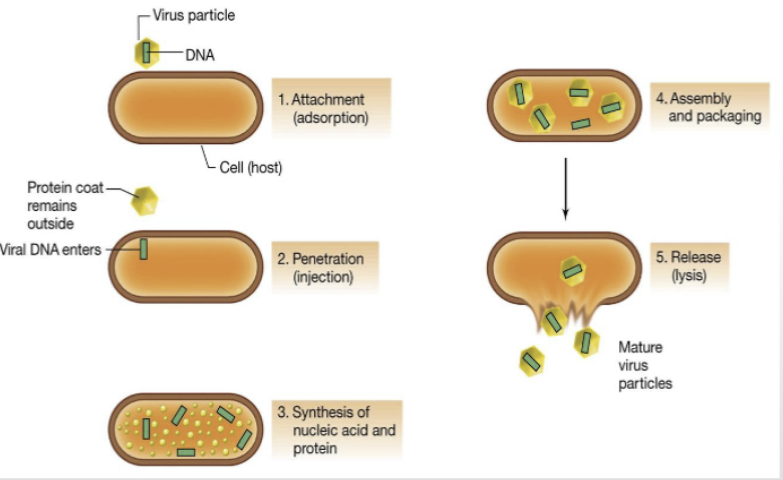
Viruses binds to receptor on cell surface and then injects its genetic material into the host cell. The host cell then uses its internal components and synthesises the viral proteins of the virus. Inside the cell, the viral proteins come together and assemble to form multiple copies of the virus. The viral particles then bursts out of the cell, taking some of the host cell membrane with it to make their protein capsid.
What types of molecules can serve as receptors for viruses on the cell surface?
Proteins, sugars, lipids, or complexes of these.
How does the HIV virus use receptors and co-receptors to enter a cell?
It first binds to a common, low-affinity receptor and 'rolls' until it binds to a high-affinity receptor (CD4). Because CD4 leaves the virus too far from the surface, it uses a co-receptor (CCR5/CXCR4) to pull it closer for fusion.
How do non-enveloped and enveloped animal viruses differ in their entry into host cells?
Non-enveloped viruses enter via endocytosis, while enveloped viruses enter via fusion.
How do viruses typically enter plant cells given their rigid cell walls?
They enter through damaged cell walls or via a vector, such as an animal feeding on the plant.
What is the mechanism by which a bacteriophage injects its nucleic acid into a bacterial cell?
Tail fibers and pins bind to the cell, the tail sheath contracts, and the tail core is pushed through the bacterial wall to inject the nucleic acid.
What occurs during the viral component synthesis for RNA viruses
These viruses need to synthesise RNA polymerase themselves. In some RNA viruses, genomic RNA itself can function directly as mRNA
In other RNA viruses, mRNA needs to be transcribed from the genomic RNA
Why do RNA-viruses need to synthesize RNA-dependent RNA-polymerase?
Because the host cell machinery lacks the enzyme required to replicate RNA from an RNA template.
What is the process and key enzyme used by retroviruses like HIV during synthesis?
They use reverse transcriptase to perform reverse transcription, converting ssRNA into dsDNA.
What is the difference between budding and lysis as viral release mechanisms?
In budding, the host cell may survive; in lysis, the host cell is destroyed through rupture.
What is the lytic cycle
The lytic cycle is a viral replication process that results in the destruction of the host cell, leading to the release of new viral particles. It involves the injection of viral DNA, hijacking the host's cellular mechanisms to replicate, and ultimately causing cell lysis.
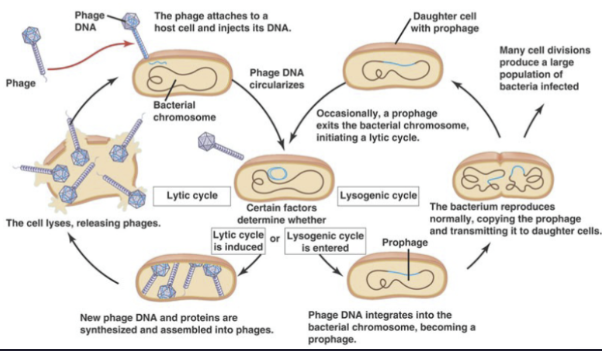
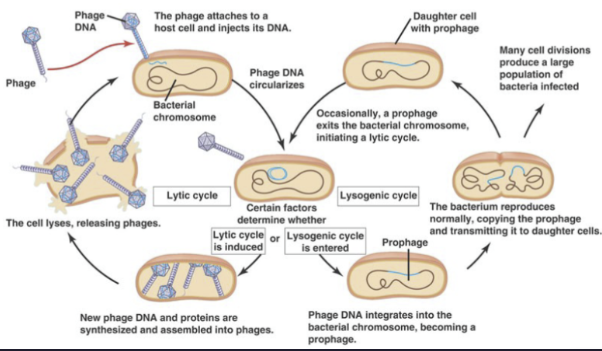
In the context of bacteriophages, what is the lysogenic cycle?
A cycle where the phage DNA integrates into the bacterial chromosome as a prophage and is transmitted to daughter cells during normal reproduction.
What is the difference between horizontal and vertical gene transfer?
Horizontal gene transfer is the transfer of material from one lineage to another, while vertical gene transfer is the transfer from parent to offspring.
What percentage of the human genome consists of endogenous retroviruses?
8%
What are mimiviruses, mamaviruses and megaviruses
They are giant viruses known for their large genomes and complex structures, often infecting amoebae.
What is a virophage
A virophage is a small virus that can only infect a host (like an amoeba) when it is already being infected by another virus (like mimi/mamavirus).
What is sputnik
Sputnik is a type of virophage that specifically infects amoebas and relies on co-infection with a larger virus to propagate.
what is a pandora virus
A giant virus which infects amoebae that has ~2500 protein-coding genes
What is Pithovirus
A virus found in Siberian permafrost in 2014 that infects amoebae
How does Medusavirus affect its amoeba host?
It forces the host to form a thick hardened shell, described as 'turning it into stone'.
What role do polydnaviruses play in parasitoid wasps?
The virus is incorporated in the wasp genome and produced in the reproductive system. When the wasp lays its eggs into its host, the virus causes the host’s immune system to be reduced, preventing the immune system from killing the eggs. This is a symbiotic relationship
Are viroids actually viruses
They are not viruses and are mostly plant pathogens
What is biosynthesis
This is when phage DNA directs synthesis pf viral components by the host cell
What is maturation in the phage cycle
Viral components are assembled into virions