Capacity Limits of Attention
 Call Kai
 Learn
Learn Practice Test
 Spaced Repetition
 Match
Match Flashcards
 Knowt Play
1/11

There's no tags or description
Looks like no tags are added yet.
Name | Mastery | Learn | Test | Matching | Spaced | Call with Kai |
|---|
No analytics yet
Send a link to your students to track their progress
12 Terms
Key example of capacity limits of attention (1)
Attentional blink
Attentional blink def
An inability to report a target stimulus if it appears to soon after another target stimulus
Attentional blink elaboration mapped to specific stimuli + timings
When two targets (T1 and T2) are presented in rapid succession, the processing of T1 disrupts the processing of T2, so T2 is often missed if presented within 200-500 ms after T1
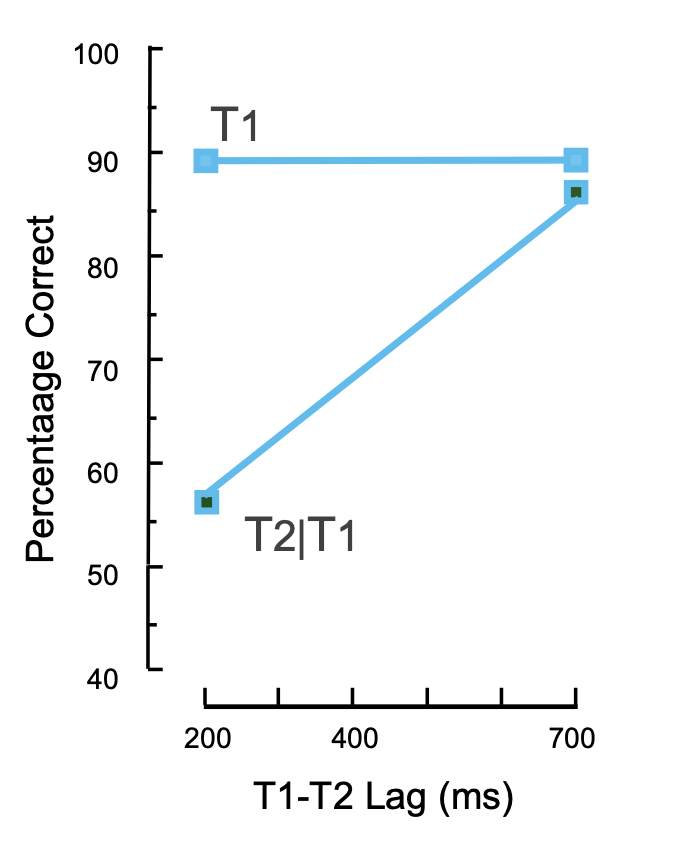
What is lag-1 sparing?
Lag 1 Sparing: If T2 appears immediately after T1 (approx. 100ms), it is often "spared" and detected correctly
2 models to explain attentional blink
Bottleneck models
Biased competition models
Bottleneck models description (1)
Suggests that sensory detection (stage 1) occurs in parallel (can sense many different things at once), but conscious awareness + working memory consolidation (stage 2), occur serially, resulting in ‘bottleneck’, where not all visual input can be processed to reach our conscious awareness
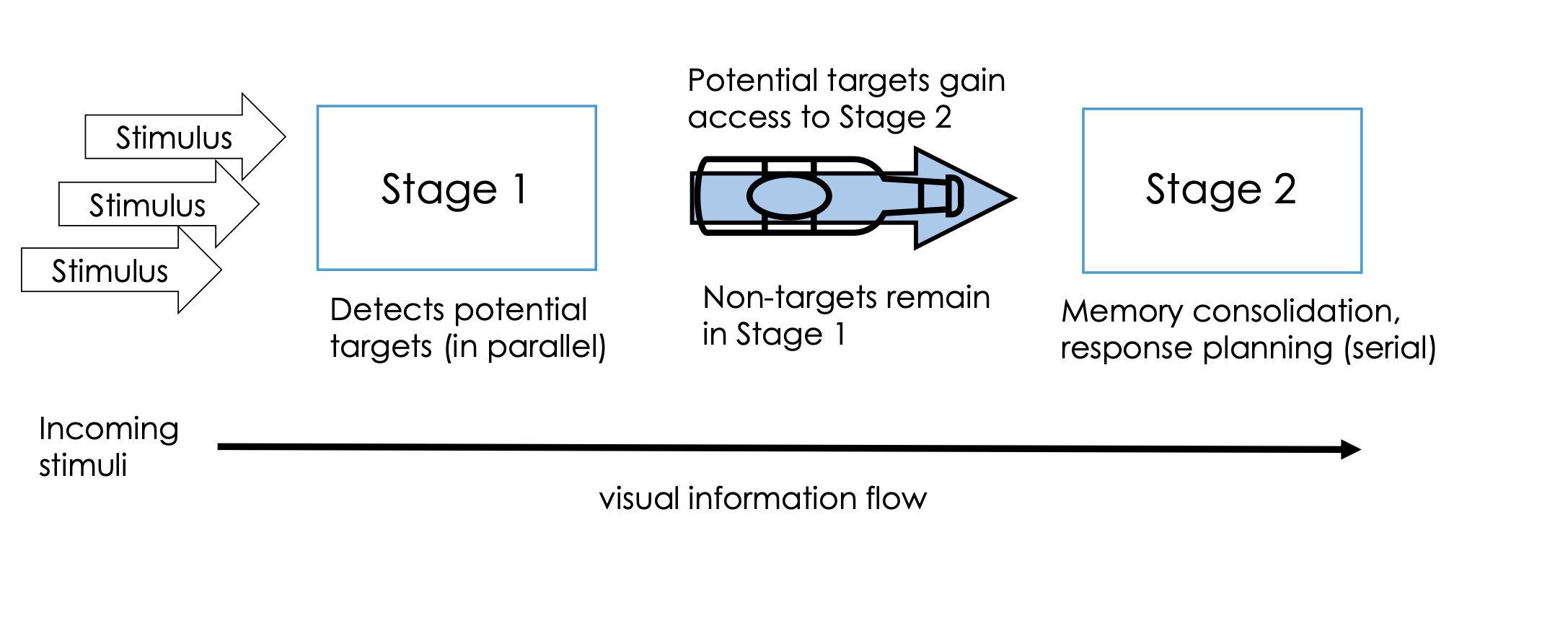
Biased competition models description
Sees attention as an ‘emergent property’ to resolve many stimuli competing for neural attention
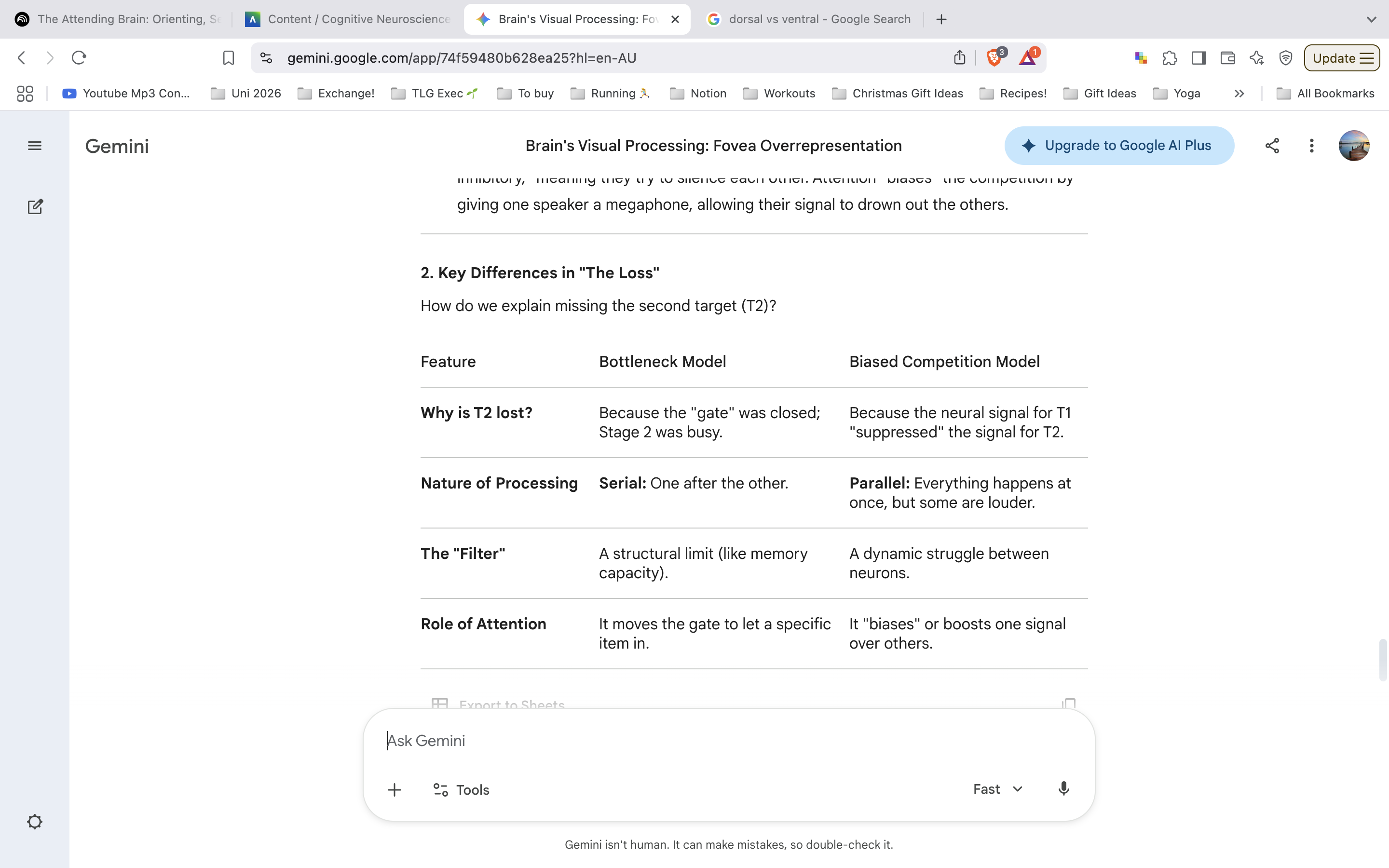
Key differences in how T2 target was ‘lost’, based on bottleneck vs biased competition models (don’t need to memorise, just for your understanding)
fMR findings related to attentional blink for early vs later processing
Attentional blink affects P300 (later processing related to WM consolidation)
Attentional blink doesn’t affect N1 or P1
Implication/suggestion (1)
Attentional blink affects WM consolidation, but not sensory perception (i.e. the brain "sees" the missed stimulus but cannot consolidate it)
fMRI resesarch on ‘missed’ targets’ (2) + implication (1)
Even when targets were 'missed’, there was still more PPA activity than when there was no stimulus at all
But this activity did not reach frontal areas
Indicates that the meaning of a stimulus can be represented without conscious awareness of that stimulus
Which model do the 2 examples of fMRI research support? (1)
Bottleneck models → we ‘see’ lots of stimuli, but not all reach our conscious awareness