Topic 5 (Data Link Layer)
 Call Kai
 Learn
Learn Practice Test
 Spaced Repetition
 Match
Match Flashcards
 Knowt Play
1/53

There's no tags or description
Looks like no tags are added yet.
Name | Mastery | Learn | Test | Matching | Spaced | Call with Kai |
|---|
No analytics yet
Send a link to your students to track their progress
54 Terms
Data Link Layer
Prepares network data for the physical network.
Data Link Layer
Is responsible for network interface card (NIC) to NIC communications.
Frames
Exchanges ________ between endpoints over the network media.
Data Link Layer
Controls how data is placed and received on the media.
Data Link Layer
Performs error detection and rejects any corrupt frame.
Layer 2 Ethernet destination and source NIC information (address)
The data link layer adds ________________________ to a Layer 3 packet.
IEEE 802 LAN/MAN standards
are specific to the type of network (Ethernet, WLAN, WPAN, etc.).
Logical Link Control (LLC)
Communicates between: Networking Software and Device hardware
Networking software
At the upper layers
Device Hardware
at the lower layers
Media Access Control (MAC)
Sublayer provides: Data Encapsulation and Media Access Control
Data Encapsulation
provides addressing and error detection
Addressing
source and destination addressing for transporting the Layer 2 frame between devices on the same shared medium.
Error Detection
includes a trailer used to detect transmission errors.
Media Access Control
to allow multiple devices to communicate over a shared medium.
Point-to-point, Hub and spoke, Mesh
There are three common physical WAN topologies.
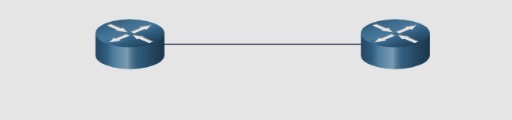
Point-to-point
the simplest and most common WAN topology. Consists of a permanent link between two endpoints.
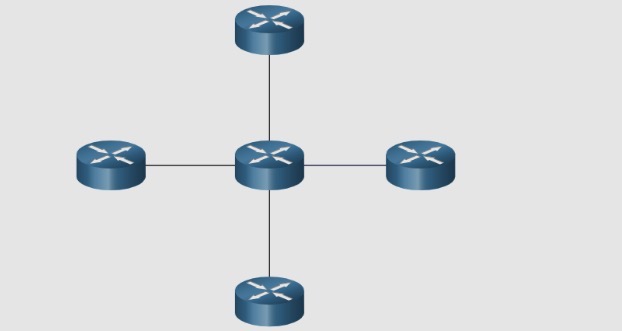
Hub and spoke
similar to a star topology where a central site interconnects branch sites through point-to point links.
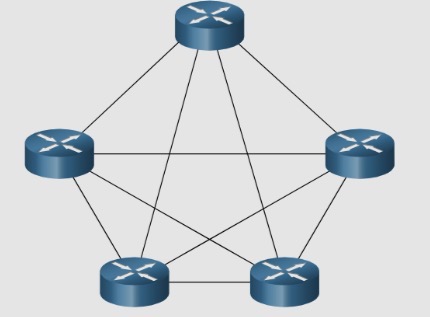
Mesh
provides high availability but requires every end system to be connected to every other end system.
Point-to-point
Hub and spoke
Mesh
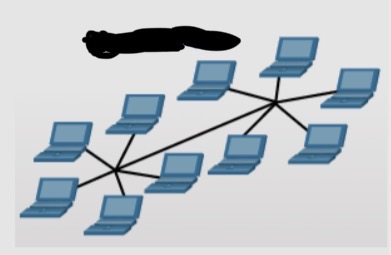
Star and extended star
Typically used to interconnect end devices on LANs
Star and extended star
Very scalable and easy to install and troubleshoot
Star
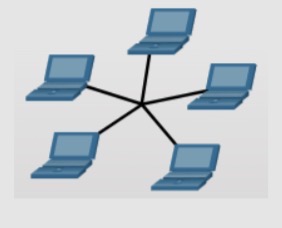
Extended Star
Legacy LAN topologies
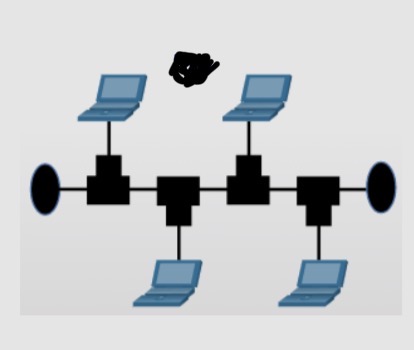
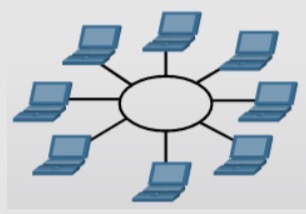
Consists of Early Ethernet Bus and Legacy Token Ring.
Early Ethernet Bus
All end systems chained together with coaxial cable and terminated on each end.
Legacy Token Ring
Each end system is connected to its respective neighbors to form a ring.
Bus
Ring
Half-duplex communication
Only allows one device to send or receive at a time on a shared medium.
Half-duplex communication
Used on WLANs and legacy bus topologies with Ethernet hubs.
Full-duplex communication
Allows both devices to simultaneously transmit and receive on a shared medium.
Ethernet
________ switches operate in full-duplex mode.
multiaccess network
is a network that can have two or more end devices attempting to access the network simultaneously. Examples: Ethernet LANs and WLANs.
Contention-based access and Controlled access
What are the access control methods
Contention-based access
• Carrier sense multiple access with collision detection (CSMA/CD) - used on legacy bus-topology Ethernet.
• Carrier sense multiple access with collision avoidance (CSMA/CA) - used on Wireless LANs.
Carrier sense multiple access with collision detection (CSMA/CD)
used on legacy bus-topology Ethernet.
Carrier sense multiple access with collision avoidance (CSMA/CA)
used on Wireless LANs.
Controlled Access
Deterministic access, where each node has its own time on the medium.
Carrier sense multiple access with collision detection (CSMA/CD)
Used by legacy Ethernet LANs.
Carrier sense multiple access with collision detection (CSMA/CD) and Carrier sense multiple access with collision avoidance (CSMA/CA) - used on Wireless LANs.
Operates in half-duplex mode where only one device sends or receives at a time.
Carrier sense multiple access with collision detection (CSMA/CD)
Uses a collision detection process to control when a device can send and what happens if multiple devices send at the same time.
Carrier sense multiple access with collision avoidance (CSMA/CA)
Used by IEEE 802.11 WLANs.
Frame
Data is encapsulated by the data link layer with a header and a trailer to form a ______.
Header, Data, Trailer
a frame has three parts
Frame Start and Stop
Identifies beginning and end of frame
Addressing
Indicates source and destination nodes
Type
Identifies encapsulated Layer 3 protocol
Control
Identifies flow control services such as quality of service (QoS).
Data
Contains the frame payload
Error Detection
Used to determine transmission errors
Layer 2 Addresses
• Referred to as a physical address.
• Contained in the frame header.
• Used only for local delivery of a frame on the link.
• Updated by each device that forwards the frame.