Selling environment (brick & mortal) - eCommerce & Retail Mrkt
 Call Kai
 Learn
Learn Practice Test
 Spaced Repetition
 Match
Match Flashcards
 Knowt Play
1/37

Earn XP
Description and Tags
eCommerce & Retail Mrkt
38 Terms
Who developed the ‘Servicescape’ concept and when?
Developed by → Booms and Bitner
Developed in → 1981.
What is a Servicescape?
The physical setting in which a marketplace exchange is performed, delivered, and consumed.
What model does the Servicescape build on?
Starts with the concept of
→ ‘Stimulus–Organism–Response’ (SOR) model.
What does SOR become in the Servicescape model? (4)
SORM — Stimulus, Organism, Response, Moderators
Name the shop layout types (3)
Grid layout
Racetrack layout
Freeform layout
What is a grid layout? (with example)
A structured layout typical of discount retailers, focusing on footfall flow and queue management.
E.g. → (Aldi, Dunnes, Tesco …)
Benefits of a grid layout (3)
Logical and easy to understand
Gondolas labelled clearly
Easy to find goods
Issues with a grid layout (2)
Feels mechanical
Can create a boring experience
What is a racetrack layout? (with example)
A layout that guides customers around a set path to ensure they see a wide range of products.
E.g. → (IKEA, Home store)
Benefits of a racetrack layout (4)
Easy customer flow
Works well for smaller shops
High product density per square foot
Logical grouping of departments
What is a freeform layout? (with example)
A layout designed to feel like “organised chaos,” encouraging browsing and exploration.
E.g. → (Brown Thomas)
Benefits of a freeform layout (4)
Encourages browsing
Supports hedonistic shopping
Allows creative design
Creates pockets of interest
Drawbacks of a freeform layout (3)
Harder to use in large stores
Customers may struggle to locate products
Less product per square foot
What products should be placed at the entrance to entice customers? (2)
Bakery items
Colourful fruit and vegetables
Where should footfall drivers be located?
Around the edges or back of the store.
What items should be placed in prominent (attention grabbing) locations? (2)
High‑margin or
Impulse‑buy items.
Why use end‑of‑aisle displays? (2)
Creates High exposure, and
Positions the store as cheaper through special offers.
What are key points to consider when designing a store layout? (5)
Manage footfall flow
Create pockets of interest
Inject excitement
Encourage additional purchases
Encourage impulse purchases
What are the five senses retailers use to enhance experience?
Sight
Sound
Touch
Taste
Smell.
How does sight influence retail experience? (3)
Lighting
Colour choices
Brand positioning through colour
How does sound affect the retail environment? (3)
Creates ambience
Can annoy customers
Must balance tone and social interaction
How is smell used in retail? (3)
Coffee shops, perfume counters
In‑store bakery placement
Scent branding (e.g., Abercrombie & Fitch)
What did Tischler’s (2005) experiment show?
Vanilla scent in women’s department and spicy scent in men’s doubled turnover
Reversing scents reduced turnover
Why is touch important? (3)
Creates familiarity
Reduces anxiety
Boosts confidence
How is taste used in retail? (2)
Free samples
Hot drinks in salons
What are the three key components of the physical environment (stimulus)? (3)
Ambient conditions
Space & function
Signs, symbols, artefacts
What is the holistic environment concept?
Customers process multiple stimuli simultaneously to form an overall impression.
What is a moderator in the Servicescape model?
Anything that increases or decreases a customer’s response to a stimulus.
Give an example of a moderator.
Hunger increasing response to food smells
Motivation reducing negative response to cold
How do employees respond to stimuli?
The right stimuli increase commitment and willingness to engage with customers.
What customer behaviours result from positive stimuli?
Enter and explore
Stay longer
Carry out planned purchases
Engage in social interactions
What are key criticisms of the Servicescape model? (3)
People respond differently to the same stimulus
Many stimuli are hard to measure
Overemphasis on physical factors, not social interaction
What is in‑store communication?
Providing information through signs, posters, and technology to support navigation, promotions, and brand building.
What is visual merchandising?
The strategic design of store, window, and digital displays to attract customers and maximise sales.
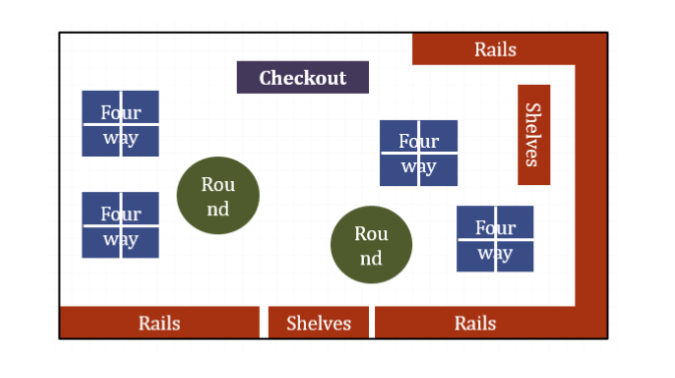
What store layout is this ?
Freeform layout
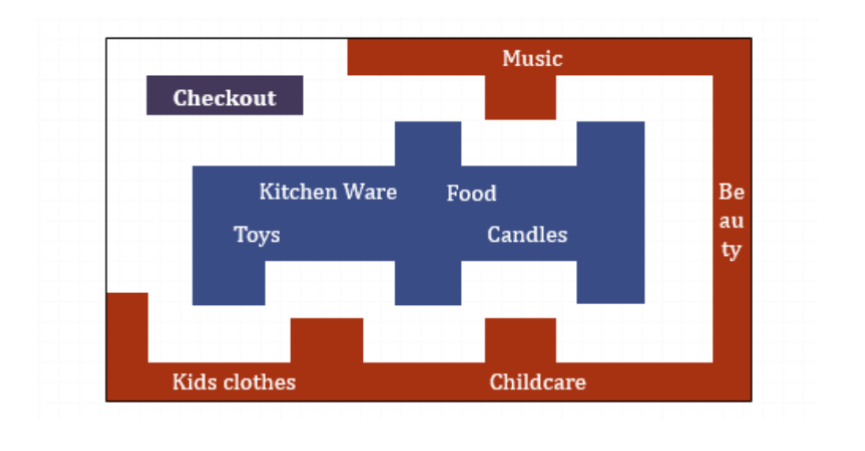
What store layout is this ?
Racetrack layout
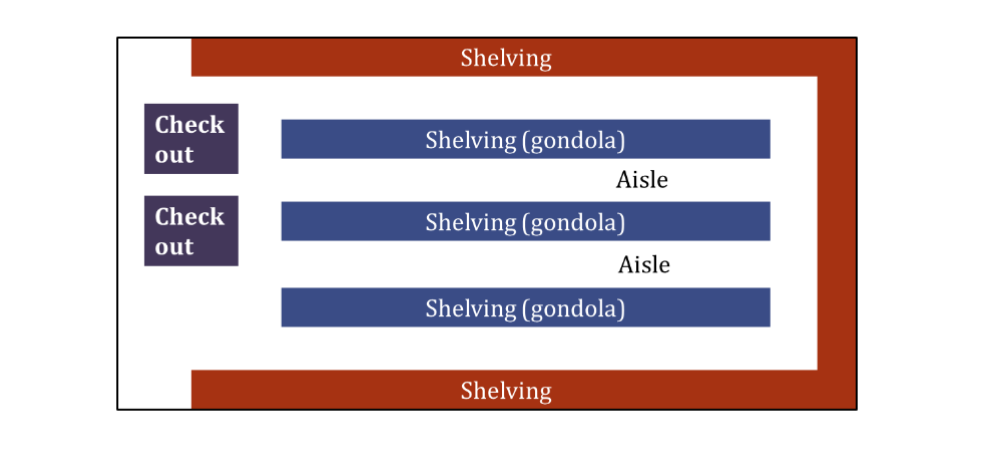
What store layout is this ?
Grid layout
Who conducted an experiment in 2005 and discovered that
Vanilla scent in women’s department and spicy scent in men’s doubled turnover
Reversing scents reduced turnover
Tischler