4D - Symbolic language (Non-cognitive)
 Call Kai
 Learn
Learn Practice Test
 Spaced Repetition
 Match
Match Flashcards
 Knowt Play
1/30

There's no tags or description
Looks like no tags are added yet.
Name | Mastery | Learn | Test | Matching | Spaced | Call with Kai |
|---|
No analytics yet
Send a link to your students to track their progress
31 Terms
What is the difference between a sign and
Have a deeper significance and ‘point beyond themselves’
''A pattern or object which points to an invisible metaphysical reality and participates in it '' - Erika Dinkler-con Schubert
They can be pictorial, abstract, verbal or active (a symbolic action).
E.g. a light burning in a Catholic church = the presence of Christ, the light could mean so much to a Catholic Christian/Christ/tradition/worship/familiarity.
However a sign doesn’t point to a deeper reality beyond itself it just tells you to do or don’t do something.
Signs can become symbols if people attach meaning to them.
What are some examples of things that can be used as symbols?
Poppy = remembrance
Red = bad/stop
Green = good/go
Handshake = agreement, respect, acceptance, peace
Flags
Cross
Wudu - Symbolic because there is a spiritual component
Buddhist monks shaving their head - symbolic to shave their head to detach themselves from the world/things other people care about
Explain the symbolism of a national flag
Represents the independence of a nation.
Represents pride in their nation.
People may see flags as divisive, as a symbol of empire.
The purpose of symbols in religion?
They are a non-cognitive way of using language to refer to religious figures etc.
It’s a way of describing God (who may or may not be reality)
They allow for the sharing of concepts relevant to particular faiths i.e. baptism.
How can sacred texts be read symbolically?
Scripture/holy books can be interpreted symbolically, this means the words might actually mean something else, they represent a different truth.
This symbolic interpretation of the text/scripture is Liberal - because it is open to interpretation.
Meaning - people read into it what they believe to be true.
Jesus’ parable of the mustard seed
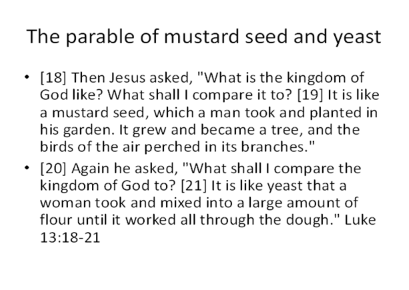
How can you interpret Jesus’ message in his parable of the mustard seed?
The mustard seed is a person's faith as the faith grows it turns into something more.
The yeast - the yeast grows.
The man takes the small mustard seed - the man could represent God.
In what way is the parable symbolic?
Mustard seed
Man - could represent God
Garden - paradise, earth
Tree - shelter, safety
Birds of the air
Branches
You only need a small amount of yeast to make dough rise - God using something small to have a big effect.
They are pictorial images that represent something beyond themselves.
Can miracles also be symbolic?
Example of Jesus walking on water
Miracles can be interpreted symbolically - not literally true but showing something about God/Jesus.
Walking on water.
Did Jesus walk on water, or was it due to a freak cold spell that created ice on the sea?
Some scientists believe this is possible.
Back in the day water was representative of chaos, terrifying to people because it could change at any moment and the unknown.
Jesus' ability to walk on water could represent his ability to overcome chaos.
Symbolic to his disciples that he was more than a person - the same way God was the only one that could control the seas.
Background on Randall and Tillich
Having considered previously the function of language when it is considered as non-cognitive, leads us to an alternative consideration of how language conveys meaning.
Randall who in 1958 wrote the book The Role of Knowledge in Western religions, recognised that religion and science were both human activities that performed different functions yet both had a vital role to play on the cultural life of human beings.
Paul Tillich wrote in his book Dynamics of Faith (published in 1957) about symbols opening up levels of reality to helps humans engage with their 'ultimate concern'
e.g. whatever someone is most concerned with is their God.
According to Randall, why are symbols powerful?
Symbols are rich in meaning and therefore can be interpreted in a myriad of different ways.
Sometimes the meaning of the symbols can change.
These changes can occur because society itself changes; our priorities change, our understanding of our own selves change.
Even those things that to us once had prime importance in our lives, because of the passage of time, fade in significance from what they once were.
What’s a key quote from Randall about religious belief?
'‘If the function of religious beliefs is not to generate knowledge and truth, what is their function? Very early in every great religious tradition, reflective men came to see that the ordinary ideas entertained and used in worship, prayer and ritual could not be ''literally'' true. The idea of God, for example, employed by the unreflective in the actual practice of the religious arts, could not be adequate to the true nature of the divine'‘
What is an A03 critique of symbols?
Symbols can be changed into negative things e.g. the Swastika was originally the Hinduism symbol of peace.
Symbols can become irrelevant.
How do symbols bind people together?
They resulted in unifying people together from tribes to city-states, from kingdoms to nations.
They gave people an identity: individual, corporate, cultural , national.
In doing so , they provided a common vision of the values that held people together - in essence this became the core of what would be recognised as a cultural and religious identity.
What are the 4 key functions of a symbol according to Randall?
Motivating
Socially binding
Communicating
Disclosing
What is the function of a symbol as being motivating?
Religious symbols acted as motivators, they led those who are influenced by them to forms of action.
These symbols were also able to communicate qualitative or shared experiences, experiences that were often considered to be difficult to put into words.
The power of symbol was to evoke the feelings of those shared experiences and as such gave a particular power to the symbol itself.
E.g. the cross - Christians motivated to live in the way Jesus did even if it means death.
What is the function of a symbol as being socially binding?
They resulted in unifying people together from tribes to city-states, from kingdoms to nations.
They gave people an identity: individual, corporate, cultural , national.
In doing so , they provided a common vision of the values that held people together - in essence this became the core of what would be recognised as a cultural and religious identity.
E.g. National flags.
What is the function of a symbol as being communicating?
Religious symbols had a clear primary role, in a non-cognitive sense, to provide a function.
This function is sometimes described as a revelation of truth.
Randall believed that to articulate this is a complex matter.
E.g. Candles, poppies, anything that points beyond itself like handshakes, colours.
What is the function of a symbol as being disclosing?
The function of the symbol is to make us see something, something which would not otherwise have been apparent.
Therefore religious symbols, for Randall, served as instruments of revelation, of visions about power as possibilities in the world.
For Randall, it was only through symbols that human beings could approach the Divine and only through symbols and symbolic language could we truly live a religious life in any meaningful sense.
E.g. Yin Yang symbol - reveals that there is light and dark in everyone.
What does the phrase ‘ultimate concern mean’?
Paul Tillich
God is the ultimate concern however whatever people deem as the most important thing in their life is their ultimate concern and therefore their 'God'.
What are Paul Tillich’s 6 functions of a symbol?
Symbols point beyond themselves.
Participate in the reality to which they point.
Open up new levels of reality.
Unlock dimensions and elements of our soul.
Cannot be produced intentionally.
Symbols live and die.
What is the function of - symbols point beyond themselves?
Symbols point beyond themselves to something else.
What is the function of - Participate in the reality to which they point
It is also part of what it is pointing to.
E.g. a national flag might represent pride, independence but the flag is also a matter of pride for people.
What is the function of - open up new levels of reality?
Symbols open up levels of reality that are otherwise closed to us.
What is the function of unlock dimensions and elements of our soul?
Symbols unlock dimensions and elements of our soul that correspond to the dimensions and elements of reality.
It reveals information about a person that they didn’t otherwise know.
Subconsciously understanding something that wasn’t otherwise understood.
What is the function of- cannot be produced intentionally?
Symbols cannot be produced intentionally.
They grow out of the individual or collective unconscious and cannot function without being accepted by the unconscious dimension of our being.
They just become based on collective or individual unconscious.
What is the function of - symbols live and die?
Symbols like living beings, grow and die.
They grow when the situation is ripe for them and they die when the situation changes.
They grow when relevant and die when irrelevant.
What does Randall himself admit about the language of symbols that challenges their validity?
Challenges to symbolic language
Randall recognises that the language of the symbol is inherently non-cognitive.
As such, symbolic language does not provide information about the empirically knowable, objective world in an objective and empirical way - for to do so would make it cognitive language - which is it not.
This immediately puts it at odds with the conclusions of the Vienna Circle and subsequent logical positivists, in that symbolic language - not being verifiable, falsifiable, analytic, synthetic or mathematical, is rendered as essentially meaningless - in a cognitive and empirical sense.
What does Tillich himself admit about the language of symbols that challenges their validity?
Paul Edwards, criticised Tillich's work on symbols as 'philosophical confusion'.
Edwards noted that Tillich himself recognises, in his Systematic Theology, the inability to express in literal terms anything meaningful about God.
No symbol can express anything meaningful about God.
How can the changing nature of symbols affect their meaningfulness?
Symbols change over time.
Tillich recognises this himself, yet it did not deter him from believing that symbolic language can still provide meaningful insights into deep and powerful truths.
However, if one takes a symbol and changes its meaning, then one is not just altering the symbol but it is also altering something even more fundamental - that is, the association of that symbol from and for the culture(s) that it is associated with.
There are a number of examples of such symbols changing over time.
If it can change it is not a stable way to communicate truth about God.
E.g. the ichthus - a symbol used by early Christians to signify safe place to meet and to hide their basic creed, which was originally used in pre-Christiaan times as a fertility symbol, with the shape being associated with the womb of the Great Mother Goddess.
E.g. the Swastika - originally a symbol from the religions originating in the East which is often associated with the universal principle of harmony and peace being perverted into a symbol of hatred for may in the west because of its association with the Nazis.
What is an additional challenge?
Symbols can be divisive rather than unifying e.g. national flags.