rods and cones
 Call Kai
 Learn
Learn Practice Test
 Spaced Repetition
 Match
Match Flashcards
 Knowt Play
1/15

There's no tags or description
Looks like no tags are added yet.
Name | Mastery | Learn | Test | Matching | Spaced | Call with Kai |
|---|
No analytics yet
Send a link to your students to track their progress
16 Terms
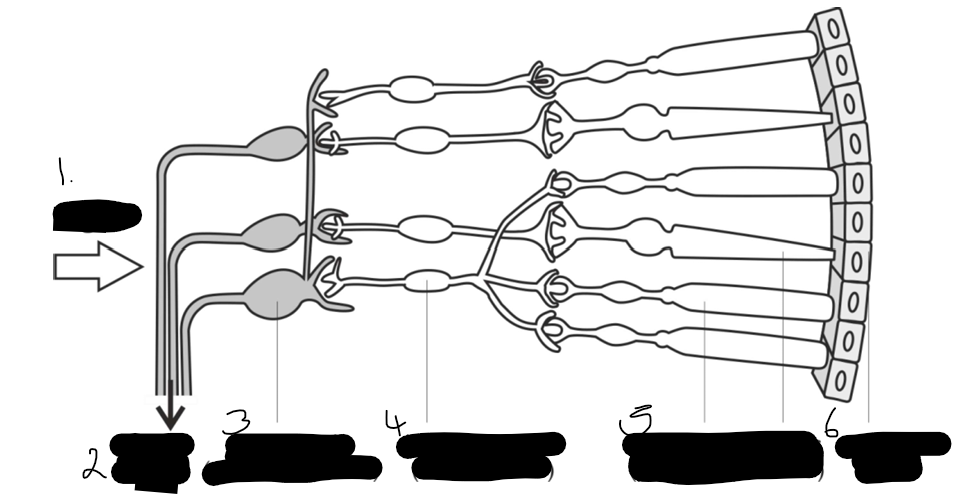
light
optic nerve
ganglion (sensory neurone)
bipolar neurones
first line rod second line cone
pigmented retina
what is a photoreceptor
these are receptors that detect light
what are the 2 types of photoreceptors
rods and cones
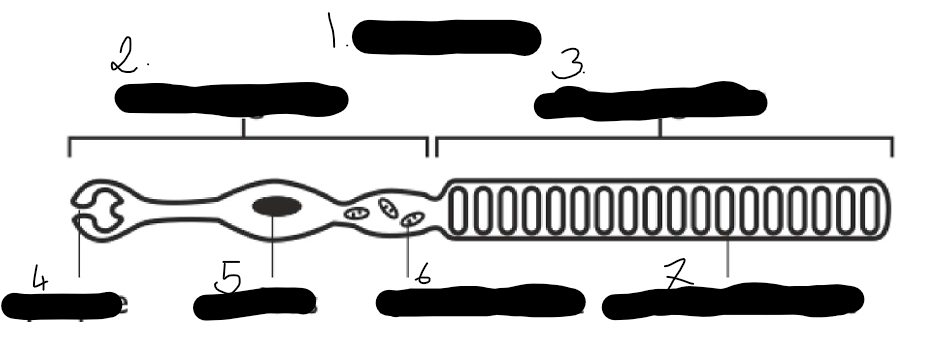
rod
inner segment
outer segment
synapse
nucleus
mitochondria
membrane disks
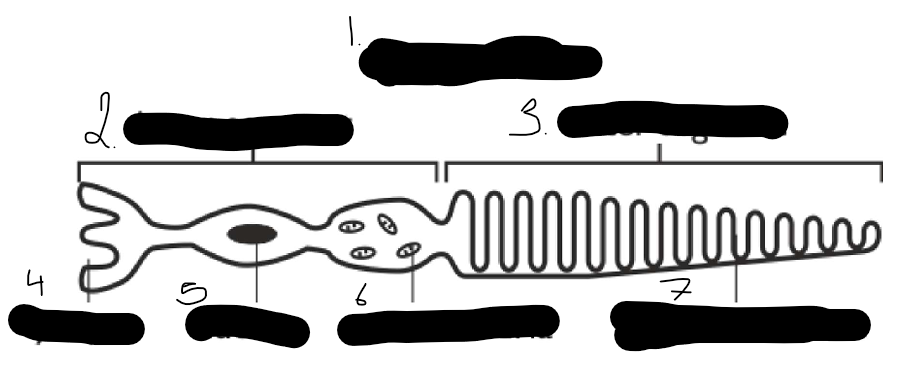
cone
inner segment
outer segment
synapse
nucleus
mitochondria
membrane disks
which has enables colour vison and which is only in black or white
rods= black or white
cones= colour vison
what is the pigment in rods
rhodopsin
what is the pigment in cones
iodopsin
In what type of cell does retinal convergence occur
rods
define retinal convergence
several rod cells converge and form a synapse with a single bipolar cell
what is the benefit of retinal convergence
In order for a generator potential to be produced in the bipolar cell a certain threshold value must be exceeded. If there are several rod cells that are stimulated at once there is a much greater chance that this threshold is reaches even in low light therefore there more sensitive
what is the process of all the stimulation from all rod cells adding together to produce a generator potential called.
spatial summation
what are other factors which make rods more sensitive
retinal convergence
the pigment rhodopsin breaks down even at low light intensity where as iodopsin is more stable
what is a limitation of retinal convergence
as many rods converge to one bipolar neurone generating a single impulse were unable to work out exactly where on the retina stimulation occurred resulting in low acuity where as each cone synapes with one individual bipolar neurone
what are the 3 types of cone
red green blue
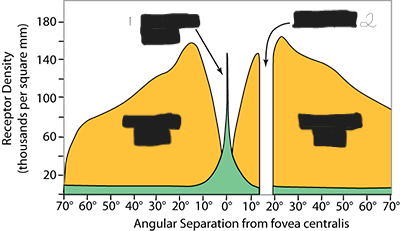
fovea = were light focused in centre of retina
blind spot = were the optic nerve is
yellow = rods
green = cones