urinary system
 Call Kai
 Learn
Learn Practice Test
 Spaced Repetition
 Match
Match Flashcards
 Knowt Play
1/12

There's no tags or description
Looks like no tags are added yet.
Name | Mastery | Learn | Test | Matching | Spaced | Call with Kai |
|---|
No analytics yet
Send a link to your students to track their progress
13 Terms
urinary system functions
maintain osmotic balance
remove waste
nephron — filtration
fluid from the blood enters the glomerulus into the bowman’s capsule
filtrate is most concentrated
nephron — reabsorption
certain filtrate components are returned from the nephron to the body
nephron — secretion
transfer of substances from the blood to the nephron to be excreted
passive transport
movement of substances from high to low concentration
does not require ATP
diffusion, facilitated diffusion, osmosis
active transport
movement of substances from low to high concentration
requires ATP
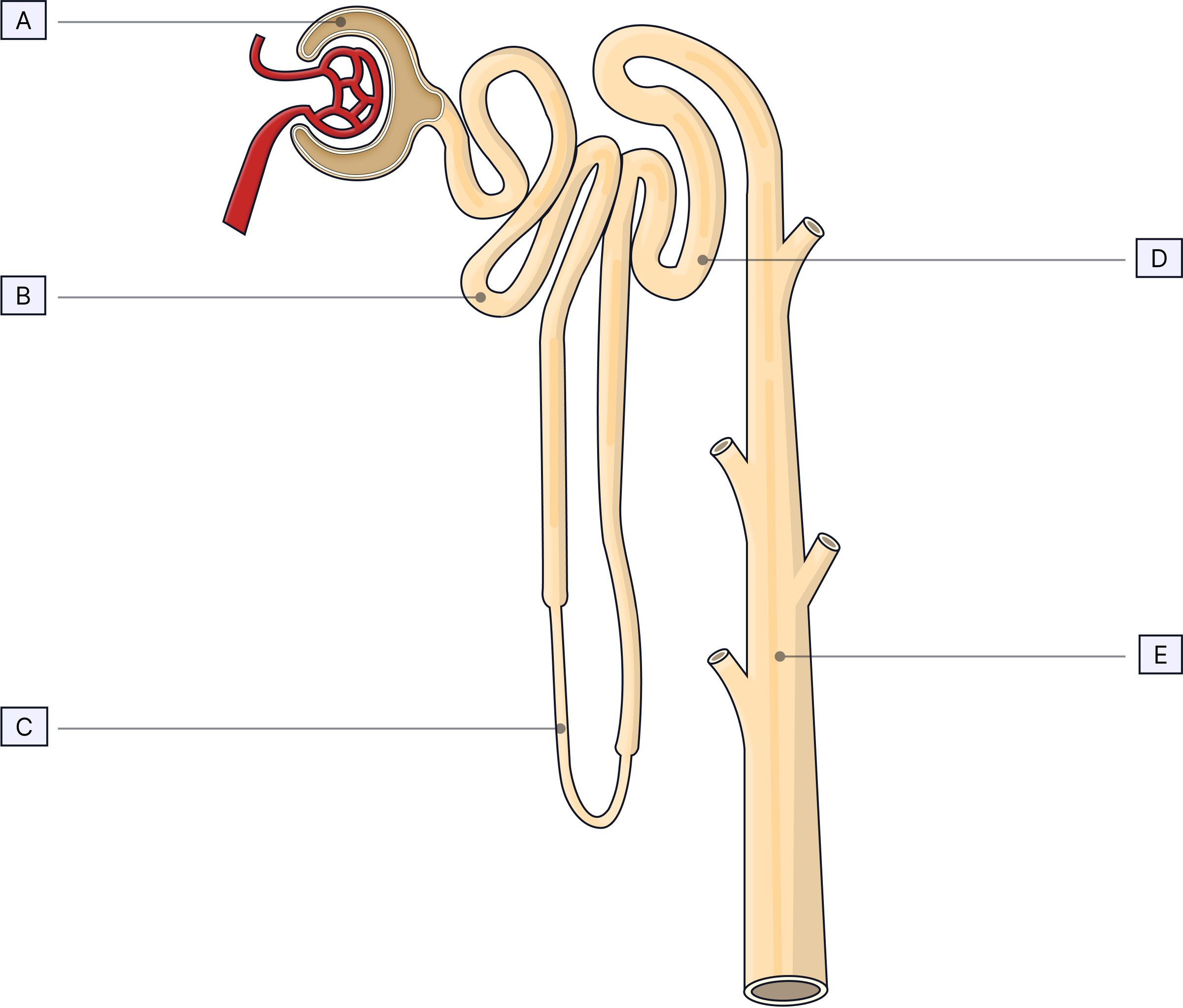
A. bowman’s capsule
B. proximal convoluted tubule
C. loop of Henle (descending & ascending)
D. distal convoluted tubule
E. collecting duct
proximal convoluted tubule
reabsorption of water, salt, and glucose
secretion of waste (hydrogen, ammonium)
descending loop of Henle
water reabsorption due to hypertonic interstitial fluid
ascending loop of Henle
salt reabsorption due to hypertonic filtrate
aquaporins
channels that regulate transport of water
found in descending loop of Henle
distal proximal tubule
reabsorption of water and salt
secretion of wate (hydrogen, ammonium)
collecting duct
reabsorption of water and salt
controlled by hormones