Clinical Massage 1
 Call Kai
 Learn
Learn Practice Test
 Spaced Repetition
 Match
Match Flashcards
 Knowt Play
1/41

There's no tags or description
Looks like no tags are added yet.
Name | Mastery | Learn | Test | Matching | Spaced | Call with Kai |
|---|
No analytics yet
Send a link to your students to track their progress
42 Terms
Describe a referral pattern
When or how pain radiates from a trigger point.
What are some descriptions a client could use to describe the referral pattern?
Radiating
Tingling
Numb
Dull
Achy
What is the intention behind clinical work?
To relieve a client’s symptoms and improve the patient’s tissue health and/or quality
What are the three physiological changes tissue will experience from clinical massage techniques?
Increased blood flow
Increased ROM
Increased lymph drainage
What is a latent trigger point?
It doesn’t fire on its own and can become an active trigger point
What is an active trigger point?
It fires on its own and has its own referral pattern
What are the Trigger Point Protocol Steps?
Press a trigger point
Reach 5.5/10 intensity
Ask for familiarity/new/traveling
Breathwork
What is the difference between a Trigger Point and a Tender Point?
Trigger Point: Has a referral pattern, usually in a distal direction
Tender Point: Does not have a referral pattern, but is tender when pressed
What is the purpose of CFF?
To spread out or separate the soft tissue fibers/adhesions from each other
What are the 5 CFF principals?
Location x 3
Consistent pressure
Therapist’s fingers and client’s skin move together as one unit across the tissue or structure
Direction
Sweep size of ½ to 1 inch
What are the 10 main muscles of the upper shoulder and back?
Trapezius, Rhomboids, Serratus Posterior Superior, Levator Scapula, Paraspinals, Subscapularis, Supraspinatus, Infraspinatus, Teres Minor, Deltoid
What are the main 5 posterior neck muscles?
Trapezius, Splenius Capitis, Posterior Cervical Muscles, Suboccipitals, Splenius Cervicis
Posterior Cervical Muscles
Semispinalis Capitis: vertical fiber direction
Semispinalis Cervicis: Vertical/oblique fiber direction
Multifidi: Oblique fiber direction
Suboccipital muscles
Rectus Capitis Posterior Major
Rectus Capitis Posterior Minor
Obliquus Capitis Superior
Obliquus Capitis Inferior
Paraspinals/Erector Spinae Medial to Lateral
Spinalis
Longissimus
Iliocostalis
Trapezius functions
Elevates shoulders
Rotates glenoid fossa upward
Draws clavicle backwards and upwards
Scapula adduction
Stabilizes scapula for glenoid fossa to rotate upward
The 4 trapezius sections
Cervical fibers
Upper fibers
Middle fibers
Lower fibers
Rhomboid sections
Rhomboid major and minor
Rhomboid functions
Adduction of scapula
Downward rotation of glenoid fossa
Assists with adduction and extension of arm by stabilizing scapula against rib cage
Serratus Posterior Superior function
Raises the ribs and helps the chest to expand
Levator scapula functions
Rotates glenoid fossa downward
Elevates scapula
Assists in rotation of the neck to the same side
BL neck extension
Paraspinals/Erector Spinae Superficial to Deep
Semispinalis
Multifidi
Rotatores
Paraspinal/Erector Spinae Muscles functions
Extend the spine
Assist with rotation of the spine
Stabilize the spine
Subscapularis functions
Medial rotation of arm at the shoulder
Adduction of the arm at the shoulder
Stabilizes the head of the humerus within the glenoid fossa
Supraspinatus function
Stabilizes the humerus head within the glenoid fossa
Abducts the arm
Infraspinatus function
Lateral rotation of the arm at the shoulder
Stabilizes the humeral head in the glenoid fossa during arm movement
Teres minor function
Lateral rotation of the arm at the shoulder
Stabilize the humeral head during movement
The deltoid has __ groups of muscle fibers. What are they?
3, anterior, medial, and posterior
Deltoid functions
Anterior: Flexion and abduction of the humerus
Medial: Abduction of the humerus
Posterior: Extension of humerus, assist abduction of arm at shoulder
What is the scientific name of “Frozen Shoulder,” and what does it mean?
Adhesive capsulitis
Loss of ROM in all directions of shoulder movement
What’s the difference between an AC joint impingement and separation
Impingement: Inflammation of bursa, swelling of tendons
Separation: Tearing of ligaments
Splenius Capitis functions and shape
Functions: Extension of head and neck, rotation of head and neck to same side
Shape: V
Splenius cervicis functions
Extension of head and neck
Rotation of head and neck to the same side
The 3 posterior cervical muscles
Semispinalis capitis
Semispinalis cervicis
Multifidi
Posterior cervical muscles functions
Semispinalis capitis and cervicis: Extension of the head
Multifidi: Extension, lateral flexion of the spine, rotation to opposite side
What are the differences between superficial and deep muscles?
Superficial: Have longer fibers, meant for bigger movements and stretching
Deep: Shorter fibers, focus on stability and movement
Suboccipital muscles lie between the ____ and ____
Occiput, C2
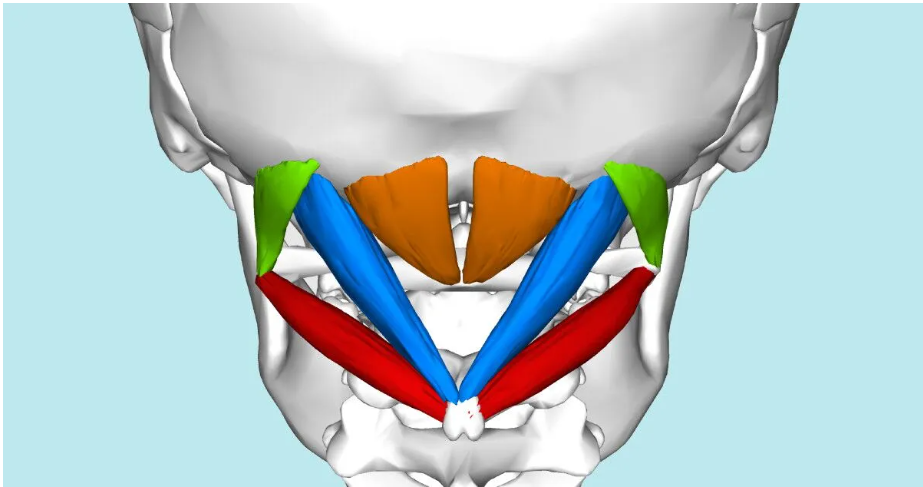
Which colors correspond with each muscle?
Orange: Rectus capitis posterior minor
Blue: Rectus Capitis Posterior Major
Green: Obliquus capitis superior
Red: Obliquus capitis inferior
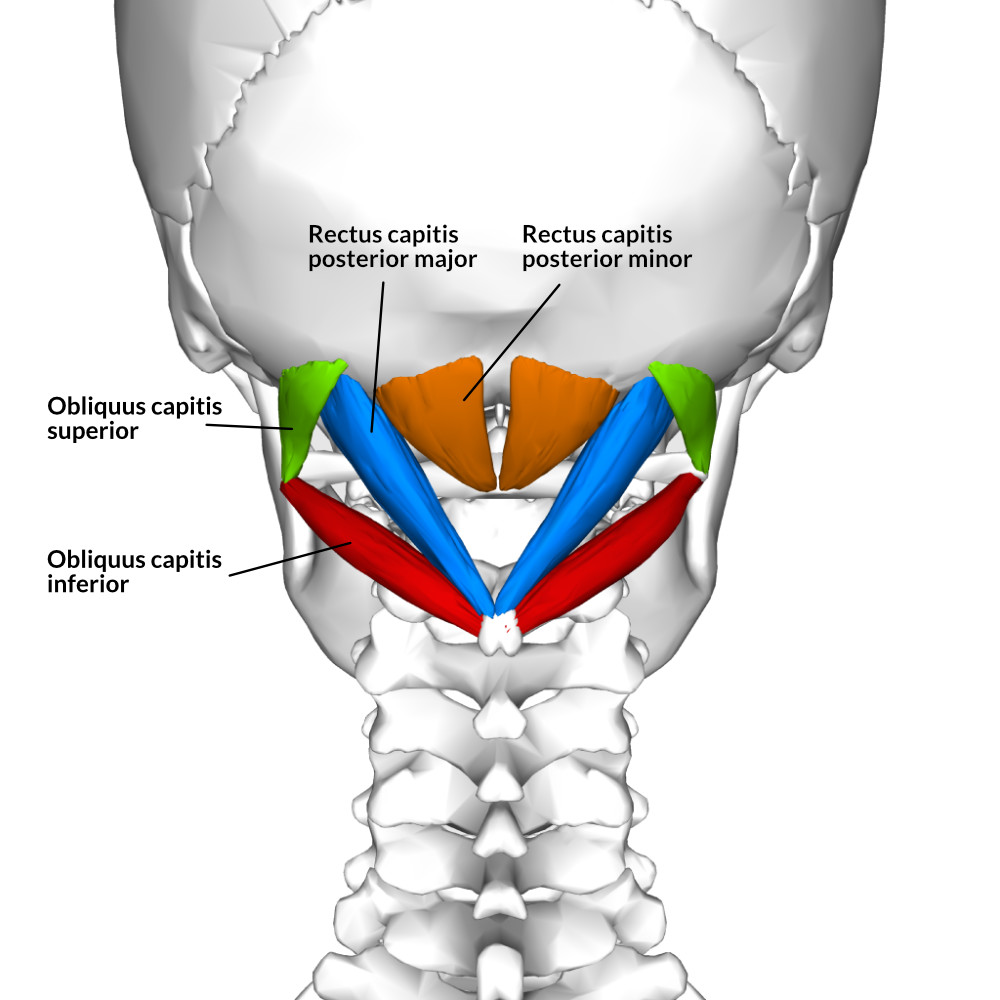
Suboccipitals functions
Occiput to C1: Flexion-Extension/Rocking
Sidebending/Tilting
C1-C2: Provides head rotation
What is the scientific name of whiplash?
Cervical Acceleration/Deceleration (CAD)
What is the scientific term of military neck?
Cervical kyphosis
Clinical Massage 1 Protocol
Fascial lift
Relaxation techniques
Thumb glide with the fibers
Thumb glide across the fibers
Thumb over thumb
Press trigger points
Cross fiber friction