Robots
 Call Kai
 Learn
Learn Practice Test
 Spaced Repetition
 Match
Match Flashcards
 Knowt Play
1/10

There's no tags or description
Looks like no tags are added yet.
Name | Mastery | Learn | Test | Matching | Spaced | Call with Kai |
|---|
No analytics yet
Send a link to your students to track their progress
11 Terms
Industrial Robots
General purpose, programmable machine that processes certain anthropomorphic characteristics
It can be programmed to perform a useful task repeatedly
Application of Robots
Material transfer and handling
Machine loading and unloading
Welding
Spray coating
Inspection
Processing operations
Assembly
Material Transfer and Handling
Material transfer applications are those in which the robot is used to move workparts from one location to another.
Examples of material transfer robot operations:
Pick & place operation
Stacking operation
Handling radioactive materials
Advantages:
Heavy, complicated and delicate jobs can be easily handled
Worker is free from repetitive tasks
Reduces material transfer idle time
Machine loading and unloading
Robot is required to supply a production machine with raw parts and/or to unload finished parts from the machine.
Advantages:
Human labour is relieved form hot and unsafe environment as in die-castings, forgings
Reduces machine loading and unloading time
Increases productivity
Welding
The applications logically divide into two basic categories, spot welding and arc welding.
Spot welding is a process in which metal parts are fused together at localized points by passing a large electric current through the two parts at the point of contact.
Several types of arc welding processes can be accomplished by industrial robots, like gas metal arc welding or MIG welding
Advantages:
Higher productivity
Improved safety and quality of work
Greater quality of product
Spray Coating
Automobile and appliances industries require the application of some form of paint.
Usually human workers apply this form of paint, the most common method is spray painting, which has many health hazards like fumes, mist, noise, fire hazard and possible cancer danger.
For these reasons, specialized industrial robots are being used more and more frequently to perform spray painting.
Advantages:
Safety of operations from hazardous environment
Lower energy consumption
Less coating material usage
Higher Productivity
Processing Operations
This is a miscellaneous category in which the robot is used to perform some manufacturing process other than welding, spray painting, assembly and inspection operation.
Operations like drilling, boring, reboring, grinding, milling, riveting, polishing, deburring, etc.
Advantages:
Increased productivity
Reduced machining time
Assembly
Included operations like parts mating, parts joining, adhesive works, crimping, etc.
Advantages:
Higher productivity
Reduced rejected parts
Less wastage of materials
Fast operations
Inspection
Traditionally inspection function has been a very labour intensive activity - slow, tedious, boring and not 100% accurate
Use of robots overcomes these problems.
Robots may use gauges or mechanical probes, optical sensors to perform dimensional checking
Six Degrees of Freedom
The purpose of the robot is to perform a useful task.
To accomplish the task, an end effector is attached to the end of the robots arm.
The robot arm must be capable of moving the end effector through a sequence of motions.
Vertical traverse
Up and down motions of the arm, caused by pivoting the entire arm about a horizontal axis or moving the arm along a vertical slide
Radial traverse
Extension and retraction of the arm (in and out movement)
Rotational traverse
Rotation about the vertical axis (right or left swivel of the robot arm)
Wrist swivel
Rotation of the wrist
Wrist bend
Up or down movement of the wrist, which also involves a rotational movement
Wrist yaw
Right or left swivel of the wrist
Additive Manufacturing
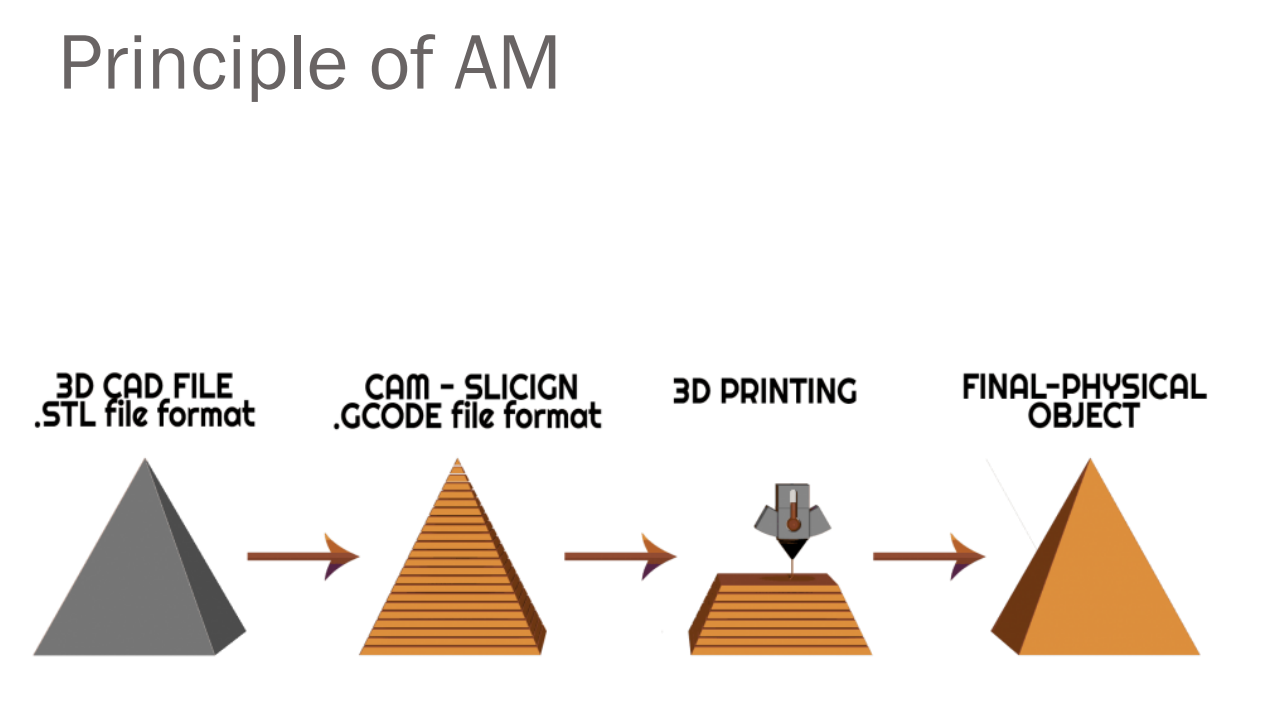
Additive manufacturing is the formalized term for what used to be called rapid prototyping and what is popularly called 3D Printing
Referred to in short as AM, the basic principle of this technology is that a model, initially generated using a 3D CAD system, can be fabricated directly without the need for process planning.
Other manufacturing processes require a careful and detailed analysis
In contrast, AM needs only some basic dimensional details and a small amount of understanding as to how the AM machine works and the materials that are used to build the part.
The key to how AM works is that parts are made by adding material in layers; each layer is a thin cross-section of the part derived from the original CAD data.
All commercialized AM machines to date use a layer-based approach, and the major ways that they differ are in the materials that can be used, how the layers are created, and how the layers are bonded to each other.
Such differences will determine factors like the accuracy of the final part plus its material properties and mechanical properties.