Intelligence (Psych 001) - Andrew Ward
 Call Kai
 Learn
Learn Practice Test
 Spaced Repetition
 Match
Match Flashcards
 Knowt Play
1/38

There's no tags or description
Looks like no tags are added yet.
Name | Mastery | Learn | Test | Matching | Spaced | Call with Kai |
|---|
No analytics yet
Send a link to your students to track their progress
39 Terms
intelligence
the ability to learn from experience, solve problems, and use knowledge to adapt to new situations
general intelligence (g factor)
according to Spearman and others, underlies all mental abilities and is therefore measured by every task on an intelligence test
fluid intelligence (Gf)
our ability to reason speedily and abstractly; tends to decrease during late adulthood
- mind is sharp
crystallized intelligence (Gc)
our accumulated knowledge and verbal skills; tends to increase with age
- developed skillz
Cattell-Horn-Carroll (CHC) Theory
the theory that our intelligence is based on g as well as specific abilities, bridged by Gf and Gc
crystalized (acquired), fluid (problem-solving & adaptability), other abilities (visual & auditory processing, memory, speed of processing, reaction time, quantitative skills, and reading-writing skills)
savant syndrome
a condition in which a person otherwise limited in mental ability has an exceptional specific skill, such as in computation or drawing
analytical (academic problem-solving) intelligence
assessed by intelligence tests, which present well-defined problems having a single right answer
predict school grades reasonably well and vocational success more modestly
creative intelligence
demonstrated in innovative smarts: the ability to adapt and generate novel ideas
practical intelligence
required for everyday tasks, which may be poorly defined, with multiple solutions
triarchic theory of intelligence
Robert Sternberg's theory that describes intelligence as having analytic, creative, and practical dimensions
emotional intelligence
the ability to perceive, understand, manage, and use emotions
percieving emotions
recognizing emotions in faces, music, and stories; identifying one's own emotions
understanding emotions
predicting emotions and how they may change and blend
managing emotions
knowing how to express them in varied situations, and how to manage others' emotions
using emotions
to facilitate adaptive or creative thinking
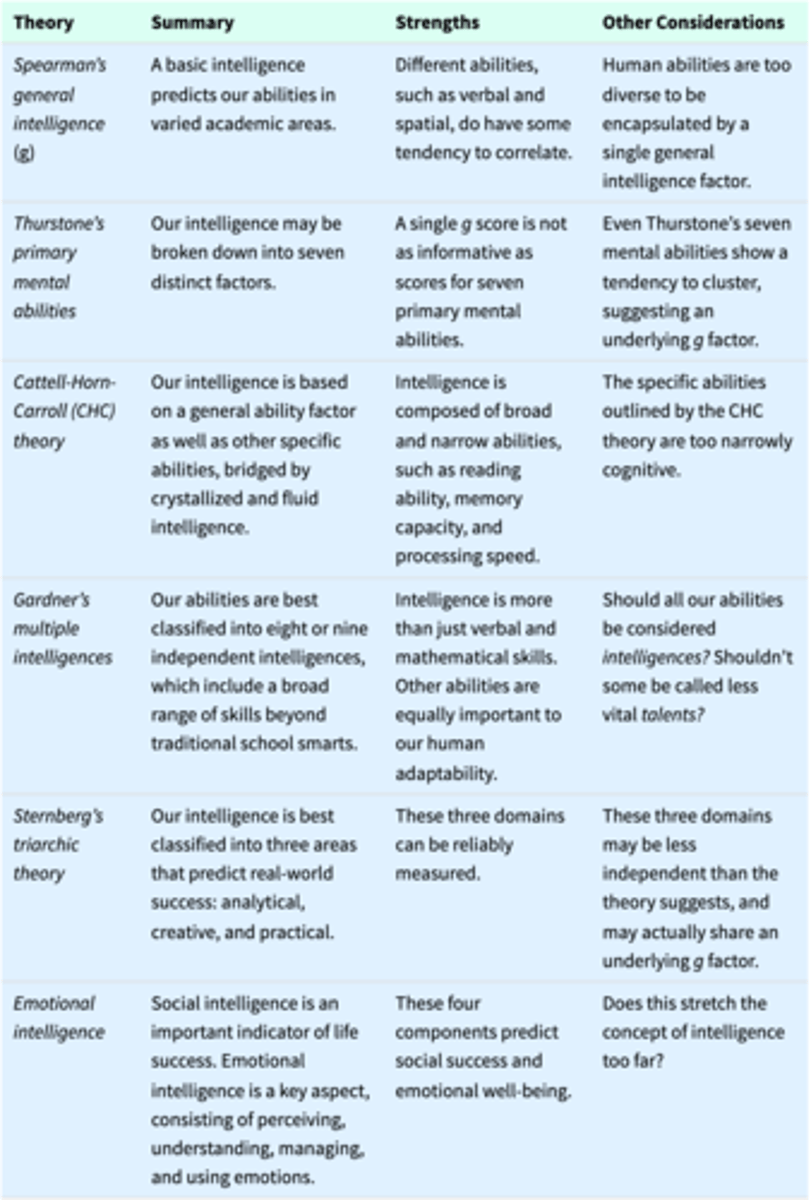
comparing theories of intelligence
(Theory: Summary, Strengths, Other Considerations)
Spearman's general intelligence (g): A basic intelligence predicts our abilities in varied academic areas. Different abilities, such as verbal and spatial, do have some tendency to correlate. Human abilities are too diverse to be encapsulated by a single general intelligence factor.
Gardner's multiple intelligences Our abilities are best classified into eight or nine independent intelligences, which include a broad range of skills beyond traditional school smarts. Intelligence is more than just verbal and mathematical skills. Other abilities are equally important to our human adaptability. Should all of our abilities be considered intelligences? Shouldn't some be called less vital talents?
Sternberg's triarchic theory Our intelligence is best classified into three areas that predict real-world success: analytical, creative, and practical. These three domains can be reliably measured.
1. These three domains may be less independent than Sternberg thought and may actually share an underlying g factor.
2. Additional testing is needed to determine whether these domains can reliably predict success.
Emotional intelligence Social intelligence is an important indicator of life success. Emotional intelligence is a key aspect, consisting of perceiving, understanding, managing, and using emotions. The four components that predict social success. Does this stretch the concept of intelligence too far?
intelligence test
a method for assessing an individual's mental aptitudes and comparing them with those of others, using numerical scores
achievement test
a test designed to assess what a person has learned
eg. this lovely exam
aptitude test
a test designed to predict a person's future performance; aptitude is the capacity to learn; thinly disguised intelligence test
eg. entrance exam; SAT
Francis Galton
interested in link between heredity and intelligence; founder of the eugenics movement
mental age
a measure of intelligence test performance devised by Alfred Binet and Theodore Simon; the chronological age that most typically corresponds to a given level of performance
Stanford-Binet
the widely used American revision (by Terman at Stanford University) of Binet's original intelligence test.
intelligence quotient (IQ)
defined originally as the ratio of mental age (ma) to chronological age (ca) multiplied by 100 [thus, IQ = (ma/ca) x 100]. On contemporary intelligence tests, the average performance for a given age is assigned a score of 100.
Wechsler Adult Intelligence Scale (WAIS)
the most widely used intelligence test; contains verbal and performance (nonverbal) subtests
- similarities: reasoning the commonality of two objects or concepts
- vocabulary: naming pictured objects, or defining words
- block design: visual abstract processing
- letter-number sequencing: on hearing a series of numbers and letters, repeating the numbers in ascending order, and then the letters in alphabetical order
standardization
defining uniform testing procedures and meaningful scores by comparison with the performance of a pretested group
normal curve
the bell-shaped curve that describes the distribution of many physical and psychological attributes. Most scores fall near the average, and fewer and fewer scores lie near the extremes
Flynn effect
The rise in average IQ scores that has occurred over the decades in many nations
ppl are getting smarter over time on avg
Reliability
the extent to which a test yields consistent results, as assessed by the consistency of scores on two halves of the test, on alternate forms of the test, or on retesting
validity
the extent to which a test measures or predicts what it is supposed to
predictive validity (criterion-related validity)
the success with which a test predicts the behaviour it is designed to predict; it is assessed by computing the correlation between test scores and the criterion behavior.
cross-sectional study
research that compares people of different ages at the same point in time
longitudinal study
research in which the same people are restudied and retested over a long period
cohort
a group of people sharing a common characteristic, such as from a given time period
hertiability
The proportion of variation among individuals that we can attribute to genes. The heritability of a trait may vary, depending on the range of populations and environments studied.
H = genes/(genes+environment)
Carol Dweck's Self-Theory of Motivation
The need for achievement is closely linked to personality factors including a person's view of how self can affect the understanding of how much a person's actions can influence his or her success
growth mindset
a focus on learning and growing rather than viewing abilities as fixed
believe in yourself!
stereotype threat
a self-confirming concern that one will be evaluated based on a negative stereotype
eg. black ppl do better on test administered by black teacher than same test from white teacher
Rosenthal effect
the result when an experimenter's preconceived idea of appropriate responding influences the treatment of participants and their behavior
PKU
avoid amino acid
can change effects by changing environment!