Parasites, bites, and stings
 Call Kai
 Learn
Learn Practice Test
 Spaced Repetition
 Match
Match Flashcards
 Knowt Play
1/54

There's no tags or description
Looks like no tags are added yet.
Name | Mastery | Learn | Test | Matching | Spaced | Call with Kai |
|---|
No analytics yet
Send a link to your students to track their progress
55 Terms
Examples of Parasites, Bites, and Stings
Parasites: Lice, Scabies
Bites: Ticks, Mosquitoes
Stings: Bees, Wasps, Hornets
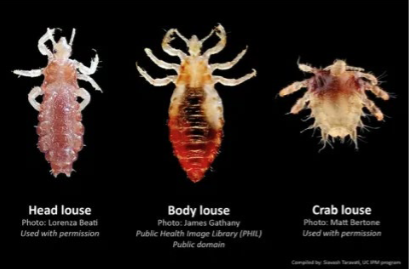
Lice Presentation
Head Lice: Found on the hair of head, may also be present in the beard, eyelashes, etc.
Body Lice: Found on the clothing, lay eggs on or near seams of clothing, move to skin to feed
Public Lice: Found on the hair around the genitals
Lice Symptomology
Initially asymptomatic
As louse multiply, patient may experience tickling feeling from hair movement
Often progresses to severe itching
Severe infestations may be associated with the presence of pruritic lesions and macules
Lice Prevention
Do not share clothing (hats, coats) or hair accessories (combs, brushes, hair bows)
Avoid head to head contact during play and other acitivities
Do not lie on beds, couches, pillows, carpets, or stuffed animals that have recently been in contact with a person infested with head lice
Lice Nonpharmacologic treatment
Manual removal of lice/nits with fine-tooth comb - should be used in combination with all OTC and RX treatment options
No evidence that suffocating lice with mayo, olive oil, margarine, butter, or similar substances is an effective treatment form
Essential oils: Rosemary, citronella, peppermint, and eucalyptus oil have shown to be off putting and potentially toxic to lice
Several OTC brands that provide “natural” remedies for the prevention and treatment of lice infestations
Additional prevention/nonpharmacologic treatment of lice
Disinfect brushes and combs of infected person by soaking them in hot water (at least 130 F) for 5 to 10 minutes
Machine wash and dry clothing, towels, bed linens, and other items in hot water and high heat dry
Seal items that cannot be washed in a plastic bag or sealed container for two weeks
Vacuum the floor and furniture where infested person sat or lay
Fumigant sprays or fogs not necessary or helpful
Permethrin
Nix, OTC
Available as lotion (1%), cream (1%), and liquid rinse (1%)
1st line treatment option for lice
For children over 2 months
Drug choice in pregnancy
Only kills live lice, not nits, use on public lice is considered off label
Permethrin (Nix) dosing and safety
Used to kill live lice (OTC)
Head Lice:
Wash hair with conditioner free shampoo prior to use and towel dry
Apply enough to thoroughly coat all dry hair and scalp
Leave for 10 minutes; rinse with warm water
Remove nits with comb
Repeat in 7 days
Public Lice:
Apply to the affected area
Leave for 10 minutes, rinse with warm water
ADEs: Topical irritation (burning sensation, skin rash)
Pyrethins + Puperonyl butoxide
RID, available as shampoo (0.33% / 4%), (OTC)
Made from chrysanthemum plants - avoid in allergy
For children over 2 years old
Only kills live lice, not nits
Pyrethins + Puperonyl butoxide (RID) dosing and safety
Used to kill live lice (OTC)
Head lice:
Apply enough to thoroughly coat all dry hair and scalp
Leave for 10 minutes
Wash and dry hair
Repeat in 7 days
ADEs: Topical irritation (burning sensation, skin rash)
Ivermectin
Sklice, available as lotion (0.5%) and cream (0.5%), (OTC)
For children > 6 months
Kills lice and nits
Ivermectin (Sklice) dosing and safety
Kills lice and nits (OTC)
Head lice:
Apply enough thoroughly coat all dry hair and scalp
Leave for 10 minutes
Rinse hair with water only
Wat 24 hours before using shampoo; single use only*
ADEs: Topical irritation (burning sensation, skin rash)
Spinosad
Used for lice (Rx)
Natroba, available as suspension (0.9%),
Can only be used in children greater than 6 months old
Spinosad (Natroba) dosing and safety
Head Lice (RX):
Apply enough to thoroughly coat all dry hair and scalp
Leave for 10 minutes; rinse with warm water
If lice are seen within 7 days, re-apply
ADEs: Topical irritation (burning sensation, skin rash)
Malathion
Used for Lice (Rx)
Ovide, available as (0.5%) lotion
Can only be used in children over 2 years old, contains large amounts of alcohol
Do not use hairdryer on hair after use
Malathion (Ovide)
Head lice (Rx):
Apply enough to thoroughly coat all dry hair and scalp
Leave on 8-12 hours (typically overnight)
Shampoo hair after completion
Can be repeated in 7-9 days
ADEs: Topical irritation (burning sensation, skin rash)
Lindane
Used for lice (Rx)
Available as Lotion (1%) and shampoo (1%)
Reserved for last line treatment
Should only be used in patients who cannot tolerate or have failed first-line treatments
Lindane dose and safety
Head lice (Rx):
Apply to dry hair and massage for 4 minutes
Add small amount of water until later forms
Rinse hair thoroughly
Do not re-treat
ADEs: BBW - Neurotoxicity
CI: patients with seizure disorders
Use with caution in children, elderly, and patients with skin conditions
Ivermectin
Used for lice, scabies) (Rx)
Stromectol, available as tablets (3mg)
Used i n topical refractory cases, labeled for use in adults but not children
Round doses to nearest tablet size (no max dose)
Caution in children < 15 kg and in pregnancy
Not ovicidal
Topical ivermectin is not used in scabies treatment)
Ivermectin (Stromectol) dose and safety (Lice)
Head Lice:
200 mcg/kg/dose x2 doses given 7-14 days apart
Public Lice:
Same as head lice
ADEs: Joint pain, tachycardia, diarrhea, elevated hepatic enzymes
CNS effects (neurotoxicity, confusion)
Scabies Presentation
Pruritic papules, vesicles, or burrow lesions found frequently between toes/fingers, palms, and genital areas.
Symptoms may take 3 to 6 weeks to appear if someone has never had scabies prior
Diagnosis: Skin scrapings evaluated on a wet mount
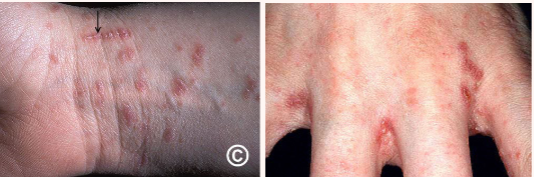
Scabies symptomology
Severe itching (often impacts sleep)
Excoriations in the interdigital spaces, wrists, elbows, buttocks, and groin
Burrows formed by the mite are visible to the naked eye
Scabies prevention
Avoid skin-to-skin contact - can be transmitted even when asymptomatic
Avoid sharing items like clothing and bedding
Wash all clothing, towels, bedding, and other items used by someone who has scabies in hot water.
Permethrin
Used for scabies (Rx)
Elimite, Available as cream (5%)
1st line treatment for scabies, labeled for children over 2 months
1 application is generally curative (need about 30 g per adult)
Limited data on ovicidal activity
Permethrin (Elimite) dosing and safety
Directions (for scabies, Rx):
Scrub skin in warm water with soap using a soft brush to remove all scabs
After bathing and drying off - apply lotion to the entire body
Avoid mucous membranes, eyes, and the face
Leave the application for 8-14 hours and then shower as normal
Repeat the process in 2 weeks
ADEs: Topical irritation
Crotamiton
Used to treat scabies (Rx)
Eurax, available as cream (10%), lotion (10%)
1st line treatment if patient has a permethrin allergy
Not labeled for use in children but can be used in older than 2 months.
Crotamiton (Eurax) dosing and safety
Directions (for scabies, Rx):
Apply a thin layer from neck to toes
Repeat application in 24 hours
Rinse off 48 hours after 2nd application
May repeat in 2-4 weeks if new lesions appear or itching persists
ADEs: Topical irritation
Tick Bites Presentation
Bites are often not felt/painless
Evidence of envenomation may not appear for several days
Lyme disease typically manifests as a “target rash” or “bull’s-eye rash”
RMFS as petechial spots usually on wrists and ankles
Tick Bites Symptomology
Fever/chills
Aches/pains
Rash
Headache
Malaise
Tick Bites Prevention
Wear clothing that covers majority of skin when outdoors in wooded areas or areas with high grass
Treat clothing/gear with 0.5% permethrin
Use environmental protection agency (EPA) - registered insect repellants (i.e., DEET)
Check clothing and body for ticks after being outdoors
Rocky Mountain Spotted Fever
Most common tickborne disease in Oklahoma
Mosquito Bites Presentation
Small, raised bumps on the skin caused by a reaction to the saliva injected into the skin by the mosquito
Can also appear as hard blisters
Mosquito Bite Symptomology
Itching, swelling, erythema, fever, hives
Mosquito Bite Prevention
Wear clothing that covers majority of skin when outdoors in wooded areas or areas with high grass
Treat clothing/gear with 0.5% permethrin products
Use EPA-Registered insect repellants (i.e. DEET)
Avoid standing water
DEET
Topical insect repellant for ticks and mosquitos
Sprays, lotions, liquids, towelettes (5-99%)
DEET Protection time and Pearls
<10 hours (% DEET is related to protection time)
Avoid combined products with sunscreen
Products >50% DEET should be applied to clothing only
Max 30% DEET for Children
Can damage plastics
Picardin indication
Topical insect repellant used for ticks and mosquitos
Available as sprays, lotions (20%)
Picardin Protection time and pearls
Less than or equal to 14 hours
Alternative to DEET, less toxicity
Does not damage plastics
Avoid in children <2 years of age
IR 3535 Indication
Topical insect repellant for mosquitos
Available as spray, aerosol, towelette, lotion (7.5-20.5%)
IR 3535 Protection time and Pearls
<4-8 hours
Can cause eye irritation
Avoid combined products with sunscreen
Slightly less effective than DEET, but preferable because lacks strong odor
Oil of Citronella Indication
Topical insect repellant for mosquitos
Available as spray, lotion
Oil of Citronella Protection Time and Pearls
<2 hours
Avoid use in children <6 months of age
Less effective
Oil of Lemon Eucalyptus
Topical insect repellant for mosquitos
Available as spray (30%)
Oil of Lemon Eucalyptus Protection time and Pearls
<4-6 hours
Can cause allergic skin reactions
Can cause eye irritation
Avoid use in children < 3 years of age
Stings Presentation
Local: Pain erythema, edema, hives
Toxic: Results of multiple stings, anaphylactic-type reaction with nausea, vomiting, diarrhea
Anaphylaxis: Severe systemic reaction with hypotension and airway constriction, can be fatal
Delayed: Occurs 5-14 days after sting, general malaise
Stings Symptomology
Wheal-and-flare reaction
Edema
Erythema
Sharp pain
Itching
Stings prevention
Wear light-colored clothing that covers exposed areas of skin
Avoid sweet perfumes, shampoos, and deodorants
Cover open food and drinks when outside
Strings Treatment
Wash the area with soap and water
Remove stinger if able
Apply ice to help with swelling
NSAIDs if the patient is experiencing pain/swelling
Anaphylaxis Symptoms
Wheezing, diminished breath sounds, hives, angioedema, hypotension
Anaphylaxis Treatment
First Line: Epinephrine - Increased risk of poor outcomes when not given within 20 minutes of initial reaction, often underused and underdosed
MOA: Increases peripheral vascular resistance, increases cardiac contractility, stroke volume, output, reverses bronchoconstriction and mucosal edema
Additional therapies: Antihistamines (diphenhydramine) - Symptom management, always given after epinephrine adminstration
Steroids - Commonly given, however, limited data showing effectiveness
Epinephrine Options (outpatient)
Autoinjector:
Epi-pen (0.3 mg/0.3 mL)
Epi-pen Junior (0.15 mg/0.3 mL)
Auvi-Q (0.1mg/0.1 mL, 0.15mg/0.15mg, 0.30mg/0.30mL)
Nasal Spray: Neffy (1 mg, 2 mg)
Epinephrine Dosing and safety (outpatient)
Autoinjector:
Patients greater than 30 kg: 0.3 mg IM injection
Patients 15 to >30 kg: 0.15 mg IM injection
Patients 7.5 to >15 kg: 0.1 mg IM injection
Nasal Spray:
15 to <30 kg: 1 mg
>30 kg: 2 mg
Tachycardia, hypertension, arrhythmia, anxiety, restlessness
Nasal Spray: Headache, nasal congestion, rhinorrhea, sneezing
Epinephrine (outpatient) Pearls
Patients with severe allergic reactions should always have 2 Epi-Pens available for use
May repeat dose in 5 to 15 minutes
Can be injected through clothing
NO absolute contraindication to epinephrine use to anaphylaxis
Epinephrine options (Inpatient) and dosing
Vial (1 mg/mL)
Prefilled syringe (0.1 mg/ mL)
Adults: 0.3-0.5 mg IM every 15 minutes until resolution of symptoms
Pediatrics: 0.01 mg/kg every 15 minutes until resolution of symptoms
Epinephrine Safety and pearls (Inpatient)
ADEs: Tachycardia, hypertension, arrythmia, anxiety, restlessness
Pearls: May repeat every 5 minutes, no absolute CI in anaphylaxis,
Vesicant - extravasation may cause ischemic necrosis