1.4.4 Motivation in theory and practice
 Call Kai
 Learn
Learn Practice Test
 Spaced Repetition
 Match
Match Flashcards
 Knowt Play
1/27

There's no tags or description
Looks like no tags are added yet.
Name | Mastery | Learn | Test | Matching | Spaced | Call with Kai |
|---|
No analytics yet
Send a link to your students to track their progress
28 Terms
Job enrichment
Giving an employee more responsible tasks
Job enlargement
Giving an employee work of a similar responsibility to do
Job rotation
Moving an employee round similar tasks
Team working
Employees in small groups with a similar aim
Productivity
Output per person that is a measure of efficiency
Division of labour
Sub-dividing a task into a number of activities, enabling workers to specialise and so become very efficient at completing what may be a small repetitive task
Hygiene factors
Everything that surrounds what you do in the job, such as pay, working conditions and social status; all are potential causes of dissatisfaction, according to Herzberg
Job satisfaction
The extent to which employees feel satisfies, motivated, and fulfilled by their work
Piece-rate pay
Pay workers per piece they produce
Trade union
An organisation that represents the interests of staff at the workplace
Delegation
The passing of authority (but not responsibility) for a task down to junior staff
Flexitime
A system of working a set number of hours with the starting and finishing times chosen within agreed limits by the employee
Kaizen
A Japanese philosophy referring to business activities that continuously improve all function and involve all employees from the CEO to the assembly line workers
Motivation
Motivation refers to the inner desire of willingness that propels a person to take action and achieve a specific goal or outcome
What is the effect of motivation?
Motivated employees are more productive and efficient, as they are more likely to be engaged in their work and take the initiative to meet or exceed their goals, they will generate higher levels of output and quality, increased productivity results in higher profits for the business
Motivated employees are more likely to be reliable and dependable, they take pride in their job, show up on time, meet deadlines and take fewer sick days, leads to increased trust between the business and its employees as well as higher productivity
Motivated employees are more likely to stay with the company long-term, which reduces the turnover rate, lower turnover rates reduce the need for costly recruitment and training
Quality circles
A group of employees who meet regularly to consider ways of resolving problems and improving production in their organisation
Remuneration
Renumeration is the total amount an employee receives for performing a job, including salary and all other monetary benefits
What is Taylor’s Sicentific Management?
Focuses on breaking down complex tasks into simpler ones, standardising work processes and providing workers with clear instructions and training to achieve maximum efficiency
Study and analyse the work processes (break down complex tasks into simpler ones, and identify the most efficient and effective way to perform each task)
Standardise the work process (creating detailed procedures and instructions for each task so that workers can follow these procedures consistently)
Select and train the workers (workers should be carefully selected based on their skills and abilities, train workers to perform their tasks efficiently and effectively, including technical skills and proper attitudes and behaviours required to be successful)
Provide incentives for performance (scientific management emphasises the use of incentives to motivate workers, this may include bonuses or piece rate pay)
How do businesses use Taylor’s Scientific Management?
Workers are trained to perform only one task, which they become very skilled at
Workers are usually only paid for the competed work (piece-rate pay)
Advantages of Taylor’s Scientific Management
Increased efficient, which lowers costs
Standardised procedures for work processes that everyone follows can help reduce errors and inconsistencies
Specialisation of labour leads to greater efficiency and productivity
Clear hierarchy and lines can lead to more efficient decision-making and communication
Improved training and development can lead to better performance and job satisfaction
Disadvantages of Taylor’s scientific management
Overemphasis on efficiency reduces worker satisfaction and creativity
Workers may disengage from work if they are reduced to working in a machine-like system
Limited applicability, as this approach may not work for roles that require high levels of creativity, problem-solving or interpersonal skills
Potential for exploitation as this approach may be used to extract more work from workers without compensating them fairly
What is Mayo’s Human Relations Theory?
It focuses on the importance of social factors in the workplace
These include factors such as communication, motivation and job satisfaction
The key to improving productivity and job satisfaction lies in understanding and improving the relationships between workers, supervisors and management
How can businesses use Mayo’s Human Relations Theory?
Empowering employees in decision making (e.g creating teams that decide their own priorities)
Team-building activities are used to build relationships
Providing feedback and recognition to employees
Creating a positive work environment by promoting open communication and providing support to employees
Encouraging employee development by offering training programmes, mentorship opportunities and career advancement paths
Advantages of Mayo’s Human Relations Theory
Improved job satisfaction
Increased productivity as workers feel valued and supported
Better communication-workers value open and honest communication, which reduces misunderstandings and conflicts
Employee empowerment increases workers’ sense of ownership and responsibility
Stronger teams as there is a sense of community and team spirit
Disadvantages of Mayo’s Human Relations Theory
Time consuming as building positive relationships requires time and effort
Lack of control as workers make more decisions
Resistance to change - some workers and managers may be resistant to the changes required by Mayo’s theory
Potential for conflict as attempts to build stronger relationships can also lead to conflicts and disagreements
Limited applicability as it may not work for businesses that require a high degree of individual autonomy and independence
What is Maslow’s Hierarchy of Needs?
Maslow’s hierarchy of needs is a theory of human motivation that outlines five tiers of human needs that must be met for individuals to reach their full potential
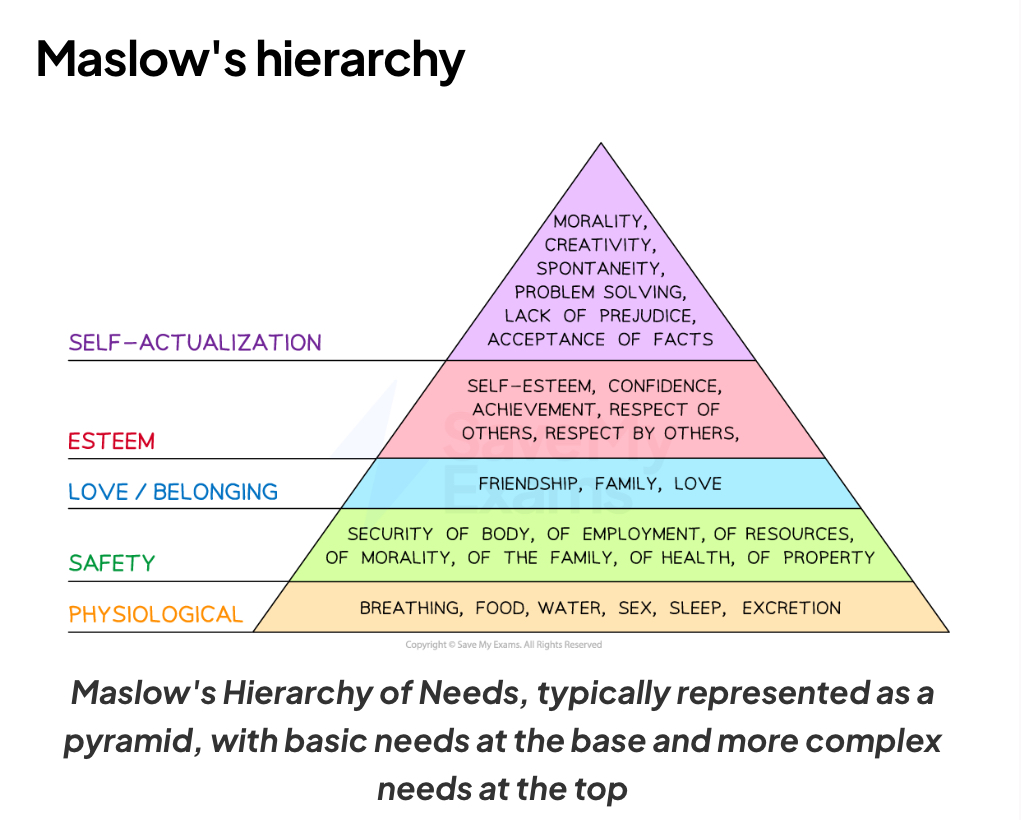
How can a business apply Maslow’s Hierarchy of Needs?
Physiological needs
Businesses can provide necessities for their employees
E.g a comfortable work environment, access to clean water and food and adequate rest breaks
Safety Needs
Businesses can provide job security, fair pay, benefits and safe working conditions for their employees
Love and belonging
Businesses can encourage teamwork and generate a sense of community within the workplace
Estes needs
Businesses can provide recognition for employees’ accomplishments and provide a positive work culture that values individual contributions
Self-actualisation needs
Businesses can help employees achieve this needs by offering opportunities for employees to pursue their passions and interests