Food Tech Exam Revision
 Call Kai
 Learn
Learn Practice Test
 Spaced Repetition
 Match
Match Flashcards
 Knowt Play
1/78

Earn XP
Description and Tags
Name | Mastery | Learn | Test | Matching | Spaced | Call with Kai |
|---|
No analytics yet
Send a link to your students to track their progress
79 Terms
What are the macronutrients?
Protein, Carbohydrates, Fat.
What are the micronutrients?
Vitamin A, Vitamin B, Vitamin C, Vitamin D, Vitamin E, Vitamin K.
What are water soluble vitamins?
Vitamin Bs and C.
What are fat soluble vitamins?
Vitamin A, Vitamin D, Vitamin E, Vitamin K.
What are the functions of protein?
growth (more for pregnancy and adolescents
to repair body cells
to produce enzymes needed for digestion
to produce hormones that control body functions
What are sources of protein?
Meat, fish, dairy products, pulses, lentils
What is HBV and LBV of protein?
HBV: contains all essential amino acids (steak) - indispensable
LBV: lack one essential amino acids: (beans, rice) - dispensable
What are symptoms of deficiency and excess of protein?
Deficiency:
Marasmus - infants under 1. happens if weaned too soon.
Kwashiorkor - occurs in children weaned off to quickly onto a diet in starchy foods and that are low in energy and protein.
Excess:
any spare protein will be stored or used for energy.
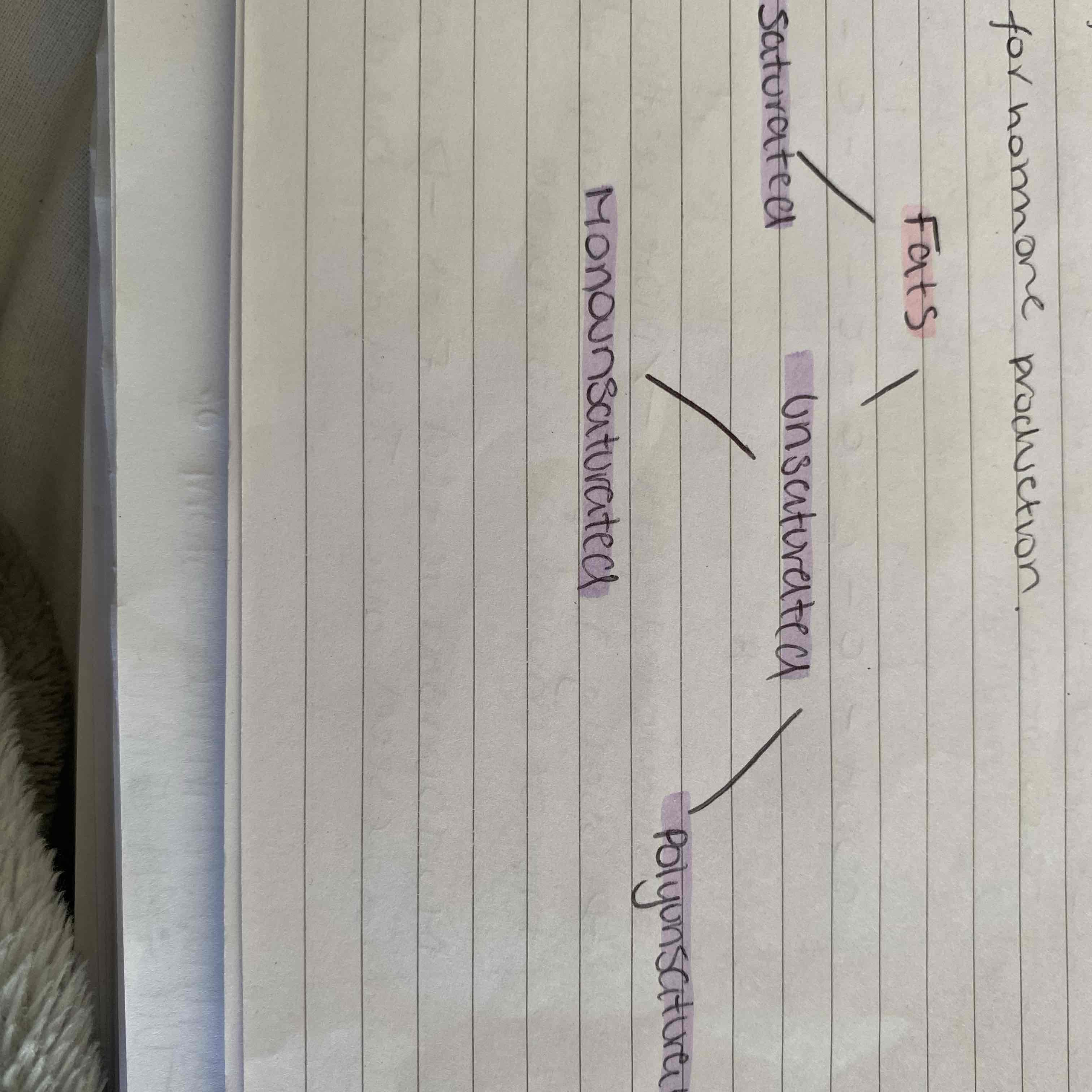
What is fat?
They provide us with energy and essential vitamins, protects vital organs, important for human proudction.
Excess: obesity, type 2 diabetes, heart disease.
What is a carbohydrate?
A macronutrient, that is made up of carbon, hydrogen and oxygen.
Provides energy, glucose oxidised in body’s cells and energy is released.
2 groups in carbohydrates what are they?
Starch (foods include bread, rice, pasta)
Sugar (milk, fruit, veg, honey)
(major sources of energy)
Carbohydrates are seperated into 3 groups, what are they?
Monosaccharides
Disaccharides
Polysaccharides
What are monosaccharides?
C6H12O6
found in fructose(cherries), glucose(molase), galactise(yogurt)
What is disaccharides?
Formed by 2 monosaccharides
C12H22O11
examples: sucrose, lactose, maltose.
What are polysaccharides?
made up of many monosaccharides
(C6H10O5)n
for example: starch, glycogen, cellulose, pectin.
What is fat?
a macronutrient that helps body keep warm, provide essential fatty acids.
Functions: helps to protect organs e.g kidney, provides a source of fat soluble vitamins, contains the essential amino acid omega 3 and 6.
What are the two types of fats?
Visible: can see it, fat on meat, butter on bread.
Invisible: can’t see it, milk, mayo, crisps, biscuits.
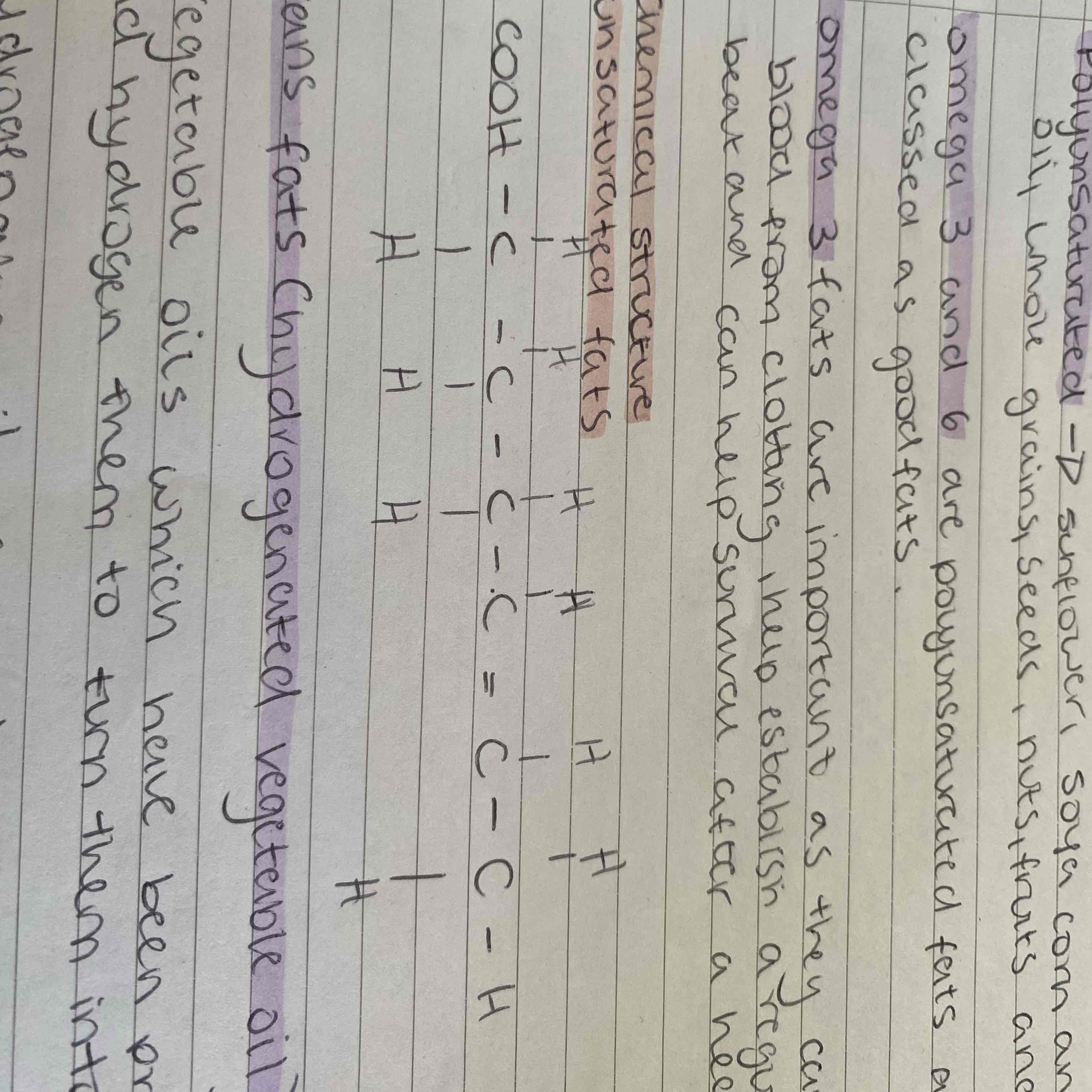
What are the different types of fats?
Saturated: least healthy, (butter, processed meats, sweet foods)
Unsaturated: more healthy, help to promote the healthier type of cholesterol in our blood.
Monosaturated: In olives, nuts, oils. One double bond.
Polyunsaturated: oils, nuts, fruit and veg.
Omega 3 and 6: are polyunsaturated fats and are classed as good fats
Omega 3: are important as they can help prevent blood from clotting, help establish a regular heart beat and can help survival after a heart attack.
Trans Fats: used in products such as cakes, biscuits, and convenience foods. Vegetable oils which have been processed to add hydrogen them to turn them into a solid. Hydrogenation makes fats less healthy like saturated fats.
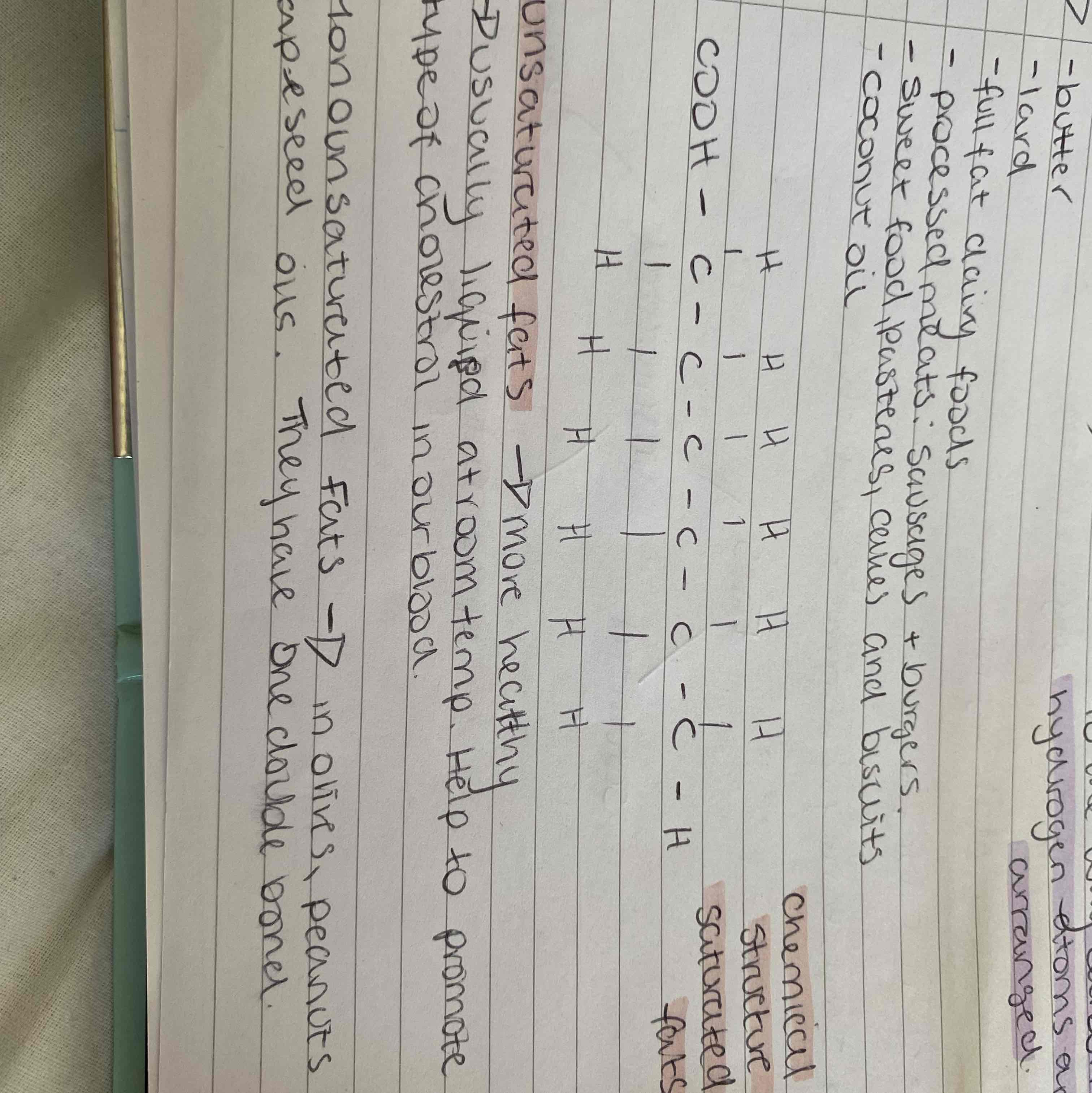
What are the two types of saturated fats?
Trans fats: have hydrogen atoms on opposite sides of double bonds. trans means across.
Cis fats: have hydrogen atoms same side of molecule. Bent in shape.
What are the food safety temperatures?
Boiling - 100°C (bacteria destroyed)
Cooking/reheating - 75°C
Minimum hot heating - 63°C
Body temperature - 37°C (ideal temp for bacteria to grow) -optimum temperature.
Food storage - 8°C (store food at this temp or below)
Fridge temp - 5°C
Freezer temp - -18°C (bacteria won’t grow but may not die)
Danger zone - (5°C-63°C)
What are the 4C’s?
Cooking, Chilling, Cleaning, Cross-contamination.
What factors affect the growing of bacteria?
Temperature, moisture, pH levels and oxygen levels.
What are food allergens and what is the definition ?
Food allergens: your immune system believes a certain food is harmful for your body. (e.g nuts, eggs, shellfish)
What is a food intolerance and what are the examples?
body can’t digest the food or the digestive system can be irritated by the food. (e.g lactose intolerance, gluten intolerance, fructose intolerance)
What is lactose intolerance?
cant digest lactose, a type of sugar found in milk and dairy products.
symptoms: stomach cramps or diarrhoea.
may lack: calcium and vitamin d.
What is gluten intolerance? (Coeliac disease)
Symptoms: stomachache, diarrhoea, bloating.
foods can’t eat: bread, pasta, cereals, biscuits, pies.
foods can eat: eggs, fruit and veg, meats, fish and poultry.
may lack b6, b9, b12.
What is fructose?
Symptoms: nausea, bloating, diarrhoea.
Cant eat foods: juices, apples, pears, asparagus, peas, watermelon.
May lack vitamin b9.
What is a Jewish diet?
No shell fish or pork.
No dairy and meat in same meal.
only eat kosher meats.
What is Hindus diet like?
No beef or beef product.
Allowed milk.
Most are vegetarian.
What is a sikhs diet?
No beef. (they are vegetarians)
What are muslims diets like?
No pork or sea food without fins or scales.
What are buddhist diets like?
Some are vegetarian and some aren’t.
What are the nutritional needs for elderly?
energy requirements decreased
protein requirements decreased for men but increased slightly for women.
Zinc needed for healthy immune system
Elderly more at risk for deficiency in vitamin d, vitamin c and folate (vitamin b9)
Calcium required for good bone health
More likely that anaemia can occur due to poor absorption.
Important to base meals on:
starchy foods
oily fish
Fruit and veg (help to lower BP)
need Irish and vitamin c.
need calcium
What nutrients do menopausal women need?
Calcium and vitamin D to prevent oestoprosis(bone strength decrease) .
less saturated fats, more fish, high fibre, whole grains foodd can benefit healthy heart.
more physical activity, low fat, calcium, fruit and veg.
What are the nutritional needs for adolescents?
11-14yrs old
energy increase, boys need more of all vitamins in minerals.
increase in all minerals for girls but not all vitamins such as thiamine (vitamin b1) , niacin (vitamin b3), vitamin b6 (pyrodoxine)
15-18yrs old
Boys: energy, thiamine, riboflavin, niacin, vitamin b12, b6, C, A increase. Need high calcium due to skeletal development.
Girls: energy, protein, thiamine, niacin, vitamins b6, b12, C increase. Iron increases due to menstural loss.
Both need Hugh amounts of calcium.
60 mins of exercise per day.
What are the nutritional needs for adults?
Nutrients needed for energy:
to maintain and repair body tissue
for normal body functions.
need less energy as they’re no longer growing
What nutrients do pregnant women need?
More energy, vitamin b1 in last 3 months (fresh fruits,nuts,cereals)
Need to keep hydrated.
Only 4 tins of tuna weekly due to mercury lvls (can harm baby nervous system)
Avoid brie.
More iron (folic acid) - meat, poultry, seafood.
What nutritional needs for babies?
1st 4-6months babies goes through rapid growth and development.
Need more balanced diet
No eggs before 6 months.
Energy increase due to activity and growing rapidly.
Increase need of all vitamins.
What nutrients do children need?
4-6yr olds
Need more energy and protein and all vitamins except vitamin c and d and minerals such as iron.
7-10yr olds
Energy and protein increase.
No change in vitamin em thiamine, vitamin a however others increase.
High energy and nutrient needed for growth and development
What is Lactating?
Energy levels decrease when baby is being weaned.
extra 300-400 kcal per day.
Dietary needs: balanced diet, fluid important, cravings:( nutrients you need)
What is Vitamin A?(Retinol)
Retinol - helps keep healthy skin and good eye sight. (carrots)
Deficiency: night blindness
What is Vitamin B1? (Thiamine)
Thiamine - releases energy from carbs in body. - eggs
deficiency: Beri Beri
What is Vitamin B2? (Riboflavin)
Riboflavin- maintains healthy skin - eggs.
What is Vitamin B3? (Niacin)
Niacin - releases energy from carbs, protein, fats in body - eggs
deficiency: anaemia
What is Vitamin B5? (Pantothenic acid)
Panothentic acid - converted to co-enzyme for respiration - green leafy veg.
What is Vitamin B6? (Pyrodoxine)
Pyrodoxine - incorporating into haemoglobin - green leafy veg.
What is Vitamin B7? (Biotin)
Biotin - involved in production of fatty acids - eggs.
What is Vitamin B9? (Folate)
Folate - prevents spinal defect in unborn babies - green leafy veg -
deficiency: anaemia
What is Vitamin B12? (Cobalamin)
Cobalamin - helps with blood clot - green leafy veg.
deficiency: anaemia
What is Vitamin C? (Ascorbic acid)
Ascorbic acid - Absoprtion of iron - citrus fruits
deficiency: anaemia
What is Vitamin D? (Cholecalciferol)
Cholecaferiol - for immune system functioning - eggs
deficiency: Rickets.
What is Vitamin E? (Tocopherol)
Tocepherol - Antioxidant - nuts.
What is Vitamin K? (Phylloquine)
Phylloquinone - helps with blood clot - green leafy veg/ liver.
What is iodine?
Makes thyroxin in thyroid glands to control metabolic rates. Makes cell membrane. - Milk, Cheese, Seafood.
deficiency: swelling in thyroid glands.
What is potassium?
Needed for regular heartbeat
works with sodium to help control muscle contractions and nerve signals.
unprocessed foods (fruit and veg)
deficiency: weakness
What is zinc?
Involved in many foods.
Involved in metabolism of DNA and RNA.
What is calcium?
Helps have strong teeth and bones.
Milk.
Deficiency: Tetany.(nerves and muscles) Oestoprosis.
What is phosphorous?
Plays important role in how the body uses carbohydrates and fats.
meats, fish, dairy products.
What is Fluoride?
Strengthens bones and tooth enamel. Prevents tooth decay. - Tea, Fish.
Deficiency: cavities in our teeth.
What is Sodium?
Ensures nerves and muscles work properly.
Take away food, salt, bacon.
Rare deficiency can cause high blood pressure if have too much.
What is iron?
Prevents anaemia, produces harmoglobin. - Red nest, eggs, fortified breakfast cereals.
Deficiency: anaemia.
What is Bmi?
18.5 (underweight)
18.5 - 24.99 (normal)
25 - 29.99 (overweight)
30+ (obese)
Weight(kg) divide by height(m) x height(m)
cm→m (divide by 100)
What is Bmi?
18.5 (underweight)
18.5 - 24.99 (normal)
25 - 29.99 (overweight)
30+ (obese)
Weight(kg) divide by height(m) x height(m)
cm→m (divide by 100)
What is Lactose intolerant?
Cant digest lactose (sugar in milk and dairy products)
What are different food poisonings?
campylobacter
listeria
salmonella (meat)
staphylococcus
What can cause food poisoning?
cross-contamination, undercooking, preparing too in advance, raw food consumed.
What are ways to avoid food poisoning?
personal hygiene, store high risk foods below 5 or above 63, cleaning, pest control, HACCP.
What are symptoms of food poisoning?
abdominal pain, nausea, fever.
What are different food temps?
75(at core temp) - cooked food - kills bacteria.
63(hot held) - max 4hrs or ict temp falls below 63.
5-63 (Danger zone) - bacteria grows more (max 90mins)
0-5 (chilled- fridge temp) - legal limit 8.
-18 (freezing temp) - too cold for bacteria to multiply.
What conditions cause bacteria growth?
temp, moisture, food, time, oxygen, ph level.
Section C: Breakfast
Porridge with blueberries and strawberries.
p: fibre(keep digestive system healthy), Vitamin B1 and B6 (helps with functioning of nervous system.)
fruit: Vitamin C (needed for growth and repairs of tissues in all parts of your body) Calcium, iron, folate(strawberries) vitamin K helps with blood clot
Greek Yogurt with berries and nuts.
Yogurt: Calcium: (helps keep bones and teeth healthy) B2+B12: (converts food into fuel+plays role in rbc formation)
Berries: Vitamin C, Fibre.
Nuts: Vitamin E(helps make DNA)
Lunch - Section C
Mushroom Soup
Sodium: (helps make balance of water, minerals). B12 (makes dna). Potassium: helps nerves, muscles and heart to function.
Caesar Salad:
Vitamin A - important for normal vision. B9(folate) - important in RBC formation and for healthy cell growth and function. Anchovies (omega 3- provides calories to give body energy)
Dinner -Section C.
StirFry
Protein:(builds and repairs muscles). Fibre (regulated body use of sugar) Vitamin B12 (in rbc formation) Calcium.
Salmon Pasta with peas and broccoli.
SP: Fibre, High in protein, Vitamin E (helps maintain healthy skin) Vitamin B12.
Peas: B1: turns carbohydrates into energy. VitaminD: helps body absorb calcium.
Snacks : Section C.
Vegetable sticks:
Vitamin A(Retinol) - important for growth and development. Sodium: helps contract and nerve muscles. Vitamin B6 (Pyrodoxine) important for brain development.
Granola Bar:
Fibre, Calcium:(helps regulate muscle contractions). Potassium: (helps nerves , muscles and heart to function)
Drinks -Section C.
Water:
6-8cups.
Iron: helps makes RBC.
Calcium: makes sure blood clot normally(deficiency:rickets)
Tea:
Zinc: help your immune system,
iron: make rbc
calcium: help build bones,
Potassium: helps nerve, muscles and heart to function well.
What is the food safety act (1995) ?
ensures business don’t include anything in food, remove anything from food, treat food in any ways that could harm consumer.
What is the Health and Safety at Work act (1974)
ensures heathy and safety procedures are followed.
safe working environment.
report incidents
ensures no one is at risk.
What is food safety (general food hygiene regulation, 1990)
ensures kitchen is clean
hygiene policies and producers followed
food safe to eat
What vitamins and minerals work together?
Calcium, Phosphorus and Vitamin D.
Vitamin C and Iron.