Science 8th Grade Final
 Call Kai
 Learn
Learn Practice Test
 Spaced Repetition
 Match
Match Flashcards
 Knowt Play
1/111

There's no tags or description
Looks like no tags are added yet.
Name | Mastery | Learn | Test | Matching | Spaced | Call with Kai | Chat |
|---|
No analytics yet
Send a link to your students to track their progress
112 Terms
Motion
What occurs when an object changes position
Relative Motion
Motion that occurs relative to one’s environment (ex. a person sitting still in a car moving at 55 mph)
Vector Quantity
A measurement/# containing both a magnitude and a direction
Distance
How far an object moves (in length)
Displacement
The distance and direction of an object’s change in position from a starting point (a vector quantity)
Speed
The distance an object travels per unit of time (Derived Unit)
Cannot be a negative value
Meters/Second
SI Unit for speed
S=D/T
Formula for Speed
Average Speed
Total distance traveled / Total time traveled
Instantaneous Speed
Speed measured at one particular point in time
Velocity
Speed with Direction [Formula: V=(Pf-Pi)/T]
Acceleration
A change in velocity
Force
A push or pull that one object can exert on another, causing the object to change in position (move/accelerate)
f=ma
Formula for force (force = mass x acceleration)
kg x m/s² (Newton)
SI unit for force
Balanced Force
when equal forces in opposite directions are applied to an object, resulting in no change in motion as they cancel out
Unbalanced Force
When a force is applied to an object and is not balanced by another force, resulting in a change in motion / acceleration
Net Force
The result (sum) of all forces acting on an object
Inertia
-The tendency of an object to resist a change in motion
-A property of matter (mass)
-The greater the mass of an object, the greater its resistance to a change in motion
Newton’s 1st Law of Motion
The tendancy of an object to resist a change in motion unless acted on by an unbalanced force.
Newton’s 2nd Law of Motion
An object will accelerate in the direction of the net force
Law of Universal Gravitation
An attractive force is always present between any two masses that is greater when the objects are closer together and have more mass
Momentum
a property of an object that is related to how much force is necessary to change its motion. A vector quantity, as it has velocity which has direction
SI Unit for Momentum
kg x m/s
Formula for Momentum
p = m·v
Law of Conservation of Momentum
Momentum can be transferred from one object to another
The momentum of an object will not change (it is conserved) unless its mass, velocity, or both, change
“In the absence of an external force (gravity, friction), the total momentum before the collision is equal to the total momentum after the collision, or is CONSERVED.”
Elastic Collisions
collisions where the objects bounce off of each other or separate.
Inelastic Collisions
collisions where the objects stick together and move as one. The mass after the collision is equal to the sum of the masses and there is just one final velocity.
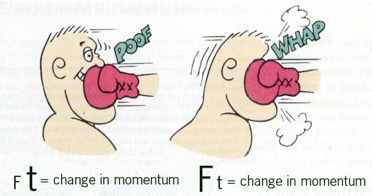
Impulse-Momentum Theorum
the impulse (the time over which a force is applied) acting on an object is equal to the change in momentum of the object (its mass x the change in velocity)
Impulse Equation
Impulse (force x time) = change in momentum (mass x change in velocity)
Force
A push or pull that one object can exert on another, causing the object to change in position (move/accelerate)
f=ma
Formula for force (force = mass x acceleration)
kg x m/s² (Newton)
SI unit for force
Balanced Force
when equal forces in opposite directions are applied to an object, resulting in no change in motion as they cancel out
Unbalanced Force
When a force is applied to an object and is not balanced by another force, resulting in a change in motion / acceleration
Net Force
The result (sum) of all forces acting on an object
Inertia
-The tendency of an object to resist a change in motion
-A property of matter (mass)
-The greater the mass of an object, the greater its resistance to a change in motion
Newton’s 1st Law of Motion
An object will resist a change in motion unless acted on by an unbalanced force.
Newton’s 2nd Law of Motion
An object will accelerate in the direction of the net force
Law of Universal Gravitation
An attractive force is present between any two masses that is greater when the objects are closer together and have more mass
Newton’s 3rd Law
Every action has an equal opposite reaction
Friction
The force between two surfaces that are touching one another
Factors Affecting Friction
The objects’ masses and the materials touching each other
Fluid Friction
The friction of an object moving through a fluid
Static Friction
The friction between two surfaces that are not moving past each other - the greatest type of friction due to needing to overcome it to begin motion
Rolling Friction
The friction between a rolling object and the surface it rolls on - the least amount of friction because each point of the wheel does not make contact with the surface it rolls on for long enough for the surfaces to interlock
Centripetal Force
A force directed toward the center of a circle for an object traveling in a circular path
Energy
the ability to do work or cause change
Kinetic Energy
The energy of motion (KE)
Potential Energy
Stored energy (PE)
Joules
SI Unit of measurement for energy and work (kg·m²/s²)
Kinetic Energy Formula
KE=1/2m·v²
Gravitational Potential Energy
(GPE) Energy stored in objects above the Earth’s surface
Gravitational Potential Energy Formula
GPE=m·9.8m/s²·h
Law of Conservation of Energy / The 1st Law of Thermodynamics
Energy cannot be created or destroyed, it simply changes from one form to another
Mechanical Energy
the energy of a system of moving parts It is found in a system of objects that are moving or have the potential to move
Chemical Energy
energy that is stored in the bonds between the atoms of compounds. If the bonds are broken, the energy is released and can be converted to other forms of energy.
Electrical Energy
the energy of moving electrons. Electrons flow through wires to create electric current.
Electromagnetic Energy
energy that travels through space as electrical and magnetic waves. types include radio waves, microwaves, X rays, and gamma rays. Also known as radiant or light energy
Thermal Energy
The sum of kinetic and potential energy in an object. (the energy of moving atoms of matter.) All matter has this energy because atoms of all matter are constantly moving. An object with more mass has more of this energy than an object with less mass because it has more atoms.
Sound Energy
a form of mechanical energy that starts with a vibration in matter. The vibrations pass to surrounding particles of matter and then from one particle to another in waves. Sound waves can travel through air, water, and other substances, but not through empty space.
Nuclear Energy
energy that is stored in the nuclei of atoms because of the strong forces that hold the nucleus together. The energy can be released in nuclear power plants by splitting nuclei apart. It is also released when unstable (radioactive) nuclei break down, or decay.
Work
When a force is exerted on an object and the object moves in the direction of the force
Work Formula
Work = force (kg·m/s²) · distance (m)
Power
The rate at which work gets done
Watt
SI unit for power (joules/sec)
Watt Formula
Work/time
Vacuum
A space that has no matter
Seismic Energy
released when earthquakes occur, transferred by waves moving through the ground
Energy Transformation
When energy changes form
FIssion
When big atoms are slit into smaller ones, releasing energy that can cause a chain reaction. This occurs on the sun and on earth
Fusion
When small atoms are merged into larger ones, releasing safe clean energy. This occurs on the sun
Waves
Rhythmic disturbances that carry energy through matter or space
Medium
Material (matter) through which a wave transfers energy. Electromagnetic waves can travel without a medium (in a vacuum)!
Crest
Top of wave
Trough
Bottom of wave
Amplitude
How far from the midline the crest or trough of a wave is
Wavelength
The length of one wave
Frequency
the # of waves that can pass a point in one second. More of these = shorter wavelength = more energy = can penetrate more matter
300,00 km/s
Speed of light in a vacuum
Length
The distance between two points, also called height, distance, or width
Mass
The amount of matter in an object
Volume
The amount of space an object takes up
Storin’ and Pourin’
Purpose of a Beaker
Measuring the Volume of Liquid
Purpose of a Graduated Cylinder
Derived Unit
2 or more simple units combined
Density
Mass over Volume
Kelvin
SI unit for Temperature
Second
SI unit for time
Meter
SI unit for length
Gram
SI unit for mass
Liter
SI unit for volume
Meniscus
The middle of the curve at the top of a liquid in a graduated cylinder
100 degrees
Temperature at which water boils (Celcius)
0 degrees
Temperature at which water freezes (Celcius)
0 degrees
Absolute Zero (Kelvin)
Accuracy
Getting close to the right answer
Presicion
Consistently getting a specific answer
Line Graphs
Can show relationships where the DV changes due to changes in the IV, often shows changes over time
X axis
Horizontal axis, always the IV