HEAL 2070 MODULE 1: BLOOD
 Call Kai
 Learn
Learn Practice Test
 Spaced Repetition
 Match
Match Flashcards
 Knowt Play
1/53

There's no tags or description
Looks like no tags are added yet.
Name | Mastery | Learn | Test | Matching | Spaced | Call with Kai |
|---|
No analytics yet
Send a link to your students to track their progress
54 Terms
Functions of blood
O2, CO2, nutrients, hormones, heat, waste product transportation
pH, body temperature, water content of cells regulation
blood clotting
Hematocrit
percent of red blood cells in blood
Makeup of blood
55% plasma
45% RBC
What % of the human body weight is comprised of blood?
8%
% of plasma and formed elements of blood
55% plasma
45% formed elemtns
Plasma is comprised of:
7% proteins
91.5% water
1.5% other solutes
Proteins in the plasma
54% albumins
38% globulins
7% fibrinogen
1% others
Formed elements are comprised of
Platelets : 150k - 400k
White blood cells : 5k - 10k
Red blood cells : 4.8 - 5.4 million
% of all white blood cells
neutrophils : 60-70%
lymphocytes : 20-25%
monocytes : 3-8%
eosinophils : 2-4%
basophils : 0.5-1%
Albumin
smallest and most numerous
substance transportation
blood pH regulation
Globulins
attack viruses/bacteria
substance transportation
Fibrinogen
Blood clotting
Hemoglobin
carries O2 to all cells and some CO2 to lungs, 4 Fe ions to help bind to 4 O2 molecules
Erytheopoiesis (production of RBCs)
begins in red bone marrow, mature in 1-2 days
Erythropoietin
hormone released by the kidneys in response to hypoxia and stimulates erythropoiesis
Agranular leukocytes
Lymphocytes, monocytes
Granular Leukocytes
Neutrophils, eosinophils, basophils
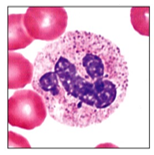
Neutrophil
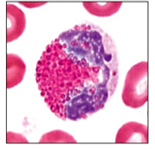
Eosinophil
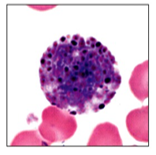
Basophil
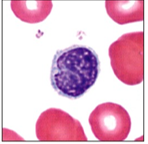
Lymphocyte
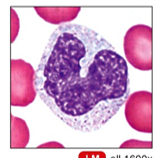
Monocyte
Neutrophil Function
Bacterial Phagocytosis/killing (acute infections)
Eosinophil function
Kills parasitic worms and decrease inflammation (allergies and parasitic infections)
Basophil function
Releases chemical mediators of inflammation —> histamine (allergies)
Lymphocyte
B cells —> antibodies, T and NK cells —> destroy infected cells and tumor cells (viral infections)
Monocyte
Phagocytic, activate lymphocytes (chronic infections)
Platelets
Hemostasis (stoppage of bleeding)
Hemostasis involves:
Vascular spasm, platelet plug formation, blood clotting
How many clotting factors are there and where do they come from?
13 and majority come from the liver
Intrinsic pathway of blood vessel injury
Activators are either in direct contact with blood or contained within (intrinsic to) blood
Extrinsic pathway of blood vessel injury
Tissue thromboplastin leaks into the blood from cells outside (extrinsic to) the blood vessels and initiates formation of prothrombinase
blood typing
Classified by the presence or absence of antigens on the surface of RBCs
Blood types by antigens
A —> A antigen present
B —> B antigen present
AB —> both A and B antigen present
O —> neither A nor B antigen present
Blood types by antibodies
A —> B antibody
B —> A antibody
AB —> neither A and B antibody
O —> Both A and B antibody
Blood typing by + or -
Rh + —> Rh factor present
Rh - —> Rh factor missing
What antigens and antibodies does a person with O- blood type have? does this person have the Rh factor? What blood types can this person receive?
Neither A or B antigen present, both A and B antibodies present, no Rh factor.
This person can receive only O- (universal donor)
What antigens and antibodies does a person with AB+ blood type have? does this person have the Rh factor? What blood types can this person receive?
Both A and B antigens present, No antibodies, Rh factor present.
This person can receive blood from people who are: O+, O-, A+, A-, B+, B-, AB-, AB+ (universal recipient)