Post-hoc tests
 Call Kai
 Learn
Learn Practice Test
 Spaced Repetition
 Match
Match Flashcards
 Knowt Play
1/7

There's no tags or description
Looks like no tags are added yet.
Name | Mastery | Learn | Test | Matching | Spaced | Call with Kai |
|---|
No analytics yet
Send a link to your students to track their progress
8 Terms
Purpose of post-hoc tests (2, linked)
Determine which groups/conditions differ significantly from each other
without accumulating familywise error
So how do we determine which groups/conditions differ significantly?
Post-hoc tests
Conduct t-tests each possible pair of groups/condition
But with smaller alpha level (to prevent accumulation of Type-I error)
2 types of post-hoc tests
Bonferroni tests
Holm’s stepdown
Bonferroni alpha formula
Bonferroni alpha = alpha level (e.g. .05) / number of comparisons
Bonferroni strength + limitation
Simple
Very conservative (increases risk of type II error)
Alternative since Bonferroni can be too conservative (1)
Holm’s stepdown: more liberal alpha than Bonferroni
Holm’s stepdown process
Conduct t-tests all possible combination of pairs
Order obtained p-values (not t-values) from lowest to highest
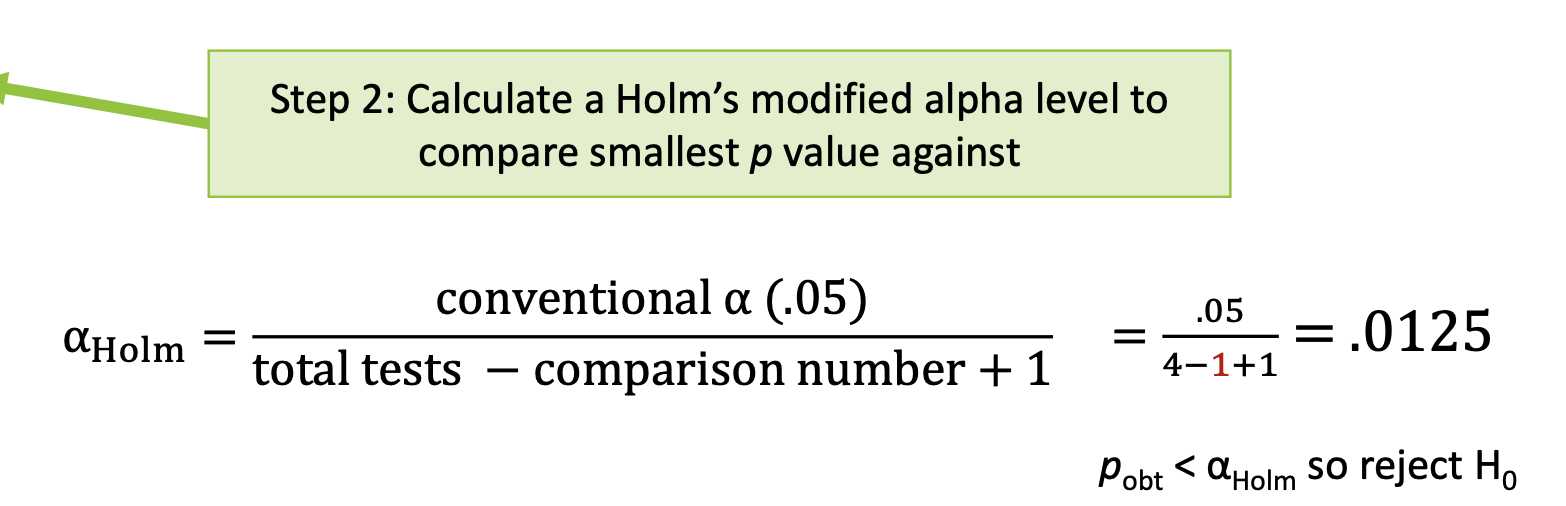
Starting with the first test (lowest p-value, most significant), calculate a Holm’s modified alpha level
Compare obtained p-value 1 to Holm’s modified alpha level 1
If p-obtained is smaller than Holm’s modified alpha, then move onto next test, and keep doing this until you p-obtained is larger than Holm’s modified alpha (non-significant)
Holm’s modified alpha formula, w/ example for first t-test