Exam 3 (final) bio quiz 9, 10, 11
 Call Kai
 Learn
Learn Practice Test
 Spaced Repetition
 Match
Match Flashcards
 Knowt Play
1/26

Earn XP
Description and Tags
running list of bio quizzes for final exam
Name | Mastery | Learn | Test | Matching | Spaced | Call with Kai |
|---|
No analytics yet
Send a link to your students to track their progress
27 Terms
(34.11) Overgrazing and dryland farming can convert savanna to __________.
desert
(34.4) Pronghorn antelopes are well adapted for dry conditions with extremes of temperature, especially cold. As global climate change causes the region where the pronghorns live to change, in temperature as well as plant, predator, and prey diversity and abundance, what is likely to happen to the pronghorns?
If the pronghorn population includes genetic variation that allows survival and reproduction in the new conditions, they will adapt.
(34.5) Why are many of the world's deserts located at latitudes of about 30 degrees north and south?
Dry air descends toward Earth's surface at about 30 degrees north and south
(34.9) In which of the following biomes would you expect decomposers to work most rapidly and efficiently?
tropical rain forest
(34.10) The dominant herbivores in savannas are
insects
(34.13) Most of the best agricultural soils in the United States occur in areas that were formerly __________.
grasslands
(34.1) An ecologist who focused on population ecology might conduct research to answer which of the following questions?
How do tapeworms cope with life in the human intestine?
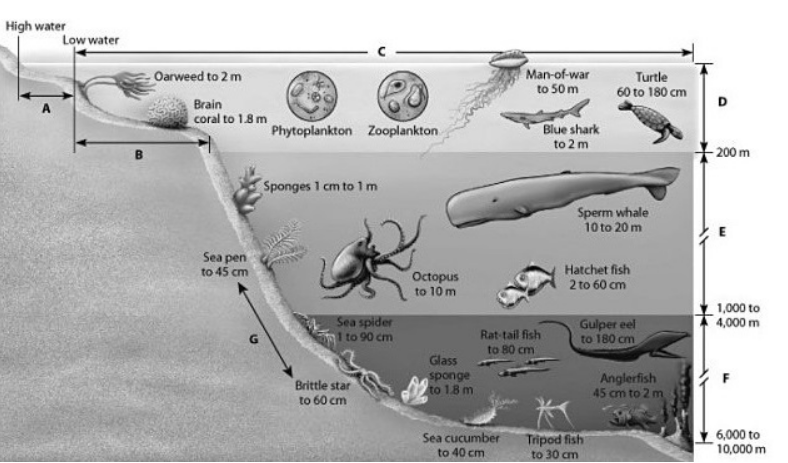
(34.6) In which of the zones shown in this depiction of an aquatic biome does photosynthesis occur?
zone d (photic zone)
(34.17) Which of the following correctly lists the biomes in order from lowest precipitation (at the left) to highest precipitation (to the right)?
desert, tundra, temperate broadleaf forest, tropical rain forest
(34.1) The most inclusive level of organization in nature is the __________.
biosphere
(36.3) A bluegill population is at its carrying capacity in a stable lake in Minnesota. Biologists studying the bluegills' reproductive behavior learn that a single female in one breeding season can produce 1,000 to 70,000 eggs. We can expect that the life table of these Minnesota bluegills will indicate __________.
high early mortality in a Type III survivorship curve
(36.4) In the models that describe population growth, r stands for __________.
per capita rate of increase
(36.4) A small population of 1,000 mice lives on a 100-acre island in the middle of a large lake. One dry summer, the lake level drops dramatically, which results in the island's size increasing to 1,000 acres. The island remains this size, vegetation quickly spreads, and the mouse population grows, doubling in size each year for three straight years. However, the hawk populations expand too. From the fourth year until the present, the death rate of the mouse population has been equal to the birth rate. Which of the following statements about this population of mice is true?
The population density of the mice went from 10 mice per acre before the lake level changed to 8 mice per acre at its new carrying capacity.
(36.7) Guppies from Trinidad form two distinct populations that differ in several life history traits. These traits appear to relate to the local predator populations. Guppy populations are small and fast-maturing if they co-occur with predatory pike-cichlids. Guppy populations that co-occur with predatory killifish are larger and slower to mature. Which experiments would best test the heritability of these guppy traits?
Raise both populations without predators to see if they maintain their life history traits.
(36.4) The logistic growth model differs from the exponential growth model in that it __________.
expresses the effects of population-limiting factors on exponential growth
(36.4) Consider a stable frog population living at carrying capacity in a pond. An average female produces 6,000 eggs during her lifetime and an average of 300 tadpoles hatch from these eggs. For the population size to remain stable, how many of these tadpoles should, on average, survive to reproduce?
2
(36.7) Which of the following best illustrates a feature of K-selection?
A mother elephant spends several years protecting her baby.
(36.5) Which of the following is regarded as a density-dependent factor in the growth of natural populations?
intraspecific competition
(37.12) During ecological succession, the species composition of a plant community generally
changes gradually because each species responds differently to the changing environment
(37.3) In an ecosystem, you would expect to find interspecific competition between
populations of two species that occupy the same niche.
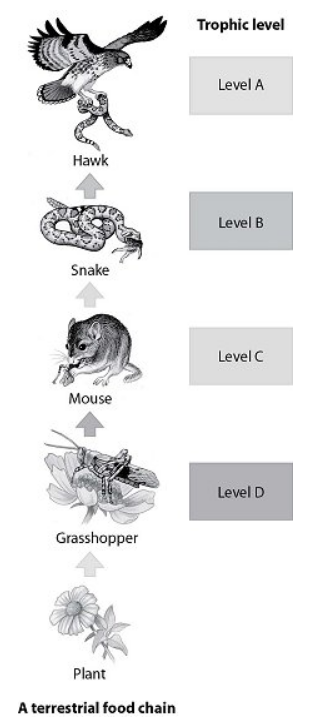
(37.8) Which trophic level in this food chain represents the secondary consumer?
trophic level C
(37.14) What generally flows in one direction through an ecosystem, from producers up through each level of consumers, and is not recycled?
energy
(37.17) Our current ability to feed the people of the world would improve if people ate a diet that only consisted of __________.
producers
(37.3) If an owl and a hawk both eat mice, what is the relationship between a hawk and an owl?
competition
(37.8) Which list accurately orders a food chain in the grasslands of Africa from low to high trophic levels?
grass, giraffes, lions, vultures, fungi
(37.4) Dinoflagellates are important to coral and coral-dwelling animals because they
provide energy in the form of organic molecules that is used by coral animals.
(37.12) Succession of communities occurs because _____.
each existing community changes the environment