Econ Exam 1 - ch. 2
 Call Kai
 Learn
Learn Practice Test
 Spaced Repetition
 Match
Match Flashcards
 Knowt Play
1/48

There's no tags or description
Looks like no tags are added yet.
Name | Mastery | Learn | Test | Matching | Spaced | Call with Kai |
|---|
No analytics yet
Send a link to your students to track their progress
49 Terms
Absolute advantage is the ability of an individual, firm, or country to:
a. produce more of a good or service than competitors using the same amount of resources.
b. produce a good or service at a lower opportunity cost than other producers.
c. consume more goods or services than others at lower costs.
d. reach a higher production possibilities frontier by lowering opportunity costs.
a. produce more of a good or service than competitors using the same amount of resources.
A production possibilities frontier will be linear instead of bowed out if:
a. the opportunity cost of producing more of either of the two goods is constant.
b. the opportunity cost of producing more of either of the two goods is zero.
c. the opportunity cost of producing either of the two goods always increases.
d. resources are employed efficiently.
a. the opportunity cost of producing more of either of the two goods is constant.
If a country has a comparative advantage in the production of a good, then that country:
a. also has an absolute advantage in producing that good.
b. should allow another country to specialize in the production of that good.
c. has a lower opportunity cost in the production of that good.
d. all are correct
c. has a lower opportunity cost in the production of that good.
What are patents and copyrights designed to do?
a. prevent entrepreneurs from earning excessive profits
b. eliminate unnecessary duplication whenever it arises
c. protect intellectual property rights
d. all are correct
c. protect intellectual property rights
According to Adam Smith, which of the following is necessary for the proper functioning of the market system?
a. For markets to work, people should take into account how their decisions affect society as a whole.
b. For markets to work, government should help citizens make the right decisions.
c. For markets to work, people must be free to pursue their self-interest.
d. For markets to work, people and government need to coordinate their decisions.
c. For markets to work, people must be free to pursue their self-interest.
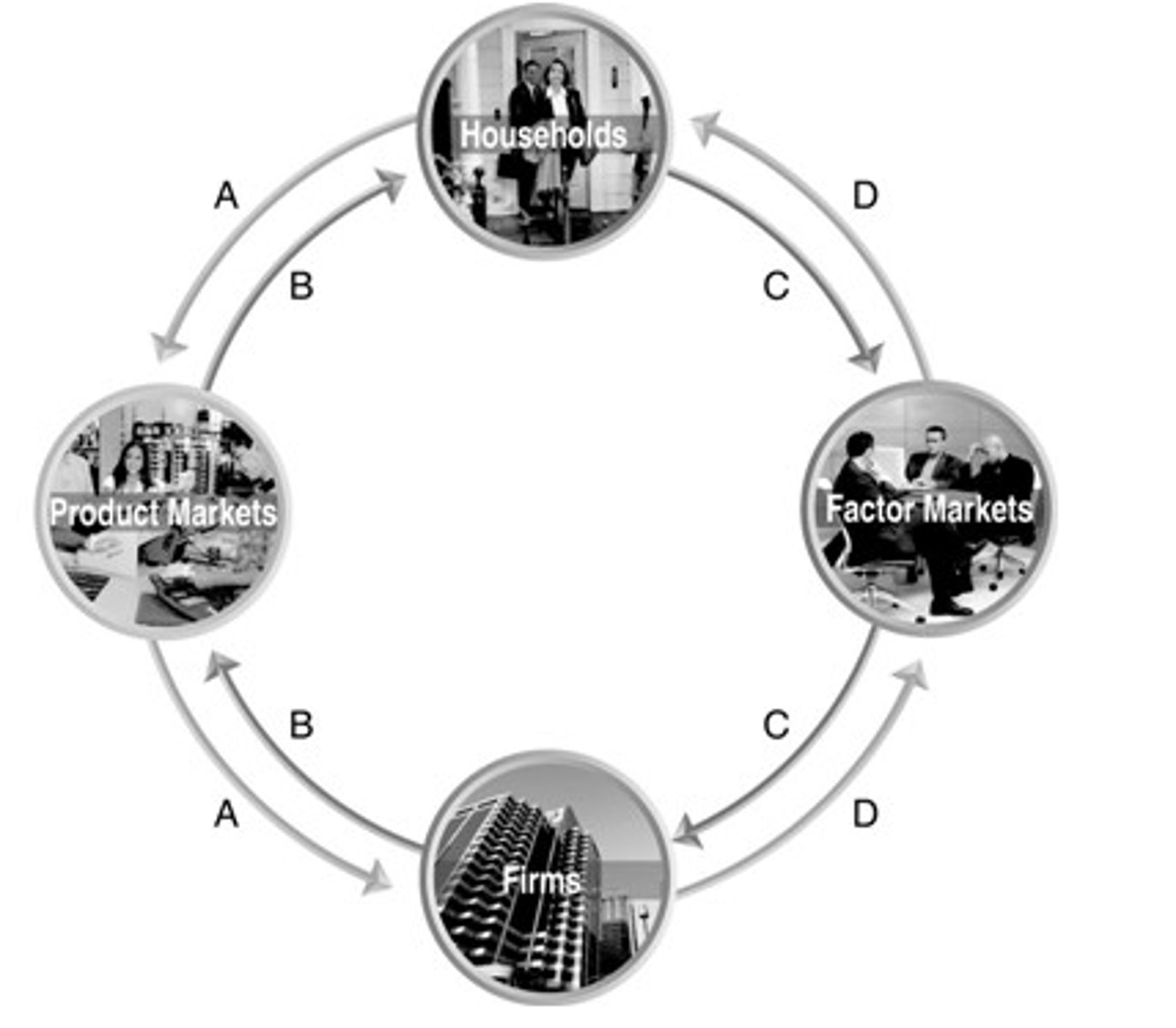
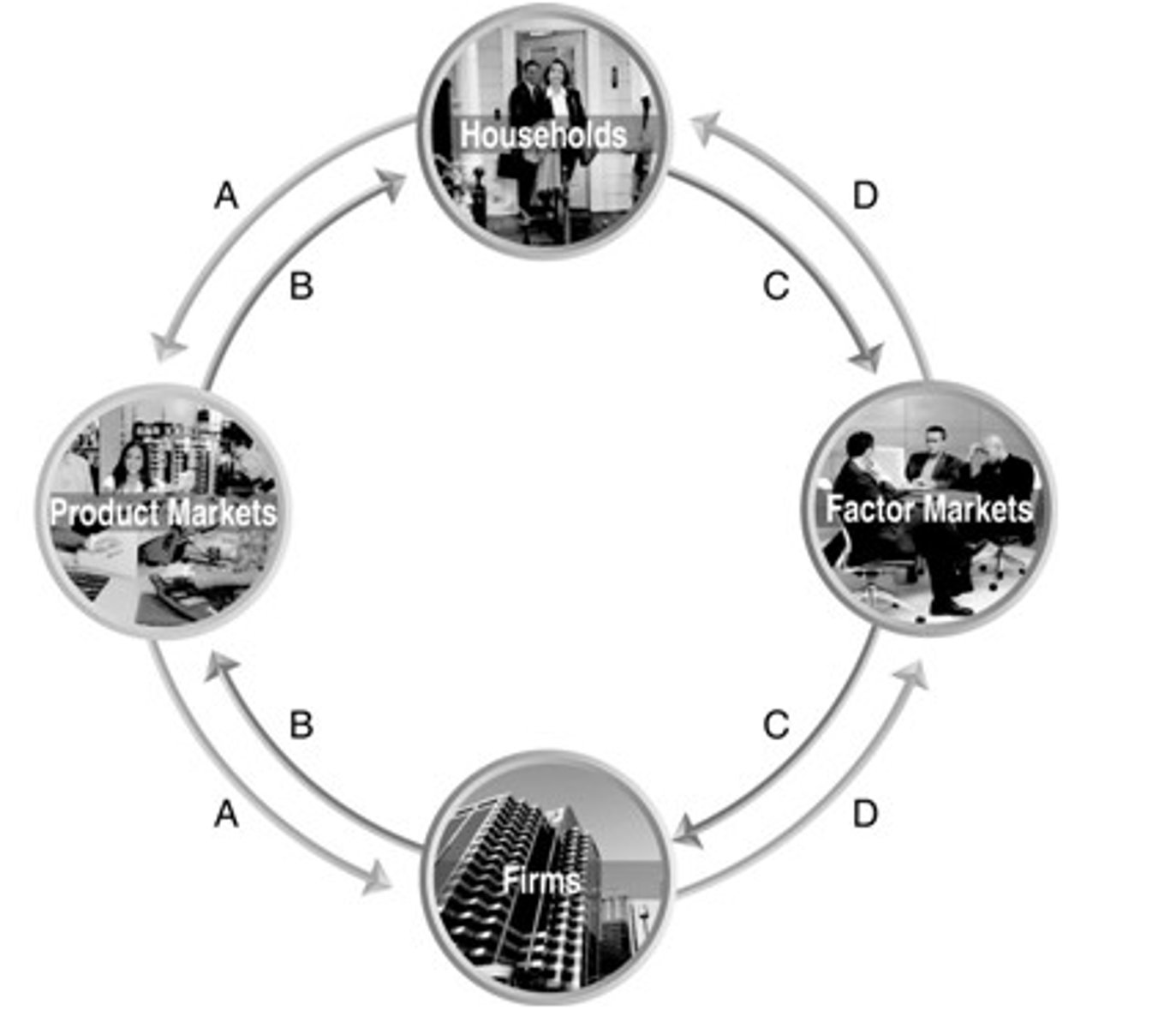
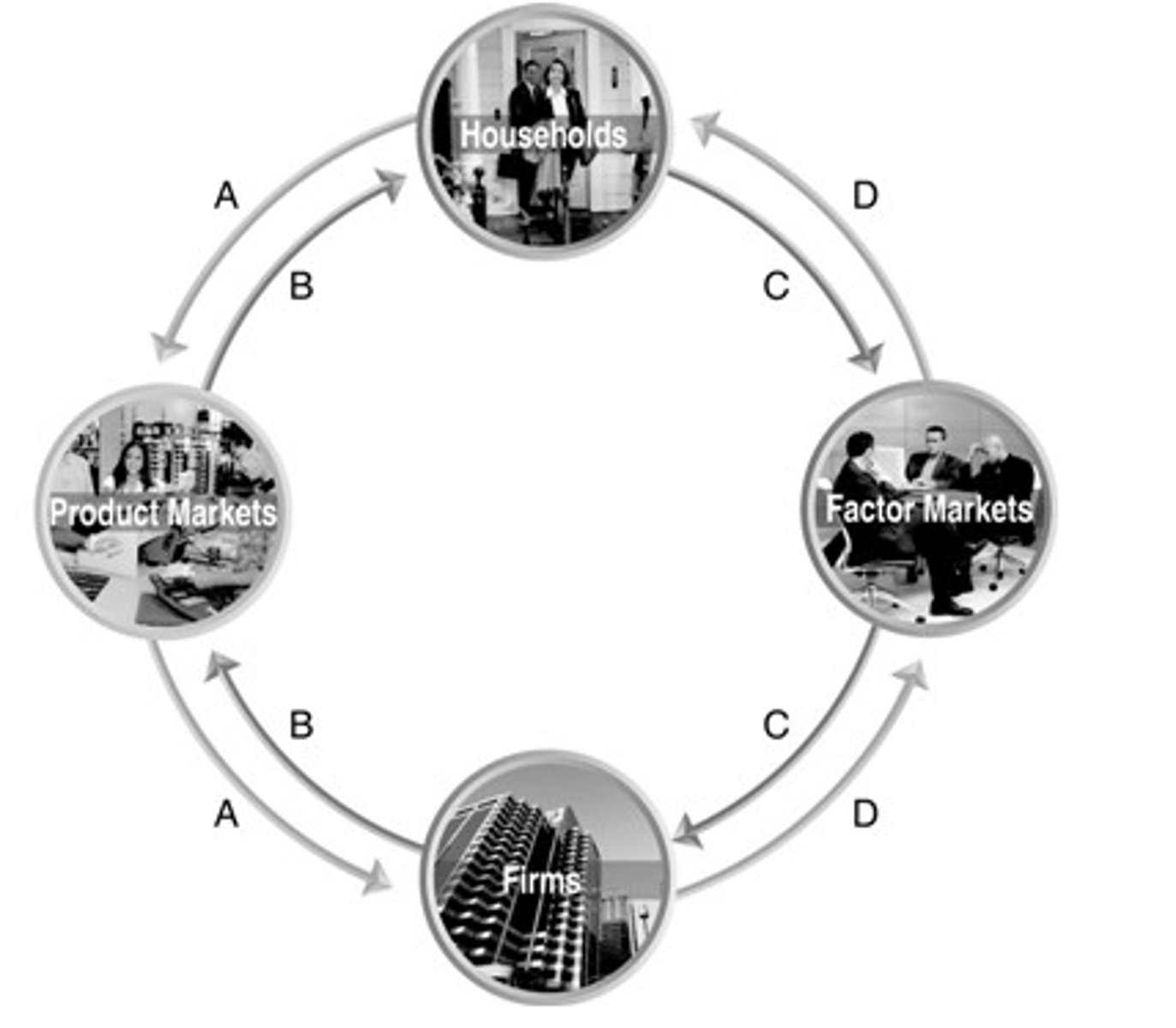
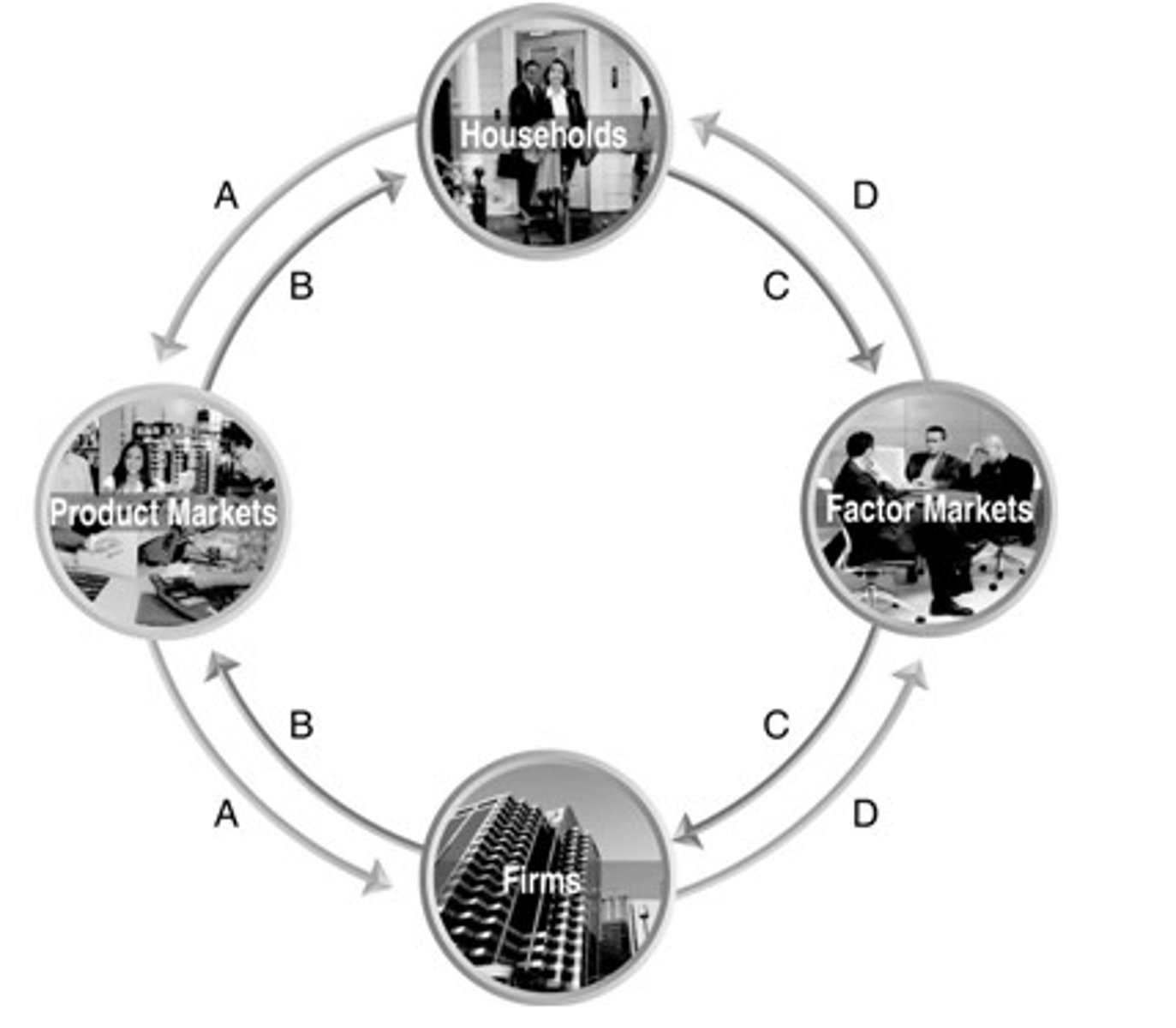
In the circular-flow diagram, which arrow shows the flow of spending by households?
a. A
b. B
c. C
d. D
a. A
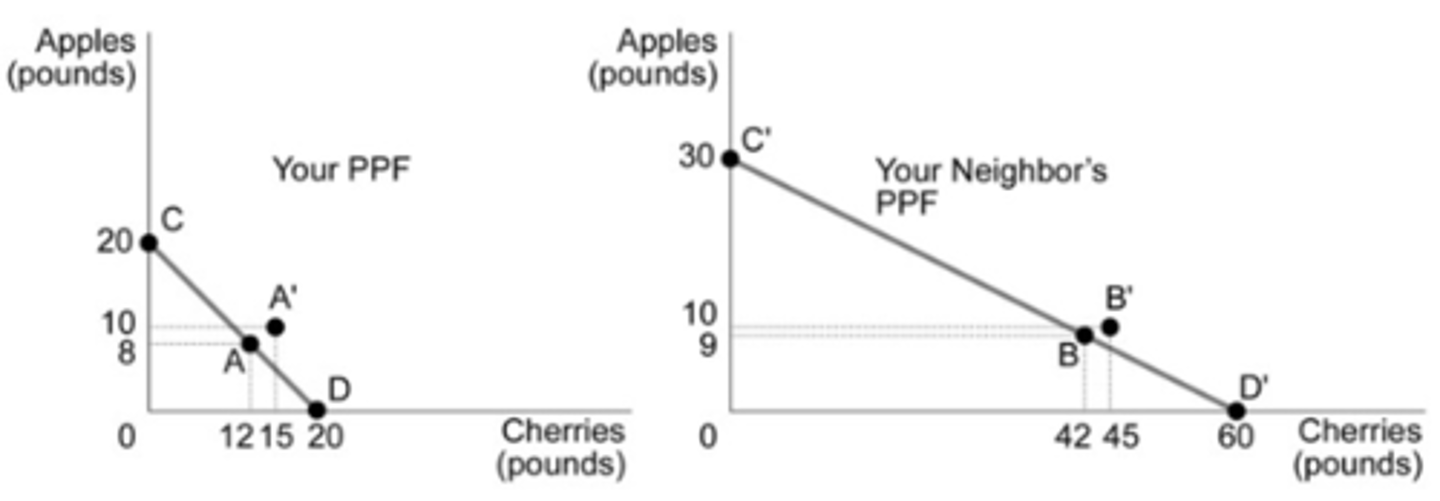
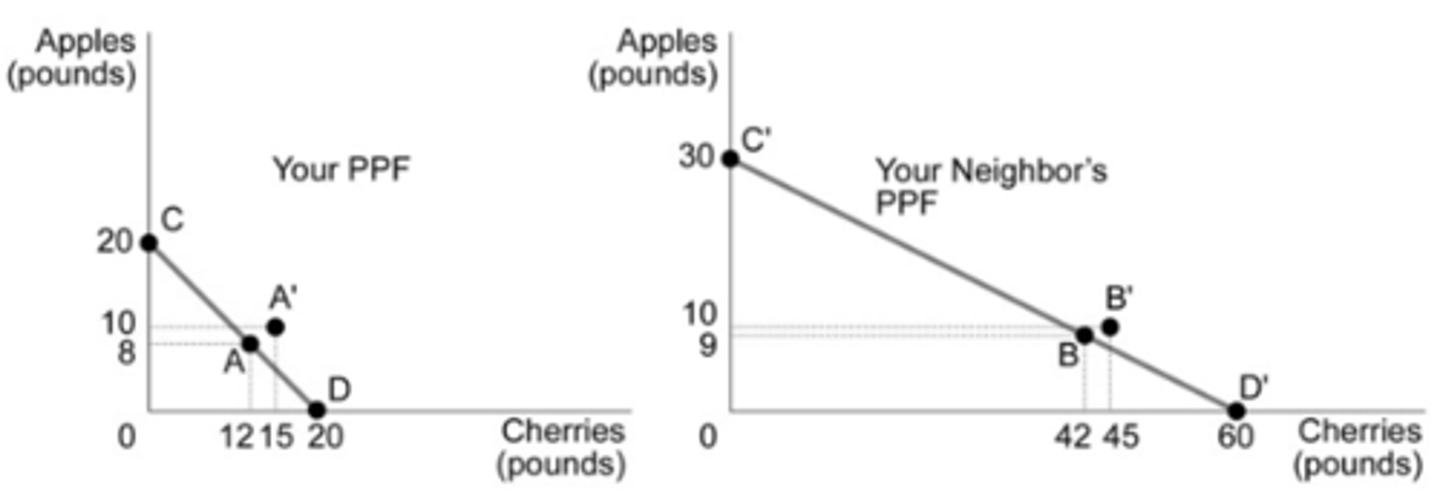
Refer to the graphs below. If you have a comparative advantage in the production of apples, what point would best represent your production with trade?
a. A
b. A'
c. C
d. D
b. A'
Generally speaking, for a market system to work, individuals must:
a. be very cautious in their approach to saving and investment.
b. take risks and act in rational, self-interested ways.
c. be able to evaluate and understand all available options.
d. consult people who have experience.
b. take risks and act in rational, self-interested ways.
What happens if a country produces a combination of goods that efficiently uses all of the resources available in the economy?
a. The country is operating on its production possibilities frontier.
b. The country is maximizing its opportunity cost.
c. The country has eliminated scarcity.
d. All options occur if a country uses all available resources.
a. The country is operating on its production possibilities frontier.
In the circular-flow diagram, which arrow shows the flow of factors of production?
a. A
b. B
c. C
d. D
c. C
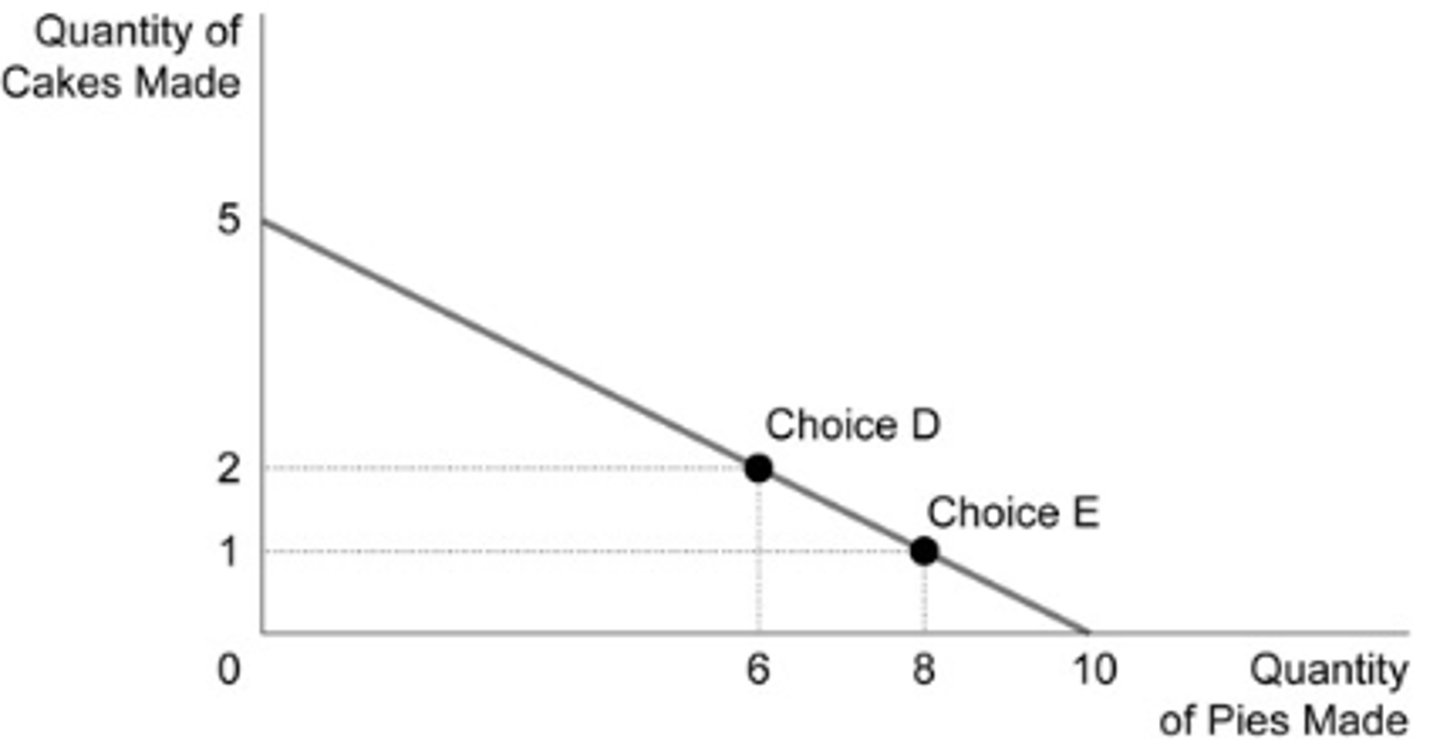
Refer to the graph below. Which of the following combinations of pies and cakes is unattainable given existing resources?
a. 2 cakes and 6 pies
b. 1 cake and 7 pies
c. 0 cakes and 10 pies
d. 4 cakes and 7 pies
d. 4 cakes and 7 pies
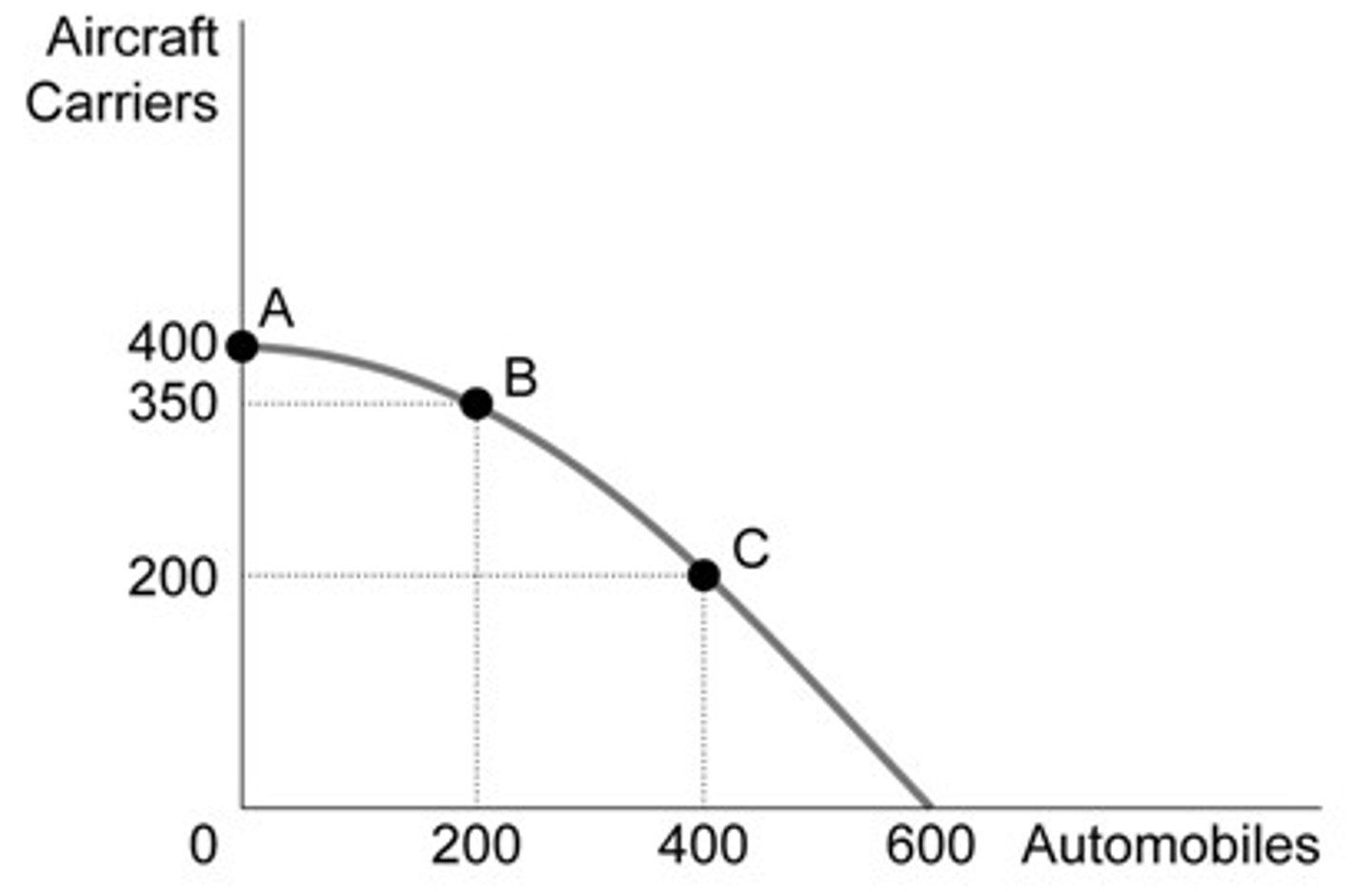
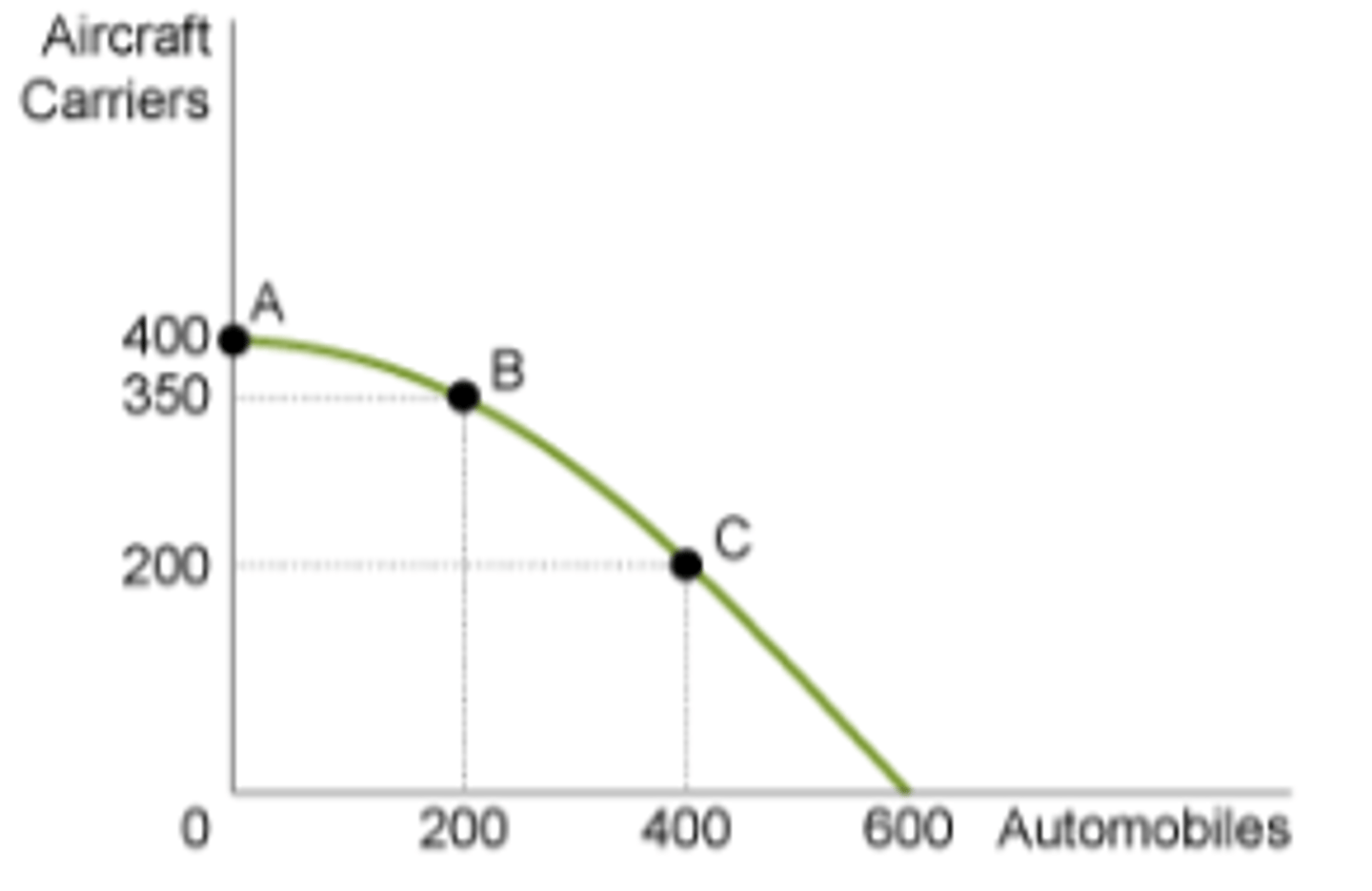
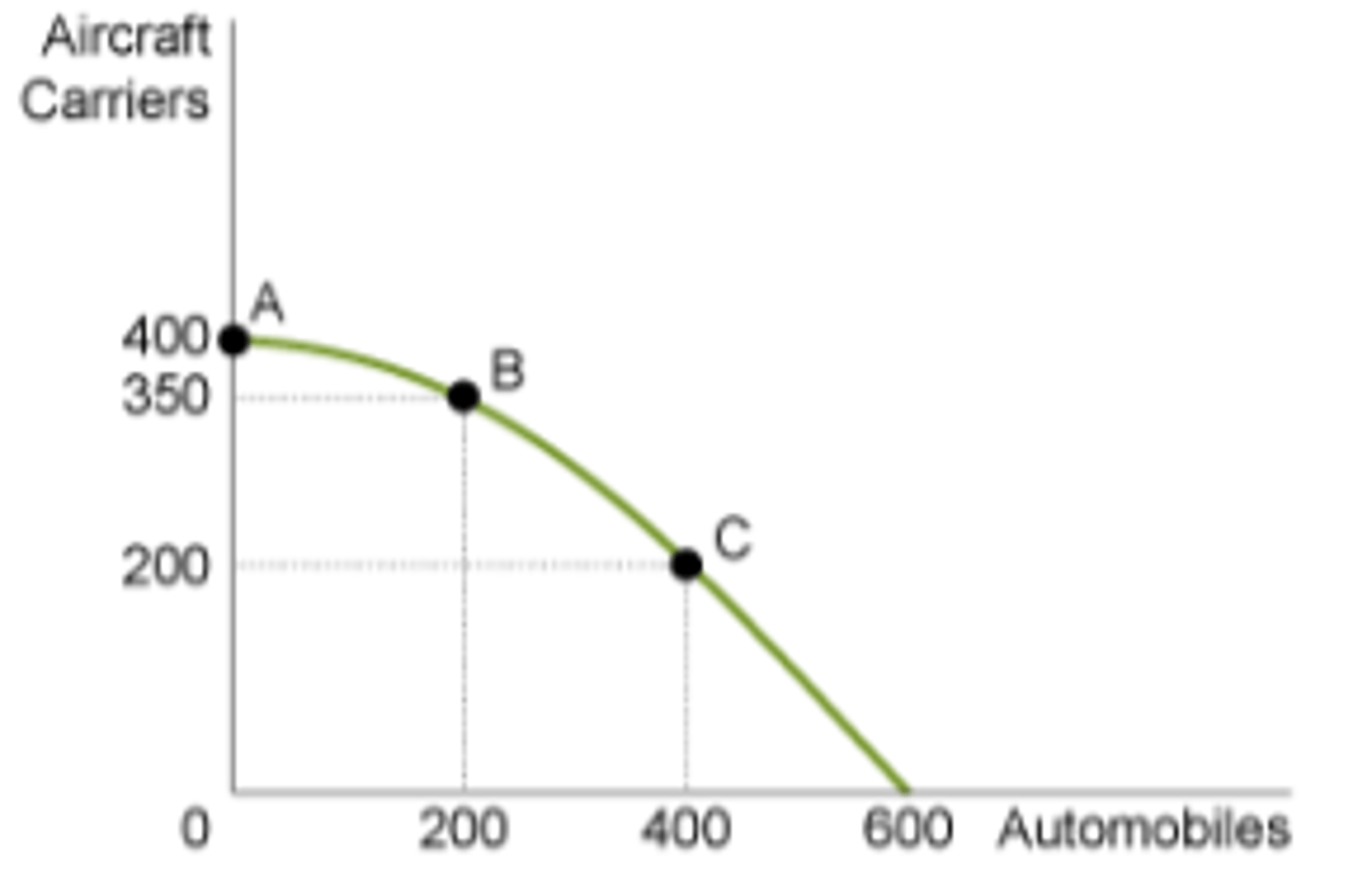
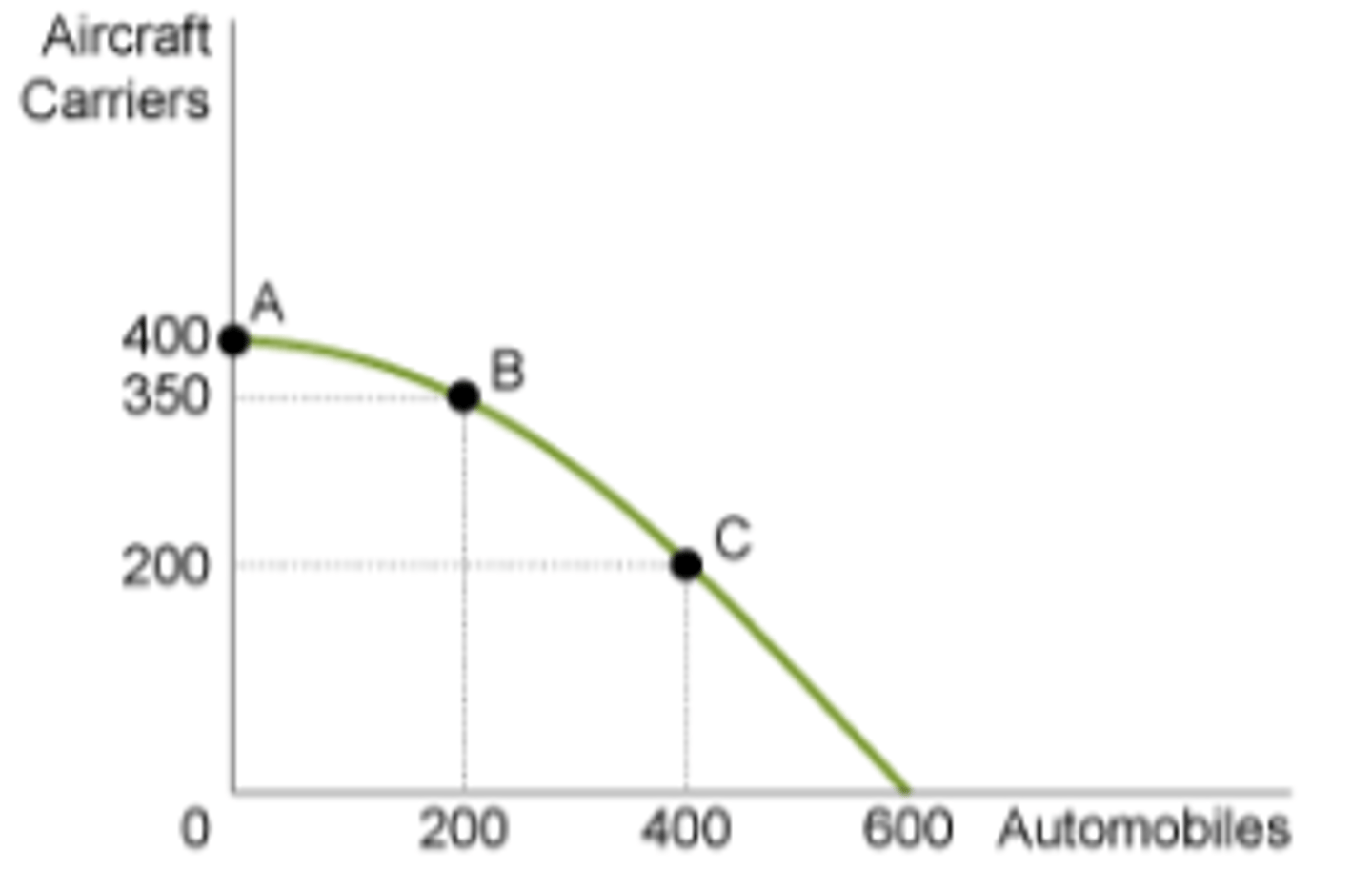
Refer to the graph below. What does the term “increasing marginal opportunity cost” mean in this graph?
a. There is a higher opportunity cost of producing either aircraft carriers or automobiles, so long as the quantity produced of that good is decreasing.
b. There is a higher opportunity cost of producing either aircraft carriers or automobiles, so long as the quantity produced of that good is increasing.
c. Increasing the production of aircraft carriers results in higher automobile production costs, such as the costs of labor and capital to build automobiles.
d. Increasing the production of either aircraft carriers or automobiles creates more opportunities in the economy.
b. There is a higher opportunity cost of producing either aircraft carriers or automobiles, so long as the quantity produced of that good is increasing.
In which markets are factors of production, such as labor, capital, natural resources, and entrepreneurial ability traded?
a. product markets
b. essential markets
c. factor markets
d. competitive markets
c. factor markets
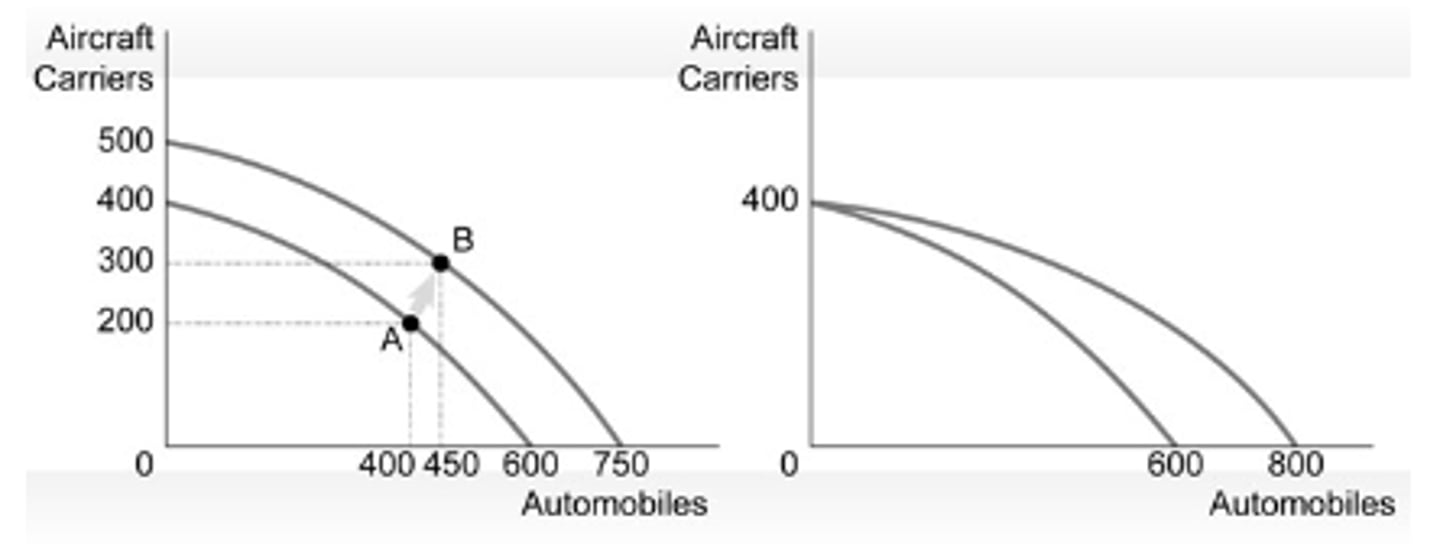
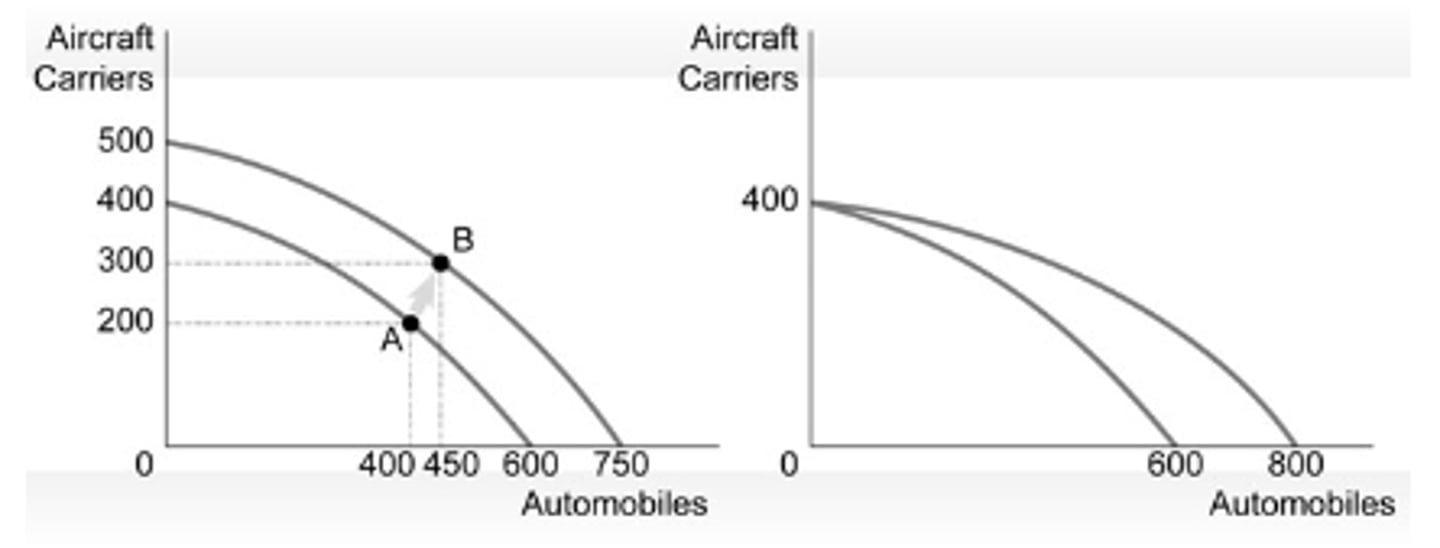
Refer to the graphs below. Which graph best represents the concept of economic growth?
a. the graph on the left
b. the graph on the right
c. both are best
d. neither graph
a. the graph on the left
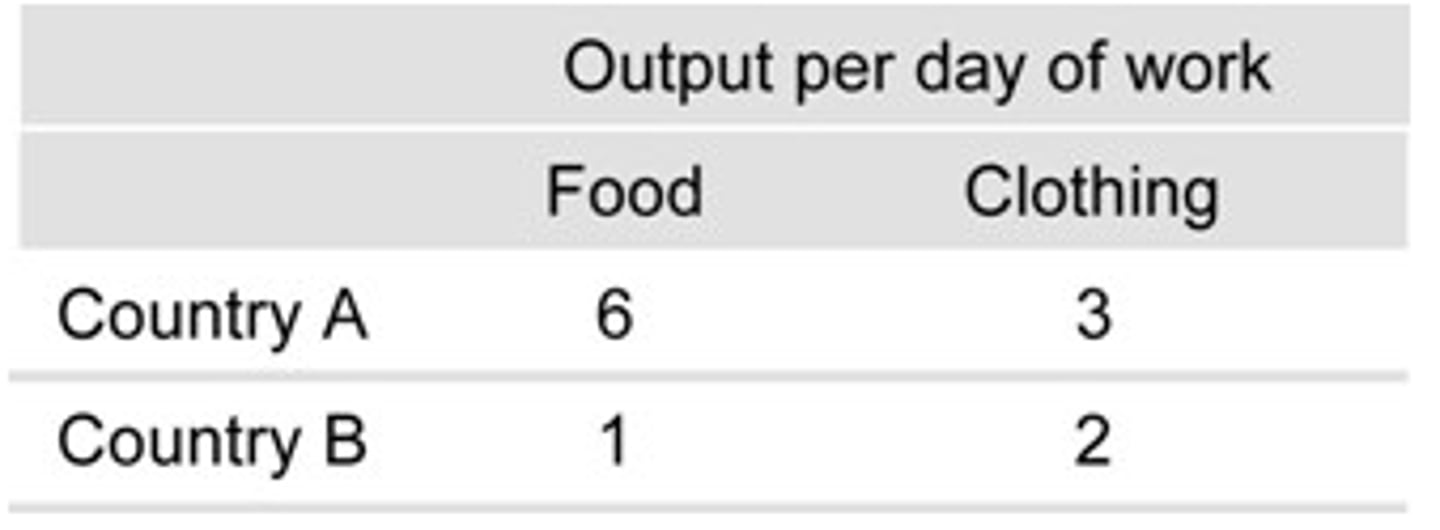
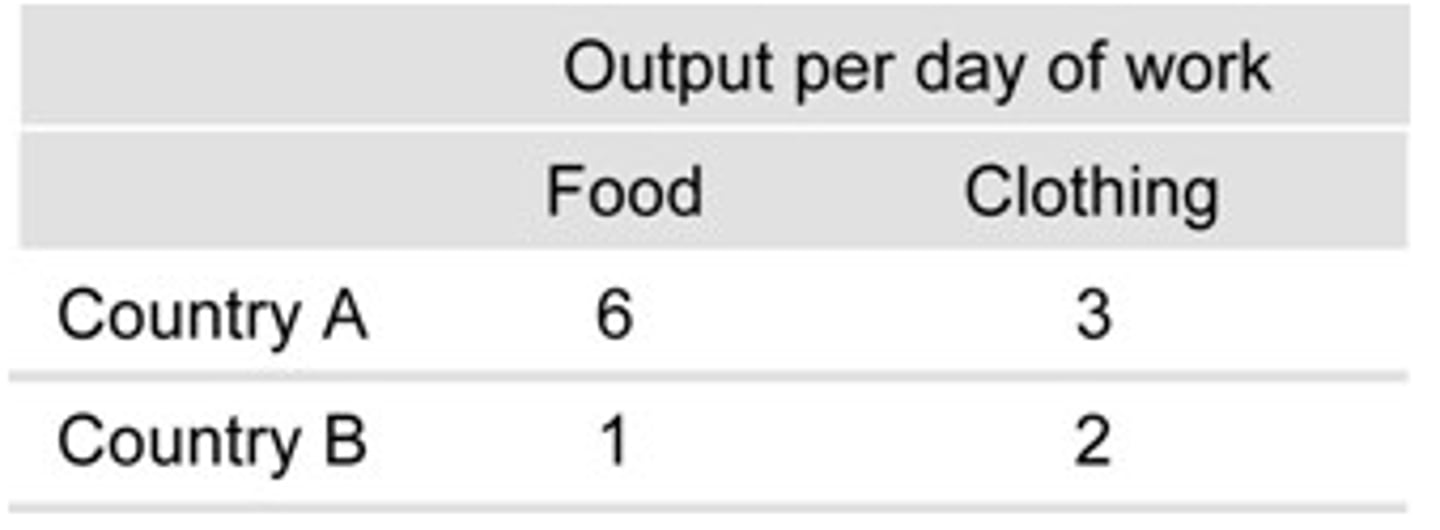
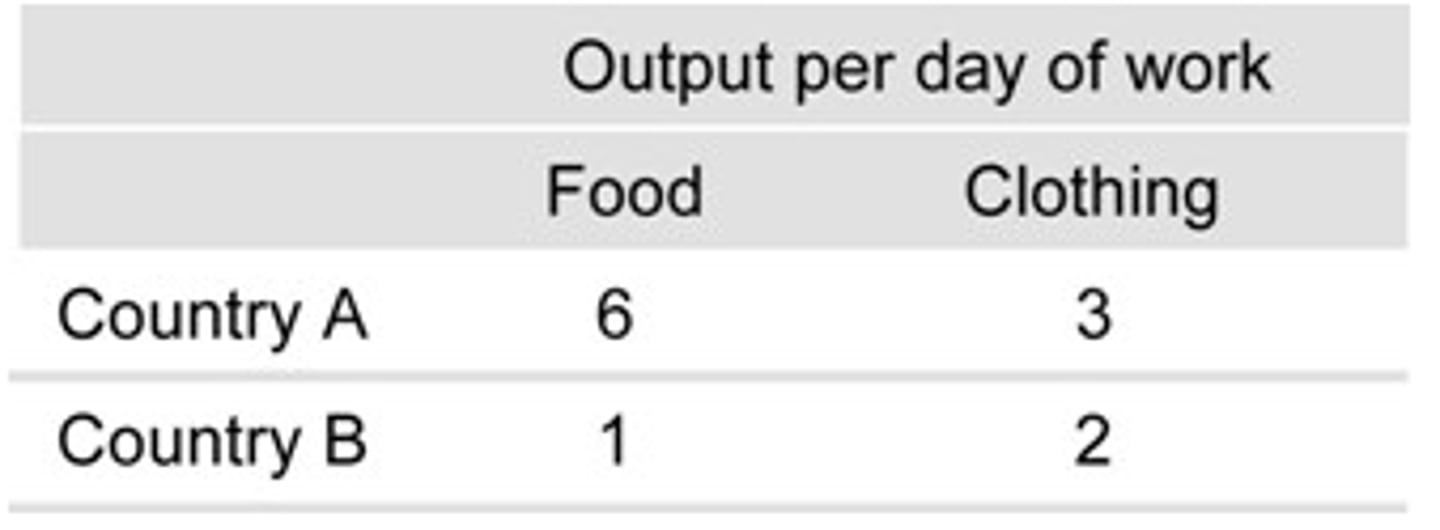
Consider the table below. What is country A’s opportunity cost of producing 1 unit of clothing?
a. 2 units of food
b. ½ a unit of food
c. 6 units of food
d. 2 units of clothing
a. 2 units of food
Which of the following statements is most consistent with positive economic analysis?
a. The United States would be better off being self-sufficient, so it wouldn’t need to rely on other nations for certain goods.
b. The United States would be better off if it specialized in the production of some goods, and then traded some of them to other countries.
c. The United States should produce at home the goods that it now imports—that way the nation can generate additional jobs here at home.
d. The United States should establish trade with friendly countries and avoid trade with its enemies.
b. The United States would be better off if it specialized in the production of some goods, and then traded some of them to other countries.
Which of the following comprises the two key groups of participants in the circular flow of income?
a. product markets and factor markets
b. government and the financial sector
c. households and firms
d. buyers and sellers
c. households and firms
The principle of increasing marginal opportunity cost states that the more resources devoted to any activity, the ______ the payoff to devoting additional resources to that activity.
a. smaller
b. greater
c. proportional
d. more instant
a. smaller
In the circular-flow diagram, which arrow shows the flow of income paid to the factors of production?
a. A
b. B
c. C
d. D
d. D
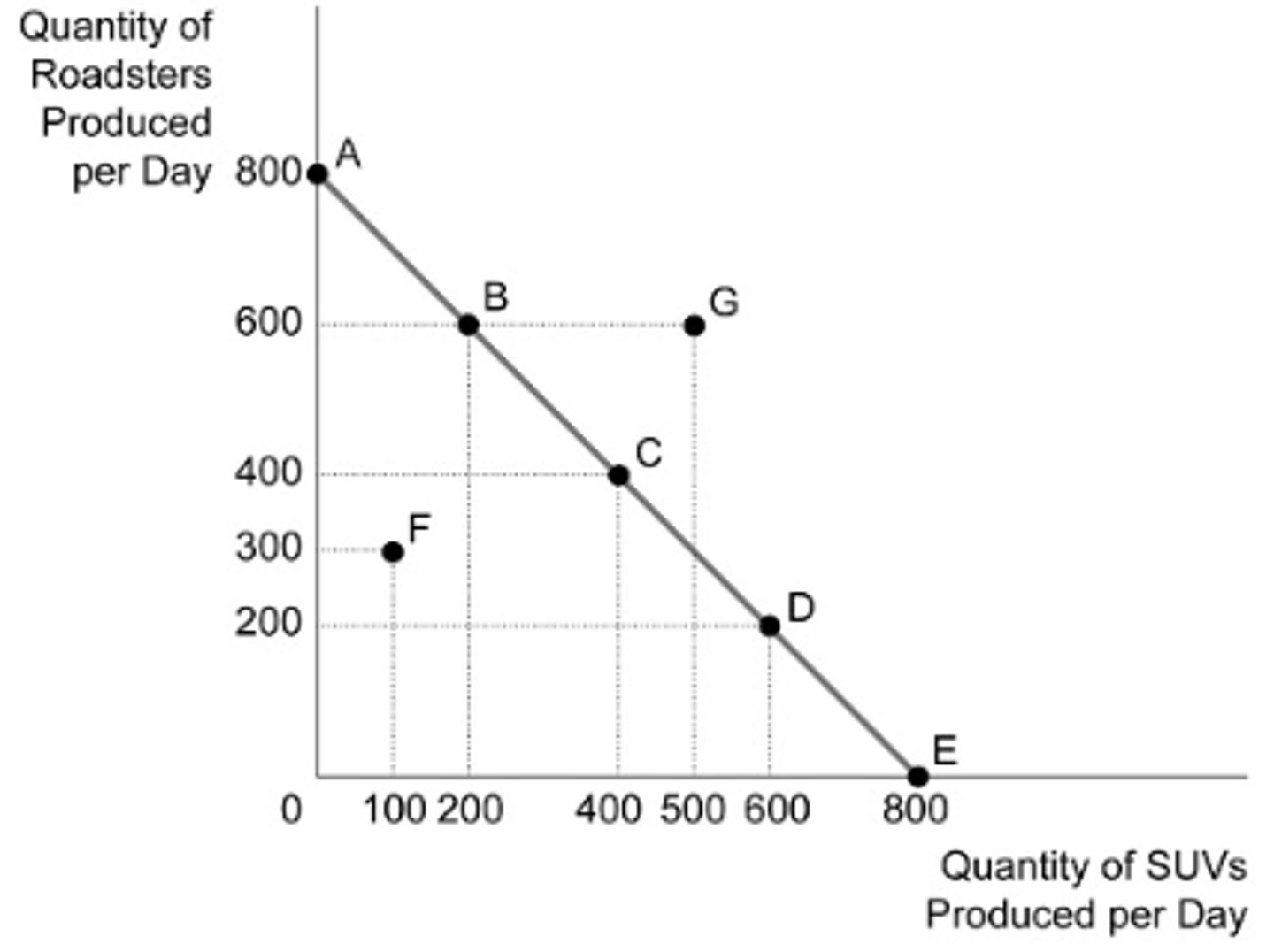
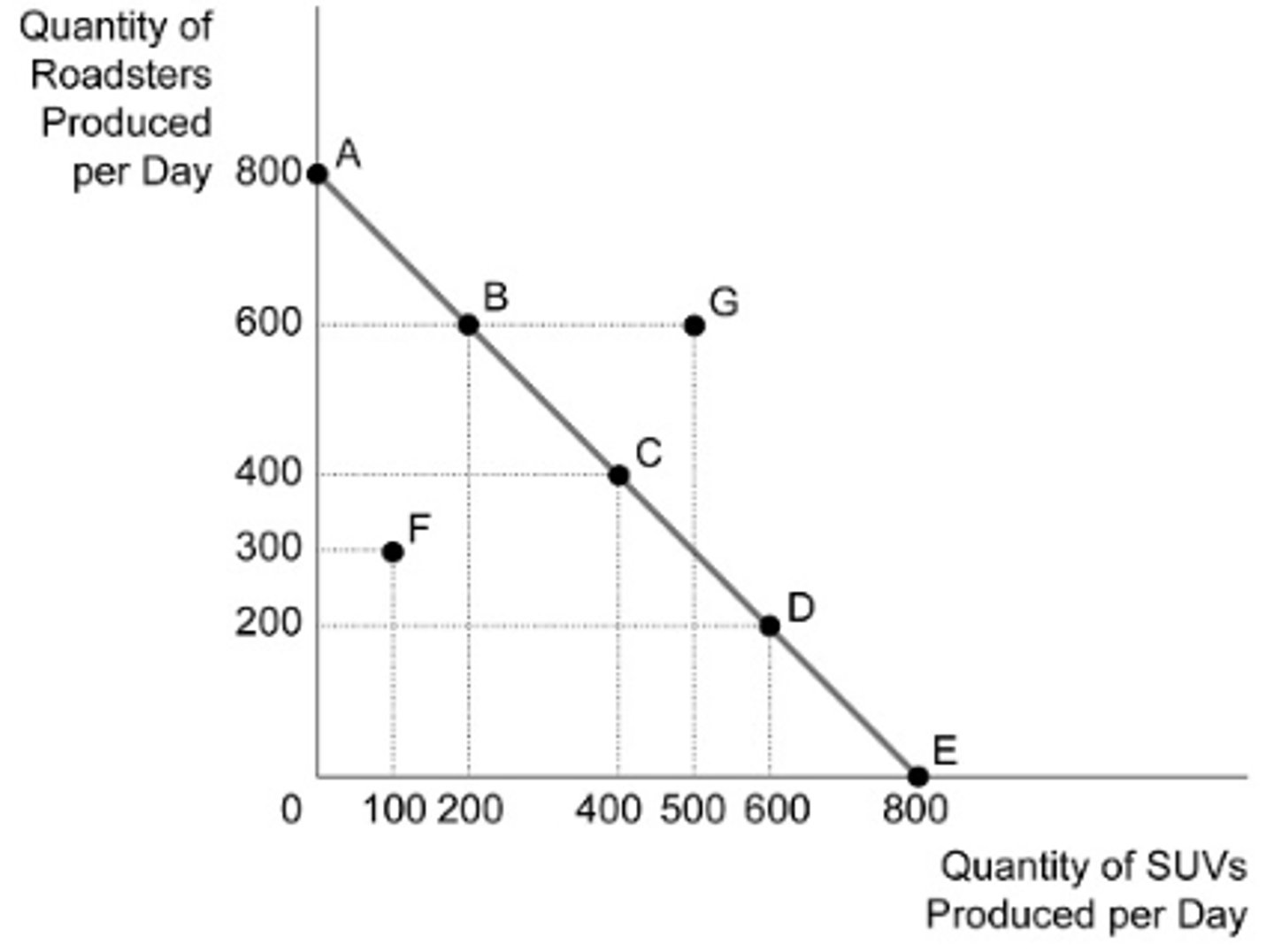
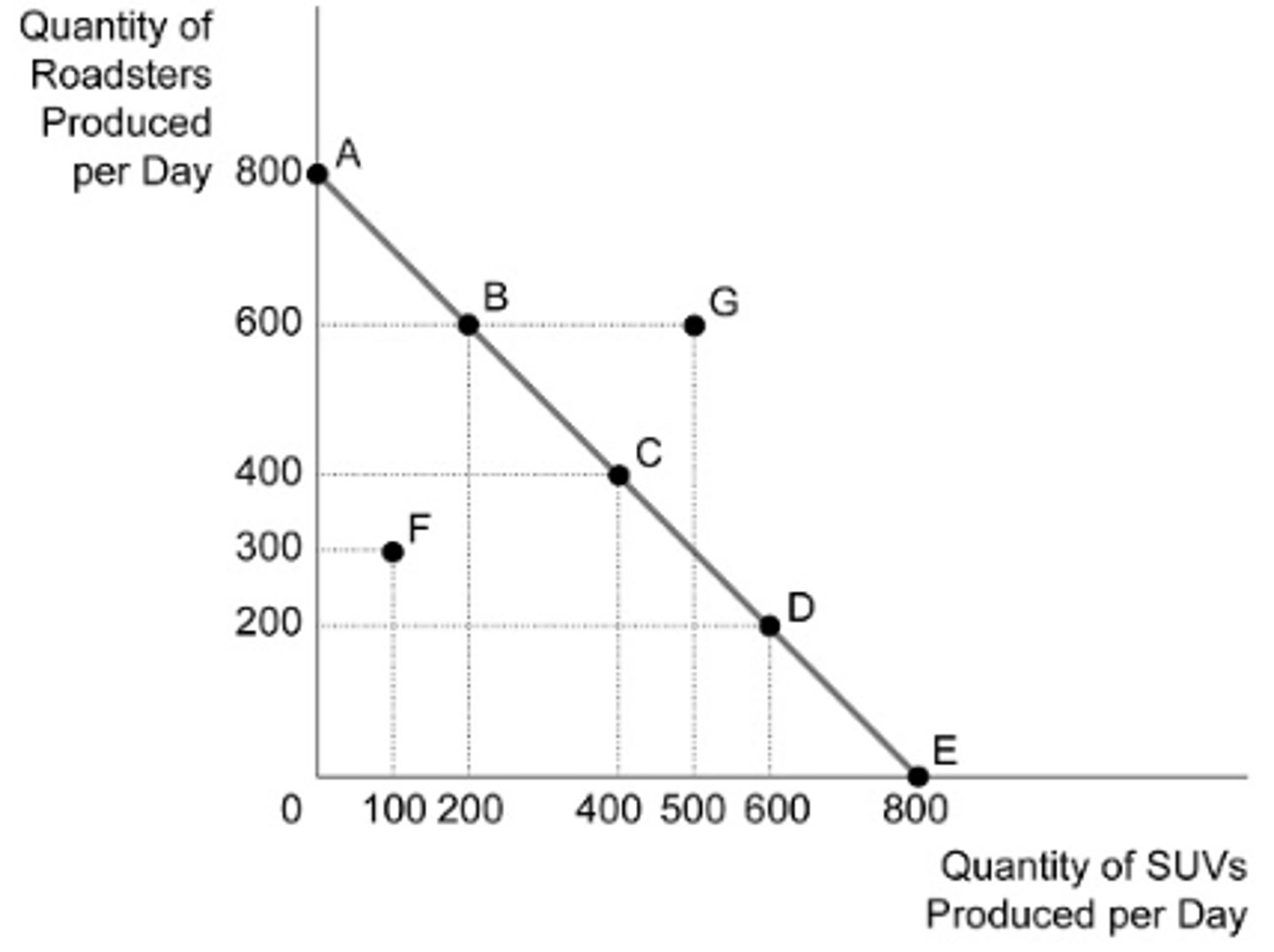
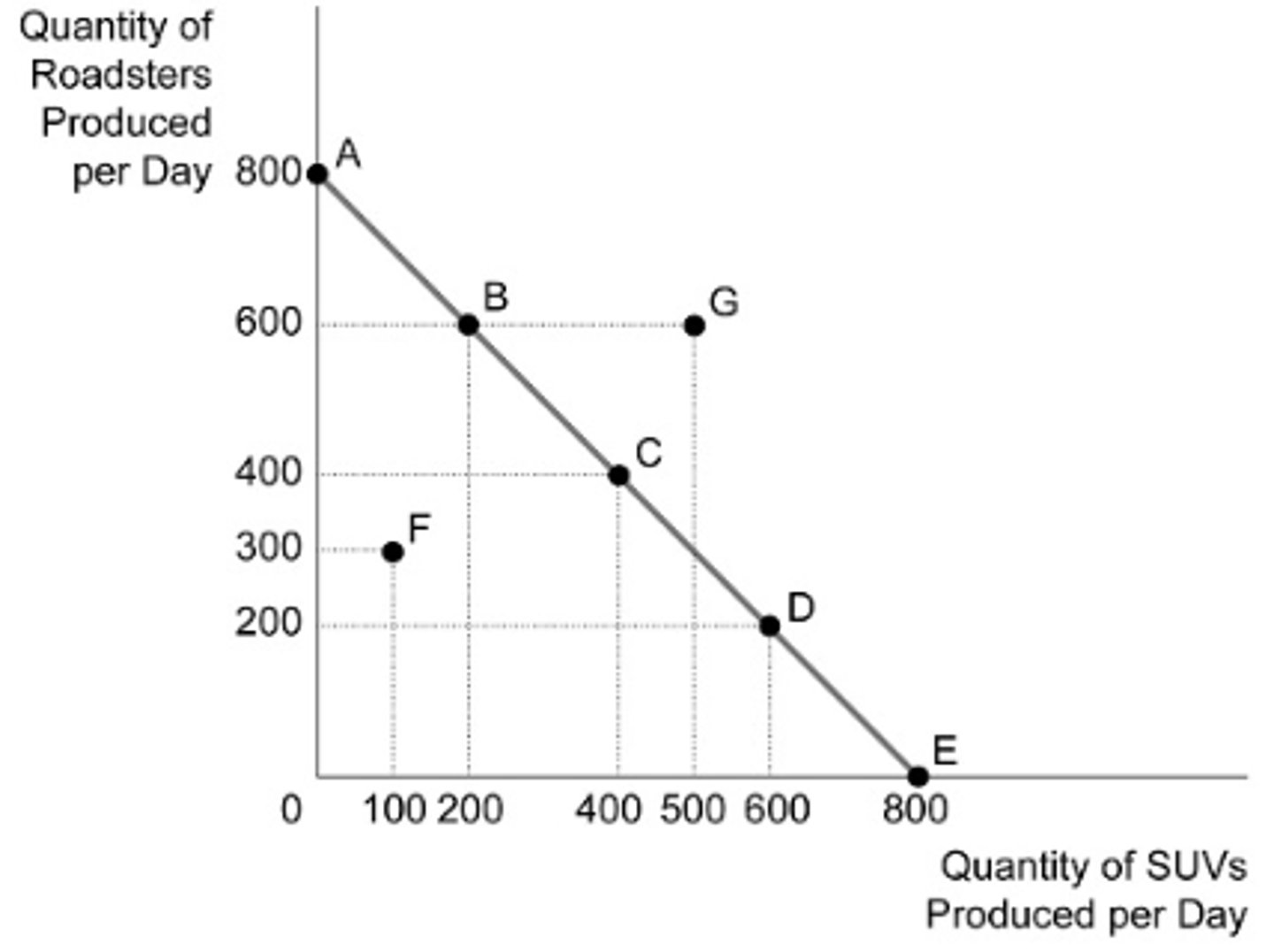
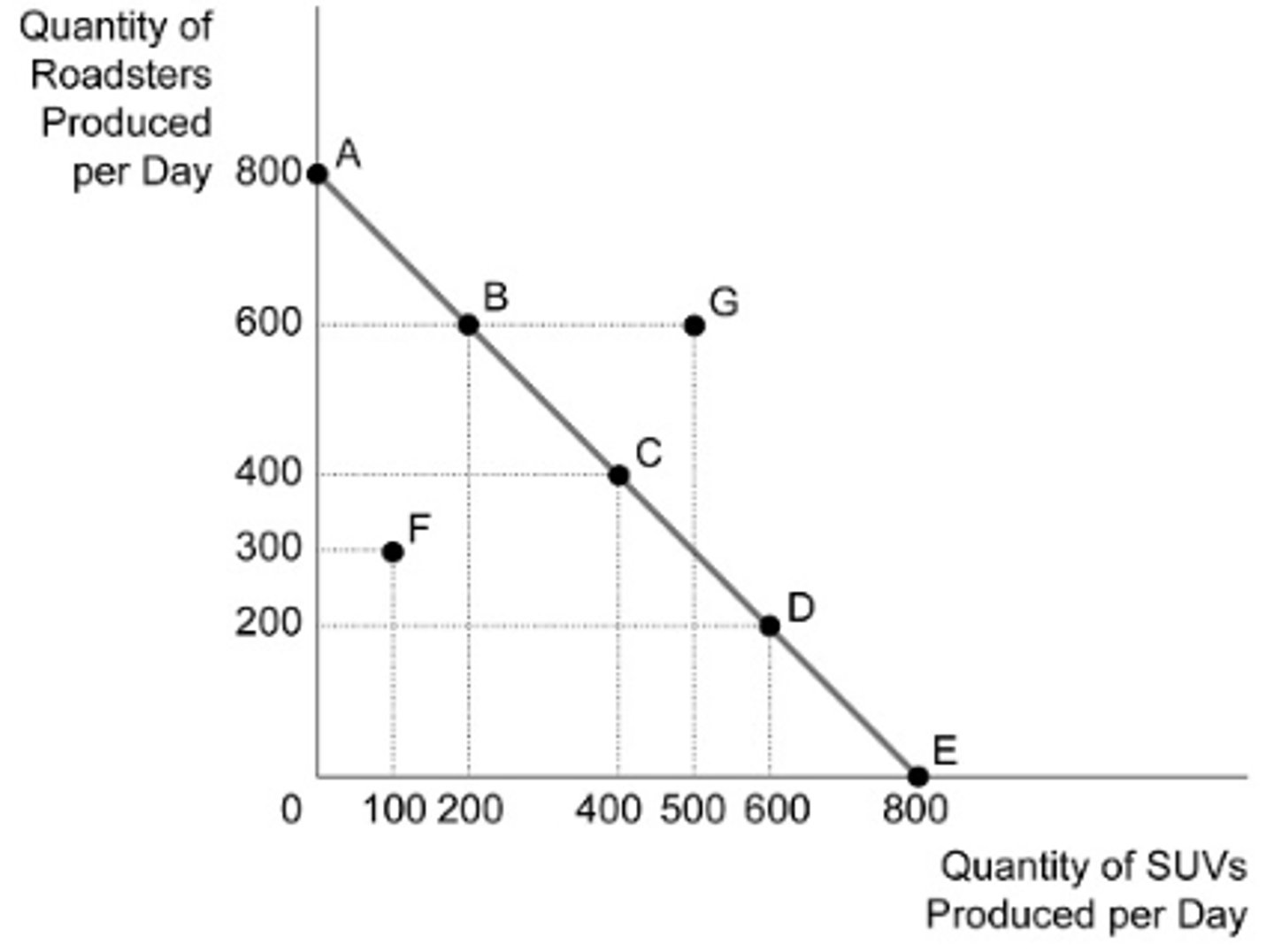
Refer to the graph below. How many roadsters are produced at the point where BMW produces 800 SUVs?
a. 0
b. any amount up to 800
c. exactly 800
d. 400
a. 0
What is the role of an entrepreneur?
a. to operate a business that produces a good or service.
b. to bring together the factors of production—labor, capital, and natural resources.
c. to take risks.
d. all options are correct
d. all options are correct
If a market system functions well, which of the following is necessary for the enforcement of contracts and property rights?
a. powerful political connections.
b. an independent court system.
c. action by government to prevent the exercise of certain property rights.
d. all are correct
b. an independent court system.
The table below shows the quantity of two goods that a worker in Country A and a worker in Country B can produce per day. Which country has an absolute advantage in the production of each good?
a. Country A has an absolute advantage in the production of each good.
b. Country B has an absolute advantage in the production of each good.
c. Both countries have an absolute advantage in the production of each good.
d. Neither country has an absolute advantage in the production of each good.
a. Country A has an absolute advantage in the production of each good.
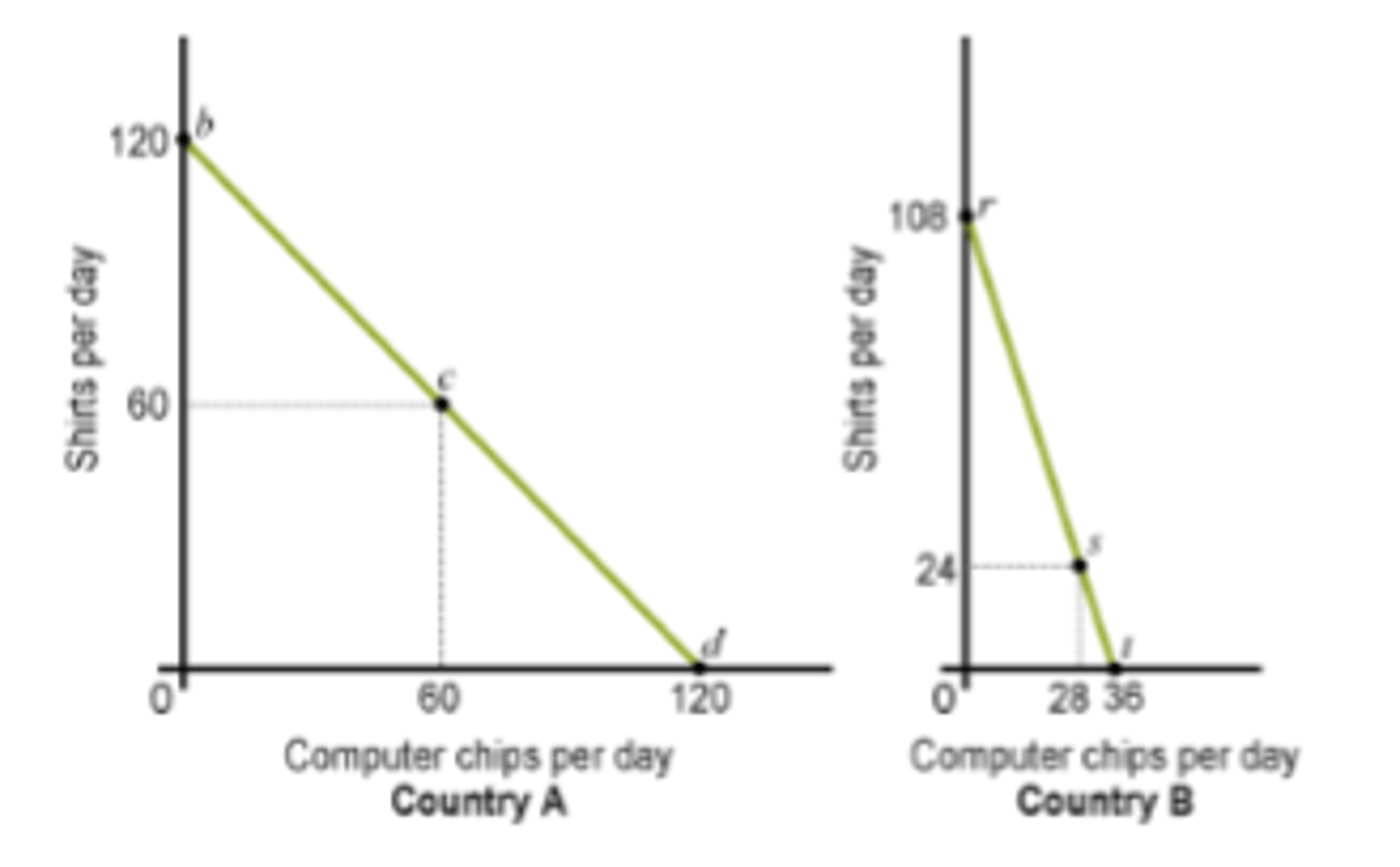
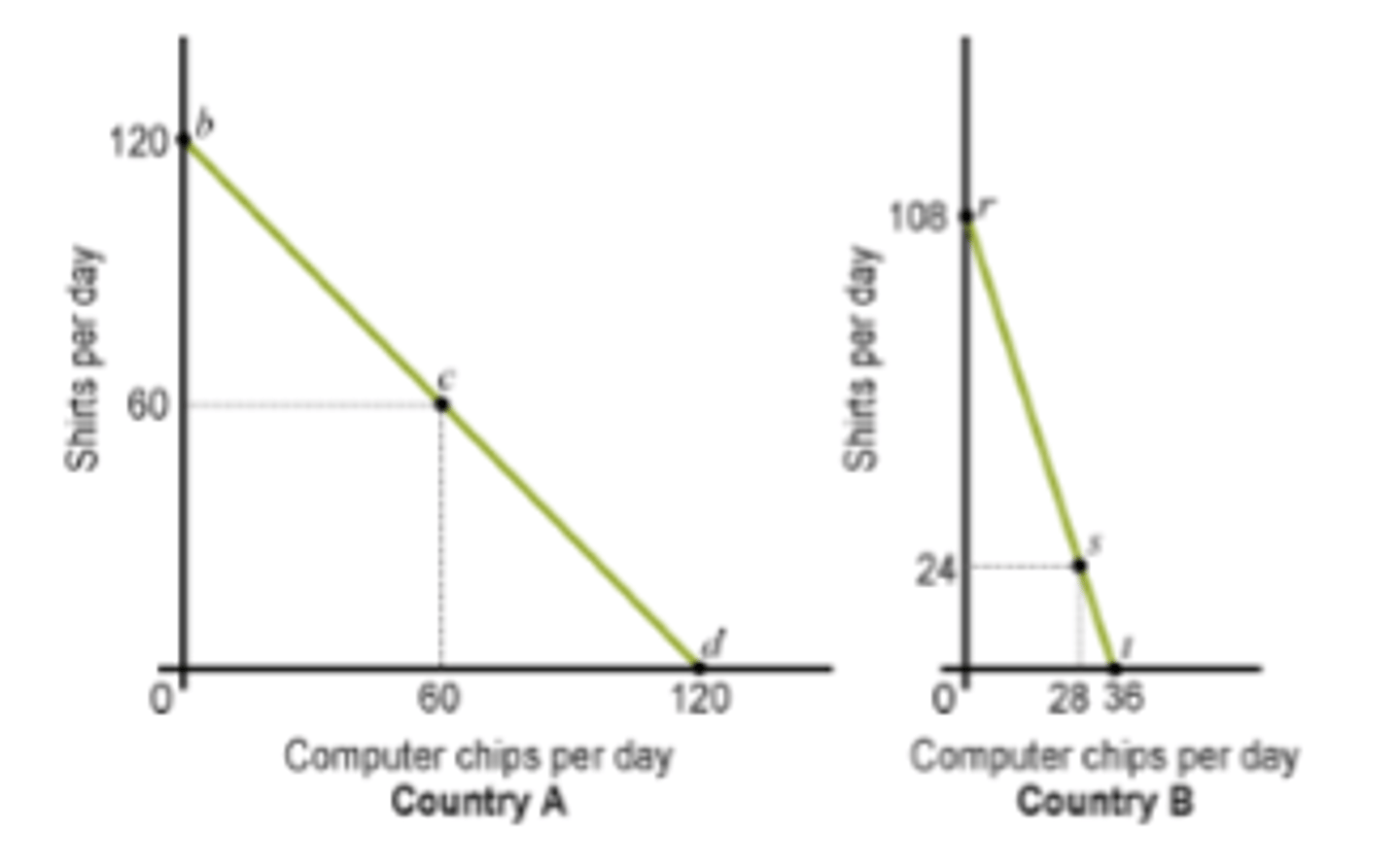
Refer to the graphs below. Each graph represents one country. Which country has a comparative advantage in the production of shirts?
a. Country A
b. Country B
c. neither country
d. both countries
b. Country B
Which of the following refers to markets where goods such as computers or services such as medical treatment are offered?
a. product markets
b. essential markets
c. factor markets
d. competitive markets
a. product markets
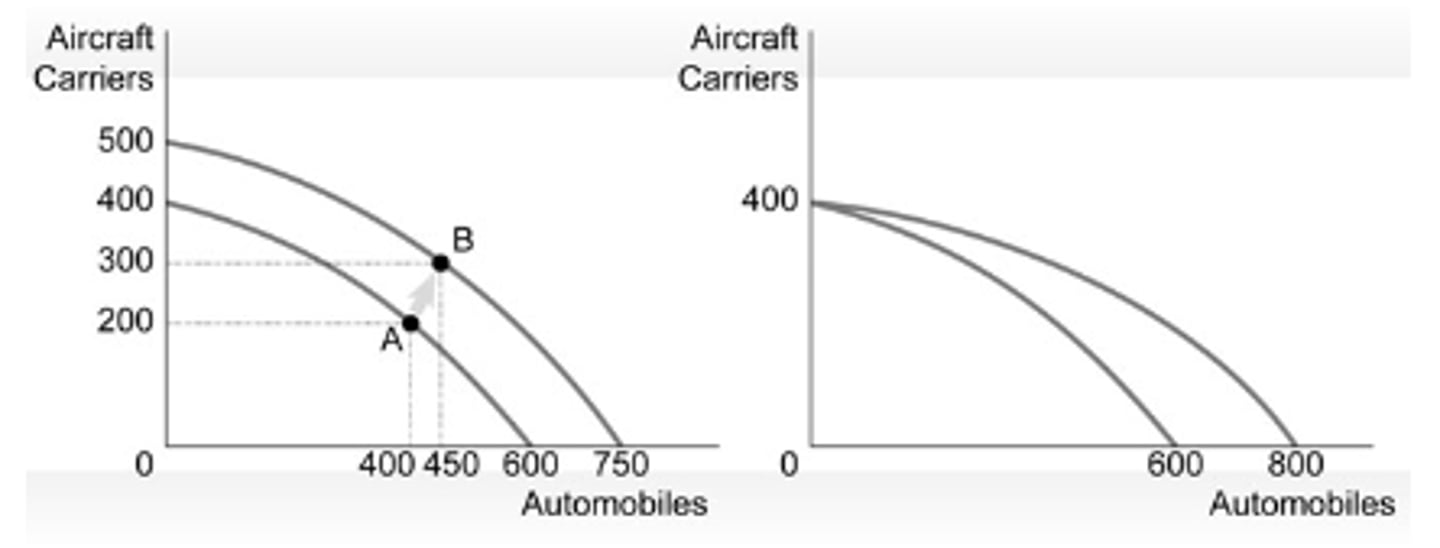
Refer to the graphs below. Which of the following could have caused the outward shift of the curve in the graph on the left side?
a. an increase in technology that affects the production of both aircraft carriers and automobiles
b. technological change that affects only the aircraft carrier industry
c. unemployment in the economy
d. a change in the cost of producing automobiles
a. an increase in technology that affects the production of both aircraft carriers and automobiles
In the circular-flow diagram, which arrow shows the flow of goods and services?
a. A
b. B
c. C
d. D
b. B
Refer to the graph below. What is the opportunity cost of producing 400 aircraft carriers?
a. 200 automobiles
b. 50 aircraft carriers
c. 200 automobiles
d. 600 automobiles
d. 600 automobiles
Refer to the graph below. Which of the following combinations is inefficient?
a. combination G
b. combination F
c. combinations A or E
d. both F and G
b. combination F
Refer to the graphs below. What is point B' on your neighbor’s PPF curve?
a. Point B' is your neighbor’s production before trade.
b. Point B' is your neighbor’s consumption before trade.
c. Point B' is your neighbor’s production after trade.
d. Point B' is your neighbor’s consumption after trade.
d. Point B' is your neighbor's consumption after trade.
What is the outcome of enforcing contracts and property rights in a market system?
a. increased economic activity
b. decreased economic activity
c. no effect on economic activity
d. an unpredictable but definite effect on economic activity
a. increased economic activity
Refer to the graphs below. Which graph better represents an improvement only in the technology used to make automobiles?
a. the graph on the left
b. the graph on the right
c. both graphs
d. neither graph
b. the graph on the right
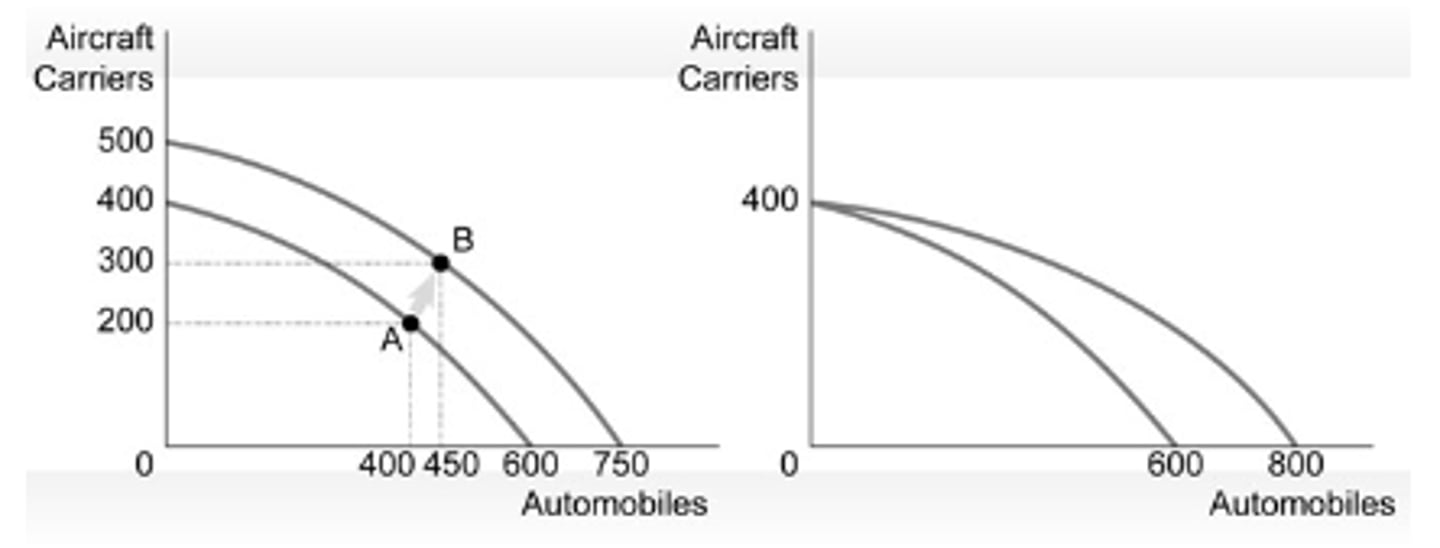
Refer to the graphs below. Which graph best represents the concept of economic growth?
a. the graph on the left
b. the graph on the right
c. both are best
d. neither graph
a. the graph on the left
Refer to the graph below. Which of the following combinations is unattainable with the current resources available in this economy?
a. combination G
b. combination F
c. combinations A or E
d. All options are correct. None of the combinations above can be attained with current resources.
a. combination G
In a free market system, which of the following groups brings together the factors of production— labor, capital, and natural resources—in order to produce goods and services?
a. the government
b. entrepreneurs
c. lobbyists
d. politicians
b. entrepreneurs
According to Adam Smith, which of the following is the instrument the invisible hand uses to direct economic activity?
a. price
b. government regulation
c. financial markets
d. cost
a. price
What is the name given to the highest-valued alternative that must be given up to engage in any activity?
a. scarcity
b. the production possibilities frontier
c. opportunity cost
d. a trade-off
c. opportunity cost
Refer to the graph below. The graph shows the data from Solved Problem 2-1. What is the opportunity cost of switching from Choice D to Choice E?
a. two pies
b. eight pies
c. two cakes
d. one cake
d. one cake
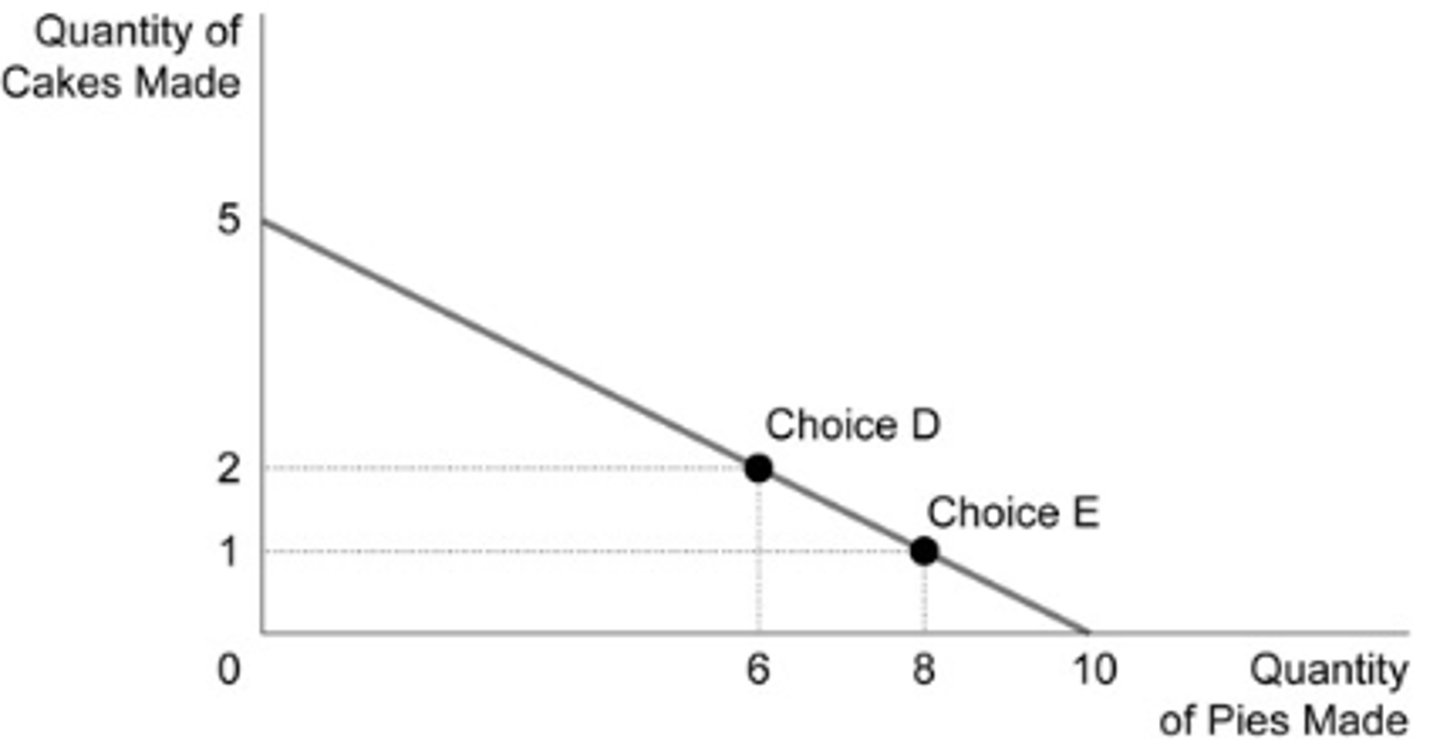
Refer to the graph below. In this problem, what is the opportunity cost of producing five cakes?
a. zero cakes
b. zero pies
c. ten pies
d. There is insufficient information to answer the question.
c. ten pies
Refer to the graph below. What is the opportunity cost of moving from point B to point C?
a. 200 SUVs
b. 400 SUVs
c. 200 roadsters
d. 400 roadsters
c. 200 roadsters
Fill in the blanks. In a simple circular-flow model, there are flows of _____; and _____ .
a. factors of production; goods and services
b. funds received from the sale of factors of production; spending on final goods and services
c. Both are correct
d. neither are correct
c. Both are correct
Refer to the graph below. As you move from point A to point B and then to point C on this graph, what happens to the marginal opportunity cost?
a. It increases.
b. It decreases.
c. It remains constant.
d. It equals zero.
a. It increases.
Refer to the graph below. Which of the following best represents the situation in which BMW must face a trade-off between producing SUVs and producing roadsters
a. any point on the graph represents that trade-off
b. moving from B to C
c. moving from F to B
d. moving from C to G
b. moving from B to C
Which of the following would create economic growth; that is, shift the production possibilities frontier outward?
a. an increase in the available labor
b. an increase in technology that affects the production of both goods
c. an increase in the available natural resources
d. all are correct
d. all are correct
Which of the following is critical to the success of a market system?
a. to allow individuals or firms to have exclusive use of their property
b. to prevent individuals from buying or selling their property depending on the circumstances
c. to allow the government to determine the optimal use of private property.
d. all of the above
a. to allow individuals or firms to have exclusive use of their property
According to Adam Smith, which of the following is true?
a. Markets work because producers, aided by government, ensure that neither too many nor too few goods are produced
b. Market prices can come to reflect the prices desired by all consumers.
c. Individuals usually act in a rational, self-interested way.
d. All are correct
c. Individuals usually act in a rational, self-interested way.
Refer to the graph below. What is the opportunity cost of moving from point B to point C?
a. 200 automobiles
b. 400 automobiles
c. 50 aircraft carriers
d. 150 aircraft carriers
d. 150 aircraft carriers
Refer to the graphs below. Each graph represents one country. Which country should specialize in the production of chips?
a. Country A
b. Country B
c. Neither country; they both should produce some chips and some shirts.
d. Both countries should specialize in the production of chips.
a. Country A
Consider the table below. Which country has a comparative advantage in the production of each good?
a. Country A has a comparative advantage in the production of both goods.
b. Country B has a comparative advantage in the production of both goods.
c. Country A has a comparative advantage in the production of food; Country B has a comparative advantage in the production of clothing
d. Country B has a comparative advantage in the production of food; Country A has a comparative advantage in the production of clothing.
c. Country A has a comparative advantage in the production of food; Country B has a comparative advantage in the production of clothing