icd final
 Call Kai
 Learn
Learn Practice Test
 Spaced Repetition
 Match
Match Flashcards
 Knowt Play
1/99

There's no tags or description
Looks like no tags are added yet.
Name | Mastery | Learn | Test | Matching | Spaced | Call with Kai |
|---|
No analytics yet
Send a link to your students to track their progress
100 Terms
social cognition
cognitive development that combines social psych w cog psych
how do infants and children reason about other people?
joint attention
The shared attention of two individuals on the same object or event
Happens through shifts in gaze, head turning, and pointing
joint attention timeline
• “Gaze” following starts to happen between 3-6 months, but it’s not fully about shared visual attention until a bit later:
By the end of the first year:
• Infants know the importance of eyes for interpreting other’s attention
Using eyes, specifically
• 9-month-olds will follow head turns, even when eyes are closed! because people turning head is cueing them to something else
• By 10-11 months, they only follow head turns when it also involves open eyes because they learn that eyes are what is involving attention
By the end of the second year:
• Infants use pointing so that they can establish joint attention with others
interpreting others’ actions
One important feature of other people’s actions is interpreting their goal – what they want – not just what they do.
interpreting actions as goal directed
When a human repeatedly reaches for an object (here, a ball) – they’re surprised when that human later reaches for the alternative object (here, a bear)
When the same actions are done by a mechanical claw – they do not make the same predictions! They look equally at the claw later picking up the ball or the bear.
interpreting actions timeline
• By 6-months infants interpret other people’s actions to be goal directed
By 9-months, infants use shared interests and behavior to predict affiliation
By 9 months, infants use shared interests to predict how people will interact.
If they see two people express the same liking for an object, they expect those people to be friendly toward one another.
They will actually look longer (expressing surprise) if they see people who disagreed on an object later acting in a friendly way.
By 14-months, infants will selectively imitate behaviors based on the goal of the person
At 14 months, infants don't just copy what a person does; they copy what the person intended to do.
The "Hands-Free" Example: If an infant sees an adult turn on a light with their head because their hands are occupied (e.g., holding a blanket), the infant will use their hands to turn on the light.
The Reasoning: The infant understands the goal is to turn on the light and realizes the adult only used their head because their hands were busy. They choose the most efficient way to achieve the same goal.
Increasingly complex connection between reasoning about social cognition and behavior
wow does social cognition develop?— culture
Strikingly similar development, despite different contexts!
Social cognitive is very robust – can develop through many different kinds of experiences!
the role of experience: objects
Children’s own experience reaching for objects impacts their interpretation’s of other people’s reaching for objects
Infants use their own motor experience as a template to understand the social world. By learning "I reach for things because I want them," they gain the ability to reason: "That person is reaching for the bear because they want the bear." —> ex: sticky mittens experiment
theory of mind
Understanding that others have mental states that affect their behavior
mental states include: desires, thoughts, beliefs, knowledge, and feelings
A flurry of research since the 1980s!
What about young children? Is it really shared across primates? When and how does this develop?
theory of mind is measured by
false belief tasks
false belief tasks
Not until children are 4 or 5 can they “pass” these tasks by overriding their knowledge of the true state of the world to understand other’s beliefs
how does developmental change happen: theory of mind
theory-theory
The idea:
• Children have a “Theory” of “mind”
• Initially this is based on their own mind
• With experience, they start to learn about things in the world and more complex perspectives and they can change their theory
theory-theory: Desire vs. Beliefs
The Core Experiment: Broccoli vs. Crackers
The video likely features a classic study by Repacholi and Gopnik (1997) used to test "Diverse Desires":
The Set-up: An adult shows a child a bowl of broccoli and a bowl of goldfish crackers. The adult tastes both, acts disgusted by the crackers, but acts delighted by the broccoli (even though most kids prefer the crackers).
The Request: The adult then asks the child, "Can you give me some?"
14-month-olds (Fail): They typically give the adult the crackers. Their "theory" of mind is still based entirely on their own mind—since they like crackers, they assume everyone likes crackers.
18-month-olds (Pass): They give the adult the broccoli. They have revised their theory to include diverse preferences, realizing that someone else can want something different than what they want themselves.
Understanding that people can hold false beliefs may be harder than understanding people can hold different preferences —> thats why children may understand preferences before false belief
developmental order, theory of mind
In Western cultures…
• Theory of Mind develops first in terms of different desires
• Then, down the list on the left BUT: this order varies in other cultures, such as China, Japan, Singapore
• E.g., Understanding knowledge comes after understanding beliefs
In Western Cultures (like the US or Canada): Children typically follow this "staircase" of understanding:
Diverse Desires: Realizing people want different things (the broccoli vs. crackers study).
Diverse Beliefs: Realizing people can have different opinions about the same thing.
Knowledge Access: Understanding that if someone hasn't seen something, they don't know it.
False Belief: Realizing someone can believe something that is objectively wrong.
In cultures like China, Japan, and Singapore, the order often flips:
Children in these cultures often understand Knowledge Access (who knows what) before they understand Diverse Beliefs.
Why? Researchers think this might be because these cultures place a higher social emphasis on respect for elders and collective knowledge—basically, knowing what the "group" knows is prioritized over individual differing opinions.
developmental cascades, theory of mind: What other ability or skill might be needed to ”pass” the false belief theory of mind task?
Inhibitory Control: Overriding your dominant response (your own belief)… to respond accurately (the other person’s false belief)
what other abilities or skills might require theory of mind?
Friendships
lying and deception
game playing
strategies for persuading others
theory of mind summarized
Children must learn that other people have independent mental states
• Not all mental states are recognized at the same time
• For example: will accept diverse preferences before passing false belief tasks
• Inhibitory control may be an important contributor to understanding false beliefs and Theory of Mind
• Theory of Mind is required for many activities that involve other people: friendships, lying & deceiving, playing games, persuasion
by early childhood, children are starting to think about these things like how you do when getting information they use..
reliability and familarilty
reliability
Judged the accurate adult as more reliable
• Later they want to seek information from the accurate adult
specific knowledge informing reliability
efers to how children don't just see adults as "generally smart," but start to understand that different people have different types of expertise.
By the time children reach early childhood, they use a person's past success in a specific area to decide if they should trust them for new information in that same area.
The Experiment: The "Fixer" vs. The "Labeler"
The slides describe a study where children watch two different adults interact with a broken toy and some tools (like a wrench or screwdriver):
The Expert (The "Fixer"): This person uses the tools correctly to actually fix the toy.
The Non-Expert: This person might name the tools but doesn't actually fix anything.
they choose the person who at the end was more reliable
familarity
Kids trust a familiar adult more than a stranger
Kids seek out a familiar adult more than a stranger for new information
familiar adult says a random object is called a hoon vs stranger says its a snegg —> kid will say it is a hoon because they go with the familiar person, when asked who to ask about the new object they go to the familar person
what happens when the adult you know is wrong?
They detail a study that asks: If an adult you know is wrong, do you still trust them more than a stranger who is right?
The Setup
The experiment involves two adults:
Familiar Adult: Someone the child knows, but who is being unreliable (e.g., calling a spoon a "duck").
Reliable Adult: A complete stranger who is being accurate (e.g., calling a spoon a "spoon").
The children are then shown a new, made-up object and both adults give it a different fake name (like "heff" vs. "snegg"). The child is asked: "What do you think it's called?"
The Results by Age
The study found a clear developmental shift in who children choose to believe:
3-year-olds: They almost always go with the Familiar Adult. At this age, the social bond and "knowing" the person outweighs the fact that the person was just wrong about the spoon.
4-year-olds: They become uncertain. They are in a transitional phase where they recognize the familiar person is wrong, but they still feel a pull to trust them. They often hesitate or show confusion.
5-year-olds: They go with the Reliable Adult. By age five, children prioritize accuracy and context-specific reliability over personal familiarity. They realize that if someone is wrong about basic things, they aren't a good source for new information—even if they are a "friend."
evaluating people’s knowledge and expertise by age
By 3-years-old: using past reliability and familiarity to decide who to trust and get information from
• When these are in conflict: using primarily familiarity
• By 5-years-old: also using reliability and familiarity
• When these are in conflict: use context-specific reliability, over familiarity
how does morality develop?
At least three overlapping factors:
1. Socialized through experience
2. Constructed through children’s own actions
3. Based on an (innate?) “moral core”
classic theories
Classic theories of moral development by scientists like Piaget, Kohlberg, and Gilligan include developmental components
• But they tend to underestimate children’s attention to different social and morally relevant features that might be relevant
kohlberg moral dilemma
famous heinz dilemma
what is heinz dilemma
The Heinz Dilemma is a famous ethical scenario used by psychologist Lawrence Kohlberg to study and categorize the stages of moral development. Rather than focusing on whether the person’s choice was "right" or "wrong," Kohlberg was interested in the reasoning behind the decision
When Kohlberg presented this to children and adults, he asked:
Should Heinz have stolen the drug?
Would it change anything if Heinz did not love his wife?
What if the person dying was a stranger?
Should the police arrest the pharmacist for murder if the woman died?
Pre-conventional Level (Approx. Ages 4–10): Children at this stage focus on direct consequences. They might say Heinz shouldn't steal because he'll go to jail, or he should steal because he'd be sad if his wife died.
Conventional Level (Approx. Ages 10–13+): Adolescents begin to internalize the moral standards of adult role models and society. They focus on maintaining social order and following the law (e.g., "Stealing is illegal no matter what").
Post-conventional Level (Adulthood): Only some adults reach this stage, where they realize that individuals are separate entities from society and that their own principles (like the sanctity of life) may take precedence over laws.
moral core
Propose an early (maybe innate) tendency to identify and like individuals who are cooperative, empathetic, or helpful, and dislike individuals who are uncooperative, unempathetic, or unhelpful
helper-hinderer studies
Infants are presented with a scene where one character helps and another hinders the main character’s goal
• Then by reaching (older infants) or looking (younger infants), which character does the baby prefer?
helper-hinderer study results
By 3-months, infants prefer helpers over hinderers
• At least by 6- to 10-months, this seems to be driven by a liking of helpers (picking helper vs. neutral) and a disliking of hinderers (picking neutral vs. hinderer)
• By 10-months, they prefer the victim of aggression vs. the aggressor and a bystander who intervene against an aggressor to help vs. those who do not intervene.
is the helper-hinder studies really social?
yes, to test this, they used an Inanimate Control with googly eyes but when it happens without the eyes infants show no preference showing they are evaluating social behavior not just movements —> attending to the goal of the main character
8-month olds attend to… (help/hinder)
goals: Prefer Helping when the character is trying to go up hill (based on eyes) But not when there’s not a clear eye-gaze indicating their goal
8-month olds prefer (morality)
an agent who tries to help > doesn’t try, even when neither are successful
10-month-olds prefer (morality)
an agent who helps on purpose > accidentally helps, BUT someone who hurts by accident > hurst on purpose.
15-month olds prefer (knwoledge and beliefs)
someone who provides correct information only when they know the agent has the correct information (vs. when they had false information)
toddlers love to help
prosocial behavior is an active part of a child's natural development.
—>morality isn't just about evaluating others (like picking the "good" puppet); it’s about the child's own actions, they like to help in home showing intrinsic motivation or a moral core towards cooperating
preference for equality in 15-month-olds
15-month-olds look longer at the unfair than at the fair →more surprised!
But, not driven by differences between the numbers – has to involve social agents ex: when one person gets more crackers than someone else (not just about the distribution)
group biases
Infants and children show in group preferences fairly early in life
group manipulation, food preferences
9-14 month old child is asked their preference: between crackers vs green beans
They are then shown two puppets:
Similar Puppet: Expresses a liking for the same food the baby chose.
Dissimilar Puppet: Expresses a liking for the food the baby rejected.
shows preference for in-group —> likes the puppet that likes the same thing better as them
helping vs harming (tangent off of group manipilation)
The experiment then introduces a Helpful Agent (returns a lost ball) and a Harmful Agent (steals the ball).
The Surprising Result:
When the Similar Puppet is involved: Infants prefer the Helper. (Standard "moral core" behavior).
When the Dissimilar Puppet is involved: Infants actually prefer the Harmer.
—> shows idea of social loyalty appearing in human morality as early as 9-14mo
dismilar and similar targets
Infants prefer those who help people like them and harm people not like them…
what are emotions?
Features of emotion:
• They often have emotion elicitors or triggers
• Include physiological changes (HeartRate, hormones)
• Cognitive appraisal associated with the emotion (i.e., how you interpret the feeling)
• Emotional expression (e.g., crying, face, body movement)
• They can serve a communicative function
They can be, and usually are, adaptive!
expressing positive emotions
First sign of happiness: smiles!
• 1st month: reflexive smiles (e.g., during sleep)
• 1.5 to 3 months: emergence of social smiles
• 3-4 months: laughs
• ~7 months: smile more at familiar people
• By end of first year: different kinds of smiles and laughs for different people and situations
expressing negative emotions
From birth: General distress
• What about more specific negative emotions?
Anger: around 4 months
• Increases in intensity between 4-16 months
Fear: lots of debate!
• Increases in intensity between 4-16 months
Both increase in intensity between 4-16 months
Self-conscious emotions, ones that require some sense of self (e.g., shame, guilt): Maybe not until 2nd or 3rd year of life
• But hard to measure! We mostly rely on behavior, but differentiating the behavior from the emotion is challenging!
infants already have basic ability to
discriminate emotions (i.e., tell them apart)?
• use emotional information to guide their own behavior?
discriminating emotions
Evident in a rudimentary way in newborns!
• Open eyes more to happy speech than to angry, sad, or neutral speech
• Prefer to look at happy vs. neutral faces
• By 3-months: distinguish between intensities of happy faces
• By 4-months: happy vs. negative emotions, e.g., anger
• By 5-months: can match emotion across modalities in
strangers
• By 7-months: categorize by positive vs. negative and other features
using emotions to predict behavior
Angry face more likely to lead to hitting than a happy face
• Arises around 12 months… to learn about the world:
• Social referencing: looking for and using social
information (including emotion) in ambiguous situations
• Infants < 12 months typically struggle with this, but it gets better around 12 months +
understand others emotions
Understanding continues to improve over early childhood
not all emotions are recognized equally at the same time in development; emotions differ in terms of:
Valence: positive vs. negative
• Right vs. Left in this diagram
• Arousal: more intense/stimulated vs. less
Up vs. Down in this diagram
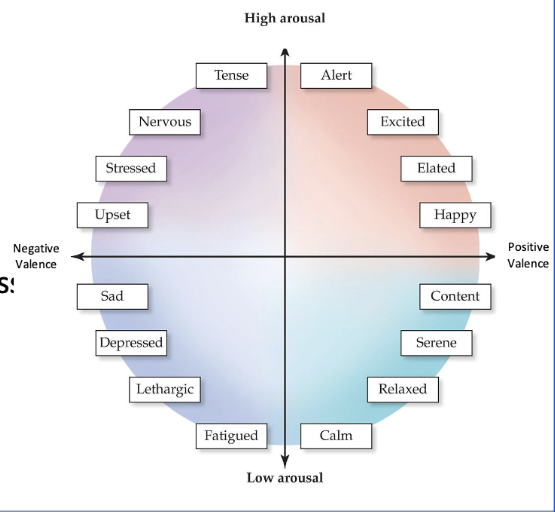
children can discriminate based off of valence
For example:
• “happy” feels good and “sad” feels bad
• can match these feelings with their causes:
• opening a present => good
• getting hurt => bad
But would have a harder time with: • happy vs. excited
• both just “good” (or “positive valence”)
can also discriminate based off of arousal
Within a valence side: high vs. low arousal is then easier
• Tense vs. Fatigued: Even though they’re both negative, different arousal
hardest for children to discriminate in emotions: emotions that have more similar valence & arousal
Depressed vs. Fatigued: Similar valence & arousal
mixed emotions show improvement around age 5
cognitive shift that allows them to understand that a person can experience two different emotions at the same time toward the same situation.
ex: sad and happy
from understanding to regulating
Expressing emotions and understanding emotions in others are not sufficient for all emotional development
• Emotional Regulation: to monitor, evaluate, and modify emotional reactions
emotional regulation in infancy
In early infancy the caregivers primarily support emotional regulation:
• removing infants from distressing situations
• distracting them
• providing hugs…
• Toward end of first year infants start using similar strategies on their own
• Related to:
• Effortful control: voluntarily regulating attention, behavior
• Inhibitory control: an aspect of executive function that allows the person to suppress a dominant or preferred response
emotional regulation in early childhood
Moving toward true self-regulation
• But also need to learn display rules (i.e., cultural norms of what is appropriate emotional expression)
• This can be difficult because of difficulty with effortful control more generally: need to develop strategies!
tempament
individual differences in emotional, motor, and attentional reactivity and self-regulation
• Consistent across tasks
• Consistent across time
original dimesiona and classifications
Nine dimensions:
• Approach-withdrawal
• Adaptability
• Quality of Mood
• Intensity of Reaction
• Distractibility
• Persistence
• Rhythmicity or Regularity
• Threshold of Responsiveness
• Activity
Put into three categories:
• Low Reactive/Easy Babies (~40%):
Easy-going and spontaneously approach new people, objects, and situations
• High Reactive/Difficult Babies (~10%):
Very fearful or avoidant in unfamiliar situations and shy with strangers
• Middle Reactive/Slow to Warm Up Babies (~15%): Mix of both, less consistent traits
modern classifications for temparment
Three dimensions:
• Reactivity or negative emotionality: irritability, negative mood, inflexibility, high-intensity negative reactions
• Self-regulation: effortful control of attentional and emotional processes, persistence, non-distractibility, emotional control
• Approach/Withdraw (or inhibition or sociability): tendency to approach novel situations and people vs. to withdraw and be wary
temperament is related to adult personality
Temperament dimensions
• Reactivity
• Self-regulation
• Approach/Withdraw
Personality
• Openness to experience
• Consciousness
• Extraversion
• Agreeableness
• Neuroticism
reactivity and neuroticism
approach/withdraw and openness to experience
how does temperament relate to emotional development
Reactivity: associated with shyness
• High fearfulness, difficulty with new things
• Difficulty regulating negative emotions
Self-Regulation: regulating toward goals, controlling behavior
• High on these dimensions leads to better emotional regulation
what causes development changes
Direct Effects
• E.g., on social development
• High on the “withdrawal” dimension → social withdrawal
Indirect, or Evocative, Effects
• The child’s temperament elicits different responses from people in their environment
• E.g., Cheerful social children → more positive interactions
• E.g., Highly negative, reactive child → more discipline
Interactional Effects
• Goodness-of-fit with the environmental expectations
• E.g., your temperament is to not engage with new situations right away, but the people around you expect you to engage (or vice versa!)
• E.g., a baby with high activity needs in a small apartment vs. open rural land
attachment
One aspect of the relationship between child and caregiver that is involved with the child feeling safe, secure, and protected
• Children can establish different attachment relations with multiple caregivers!
ainsworth and the strange situation
8 stages —> 4 attachment styles
stages:
1) introduction of infant and caregiver to unfamiliar room
2) infant & caregiver left alone in the room
3) stranger enters room
4) caregiver leaves infant w stranger
5) caregiver re-enters room and stranger leaves
6) caregiver leaves the infant alone in room
7) stranger enters the room
8) caregiver enters room
=
1) secure
2) insecure resistant (ambivalent)
3) insecure avoidant
4) disorganized
4 styles of attachment
What the parent does= quality of caregiving (Sensitive/Loving, Insensitive/Rejecting, Insensitive/Inconsistent, Atypical)
how the child “handles” it= strategies to deal with distress —> organized=predictable, disorganized= unpredictable
the category of attachment= type of attachment
sensitive & loving, organized= secure
Caregiving Quality | Strategy/Predictability | Attachment Style |
|---|---|---|
Sensitive & Loving | Organized | Secure |
Insensitive & Rejecting | Organized | Insecure-Avoidant |
Insensitive & Inconsistent | Organized | Insecure-Resistant |
Atypical (Frightening) | Disorganized | Insecure-Disorganized |
secure attachment
Organized: because the child’s response is predictable – when they’re distressed, they approach the caregiver and maintain contact until they feel safe again
• Secure: because the caregiver is a secure home base from which to explore
• Parental Behavior: consistently respond to distress in loving ways
In the Strange Situation: They might be upset by the caregiver leaving, but are happy when they return and are able to return to play.
• 55% of the general population
avoidant attachment
Organized: because the child’s response is predictable – when they’re distressed, they avoid the caregiver
• Insecure: puts the child at increased risk of social and behavioral issues
• Parental Behavior: the caregiver consistently responds in insensitive/rejecting ways
In the Strange Situation:
• Don’t seem to notice or care when the caregiver comes/goes
• 23% of the general population
resistant attachment
Organized: because the child’s response is predictable – when they’re distressed, they display intensely negative emotions
• Insecure: puts the child at increased risk of social and behavioral issues
• Parental Behavior: the caregiver responds inconsistently or makes the issue about the parents’ distress rather than the child
In the Strange Situation:
• Extremely distressed by the separation & not easily soothed by the reunion
• 8% of the general population
disorganized attachment
Disorganized: display unusual behaviors; freezing behaviors; seems like they can’t find a solution/figure out what to do
• Insecure: puts the child at very high risk for psychopathy and maladjustment
• Parental Behavior: atypical; described as frightening, frightened, dissociated, sexualized, or otherwise atypical; not limited to when the child is distressed
In the Strange Situation:
• Contradictory behaviors; fear and freezing
• ~ 15% of low-risk infants and 85% of high-risk infants
15% of Low-Risk Infants: In stable, "low-risk" environments (typically middle-class families with no history of trauma or abuse), disorganized attachment is relatively rare. Even in these settings, it can occur if a parent is unintentionally frightening or experiences their own unresolved trauma.
85% of High-Risk Infants: In "high-risk" environments, this style becomes the vast majority. These environments often involve:
Socioeconomic extreme poverty.
History of maltreatment, neglect, or abuse.
Parents dealing with severe substance abuse or untreated mental health issues.
attachment shifts by middle childhood
Children become less reliant on their parents as attachment figures to help them deal with stressful situations BUT: the child’s perception of their parents’ availability and responsiveness did not change with age
Positive attachment: support is available, even though they’re figuring out how to be independent and not need it
positive emotional relationships with their parents —> positive psychological and behavioral adjustment
insecure attachments in middle childhood —> internalizing problems (e.g., anxiety and depression)
2 dimensions of parenting styles
1. responsiveness/warmth: the level of affection, support, and responsiveness a parent shows toward their child. It includes behaviors like being nurturing, accepting, and showing love and affection.
2. demandingness/control: the extent to which a parent sets boundaries, expectations, and consequences for their child's behavior. It involves establishing rules, monitoring behavior, and using discipline to guide children.
permissive parents
high in warmth/responsiveness
• low in control/demandingness.
allow children to do whatever they want
• Sometimes interact with their children as “friends” rather than as parents
• Do not expect their children to follow rules or regulate their behaviors
• Children tend to demonstrate immature, inappropriate behaviors and have difficulty controlling impulses
authoritative
high in warmth/responsiveness
• high in control/demandingness.
Sensitive to their children’s needs allow them some autonomy and say in decisions
• Balance the use of reasoning and discipline
• Children are more likely to do well academically and socially (***)
uninvolved parents are
low in warmth/responsiveness
• low in control/demandingness.
Disengaged and uninterested in their children’s lives
• Rarely respond to children’s emotional needs.
• Do not place demands or expectations on their children, but do provide children with basic needs, such as food and a place to live.
• Children are at risk of adjustment problems; becoming emotionally withdrawn, unfulfilled emotional needs.
authoritarian parents
low in warmth/responsiveness
• high in control/demandingness.
Expect children to be obedient and follow instructions
• They do not explain to children why rules are implemented or permit children to negotiate.
• Children experience low autonomy, tend to be quiet and obedient, and sometimes suffer from low self-esteem, depression, and low social competence.
• Aggressive tactics used by parents may reinforce aggressive and impulsive behaviors in children.
imporantant cultural differences within parenting
Parenting looks very different cross-culturally and different components of parenting might be differentially adaptive in different
contexts
• For example, although Authoritative parenting is considered “the best” in Western cultures, Authoritarian parenting is very common in other cultures and in lower income families
• Importantly, though, it often differs from Western/high-income versions of “authoritarian” parenting – in ways that sometimes align with authoritative parenting and predict positive outcomes
What features of parenting might hurt emotional and social development?
Dismissive Responses to emotions: “Big boys don’t cry”, “Just get over it”
• Being overly psychologically controlling, and in particular parental disrespect (might be the important negative feature of authoritarian parenting)
• Corporal punishment (e.g., hitting, spanking): increases aggression, antisocial behaviors, mental health issues
• Household chaos (e.g., unpredictability, high stress)
parental sensitivity positevly impacts social and emotional development
Emotional Coaching (validation, coping strategies) helps socialize positive emotional development
• Conversations about feelings and mental states help support children’s emotional understanding
• Increases understanding of other’s emotions → better social skills, prosocial behavior, and cooperation
the rouge test of self recognition/ concept
Children usually “pass” this test near the end of the second year of life (i.e., soon before turning 2 years old)
What is the Rouge Test?
The test involves placing a small amount of red rouge (makeup) on a child's face, usually on the nose or forehead, without them noticing. The child is then placed in front of a mirror to observe their reaction.
Passing the Test: A child "passes" if they look in the mirror and then touch their own face to investigate the mark. This indicates they recognize that the reflection is "me" and that their physical appearance has changed.
Failing the Test: If the child ignores the mark or tries to touch the "other baby" in the mirror, it suggests they do not yet possess a clear self-concept.
self awarenessis important for emotion
Remember: some emotions require self-awareness
• Embarrassment
• Shame
• Pride
Children begin to display these emotions around age 2
gender and socialization
By 24 to 30 months, toddlers typically have some sense of gender categories and their own gender label (i.e., “boy” or “girl”)
• Also leads to gender stereotyped play
where does gender stereotypes play come from
When adults interact with a baby, they often offer toys based on the gender they believe the baby to be, rather than the baby's actual interest or biological sex.
This suggests that gendered play is reinforced by the environment and adult behavior from a very early age.
where does gender stereotypes play come from —> not just preferences but ability too
11-month-old babies regarding physical abilities (specifically crawling/climbing):
The Finding: Parents were asked to predict what their babies could attempt or be successful at.
The Bias: Parents consistently underestimated girls (red data points) and were more likely to overestimate or accurately predict boys' abilities.
The Takeaway: These underlying parental biases about "what girls do" vs. "what boys do" shape the opportunities and encouragement children receive, which ultimately funnels them into stereotyped play patterns.
different kinds of play
parallel and cooperative
parallel play
Playing near each other, maybe even with the same toy. But not together.
You could remove a kid from the situation and nothing would change.
cooperative play
Working together, having roles in the play If you removed one of the kids, the play would change
parllel play to cooperative play
Infants & Toddlers —> Early Childhood
this shift from parallel to cooperative happens between 4-6 yrs old
different kinds of agression
hostile, instrumental, relational
hostile aggression
Actions, with the intention to inflict pain on someone
increase in toddlerhood, but then decrease in early childhood
instrumental aggression
Aimed at achieving a specific goal
Increase in toddlerhood, but then decrease in early childhood
relational aggression
Non-physical aggression in which harm is caused by hurting someone’s relationships or social status
increases in early childhood
why do hostile and instrumental aggression increase in toddlerhood, but then decrease in early childhood
children get better at
language:
“can I have that toy next?” vs. grabbing it from their hand
inhibiting disruptive or not appropriate behavior
Social skills
social comparison
the judgment of one’s traits, abilities, and behaviors relative to other people; increases with age
social comparison in early childhood
less likely to make social comparisons
• when they do, tend to compare themselves to a single person
social comparison in middle childhood
More likely to make social comparisons
• compare themselves across several areas to a large number of people across networks
social comparison & cog dev
Changes in cognitive development also change the nature and impact of social comparison:
Decentration: focusing on multiple dimensions
• Perspective Taking and Theory of Mind: other people’s mental states may differ from theirs
• Lower egocentrism: not just focusing on themselves → Less protected to just think “I’m the best!”
concept of self changing from early- middle childhood bc of cognitive skills
Decentration: decline in the use of extreme, all-or-nothing self-descriptions, “I’m the best!”
increase in descriptions across multiple positive and negative traits and skills, “I’m a great basketball player, but only an average student at math.”
Attention to mental states: What’s inside matters too
• shift from a predominant emphasis on observable characteristics or behaviors, “I have dark hair and watch scary movies,” to an emphasis on internal traits and personality dispositions, “I’m shy and anxious.”
How do I compare?
• As children develop, they increasingly compare themselves to peers from multiple social groups: “I am a fast runner compared to my close friends. But I’m not as fast as children on the track team.”
friendships & bullying
Friendships are often formed through similarities
• Research suggests that it’s similarities → friends (not friends → similarities)
• The more similarities friends share, the more they are likely to remain friends over time
• What kind of similarities?
• Age, gender, race, ethnicity
• Activities, hobbies, interests, personality
• Engagement in prosocial or antisocial behaviors, likelihood of being accepted/rejected/victimized by peers
• Academic interest and motivation
cascades w/ social development: emotional regulation
Problems in emotion understanding and regulation place children at risk for mental health problems, social isolation, and disengagement from school.
Difficulty regulating emotions at 5 and 7 years old —> low friendship quality, low peer acceptance
bullying has changed over time
traditional bullying vs cyberbullying
Feature | Traditional Bullying | Cyberbullying |
|---|---|---|
The victim’s possible actions... | They can avoid the bully by going somewhere else or going home. | The victim cannot escape the bully, because the internet follows the victim everywhere. |
The bully’s identity... | The victim knows who the bully is; can avoid them at other times; can tell teachers/parents/adults who they are. | False or anonymous identities can be used. |
The audience... | Typically only a few people present for the bullying. | It can reach a very wide audience, well beyond the people directly involved. |
The continuity... | Bullying is a “discrete” event, it ends when the situation ends. | It can continue indefinitely… even just one post can remain reshared or redownloaded forever. |