bio mech
 Call Kai
 Learn
Learn Practice Test
 Spaced Repetition
 Match
Match Flashcards
 Knowt Play
1/18

There's no tags or description
Looks like no tags are added yet.
Name | Mastery | Learn | Test | Matching | Spaced | Call with Kai |
|---|
No analytics yet
Send a link to your students to track their progress
19 Terms
3 separate bones for innominate bone
Pubis, ilium, and ischium
T/F the pubic symphysis moves a significant amount
False
Muscles have proximal attachment at ischial tuberosity
Hamstrings and adductor magnus
Femur has convexity, which increase WB tolerance, label tension and compression sides
Compression side is the medial side of the femur and the lateral side is the tension side
Draw portion of the femoral neck that undergoes tension and compression in standing
top - tension
bottom- compression
Describe arthrokinematics in pelvic-on-femoral motion
pelvis moving on stable femur = concave on convex = same roll/slide
Largest muscle for largest moment arm for hip extension
(glute max or bicep femoris) sagittal plane of femoral + muscles
What quad muscles crosses the hip/ what is proximal attachment
rectus femoris → connects at ASIS
Label the following: adductor magnus, sartorius, obturator internus
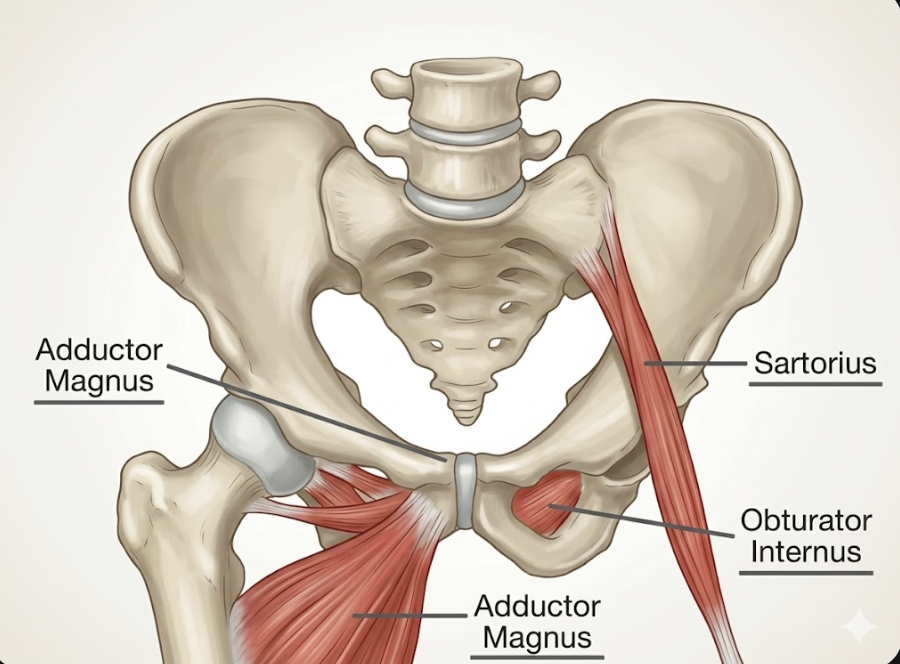
how does adductor magnus can create hip flexion, hip extension, and hip adduction
Hip Adduction (The Broad Job): The entire muscle is built for this. With its origins spanning along the bottom of the pelvis, any contraction will pull the thigh inward toward the center line.
Hip Flexion (The Front Role): The "anterior" or front fibers originate furthest forward on the pelvis. When the leg is stretched behind the body, these fibers are stretched, and when they contract, they pull the leg forward.
Hip Extension (The Back Role): The "posterior" or back fibers originate furthest back on the "sit bone," just like the hamstring group. When the leg is in front of the body (flexed), these fibers are elongated, and when they contract, they drive the leg backward.
Explain graph and implications of lifting an object from floor
hip external moment arm, pelvic-on-femoral flexion
3 joints/ compartments of the knee
Lateral and medial tibiofemoral and patellofemoral
Draw genu varum, what joint would increase “wear-and-tear”
knees angled outward
Medial tib-fem
T/F: muscles attach to the meniscus
true (popliteous muscle)
Primary and secondary function of the menisci
absorb compression / manage shear
Primary role of MCL/LCL? what are secondary roles?
primary- is to prevent excessive frontal plane motion, secondary- limited sagittal and axial rotations
Please demonstrate what range has the highest external torque demands on the knee in both open and closed chain
closed chain- barbell back squat
open- seated leg extension
T/F knee flexor torque production is more governed by F-L relationship then by internal moment arm
True