7. Transport in plant
 Call Kai
 Learn
Learn Practice Test
 Spaced Repetition
 Match
Match Flashcards
 Knowt Play
1/41

There's no tags or description
Looks like no tags are added yet.
Name | Mastery | Learn | Test | Matching | Spaced | Call with Kai |
|---|
No analytics yet
Send a link to your students to track their progress
42 Terms
why do plants need transport system?
they have small surface area to volume ratio
state the 3 types of plant tissues.
epidermis (outermost layer) , vascular tissues (xylem and phloem) and ground tissues (not epidermis nor ground)
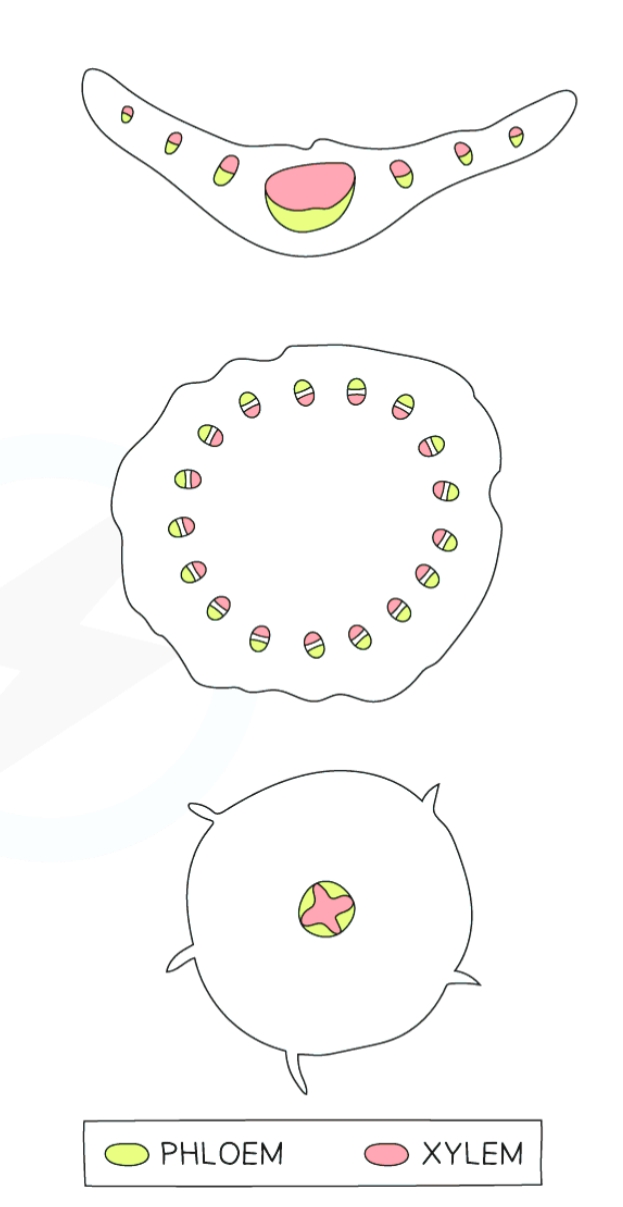
state the sections .
leaf , stem , roots
state the function of parenchyma tissues.
they act as packing tissues to support the roots stem and leaves
state the parenchyma layers in root stem and leaves.
root cortex , stem cortex and pith , palisade and spongy cells
how do parenchyma cells support the plant?
by turgor pressure and photosynthesis (palisade and spongy)
what is the role of sclerenchyma.
provide support
state the properties of sclerenchyma cells.
dead tissues and lignified
where are sclerenchyma cells located?
in the stem , outermost part of vascular bundle
what are collenchyma cells?
makes cell wall thicker
where are collenchyma cells found?
in the leaf (midrib)
where is the endodermis found ?
found in the root and has a single layer
how the xylem vessel is formed?
lignin surrounds original vessels , the living cells are deprived of water and die , this creates a hollow vessel with dead cells and no end walls
why are there pits?
when the plasmodesmata died the pits were formed
what is the function of lignin in the xylem cell wall?
provides strength to xylem
what is the function of the pits?
allow lateral movement of water in case of air bubbles forming
what is the function of the phloem tissue?
to transport assimilates (organic compounds) from source (leaf) to sink (roots)
the organic compound are dissolved in water to form ____________.
sap
what does the phloem consist of ?
sieve tube elements and companion cells
outline the structure and function of each structure of the sieve tube elements.
sieve plates and sieve pores → allow for continuous movement of assimilates
cellulose cell wall → strengthen the wall to withstand hydrostatic pressure
thin cytoplasm → reduce friction to facilitate movement of assimilate
no organelles → facilitate movement of assimilates
outline the structure and function of companion cells.
has transport protein in plasma membrane → to move assimilates into and out of sieve tube elements
large number of mitochondria → more atp for active transport of assimilates
plasmodesmata → links companion cells and sieve tube element
state the 2 ways by which water moves in a plant.
apoplastic and symplastic pathway
explain the apoplastic pathway?
moving through the cell wall by diffusion
explain the symplastic pathway.
moves through the cytoplasm via osmosis
state the pathway to the xylem from the roots.
water and mineral uptake through the roots → via entering the cell membrane or active transport
apoplastic or symplastic pathway to reach endodermis
endodermal cells contain casparian strip which blocks the apoplastic pathway
symplastic pathway is taken and enter the xylem via the pit
explain the movement of water into the leaf to cause evaporation.
water evaporates at the surface of the mesophyll cells and diffuses into the atmosphere through the stomata
this lowers the water potential in adjacent cell and water is drawn from the xylem
what are the 2 properties of water important for transpiration.
it is polar and can form hydrogen bonds
what is meant by cohesion in water molecules.
the force of attraction between the water molecules
what is meant by the adhesion of water molecules.
the force of attraction between the water molecules and the wall of the xylem
what is the role of the cohesive and adhesive force?
cohesive force provides strong tensile strength and adhesive force prevent the stream from pulling away
how is the cohesion and adhesion mechanism called?
cohesion tension theory
what does the plant help the movement of water.
by secreting solutes to lower the water potential in xylem and increasing the pressure
what are xerophytic plants?
adapted to dry and arid conditions
what must the xerophytes do to survive?
maximise water conservation
state the adaptation of xerophytes.
fleshy succulent leaves → water storage
sunken stomata / covered in hairs → reduces diffusion gradient near stomata
leaves reduced to spines / curled → reduced surface area for transpiration
less stomata
thick waxy cuticle → water loss reduced
what is the process of transporting assimilate through the phloem?
translocation
assimilates is transported from __________ to ___________ .
source to sink
state some source of assimilate.
leaves , stems , tubers , tap roots , food stored in seed
state some examples of sinks.
meristem , roots
which carbohydrate is transported as assimilate? and why?
sucrose , because they are non reducing sugars
explain loading of assimilates?
apoplastic pathway is taken
modified companion cells pump hydrogen ions out of the cytoplasm into cell wall Via a Proton pump (ATP)
high concentration of hydrogen ions in cell wall of companion cell , it moves back to cytoplasm
hydrogen ions move by a cotransporter protein which also transport sucrose molecules into companion cell
moves to sieve tubes via plasmodesmata
explain the mass flow in the phloem.
a pressure difference is created by actively loading sucrose into the sieve elements at the source which lowers the water potential in the sap
water moves into the sieve elements
hydrostatic pressure increases at source
as solutes are being removed from the sieve , hydrostatic pressure decreases
this creates a hydrostatic pressure difference
this results in the mass flow