B-cell Development
 Call Kai
 Learn
Learn Practice Test
 Spaced Repetition
 Match
Match Flashcards
 Knowt Play
1/14

There's no tags or description
Looks like no tags are added yet.
Name | Mastery | Learn | Test | Matching | Spaced | Call with Kai |
|---|
No analytics yet
Send a link to your students to track their progress
15 Terms
What are antibodies and where are B cells produced?
Antibodies are the secreted form of the B cell receptor (BCR). B cells are produced in the bone marrow and together with T cells make up the adaptive immune system.
How is BCR diversity generated?
Somatic recombination of V, D, J segments in every developing B cell in the bone marrow.
Every individual B cell has a unique BCR from differences in the variable region.
CDR3 (the VDJ junction) is the most variable part.
What are the two processes required for B cell development in the bone marrow?
1) BCR generation via somatic recombination. 2) Selection — ensuring BCR does not attack the body itself (preventing autoimmunity).
What do stromal cells provide to developing B cells in the bone marrow?
Adhesion molecules and survival signals (contact), and growth factors for growth, proliferation and specific cytokines.
What are the stages of B cell development in order?
Stem cell (germline, no BCR) → Pro-B cell (somatic recombination of heavy chain begins) → Pre-B cell checkpoint 1 (preBCR formed, heavy chain checked, proliferation) → Pre-B cell (light chain recombination) → Immature B cell (full BCR expressed) → Naive B cell (after positive selection in periphery)
What is checkpoint 1 (preBCR) and what happens here?
After heavy chain recombination — preBCR formed (heavy chain + surrogate light chain).
Checks if heavy chain is functional → if productive: allelic exclusion of second chromosome + proliferation burst (~100 pre-B cells with same heavy chain).
If both chromosomes nonproductive → apoptosis. Maximum two attempts.
Why does light chain recombination have more chances than heavy chain?
Two possible light chain loci (κ and λ) + several rearrangements possible per locus → ~85% success rate.
More chances for a productive/functional light chain compared to heavy chain (only 2 attempts).
What are the 3 possible outcomes of negative selection depending on antigen type?
Multivalent self-antigen → receptor editing → apoptosis if fails.
Monovalent self-antigen → anergy.
No self-reaction → survival → leaves bone marrow.
What happens to self-reactive B cells in the bone marrow (negative selection)?
If BCR binds multivalent self-antigen → BCR crosslinks → receptor editing (attempts to change BCR specificity by new light chain recombination).
If receptor editing fails → apoptosis. If BCR binds monovalent self-antigen → B cell becomes anergic.
What is receptor editing?
When a self-reactive BCR crosslinks with self-antigen, the B cell attempts to change its BCR specificity by undergoing new light chain recombination → changes self-reactivity. If not effective → apoptosis.
Why does anergy occur with monovalent rather than multivalent self-antigen?
Monovalent antigen cannot crosslink BCRs strongly enough to trigger receptor editing or apoptosis — instead the B cell survives but becomes permanently unresponsive.
What is positive selection of B cells and where does it occur?
Immature B cells differentiate into naive B cells in the primary follicle of secondary lymphoid organs by interaction with follicular dendritic cells (FDCs). After positive selection, mature B cells recirculate between blood and lymphoid organs searching for their ligand.
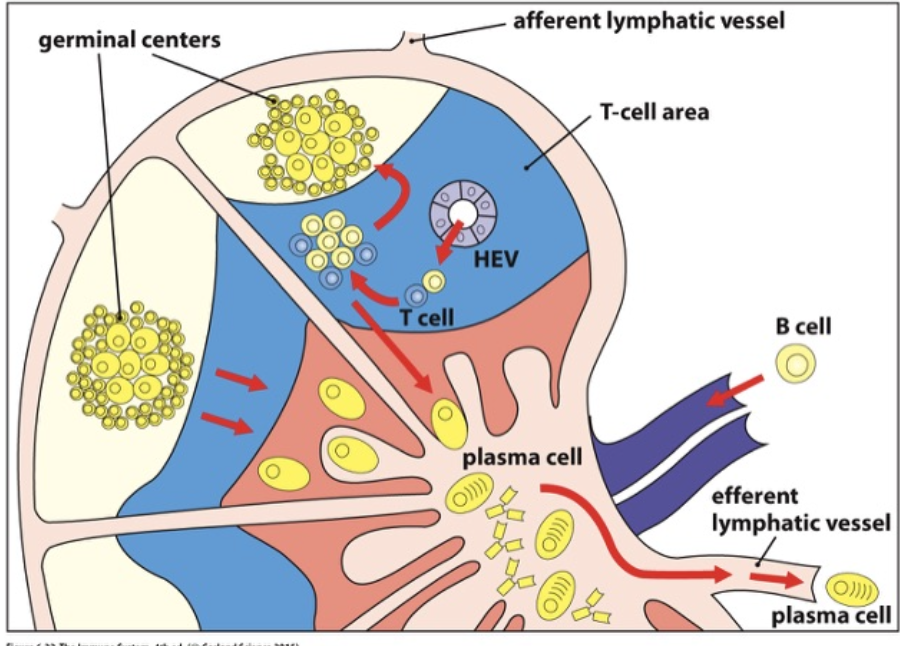
How do naive B cells enter lymph nodes and find antigen?
Enter via high endothelial venules. Chemokines (CXCL13) cause migration into B cell follicles. Antigens are captured by subcapsular sinus macrophages and FDCs — these keep intact antigen on their surface (via complement receptors binding complement-coated antigen) → B cells can be activated by intact antigen.
Where do T and B cells interact and what happens?
On the border of T cell and B cell areas in the lymph node. B cells present processed antigen on MHC II to CD4 T cells → cognate interaction → T cell help for B cell activation.
What are the different areas of the lymph nodes?