astro 101 midterm #2 practice test
 Call Kai
 Learn
Learn Practice Test
 Spaced Repetition
 Match
Match Flashcards
 Knowt Play
1/49

There's no tags or description
Looks like no tags are added yet.
Name | Mastery | Learn | Test | Matching | Spaced | Call with Kai |
|---|
No analytics yet
Send a link to your students to track their progress
50 Terms
This act of separating the different colors of light through being refracted by different amounts is
known as
dispersion.
In the early days of our Universe (i.e., ∼ 14 billion years ago), the only elements that scientists believe
existed were
hydrogen, helium, and lithium.
Through which one of the following measurements will an astronomer be able to most accurately
determine the distance to a very nearby star?
By very accurately measuring the position of the nearby star in the sky relative to more distant stars over the course of six months.
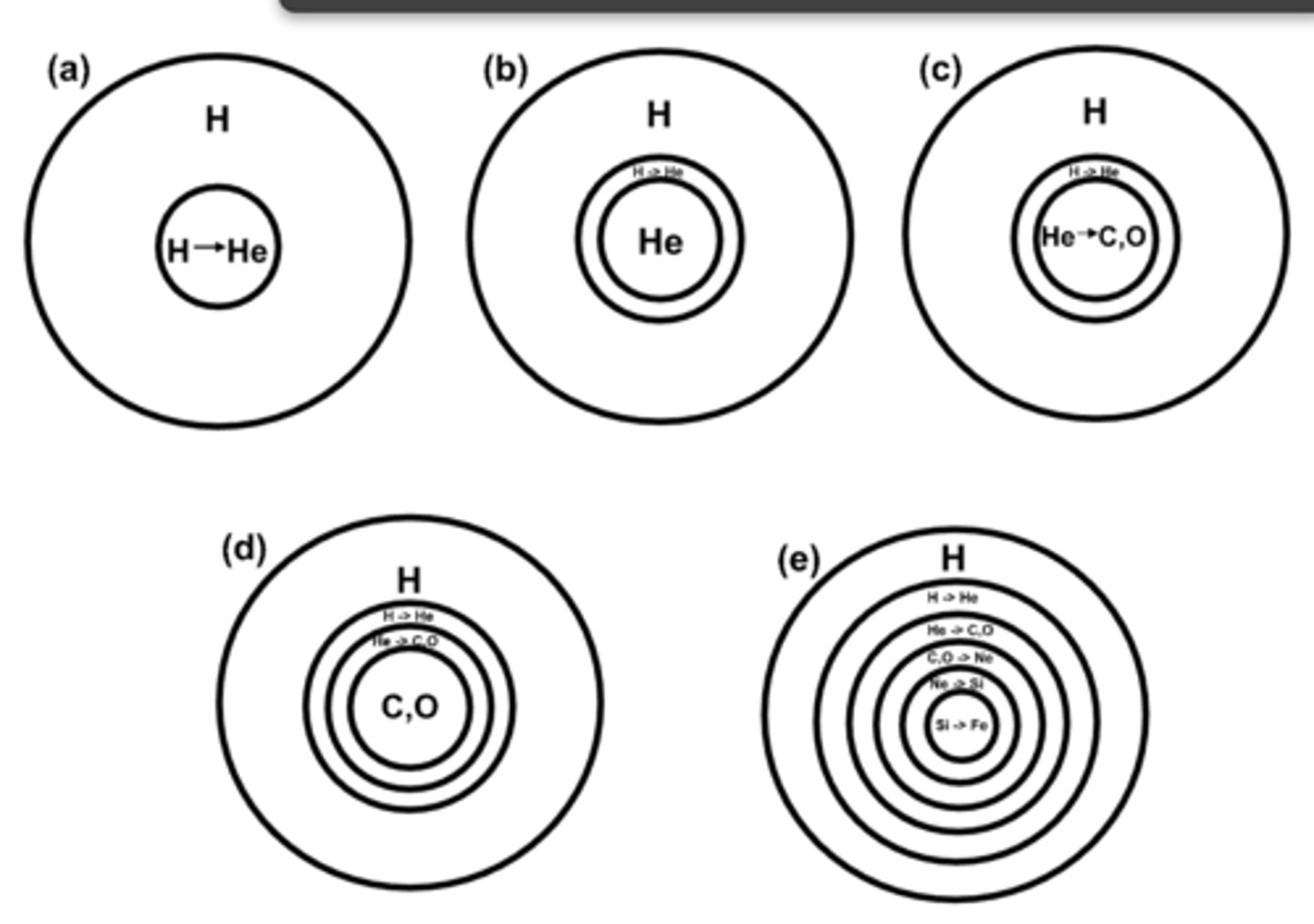
The diagrams below represent different stages of evolution in the lives of stars, where the chemical
symbols indicate the primary constituent of each layer of the star (that is, H = hydrogen, He =
helium, C = carbon, O = oxygen, Ne = neon, Si = silicon, and Fe = iron), and arrows (→) indicate
layers in which one element is being actively fused into another element. Of the choices given below
(labeled ‘a’ through ‘e’), which one do astronomers believe most accurately represents the current
structure of our Sun?
A
Light bulb ‘A’ is a 50-watt light bulb. Light bulb ‘B’ is a 100-watt light bulb. Both light bulbs are
turned on, and are located at a distance of 10 meters from an observer. Which one of the following
statements is TRUE?
Light bulb 'B' will have twice the apparent brightness of Light bulb 'A' at the location of the observer.
T or F. Astronomers currently believe that elements heavier than iron (i.e., with more protons in
their nuclei) can be produced in the cores of low-mass stars during the final years of their lives.
False
As defined by astronomers, a standard candle is:
An object of known luminosity.
Samantha is generating waves on the surface of a pond by tapping her finger into the water two times
per second. This creates a series of waves in which the individual wave crests are 30 centimeters
apart. With what velocity are the waves traveling through the water?
60 centimeters per second.
Which of the following is a correctly ordered listing of some of the regions of the electromagnetic
spectrum, progressing from shorter to longer wavelengths?
gamma rays, X-rays, ultraviolet rays, visible light, infrared rays, radio waves.
Which of the following evolutionary stages do we not expect our own Sun to go through?
Exploding as a Type II supernova.
Which one of the following is NOT a “rule” that electrons in atoms must obey, according to the
quantum model of the atom?
The energies of the allowed electron orbits are the same for all elements.
T or F. According to theoretical calculations, if our Sun had been born with only half the amount
of mass that it actually does have, it would never have been able to generate power through nuclear
fusion, and thus would not have become a star.
False
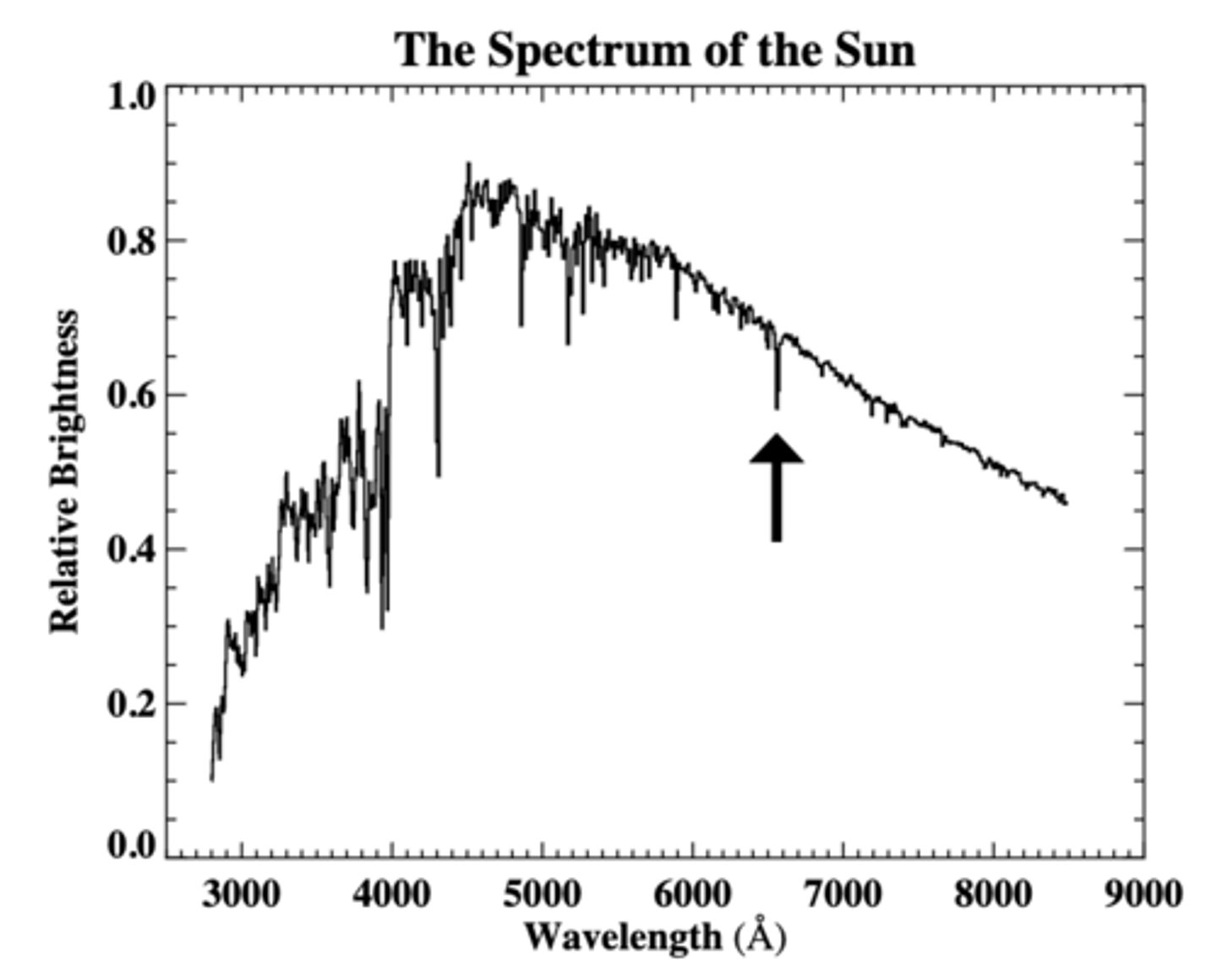
By determining the wavelength at which maximum brightness occurs in the spectrum of the Sun (i.e.,
the broad “peak” of the spectrum shown in the figure, located around λ ≈ 4700 ̊ A) astronomers are
able to directly determine which one of the following properties of the Sun?
The temperature of the Sun's photospher
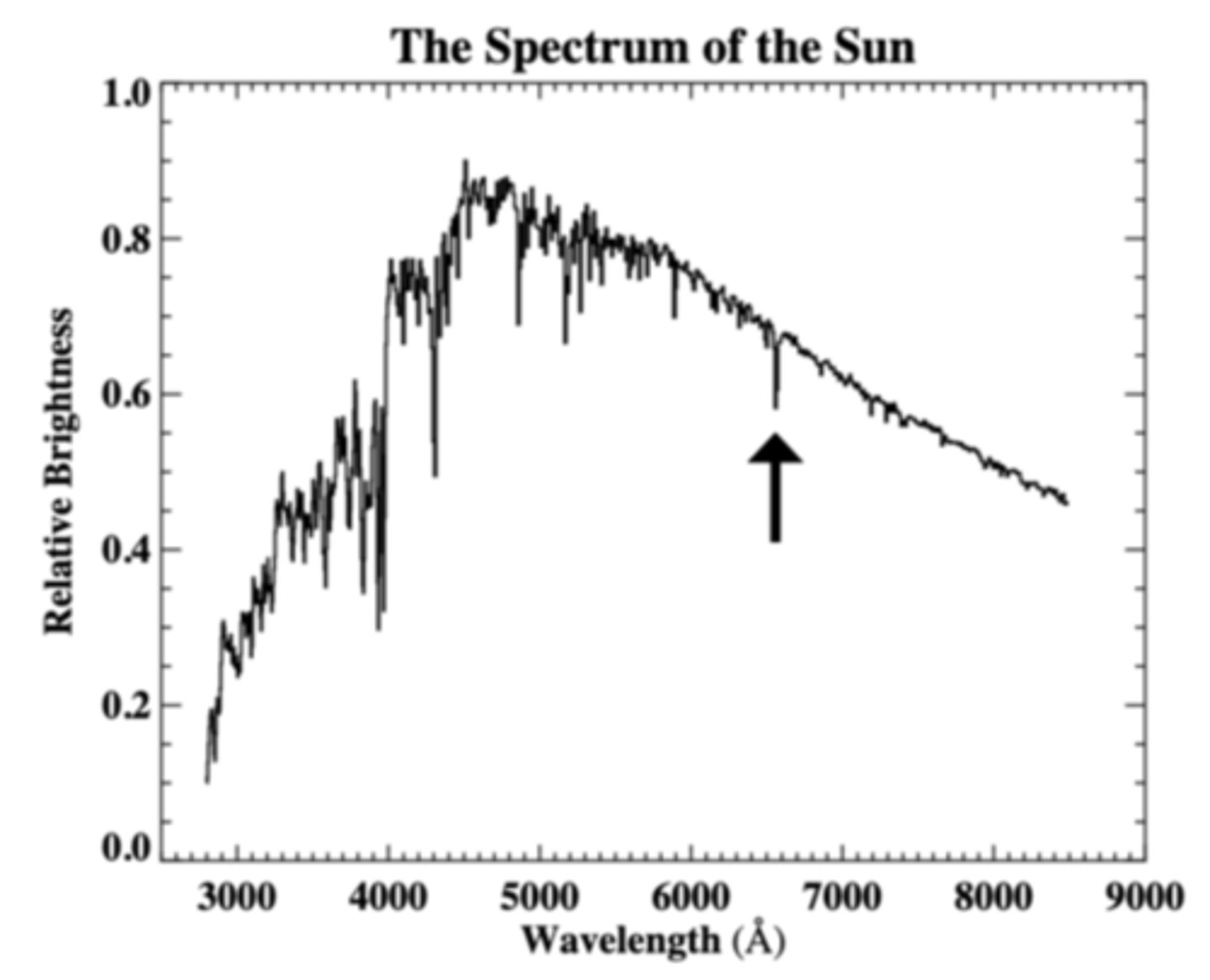
The spectral “feature” that is indicated by the arrow in the figure is most generally referred to as
an absorption line
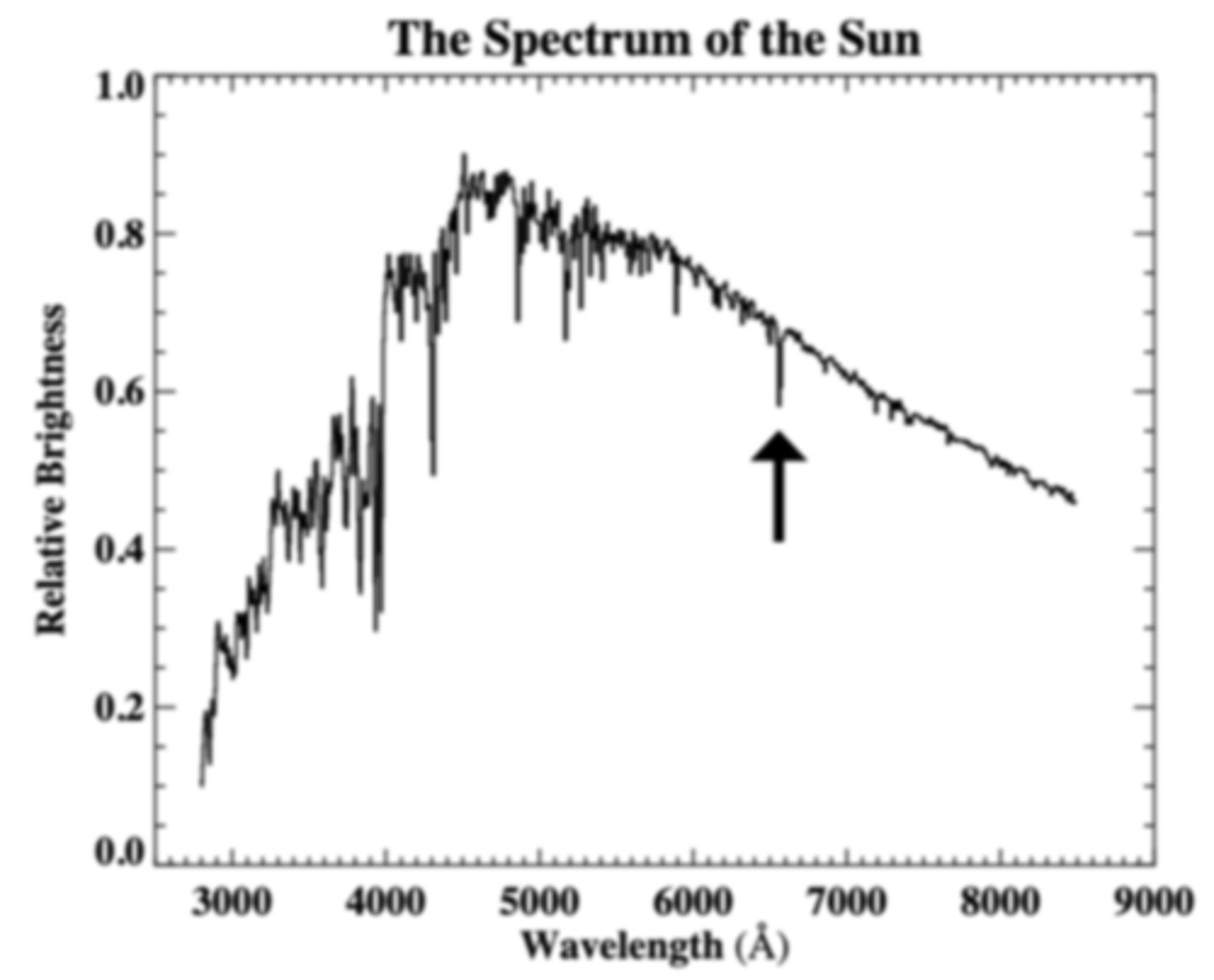
The measurement that the spectral “feature” that is indicated by the arrow in the figure occurs right
at a wavelength of λ = 6563 ̊ A allows astronomers to conclude which of the followi
That the Sun's atmosphere contains the element hydrogen
What supports a white dwarf star against gravitational collapse?
Electron degeneracy pressure.
The scientist whose PhD thesis in 1925 laid the foundations for our current understanding of the
precise chemical composition of the Sun was
Cecilia Payne-Gaposchkin.
The very short-range but powerful attractive force that binds protons and neutrons together is known
as the
strong nuclear force.
Which one of the following things was first discovered to exist in nature before it had even been
proposed to exist by scientists?
A white dwarf star.
Which one of the following is NOT a property of neutrinos?
Neutrinos are extremely massive particles, estimated (although not known precisely) to have a mass greater than 100 times the mass of a proton.
T or F. Every star, regardless of its initial mass, spends the majority of its life as a “main-sequence”
star.
True
T or F. The proportion of “heavy” elements (that is, elements with more protons in their nuclei than
the element hydrogen) in our Universe is predicted to be decreasing with time.
False
When does fusion end in the core of a “high-mass” star?
After production of the element iron.
Which one of the following statements about planetary nebulae is FALSE?
With few exceptions, the pictures scientists have taken of all planetary nebulae look very similar to one another.
Stephanie observes a binary star system in which stars Oliver and Jasper are orbiting around a
common “center of mass”. Stephanie determines that the “center of mass” of the binary star system
is much closer to star Oliver than it is to star Jasper. From this, she can conclude that
Star Oliver contains more mass than star Jasper.
The main reason that the strength of gravity at the surface of the star Sirius B (a white dwarf) is so
much stronger than the strength of gravity at the Earth’s surface is that
Sirius B contains much more mass than Earth does.
When high-mass stars die, which types of objects do astronomers believe they leave behind?
Neutron stars and black holes.
T or F. The Orion Nebula is a vast region of space in which a thin, low-density gas is being heated
by hot, young stars. When Armando takes a spectrum of the hot, low-density, glowing gas of the
Orion Nebula, he will see a spectrum that is commonly referred to as a “continuous” spectrum.
False
T or F. Red light has a lower frequency than blue light does.
True
T or F. The Sun, like the Earth, is mainly made up of the elements iron and oxygen.
False
The basic physical principle that astronomers believe explains why neutron stars are typically “born”
spinning very rapidly is known as
the conservation of angular momentum.
When a white dwarf experiences a typical “nova” explosion, what do astronomers believe has just
happened?
A burst of fusion of the element hydrogen on the surface of the white dwarf.
Hydrostatic equilibrium refers to
a state of equilibrium in a star in which the inward pull of gravity is just balanced by the outward forces of gas and radiation pressure.
Matthew is creating waves in a pool of water by tapping his finger once per second on the water’s
surface. If Matthew wish
None of the above answers is correct, since nothing that Matthew can do will change the velocity of the waves in the pool of water, since their velocity is completely determined by the medium through which they are traveling.
T or F. When an electron “jumps” from the n = 2 to the n = 1 energy state in a hydrogen atom,
it emits a photon with a wavelength of λ = 1216 ̊
A. When an electron “jumps” from the n = 3 to
the n = 1 energy state in a hydrogen atom it emits a photon with a wavelength that is less than
λ = 1216 ̊
A.
True
T or F. The majority of the mass of an atom is contained in its nucleus.
True
T or F. Scientists believe that nuclear fusion is occurring throughout the Sun, from its core region
all the way to its surface.
False
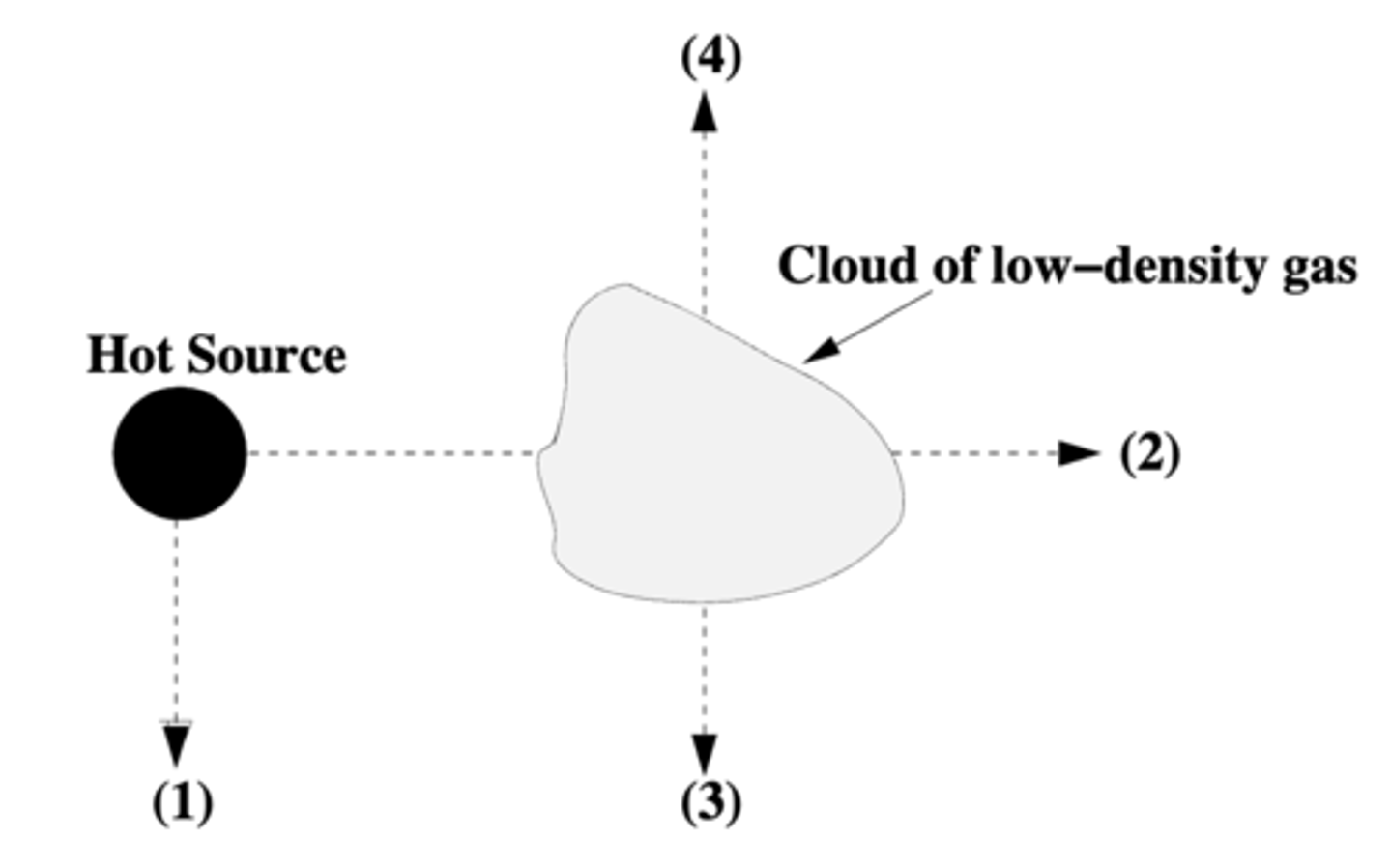
The diagram below shows a hot, opaque source of light (produced, for instance, by a solid object or
a very dense gas) and a “cloud” of low-density gas nearby. Four different positions from which these
objects may be viewed are indicated by arrows.
Which one of the following statements is FALSE?
If you observe the spectrum of the hot source from position (2), you will see a continuous
spectrum with dark lines (i.e., an absorption spectrum).
An atom contains 1 proton and 1 neutron in its nucleus. What kind of element is this atom?
hydrogen
T or F. The more mass a star is born with, the more luminous it will be when it is a main-sequence star.
True
T or F. Fewer than 1% of stars exist in binary star systems.
False
The end result of the proton-proton chain of nuclear fusion in the Sun is that hydrogen nuclei are
converted into:
helium nuclei, photons, neutrinos, and positrons.
A sunspot represents
a region of the Sun's surface that is cooler, and thus darker, than the surrounding regions
The Hβ spectral line of the Balmer series of hydrogen has a wavelength of 4861 Angstroms for a
hydrogen source that is at rest. Of the following, which observed wavelength of this line in a star’s
spectrum would indicate that the star is approaching us (that is, moving towards us) at the greatest
speed?
4851 angstroms
Using a good pair of binoculars, you observe a section of the sky where there are stars of many different
apparent brightnesses. You find one star that appears especially dim. From this observation, you
can immediately conclude that this star looks dim because:
it could appear dim for more than one of the above reasons; there is no way to tell which answer is right without more a more detailed study of the star.
Deep inside a red supergiant star near the end of its life are several concentric shells of different ele-
ments around a central core. What are the general trends seenin these layers, going from outside inward?
Element nuclei get heavier, temperature increases, and time for each layer to develop decreases.
The type of star that astronomers currently believe can explode as a “Type Ia” supernova is
a white dwarf in a binary star system.
T or F. A white dwarf with a mass of 1.1 MSun has a smaller radius than a white dwarf with a mass
of 0.7 MSun.
True
T or F. The planet Jupiter is technically considered to be a star since nuclear fusion does occur in
its core, although at a greatly reduced rate compared with the Sun.
False
Of the following, which color of star has the highest surface temperature?
Blue star