PUBH UMN 3001 Exam 1 Actual questions and answers with 100% accuracy(VERIFIED BY PROFESSOR)
 Call Kai
 Learn
Learn Practice Test
 Spaced Repetition
 Match
Match Flashcards
1/41

There's no tags or description
Looks like no tags are added yet.
Name | Mastery | Learn | Test | Matching | Spaced | Call with Kai |
|---|
No analytics yet
Send a link to your students to track their progress
42 Terms
Primary Prevention
Preventing people from engaging in bad behavior or catching an illness ie. DARE
Secondary Prevention
Being proactive in spotting early signs/symptoms, controlling an illness ie. Mammograms
Tertiary Prevention
Rehab, prevention of further problems or illness getting worse, trying to cure ie. Radiation Therapy
10 Essential Functions of PUBH
1. Monitor Health
2. Diagnose and Investigate
3. Inform, educate, and empower
4. Mobilize community partnerships
5. Develop policies
6. Enforce laws
7. Link to and provide care
8. Assure a competent workforce
9. Evaluate
10. Research
Difference between PUBH and medical care?
PUBH=Broad, focus on prevention and control of disease.
Medical=Focuses strictly on treatment/cure.
Monitor Health
Assessment
ID and solve community problems.
What's going on in our community?
-ID health risks, collaborate w/ private providers, attention to vital stats, and using appropriate methods/tech to communicate data.
Diagnose and Investigate
Assessment
Problems/hazards in the community.
How effective is our response?
-Epidemiologic investigations, active infectious disease epidemiology programs, access to PUBH labs.
Inform, educate, and empower
Policy Development
How well do we keep all segments of our state/community informed about health issues?
-Accessible health info, health education and promotion programs, health communication plans.
Mobilize community partnerships
Policy Development
How well do we engage people in state/community health issues?
-Building partnerships, facilitating partnerships.
Develop policies
Policy Development
Plans that support individuals and community health efforts.
What policies in both the government and private sector promote health in our state/community?
-Effective local public health, state leveling planning, alignment of resources and strategies.
Enforce laws
Assurance
Regulations that protect health and ensure safety.
Link to and provide care
Assurance
Are people in my state receiving the health services that they need?
Assure a competent workforce
Assurance
Do we have a competent public health staff?
-Adoption of continuous quality improvement, active partnerships, educational training, efficient processes for licensure of professionals.
Evaluate Effectiveness
Assurance
Are we meeting the needs of the population we serve?
Research
All 3
For new insights and innovative solutions to health programs.
Determinant of health?
Something that determines or influences an individuals health ie. age, income, gender, etc.
Define Public Health.
Science and art of preventing disease.
Public Health Approach to Prevention
1. Define and describe the problem-what's the issue, signs and symptoms.
2. ID cause-Collect and analyze data
3. Break down into manageable components: TAPES
a. Technical-Cause known?
b. Administrative-Quality of care? Who provides care?
c. Political-Legal problems? Controversial?
d. Economic-Costs with prevention/treatment.
e. Sociocultural and Behavioral-Lifestyle, stigma.
4. Develop and test interventions-Experiments
5. Implement Interventions-Laws/programs
6. Evaluate interventions-Did it work?
Top cause of death?
Tobacco (Heart disease is #1 illness/disease.)
Father of Epidemiology
John Snow
Cholera outbreak in London 1854. Discovered Miasmas/dirty air. Mapped city and found contaminated water hole.
Incidence
Number of NEW cases in a population.
Prevalence
Total number of cases existing in a defined population at a single point in time.
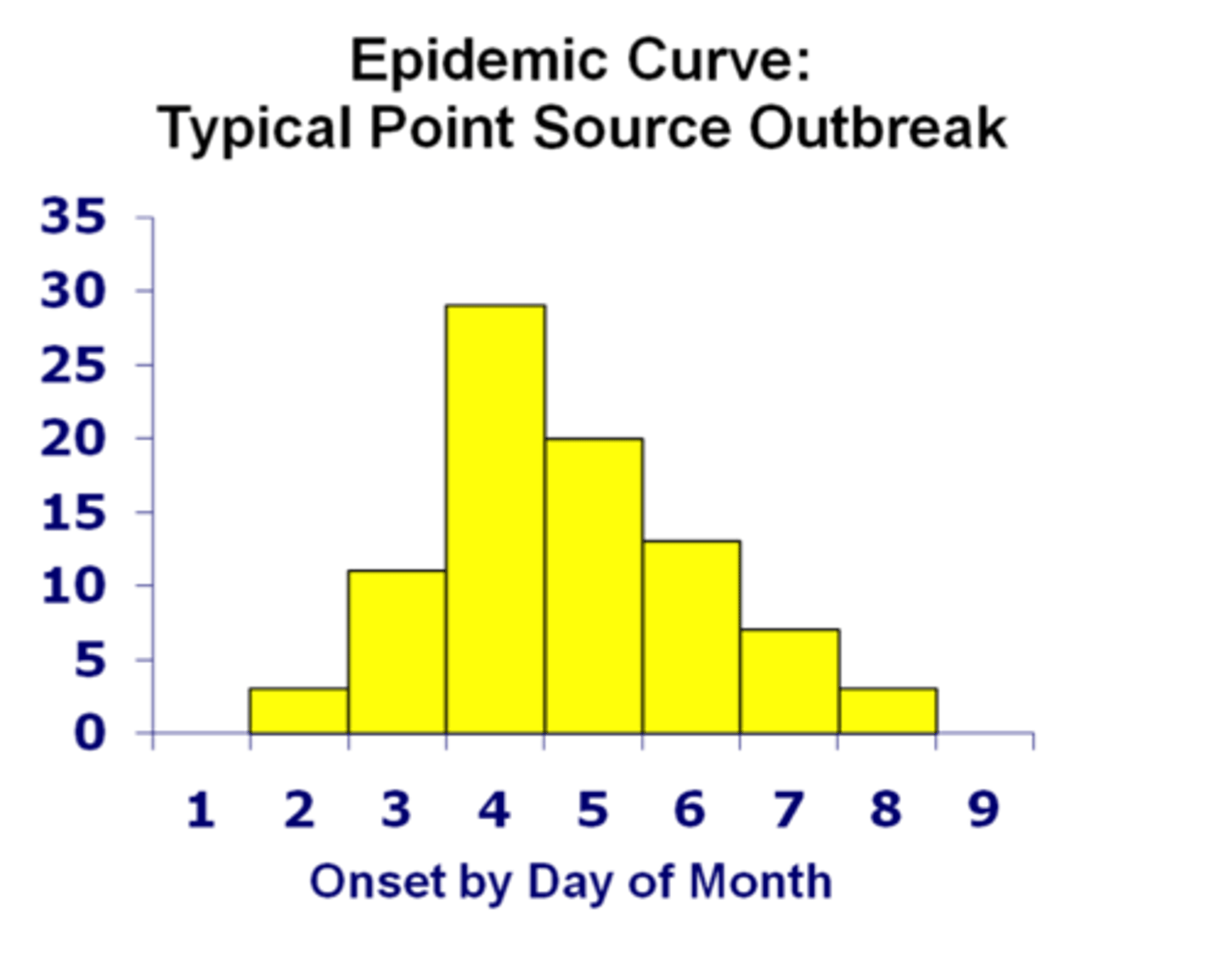
Epidemic Curve
Figure that shows the number of new cases of disease caused by an infection over time.
Why is data essential to PUBH?
ID what health issues we currently have, be able to ID our needs and how they can be met, see how severe health problems really are, ID changes and compare current issues and rates with issues and rates of the past.
System of epidemiologic surveillance
Effectively/efficiently monitoring health, focuses on reported diseases as soon as they are diagnosed, that way diseases can be investigated immediately.
PUBH focuses on _____________.
Prevention
Framington Heart Study
5000 men and women in Massachusetts aged 30-62 were studied every 2 years for a long time.
Study identified- high BP, high cholesterol, smoking, obesity, diabetes, and physical activity as major risk factors to long term health.
Gostin's 7 models of public health intervention
1. Power to tax and spend-Tax tobacco products more.
2. Power to alter the information environment-Regulate businesses to label products.
3. Power to alter the built environment.
4. Power to alter the socioeconomic environment.
5. Direct regulation of persons, professionals, and businesses-Individual behaviors like seat belts and helmets on motorcycles.
6. Indirect regulation through tort system.
7. Deregulation-Laws as a barrier to health.
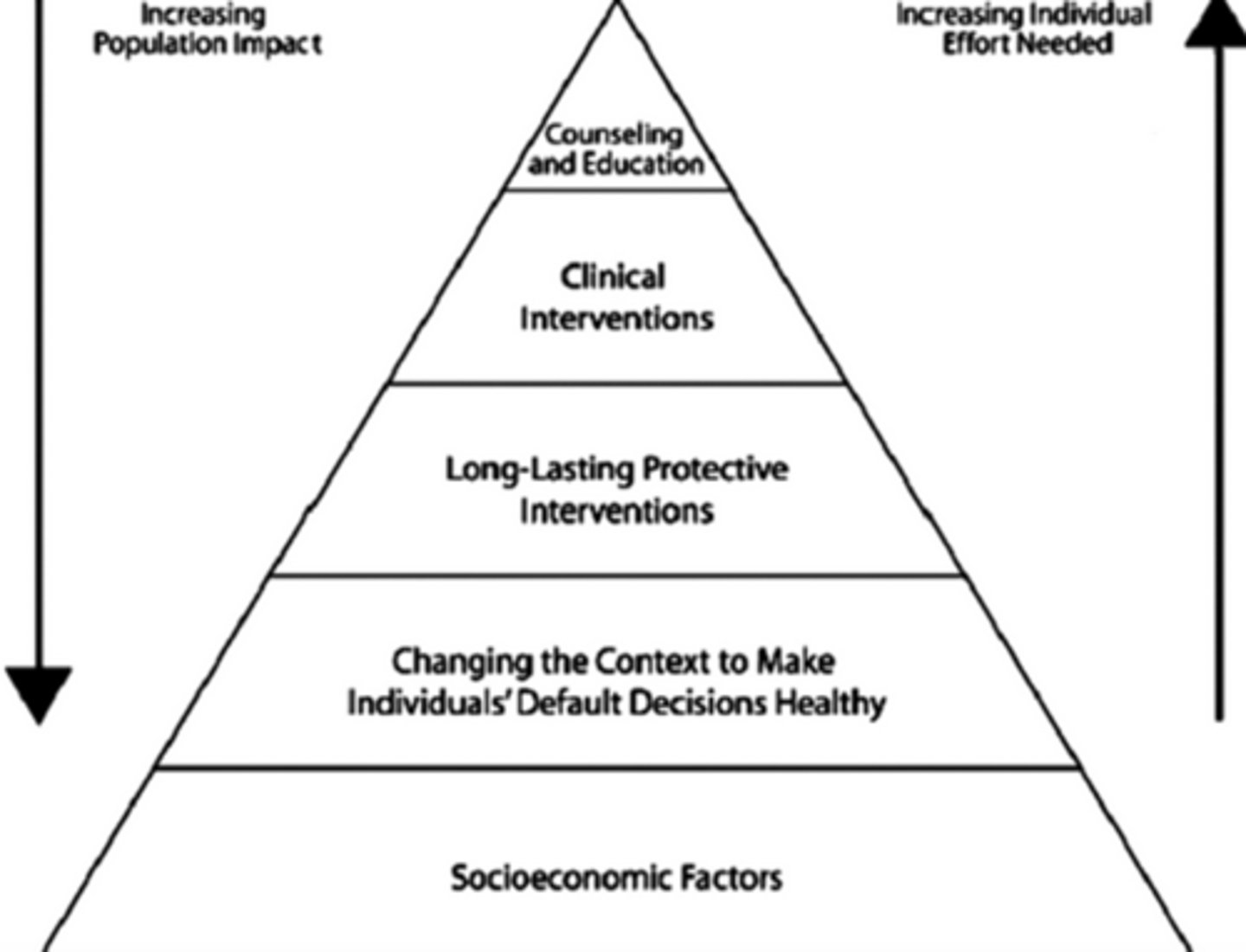
CDC Health Pyramid
Basic characteristics of health system?
Agencies for planning, funding, and regulating.
Money to finance
Those who provide heath services like the gov. and hospitals.
Name 6 Protocol conditions for clinical research
1. Social Value-Significant to society?
2. Scientific validity-Measures what it promises?
3. Fair subject selection-Randomized and equal chance.
4. Acceptable risk-benefit ratio-Benefits should outweigh the risks.
5. Informed consent-Subjects agree to what they're getting into.
6. Respect for enrolled subjects.
4 principles for distributing scarce resources
1. Health maximization-Resources allocated in such a way that the total beneficial impact on health is large as possible.
2. Equity-Ensure everyone has equal chance of receiving a scarce resource.
3. Priority to the worst-Organ recipient lists.
4. Personal responsibility-Lower priority should be given to people whose health problems may relate to own health behaviors.
Stanford Prison Experiment
Psych. experiment where basement was a prison. Some were guards and some were prisoners. Got serious and was unethical because prisoners were harmed.
10 essential benefits that private health insurance must provide.
1. Ambulatory patient services.
2. Emergency services.
3. Hospitalization
4. Maternity and newborn care
5. Mental health and substance use
6. Prescription drugs
7. Rehab services
8. Lab services
9. Preventative and wellness services
10. Peds services
Where do peeps get health insurance?
Government
Self purchased
Through employer
4 barriers to healthcare
1. Could not afford prescription drugs.
2. Went without needed care due to cost.
3. Postponed seeking care due to cost.
4. No usual source of care. THE BIGGEST ONE
ACA most beneficial factor?
Young adult coverage till 26 y/o
4 exceptions to the ACA's requirement to have health insurance coverage?
1. Peeps who don't pay taxes
2. Non-legal residents
3. Prisoners
4. Native Americans
Impact of Surgeon General's report?
Allowed for tax on tobacco and afterwards was the first sight of decrease in number of smokers in US.
Conclusions within hierarchy in monkeys?
Inferior monkeys had higher levels of stress, anxiety, and BP, which led to a quicker death.
If income is low, then _______.
life expectancy is low. (More stress, not able to get high quality care.)
If income is high, then __________.
life expectancy is high. (Less stress, able to get high quality care.)