Cog Neuro Exam 2 (Notes)
 Call Kai
 Learn
Learn Practice Test
 Spaced Repetition
 Match
Match Flashcards
 Knowt Play
1/158

There's no tags or description
Looks like no tags are added yet.
Name | Mastery | Learn | Test | Matching | Spaced | Call with Kai |
|---|
No analytics yet
Send a link to your students to track their progress
159 Terms
Why do we need memory?
Memory allows us to retain information for future use.
Types of Shorter forms of Memory
Sensory Memory
Working Memory
Short term memory
Types of Long-term memory
Declarative Memory
Non-Declarative Memory
What is Sensory memory
high capacity, very short-duration memory that happens between sensory systems
within this short window, it can be as effective as having attention directed to the information in advance
Types of Sensory Memory
Iconic memory (Visual) → lasts less than 500ms
Echoic Memory (Auditory) → can last up to 10s
What is Iconic Memory
Sensory memory associated with visual systems
lasts less than 500ms
As iconic memory decays → there is a slow decaying in V1 response
What is the capacity of short-term memory
~7 item
longer duration of 15-30s
What is working memory
an expansion of the concept of short-term memory to include manipulation of maintained information
recalling information that is no longer present
How does selective attention influence sensory memory
it can boost the amount of items you retain
if a cue is given within the first 100ms of a delay (after an image has been shown and removed), a person can perform just as well as if they were given the cue in advance
any more (900ms) cuts a person’s visual sensory memory capacity in half → benefits of sensory memory lost; can only recall what was encoded into WM
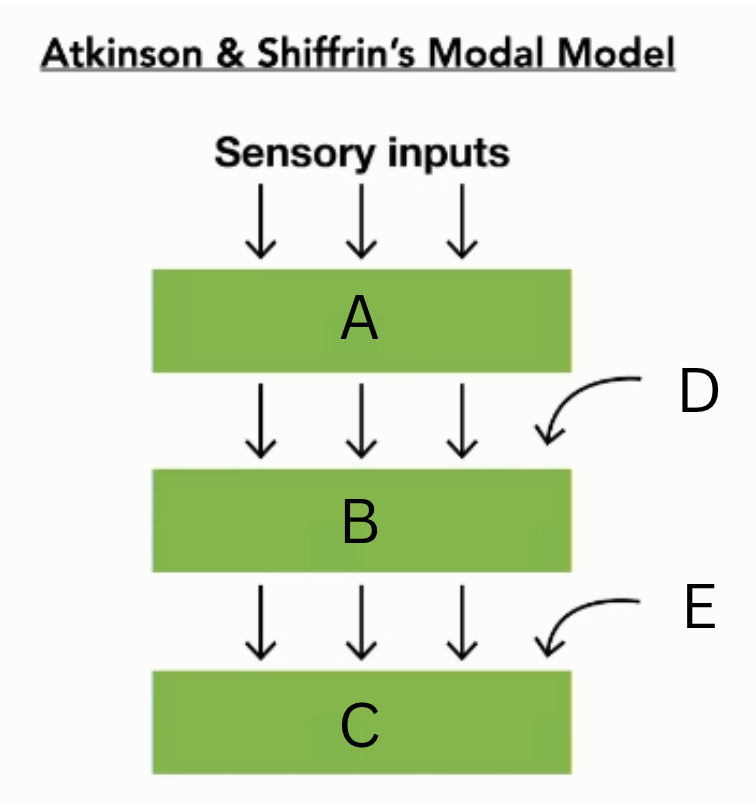
Describe Atkinson & Shiffrin’s Modal Model of Memory
A: Sensory Register
B: Short-term storage
C: Long-Term Storage
D: Attention
E: Rehearsal
What does Atkinson & Shiffrin’s Modal Model of Memory propose?
a serial structure (hierarchical): attention shifts info from sensory memory to STM, then rehearsal shifts from STM to LTM
Proposes a unitary STM store: any type of information all goes in one short-term memory box
What are the two problems with Atkinson & Shiffrin’s Modal Model of Memory?
found patients that have impaired STM but intact LTM (vice versa: impaired LTM, intact STM)
patient HM had impaired STM and intact LTM
serial structure doesn’t make sense if you can bypass STM and encode into LTM
STM impaired patients had a lot of selectivity in their impairments (e.g. impaired visual STM but intact audio STM)
pushes back on unitary STM store; all types of information isn’t being encoded in the same place in the brain
Is the Atkinson & Shiffrin’s Modal Model of Memory widely adccepted?
no, it has been dismissed
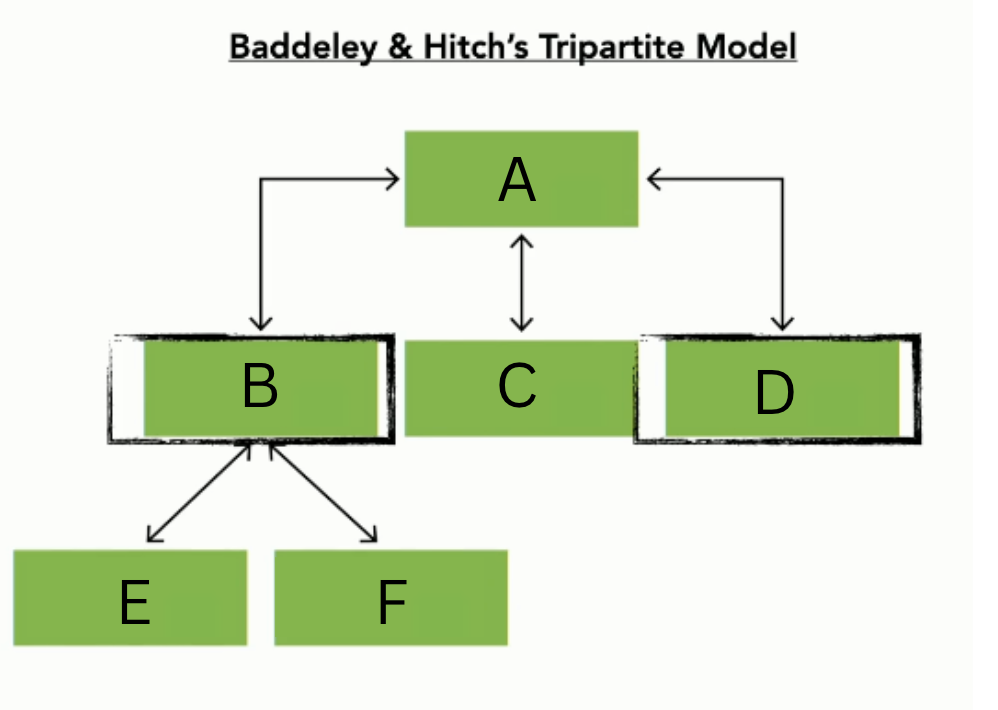
Describe Baddeley & Hitch’s Tripartite Model of Memory
A: Central Executive
B: Phonological Loop
C: Episodic Buffer
D: Visuospatial Sketchpad
E: Articulatory Loop
F: Acoustic Store
What does Baddeley & Hitch’s Tripartite Model of Memory propose
separate short-term memory stores for acoustic information (phonological loop) vs. visual/spatial information (visuospatial sketchpad)
a control centrer that arbitrates between and coordinates STM subsystems (central executive)
What is the evidence for separate STM stores for different types of information?
when holding a word list in mind with an imagery strategy (imagining a picture of the word-list), you remember fewer words if you are simultaneously tracking visual movement (or performing any other type of visual task)
similarly, if you are using a rehearsal strategy (verbal repetition), you remember fewer words if you are simultaneously repeating nonsense words (or performing any other type of verbal task)
looking at patients with brain damage: if you give different types of task (spatial span task or verbal version of spatial span task) people with brain damage in different areas struggle with these tasks: dissociation is most important (selective impairement)
Damaged parieto-occipital regions (especially right hemisphere) → impairment in spatial span task; intact on other tasks
premotor and supramarginal gyrus → impairment in verbal version of spatial span task; (speech production and perception still intact)
What is the spatial span task?
Theres a bunch of different blocks on the table
the experimenter taps them in a specific order
participant waits for 7-10s
participant has to tap the boxes in the same order
tests visuo-spatial sketchpad
What is the verbal version of the spatial span task
Participant hears a bunch of letters in a row
DELAY: they wait 7-10s
Then, participant has to repeat back the letters in the same order
tests phonological loop
What is working memory?
contains the concept of short-term memory (+ more things)
analogy: your mind’s blackboard
TWO COMPONENTS
memory component (maintenance) → representation of information that used to be there but is no longer there, that has to be maintained
working component (manipulation) → some type of manipulation or updating given your particular task goal; mentally manipulating information + anytime you have to re-organize or update information in working memory
What is working memory necessary for?
holding a goal in mind
linking relevant pieces of information together to make inferences
directing attention and action towards the goal
connecting them over time (e.g. strategize, plan)
Classic working Memory Tasks (Maintenance)
No tasks ask to manipulate information, just to maintain it
Delayed Match to Sample
presented with stimulus
image goes away
delay
participant presented with a choice of stimuli, asked to select the correct one
Visual Array
presented with an array of visual items
array goes away
delay
asked question about the stimulus
asked which stimulus is correct (i.e. is this color correct?)
asked to reconstruct stimulus or array
Digit/Letter Span
Presented with a list of digits or letters sequentially
participant must correctly reconstruct at the end
Classic Working Memory Tasks (manipulation)
Backwards span
same as digit/letter span but participant is asked to recall/reconstruct the span backwards
N-back task
see a stream of stimuli (what the stimuli is does not matter)
asked to press a button anytime the same stimulus appears after N times
N = 1 → one back: anytime the stimuli appears back to back
N = 2 → two back: responding when there are 2 letters between the same stimulus
A is shown, two other letters are shown in between, A is shown again (press button)
typically N = a high number (3 or 5)
higher N backs are harder because participant has to store and recall a string of information at once and manipulate said information rather than just one (for 1-back)
on every trial you have to update whats in your working memory
Explain the involvement of the PFC in working memory
PFC Activity persists during working memory delay even after the extenral stimulus is removed
scientists found (in monkeys) that there is a lot of persistent firing in PFC neurons during working memory delay even after external stimulus is removed
not related to perception, not related to action explicitly
even when delay period is longer, the neurons firing still persists
Lled people to believe PFC is involved in working memory maintenance
PFC activity increases with load (when there is more information to maintain) and stops when the item is no longer needed
Persistent activity seems to predict/be associated with WM performance in humans
higher spikes for when something needs to be remembered correctly
PFC Lesioned Monkeys
PFC-lesioned monkeys become impaired at recalling location of food (stimulus that needs to be remembered) that is out of sight unless there is a learned cue
learning cues involves a different type of memory system (one not affected by the lesion)
Performance on WM tasks improves dramatically if room is darkened during delay period → this is because there is a reduction of visual stimuli (less competition of visual stimuli when trying to remember)
What does PFC persistent activity represent for memor?
It was initially thought to be the storage of the information (maintenance of location or specific stimuli)
however current evidence suggests its more about control, selection, and task goals and not about the sensory content itself
leaves question: if the content that is being maintained is not in the PFC then where is it? → the sensory cortex
What brain regions is the sensory content being maintained in?
the sensory cortex
What is the sensory recruitment hypothesis?
the idea that the same regions that primarily process information maintain it during working memory
if this is true then we should be able to see evidence in sensory systems (like the visual system) of maintenance of information over working delay period
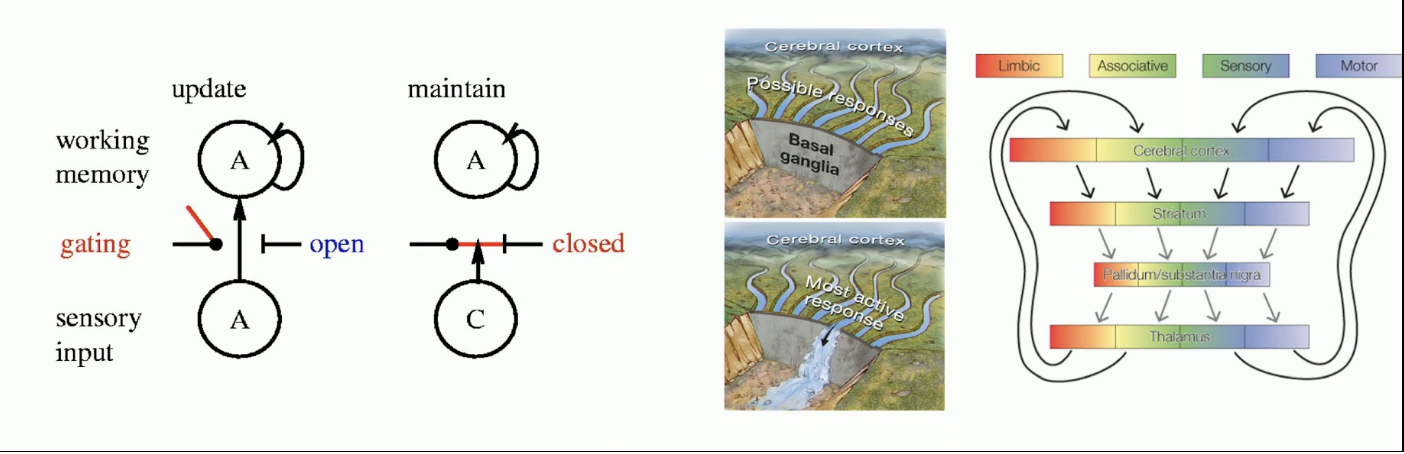
Gating Mechanism of Working Memory
brain faces dilemma:
stability (gating out) → keeping current information stable + protected from distractions + noise
flexibility (gating in) → allow new information to enter and replace old information
If the brain updated constantly → working memory would be too unstable
if brain never updated → it would be too rigid and unable to respond to new information
so brain needs a control system (a gate) that decides when to let information in and when to keep it out → basal ganglia as the gate (basal ganglia also involved in motor skills)
basal ganglia decides when that memory should be updated
What is Automatic Behavior
Behavior that we do without thinking:
Habitual, obligatory, rapid, and stimulus-driven
Often engaged without consideration of future consequences
What is controlled behavior
behavior that is:
Internally guided, slow, deliberative, consistent with goals and broader context
Harder to do under load/fatigue
Typically feels effortful
What are the areas of the prefrontal cortex
Lateral prefrontal cortex
Frontal pole → very front, underneath your forehead
Orbitofrontal cortex → right behind your eyes
Medial prefrontal cortex (including anterior cingulate cortex)
What does the PFC do
most widely interconnect part of cortex
Heteromodal association cortex
PFC must receive inputs from all secondary sensory areas in order to perform its tasks related to cognitive control
Sends widespread feedback projections that can influence processing in other brain systems
Regions of brain that continue expanding latest in development (adolescence)
PFC show mixed selectivity
What is mixed selectivity
means individual neurons respond to multiple tasks/stimulus features or combinations of features rather than single features
this is useful because it allows for multiple stimuli to be processed by single neuron increasing efficiency of PFC
Phineas Gage
(1849) Foreman of railroad construction crew. Triggered dynamite charge which sent the tamping rod he was holding through his head.
Survived, but accident destroyed parts of prefrontal cortex.’
Changed personality. Couldn’t hold down job, became vulgar, impulsive, and temperamental.
What are the effects of Frontal lobe damage
Environmental dependency
Imitation
Utilization → if they see an item that typically triggers a specific type of behavior they will act on that despite inappropriate environmental contexts
Perseveration → trouble stopping oneself from repeating an action
Wisconsin card sorting task
Will keep using same sorting rule even if they know the rule is wrong
Poor planning abilities
Disconnect between knowledge and action
Know what they are supposed to do but have a hard time carrying out these actions in correspondence with what they’re supposed to do
Loss of goal-directedness
Exhibit socially inappropriate behavior
Often commit crimes or do behaviors that would go against social norms
Rage
Similar behavior to children
Most metrics of cognitive ability in tact
Vocabulary, language function
Semantic and episodic memory
Perceptual processing
Motor function
IQ score in typical range
What are the two concepts under inhibitory control?
response inhibition → the ability to stop, interrupt, or abort responses
inference control → resolves competition between incompatible responses or representations
sources of attentional control → direct attention to relevant information (dorsal/ventral attention networks)
sites of attentional control → targets for modulating relevant information processing (eg., V1, V4, MT)
What are two tasks that test response inhibition?
Go/no-go task → push a button when certain visual stimuli appear (go trials) and withholds response to other stimuli (no-go trials)
No-go stimuli typically has x in middle
Most of responses are go responses and it is hard to inhibit pressing button the few times the no-go stimuli is shown
Stop-signal task → respond as quickly as possible to a stimulus, unless there’s another signal (e.g., auditory tone) soon after, in which case stop yourself
What areas are involved in successful stopping?
interactions between inferior frontal gyrus(IFG), pre-SMA, the basal ganglia, and the primary motor cortex
Baseline activity in motor cortex determines whether stopping is ultimately successful
damage to the inferior frontal gyrus (IFG) impairs stopping
Circuit mediated through pre-SMA and basal ganglia
How is the inferior frontal gyrus involved in stopping or response inhibition
engaged for all stop trials (successful and failed) ⇒ recruitment of inhibitory control
damage to IFG impairs stopping
Thought Suppression task
Think/no-think task:
method:
participants are cued to either retrieve a previously learned association (“think”) or to actively prevent it from coming to mind (“no-think”)
Conclusion:
Suppressing word associations during encoding leads to decrease in hippocampal activity, and poorer recall
this activity is mediated by lateral PFC (IMPORTANT)
What does damage to lateral PFC impair?
filtering of sensory signals
What is the Flanker task?
Press a left or right button depending on whether the middle arrow is pointing left or right
Supposed to ignore the flanker arrows
No conflict when middle arrows and flanker arrows are pointing the same direction
Congruent, no control needed
Conflict when middle arrows and flanker arrows are pointing in opposite directions
Incongruent, interference control needed
How is control and automatic behaviors involved in the stroop task?
More automatic pathway to say the color the word spells out rather than the color of the font
Stimulus features that support conflicting responses (incongruent) can result in poorer performance (slower, less accurate responses) than response-congruent stimuli
When the ink color and the word itself conflict, then the response time is slower and responses are less accurate
Control can support processing of the task-relevant feature
Inhibit automatic response to do what the task is asking
inferior prefrontal cortex (IPFC) → biases you in favor of reading the word rather than saying the color of the ink
What is the Anterior Cingulate cortex?
“ACC” refers to the Anterior Midcingulate cortex (aMCC) or dorsal regions (dACC)
linked to sensory, motor, and affection control
ACC is connected to lateral PFC
What does the ACC do
ACC is involved in monitoring for conflict
many situations require us to engage control involve conflicting responses
just monitor conflict levels to determine when to increase control → Conflict needs to occur for ACC modulation to happen
One of the most debated regions of the brain, but a common view is that it links monitoring & evaluation with control
monitors conflict
when it detects conflict it communicates to the LPFC to increase control
How do we test whether the ACC is involved in detecting conflict
measure brain activity in ACC when doing tasks involving high conflict
observed that activity scales with conflict for those tasks
Explain adapting to conflict ***(needs to be edited)
People often perform better on an incongruent trial if the previous trial was also incongruent vs. if it was congruent
These conflict adaptations have been tied to interactions between ACC and LPFC across trials. Resulting in increased control and decreased conflict for trials where there was a previous conflict
What are the ERPs related to error detecting
ERPs from moments where an error is made during a case of conflict are averaged over time
Error-related negativity (ERN) occurs ~100ms after the response is made (prior to/without feedback).
Its source has been localized around rostral ACC (also error-related fMRI signals)
explain post-error slowing
when response time slows in new trials after trials where errors were made; occurs without correction
How do we adapt to errors
Errors often lead to increased caution on subsequent trials → slower and/or more accurate responses
Post error slowing → slower, more cautious response time in new trials after trials where errors were made; occurs without correction
ACC does error monitoring
Evidence: stimulating or inhibiting ACC with tDCS increases or decreases ERN and changes post-error behavior.
Define and explain task switching
Task switching → the process of reconfiguring control in the PFC to represent a different goal than the one you previously had
Don’t know how its done but know the effects
Task switching does not come for free
Reaction times (RT) are slower and error rates are higher on switch trials compared to repeat trials (“switch costs”).
Patients with PFC damage may be completely unable to switch
How do the ACC monitor the LPFC in reference to Hierarchical representations of control?
ACC may parallel hierarchy observed in LPFC
more rostral → abstract goals
more caudal → specific action based goals
Need to have a parallel gradient of ACC that maps the abstractness or specificity of the goals: ACC monitoring signals may parallel to control hierarchy in LPFC
Anterior (abstract) → posterior (specific/action based)
anterior cingulate cortex (ACC) → monitoring system that tells the LPFC when it needs to adjust control
monitors PFC to tell when to give signal to adjust control → this process is paralleled to the gradient of abstractness of the goals in the different regions of the PFC
How are goals represented in the PFC
PFC has a hierarchy of organization to represent all goals simultaneously
This maps onto an organized hierarchy
Anterior regions of PFC → abstract goals and task
As you go more posterior in PFC→ goals that are more concrete tasks (more directly related to actions)
How does control work in reference to goals?
Control doesn’t create (transmit), it modifies (modulates) existing pathways/representations!
To modify appropriately, control requires information about the current context and goals
Have to have a representation of the current context in order to be able to choose what things to do
What goals are represented in PFC
The problem: what goes do we even represent
The most detailed form of the goal: e.g. typing password to get to notes
Or more general: e.g. doing well on the exam
Answer: we should represent all the goals
What is the working definition of goals
a persistent neural state in the PFC that can bias downstream regions
Adjusting control proactively vs. relatively
Rather than relying on signals during a task (e.g., conflict, errors) to reactively adjust control, it often makes more sense to allocate control proactively
If you know you are going to do a hard task, why wait to update control after instead of doing it before
Evidence shows that we can adjust control proactively
If more trials are going to be hard → increase control
If more trials are going to be easy → decrease control
Better conflict adaptation when expecting more conflict
When there are more incongruent trials → people perform better over time than when there are less
Better performance with higher incentives → If you pay people for performing the task better they perform better
Evidence for the idea that control can be adjusted ahead of time
Define decision making
a commitment to an action or beleif on the basis of evidence; how we extract evidence until we land on a decision
What are the two highly studied forms of decision making in neuroscience
perceptual decision making → which response best fits the sensory information that is coming in through my eyes
value based decisions → which response fits my preferences
What task is used for perceptual decision making?
Random motion task → cloud of dots shown and participant is supposed to make a decision about what direction the dots are moving in
This task is also done with monkeys → track their eye movements to see what the decide on
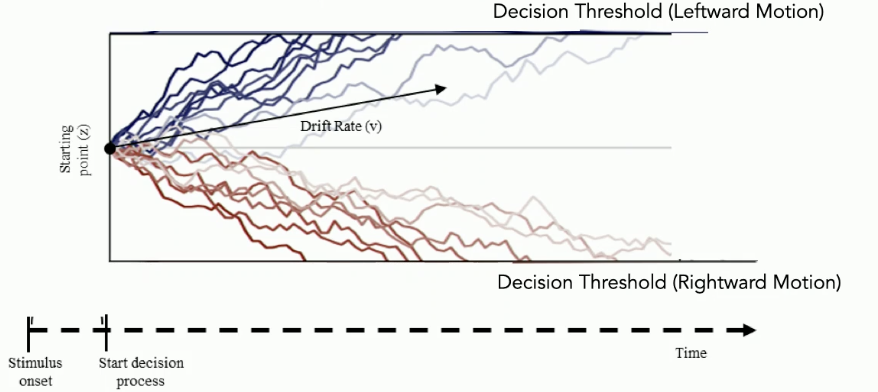
What is the drift diffusion model
overview:
popular form of evidence accumulation model
used to predict peoples’ choices and how long they take to make those choices
graph
x-axis → time
each line (blue and red lines) represents one trial: a decision that you might be making
lines also indicate the amount of evidence you have towards a motion decision
each of the two decision you could make are the top and bottom line
middle line: decision threshold
reading the graph
start in the middle
stimulus comes on → you’ll see bits of motion come into your visual system
gonna start accumulating evidence towards a left-ward or right-ward motion decision
once you cross horizontal line → mean you have passed decision threshold (have enough evidence to make decision)
analysis
the steepness of the line tells you how fast or slow the decision making process was
NOT ALL DECISIONS ARE THE SAME
What is evidence for the sensory recruitment hypothesis
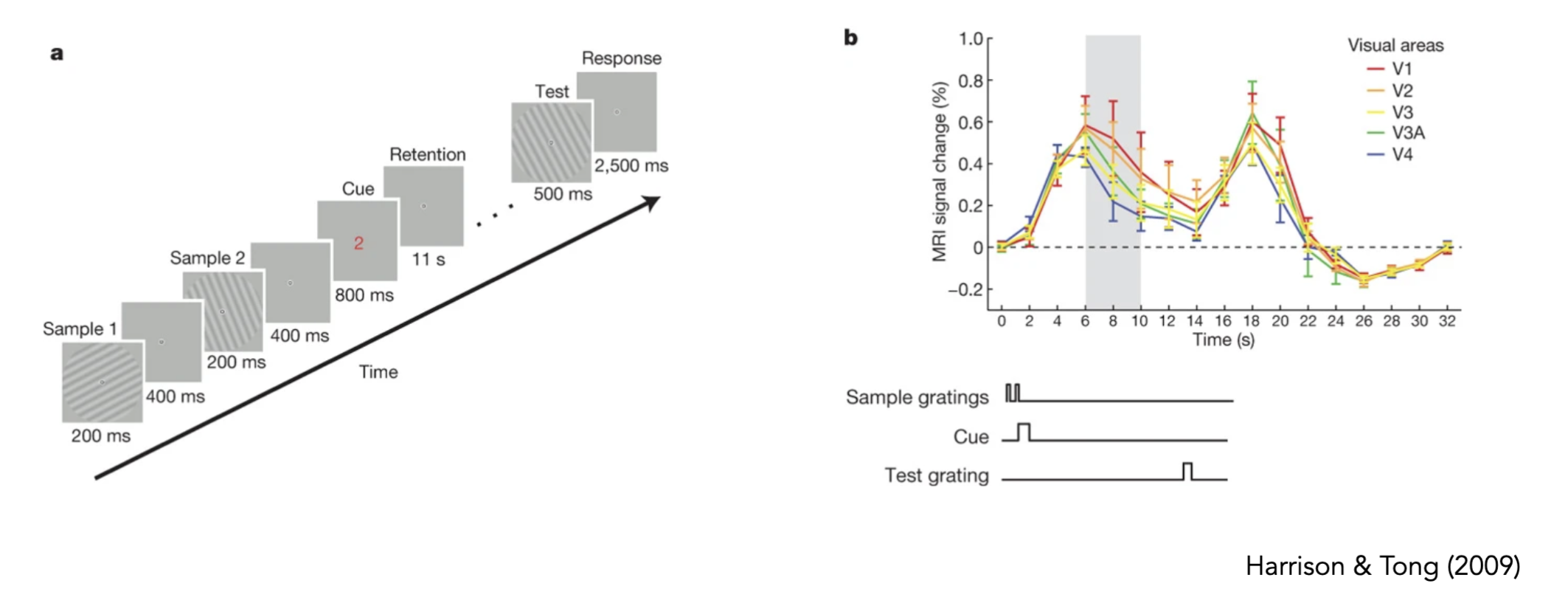
FMRI study proved this
paradigm:
presented with stripes that are oriented diagonal
given different set of stripes
told which stripes need to be maintained
diagonal → 1st
OR other → 2nd
presented with another stimulus and asked to say whether it matches with the first/second one or not
results:
on a plot, we see persistent activity in visual cortex (goes down but not all the way back down) during this time
people have devised tests to see what information is being encoded during that activity
computer trained to use visual cortex activity to distinguish when subjects are looking at one orientation vs another (while participant is looking at stimulus)
test during WM delay while theres nothing on the screen
if that model works it suggests that the delay period activity is organized in the same way → computer model had 70% accuracy
conclusion:
suggests that the content of stimuli is in that brain activity observed in the visual cortex
responses in the visual system seem to track the information that is trying to be maintained
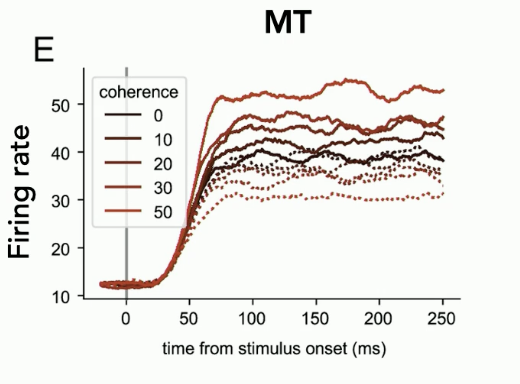
Analyze this Graph
graph is recording of neurons in area MT of monkeys as they random dot motion task
y-axis: firing rate
x-axis: time since the dots come on the screen
color gradient shows how MT neurons respond to the motion stimulus depending on how coherently in one direction the dots are moving
dark → bright red = increasing motion coherence
0% coherence → random motion
50% coherence → dots are clearly moving in same direction
50% of dots are moving in one direction
takes 50 milliseconds(ms) for activity to ramp up → thats just the time that it takes for information to travel from visual processing to MT
once it ramps up → activity is stable
conclusion: the higher the motion coherence the higher the firing rate
when more dots move in the same direction, MT neurons fire more vigorously
Firing in MT scales with the amount of motion you are perceiving
not really decision making → this is just perception but this information is gonna feed forward to other brain areas that are important for decision making
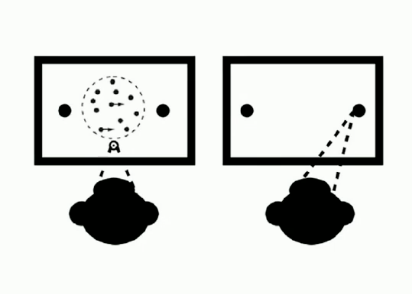
random dot motion task (with monkeys)
monkeys look at cloud of dots
dots will go away and monkeys eyes will either go to left target or right target depending on which way they believe the dots are moving
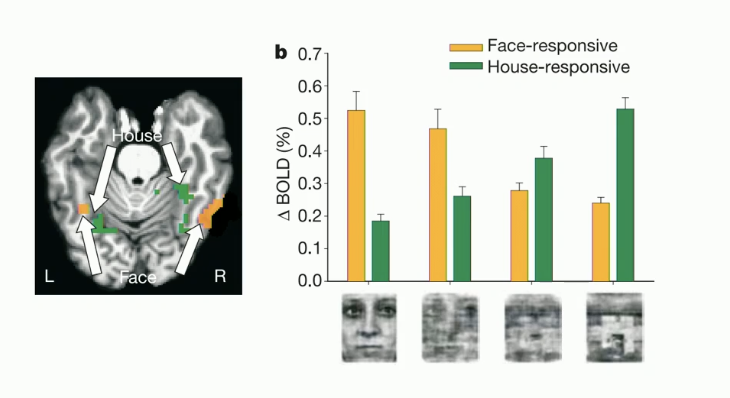
explain the face/house perceptual decision making task
perceptual decision making task
paradigm: pictures of houses and faces are overlayed in a confusing way
intermediate stimuli that look a little bit like a face and a little bit like a house
Graph:
if you look at face-responsive visual areas like FFA and house-responsive visual areas like PPA → see smooth gradients of activity:
the more face like it is → more FFA activity
more house-like image is → more PPA activity
PPA and FFA are tracking the amount of perceptual information in the stimulus
not really decision making → this is just the input for decision-making
what are the important concepts of decision-making
evidence/evidence accumulation → accumulation of information supporting each of the possible choices
decision threshold → the threshold that needs to be reached, once enough evidence has been accumulated, for a decision to be made;
once you’ve accumulated enough information to pass this threshold, the decision has already been made, you just need to make the response
noise → evidence we accumulate is affected by random factors
all of these concepts are part of an evidence accumulation model, specifically, a drift diffusion model
What are the ways that decisions vary
drift rate → the speed at which we move toward a decision threshold (how fast we made the decision)
the slope of the line:
steep slope → high drift rate; getting evidence at a fast rate
you hit the decision threshold faster
higher drift rate → leads to faster and more accurate responses;
if you accumulate information faster → reach the right information faster → make a response faster
shallow slope → slow drift rate; getting evidence at a slow rate
decision threshold → how much information/evidence is needed in order to make a decision (distance between bounds) can vary
can differ between people and context
even if drift rate is the same → amount of time to make decision changes if the bounds are changed
higher thresholds → lead to slower and more accurate responses
response bias
bias towards one decision:
offset at beginning that puts you closer to one of the bounds than the other → more likely to respond + will be faster to respond in that way
Neural basis of perceptual decision-making
MT
signals strength of motion in a given instance → momentary evidence towards a decision
strong motion → higher MT firing
weak motion → lower MT firing
NOT evidence accumulation (does not show accumulation of evidence over time)
LIP (lateral inter-parietal area)
shows accumulation dynamics
DONT see a stable response over time
steep slope → most coherent motion
shallow slope → lower amounts of motion
LIP neurons are accumulating evidence of the information they get from MT until they reach some type of threshold that signals a decision
usually studied in monkeys
LIP part of intraparietal sulcus on the lateral parietal sulcus
Intraparietal sulcus different on monkeys than on humans
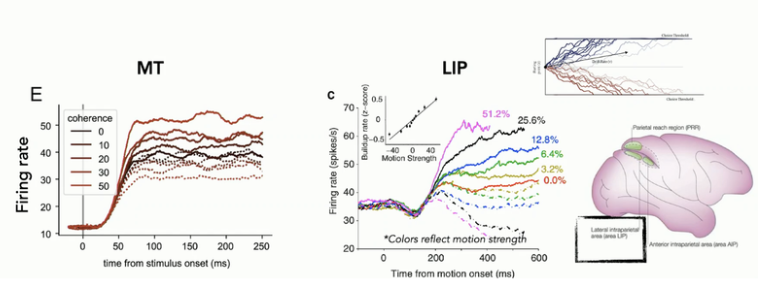
Evidence for MT/LIP circuit for perceptual decision making
Lateral Intraparietal Area (LIP)— it's a region of the parietal cortex involved in decision-making, spatial attention, and the accumulation of sensory evidence over time (as shown in that drift-diffusion style graph).
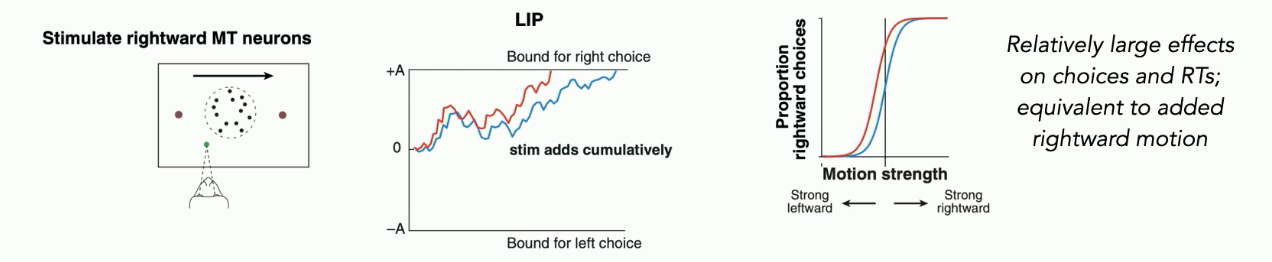
if we mess with MT → should impact the evidence accumulation process in LIP (because it should be getting evidence from MT and accumulating it overtime)
example
if we use electrodes and stimulate MT neurons that care about rightward motion → we should see that information accumulates in LIP for rightward motion decision more quickly
has downstream effects on what the monkey chooses and choice RTs
example graph
red line → LIP with fake rightward motion activity (due to MT stimulation)
looks equivalent to if there was more visual stimulus showing rightward motion even though there is none
even when there’s noting there, because we’re adding stimulation, you are more likely to make rightward motion decision
blue line → LIP control (with not interference)
control → if there is no distinct leftward or rightward motion, you should always pick 50/50
what are the brain regions that code for value in a common currency (across stimulus attributes)
these regions track different kinds of rewards and code them into some universal value signal
ventral-medial prefrontal cortex (ventral mPFC)
overlapping definition of orbitofrontal cortex
ventral striatum
striatum includes the caudate and the putamen
nucleus accumbens (NAcc)→ part of basal ganglia
more related to reward
Describe this value tracking task
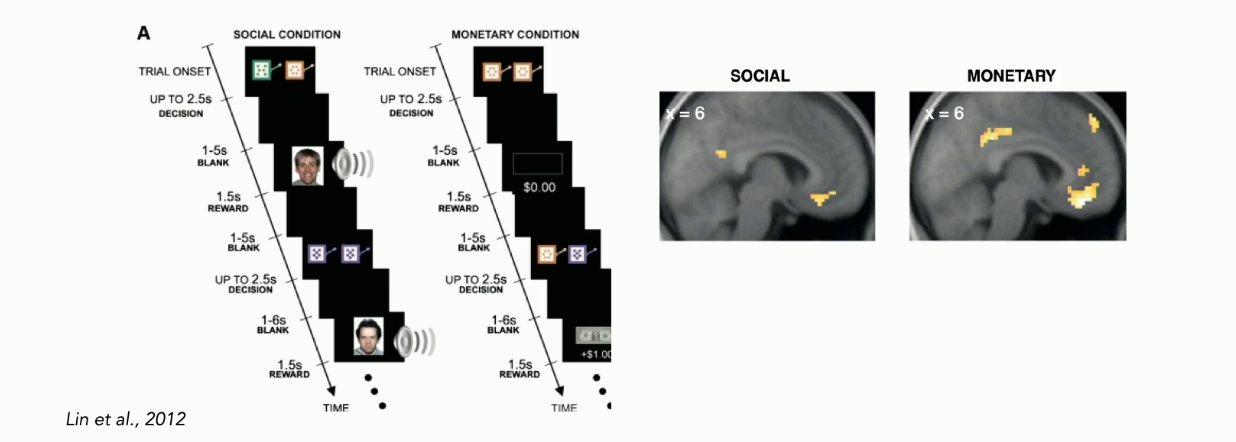
start with a value case:
start with two stimuli and you just have to pick one
learn through trial and error that one stimuli gives you a lot of money and one gives you not very much money
can track how much value people assign to the stimuli + track brain activity
can do the same for social reward
one stimulus gives you a picture of someone smiling at you, other gives you a picture of someone frowning at you
In both cases, if you look at activity in ventral medial PFC regions → see more activity for both social value and for monetary value
evidence for these regions caring about value in some type of common currency
Describe the ‘willingness to pay’ paradigm
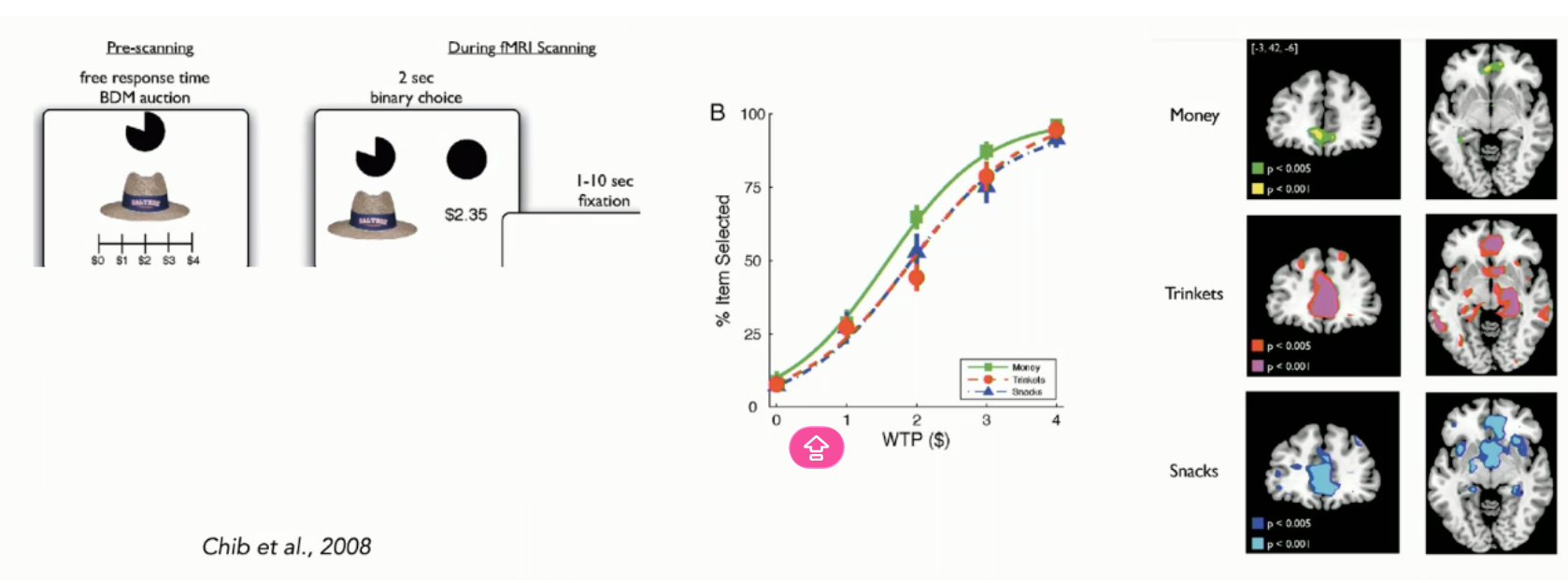
paradigm
ask someone how much they are willing to pay for an item
people give you a number
later you can make people make choices
do you want ‘X’ item or ‘___’ value of money
do you want ‘X’ item or ‘Y’ item
very easy to show that peoples willingness to pay scales nicely with whether they choose that item later
works for all type of stimuli
money, food, random objects, etc.
brain activity
in PFC → more activity for more willingness to pay for these items (regardless of what the items are)
making same point that there is this common currency for value
what is the homunculus problem?
the PFC controls behavior by directing attention, selecting actions, and overriding impulses but what controls the PFC?
if you say “a higher executive system,” then who is controlling that system → leads to infinite regress of controllers
What is the dilemma for tasks like the N-back task? How may it be solved?
problem:
dilemma between maintaining info (gating out) vs. updating (gating in) information in working memory: stability vs. flexibility
can be broadened to other WM tasks (both in lab and in real life situations)
solution:
this gating problem may be solved in art by similar gating mechanisms as motor responses (i.e., basal ganglia)
basal ganglia is also important for opening gates in working memory; deciding when new information is going to come in or when its not going to come in
gating in the motor system can be extended to cognitive concepts like WM
what is long term memory
systems that can encode, store, and retrieve information over long periods of time from minutes to a lifetime
long can mean anything here → anything greater than working memory
unlike working memory → information doe not have to be “active” to be remembered for LTM
LTM is high capacity (much higher capacity than WM)
usefulness of LTM → provides a way to exploit the relationship between the past and future
things that are remembered from the past can be useful in the future/present
subdivided into declarative vs. nondeclarative
what are the two subdivisions of LTM
Declarative (explicit) → you can talk about what you know
e.g. memories of your life, facts (you can tell someone these are things you remember)
Nondeclarative (implicit) → things you don’t have access to through your language or verbal system
e.g. knowing how to ride a bike (things you just do without real thinking or capacity to explain to someone else)
What are the two major subbranches of declarative memory
episodic memory → reflects experiences in your life for specific events, objects, places, specific things that happened
contextualized with yourself at the center (memories, self-related experiential knowledge)
semantic memory → reflects generalized knowledge or facts
just knowing facts, decontextualized, detached from where they were learned, not a specific episode
what is encoding
storing things in memory
what is retrieval
bringing memories back to mind
what is consolidation
changing memories over time
Give an overview of Karl Lashley’s work
Project:
wanted to find out where episodic memories were stored
used mice going through mazes, lesioned their brains to try to see where episodic memories (that helped them navigate the mazes) were stored
Conclusion:
the more he destroyed of the mice’s brains, the worse their memories were
concluded that memory traces were distributed across the brain not localized
this conclusion was unsatisfying because it seems incorrect
Give and overview of Wilder Penfield’s contribution to knowledge about episodic memory
Penfield was a prominent neurosurgeon in the 1950s
invented a lot of modern neurosurgical techniques
project:
would inject electrical activity into the brains of patients while they were awake and under anesthesia → would try to understand what different parts of the brain did
conclusion:
found that sometimes when he stimulated it seemed to evoke things like memory
seemed to be happening when he stimulated the temporal lobe: possible memory traces in the temporal lobe
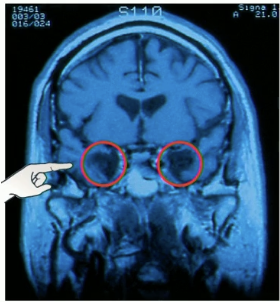
Give and overview of patient HM’s injury, cause of injury, and associated deficits (pattern of memory loss)
overview:
H.M experienced seizures in childhood that became severe as a teenager
underwent experimental surgery in his 20s that resected his bilateral medial temporal lobes because thats where a surgeon thought HM’s epilepsy was originating from
result:
surgery was successful in reducing the severity of his epilepsy but his memory was profoundly impaired
HM’s pattern of memory loss:
had anterograde amnesia + retrograde amnesia (specifically temporally graded retrograded amnesia)
his early memories seem to be intact (same as healthy individuals)
HM’s deficits were remarkably specific to episodic memory → could not form new episodic memories in any modality (spatial, visual, verbal, etc.)
however all other cognitive abilities were intact ( normal working memory, semantic memory, procedural memory ( speech understanding.. etc.)
due to impairment in hippocampus → could recall semantic aspects of memories but not episodic memories
Describe HM’s performance on Mirror Tracing Task
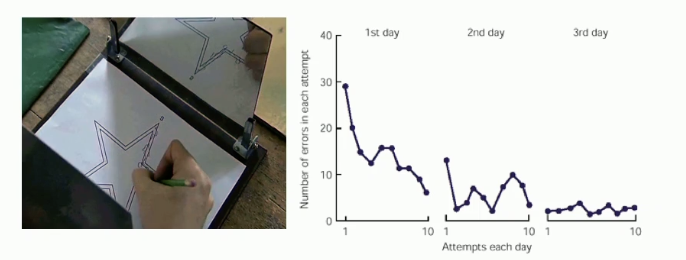
Task
participants have to trace a shape without looking at hands directly → can only at hands through looking in a mirror
Had HM perform this task over repeated sessions
outcome
HM shows the same pattern of improvement as a normal person but just doesn’t remember any of it
conclusion
episodic memory is distinct from other forms of memory
What composes the medial temporal lobe
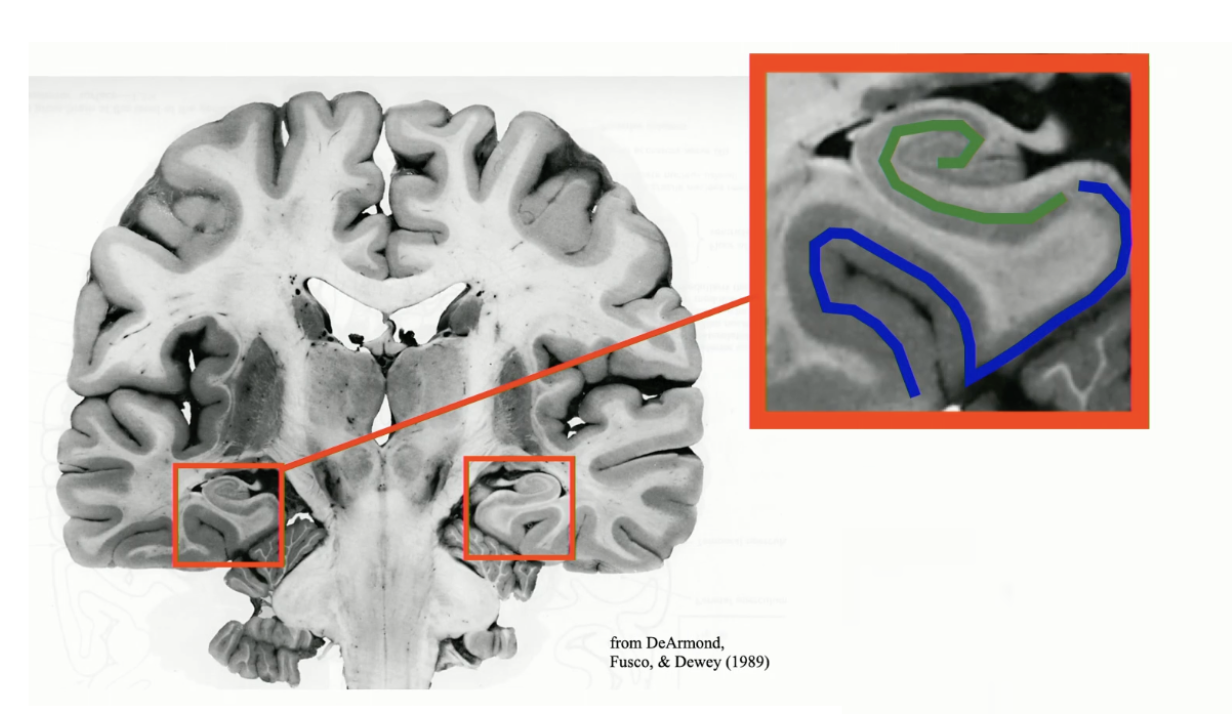
perirhinal cortex (PRC)
entorhinal cortex (ERC)
parahippocampal cortex (PHC)
all of these are direct inputs/outputs to the hippocampus
hippocampus is evolutionarily old and conserved across species + looks like a seahorse
Identify the structures highlighted in blue and green
green → hippocampus
blue → MTL cortex
made of the entorhinal cortext, the perirhinal cortex, and the parahippocampal cortex
What are the three phases of episodic memory
encoding → the process of converting sensory information into a memory trace
retrieval → the process of retrieving information from memory storage
consolidation → stabilization of encoding information into long-term memory stores; some type of change of the stored information in some way—something about the storage is changing over time
What is a subsequent memory paradigm
seeks to answer question
if the hippocampus is important for memory (which is what we think from HM), can we find evidence that activity in the hippocampus predicts whether you are going to remember something or not?
Task
individual is sitting in fMRI scanner during the task
three trials where each trial a pariticpant is presented with a different word
measure brain activity while participant sees each of these words
later, memory task is given where participant is asked whether a word from the trials was seen
if person says yes → they remembered
if person says no → they forgot
responses of the memory tests are taken and trial brain activity is labeled based on whether participant later remembered or forgot the word
results
we find a few different brain regions where
get more brain activity for subsequently remembered items than for subsequently forgotten items
brain activity located in the MTL and PFC
conclusion
MTL (and PFC) involved in successful encoding
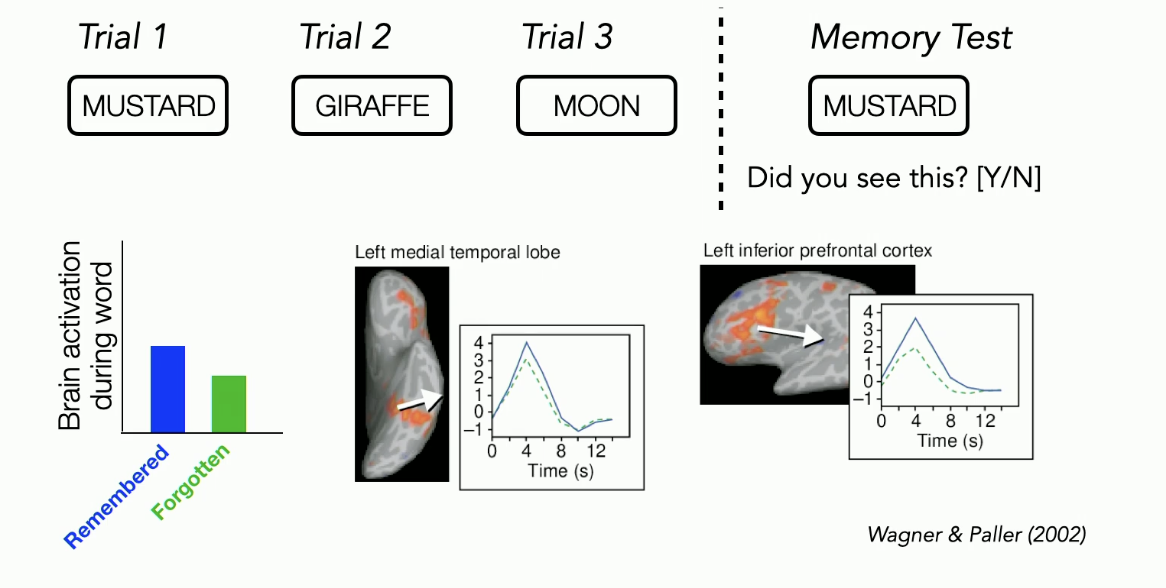
how does MTL support successful encoding
plays a role in binding (hippocampus)
memories have a lot of different features (people, place, time, internal context like emotion)
combination of features of what make the memories unique
idea is that hippocampus may play a particular role in binding all of those features together into one episode
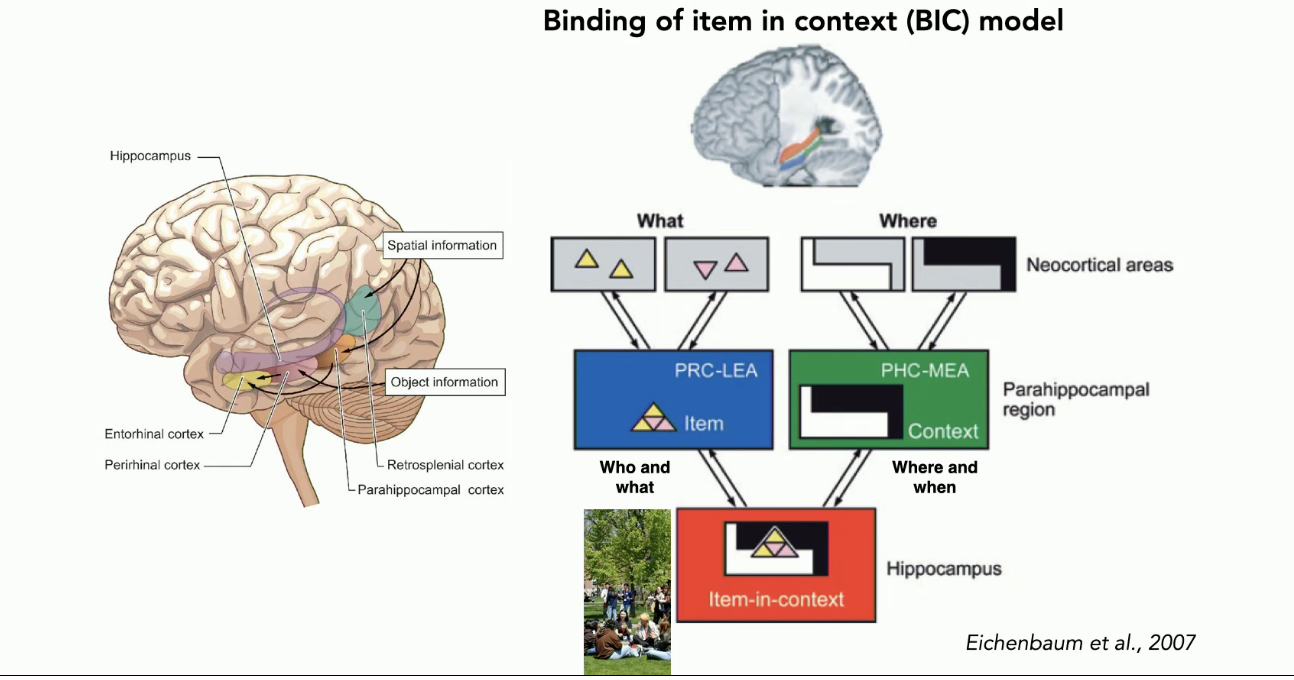
Binding of items in context (BIC) model
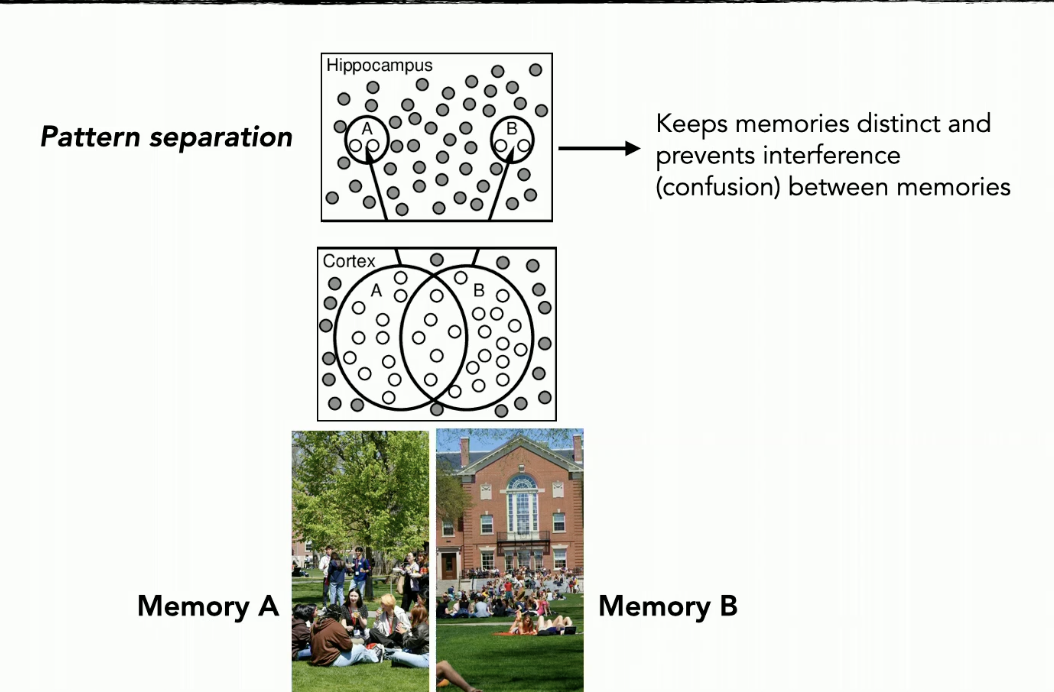
pattern separation → keeping similar memories separate
explain the Binding of item in context (BIC) model
the neocortical areas (the rest of the brain) have representations of what an wear (object and spatial representations)
these representations get fed forward into the perirhinal and parahippocampal cortex
both the PHC and PRC converge into the hippocampus
hippocampus is in a good spot to
get all in of these different type of information
bind all the information together
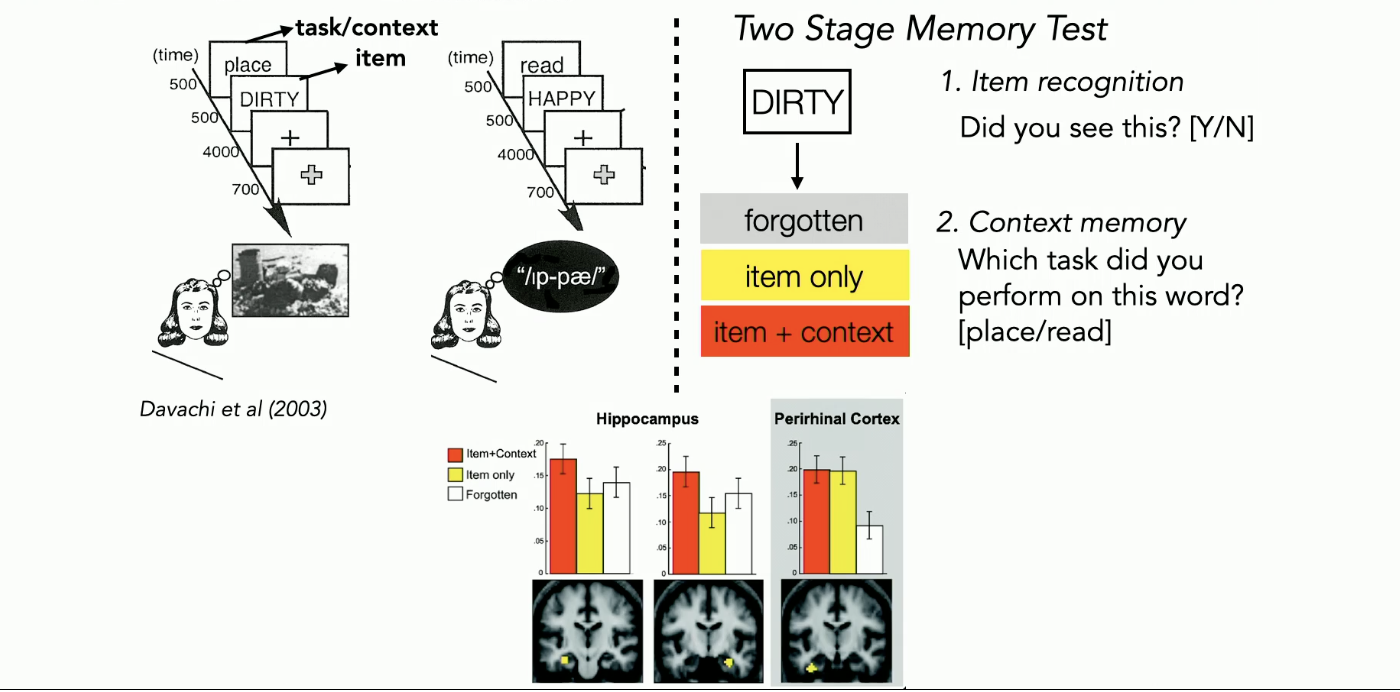
How do we actually know whether the hippocampus is important for binding
task
have people remember words across two different contexts
task contexts tell you what you should do with the word
place task-context→ you should try to imagine whatever the word is
read task-context → read the word backwards in your head
purpose of the different contexts is to create multiple components
now you have to recognize whether something happened or not + remember which task it happened in
two stage memory test
put people in a scanner while they are doing this + do the same type of memory test except there is one extra component
item recognition: did you see this word or not
context memory: which task did you see this word on
requires you to have bound that information together, not just recognize that its old
based on what they respond you can call the word:
forgotten → they forgot the word + the context
item only → remember the word but not the context
item + context → remember the word and the task they did when they saw the word
we are interested in the distinction → if hippocampus is important for binding, then it should respond more for item + context conditions
perirhinal cortex does not seem to distinguish item + context from other conditions, just cares if you remember anything at all
conclusion
hippocampus supports successful binding of multiple aspects of an experience during encoding
how does the hippocampus keep memories separate?
two similar memories activate the same/similar neurons in the visual cortex because they have lots of similar features
pattern separation:
but the hippocampus has a very separate way of coding things → even though the memories are very visually similar they are going to activate different neurons in the hippocampus
How does the MTL support succesful encoding?
hippocampus is the main reason; hippocampus is involved in both
binding together all of the co-occuring features of an event
pattern separation (keeping similar memories separate)
Which of the following best describes the logic of the subsequent memory paradigm used in fMRI studies of memory encoding
Brain activity during encoding is sorted based on whether each item is later remembered or forgotten
Which of the following describes the contribution of different MTL structures to encoding?:
A. Perirhinal cortex activity during encoding predicts later item memory but not recollection of contextual detail
B. Perirhinal cortex predicts later recollection of contextual detail
C. Hippocampal activity during encoding predicts recollection of contextual details
D. A and C
D. A and C
when is hippocampal activity the highest during encoding
when you can remember both the item (the word) and the contextual items (the task you were performing when you were encoding the word)
when was perirhinal activity the highest during encoding?
showed a boost just if you remembered the item (the word); activity was also high if you remembered the item and the contextual details (the task you were performing when you were encoding the word)
Describe the process of encoding and retrieving things from memory
Encoding
features of an experience are encoded as a pattern of activity in the sensory cortices (visual, auditory, etc.)
the hippocampus binds all of this information together
hippocampus serves as a pointer to the other systems of the brain, indexing the features of the memory
Retrieval (if the hippocampus has done this binding successfully)
Later when the hippocampus gets a cue (a reminder of that memory) it pattern completes (hippocampal pattern completion) the rest of the memory:
the whole pattern of the memory is reactivated in the hippocampus
hippocampus is recreating that pattern of cortical activity
that is going to reactivate the sensory features of the memory in cortex
at least some parts of the cortex that were active during encoding of a memory are reactivated (reinstated) when that memory is retrieved
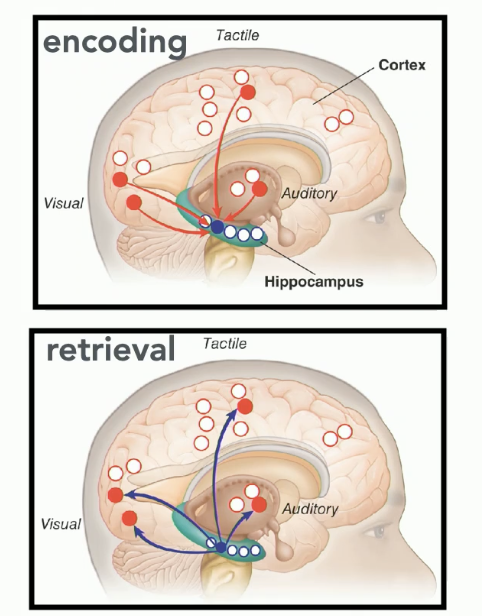
what is hippocampal pattern completion
when the hippocampus receives a cue (partial reminder of the memory)
What are the two processes that occur when you reconstruct an entire memory experience from a cue or a reminder
Hippocampal Pattern Completeion
a partial cue that reactivates part of the memory is going to engage this auto-complete process where the entire memory pattern is recreated in the hippocampus
once the memory is recreated in the hippocampus it can be recreated in cortex
Cortical Reinstatement aka Cortical Reactivation
The same cortical neurons that were activated when you experienced the event get activated when you recall it
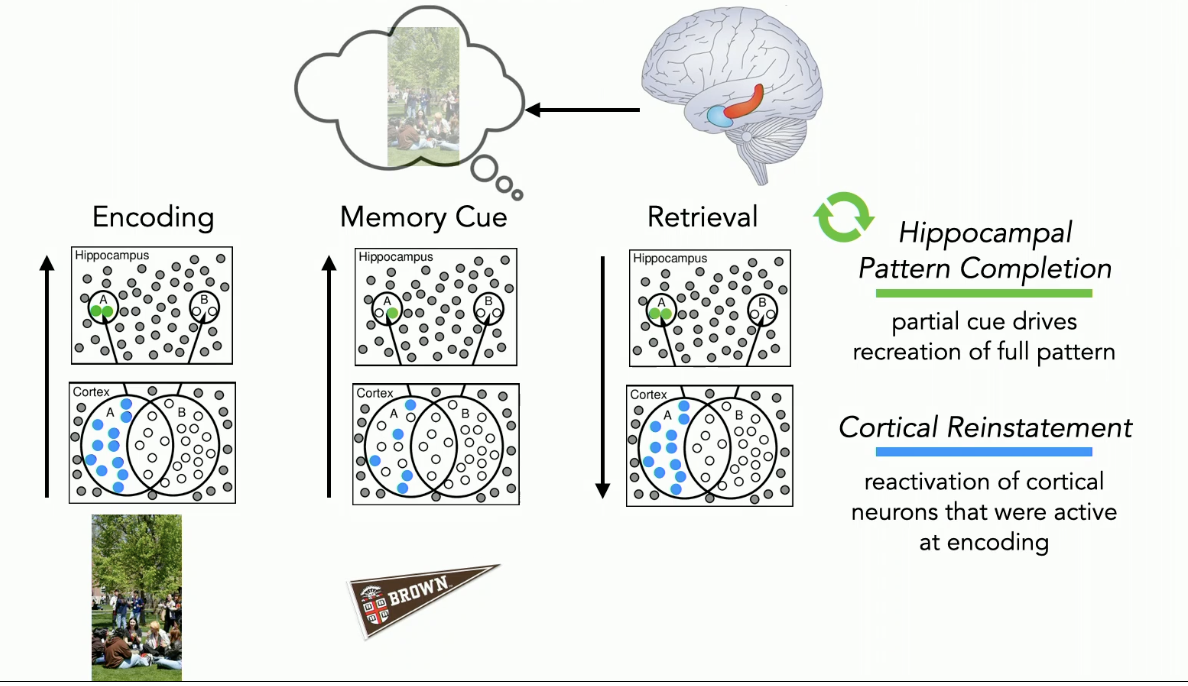
What do we see in the sensory systems during cortical reinstatement? What is the evidence in support of our conclusion?
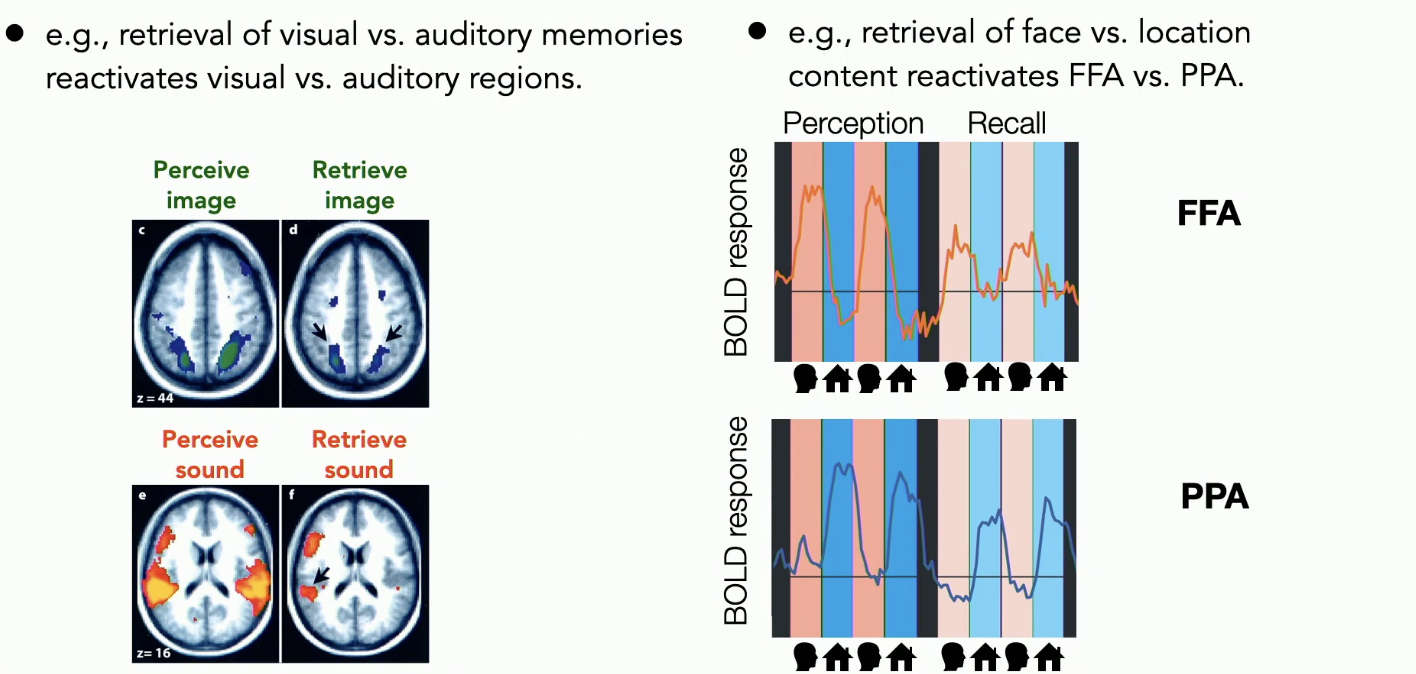
We see activity in the sensory systems while people are remembering things (i.e. faces, sounds, etc.)
Example 1: Auditory + visual regions
had people look at images + listen to sounds → saw activity in primary sensory areas during this condition
saw weaker activity in the same sensory areas when participants were asked to recall the images/sounds they’d been shown previously
Example 2: FFA + PPA
if we show people blocks of faces and houses → FFA responds to faces, PPA responds to houses
when we have people recall faces → FFA becomes weakly activated again (but only when we have people recall faces)
when we have people recall houses → PPA becomes weakly activated again
conclusion
retrieval of visual vs. auditory memories reactivates visual vs. auditory regions.
retrieval of face vs. location content reactivates FFA vs. PPA
when we bring things back to mind we are engaging the same cortical regions as when we first experience them
cortical reinstatement pattern of reactivating sensory regions is widespread across many cortical regions