Chemistry Chap 4: Reactions & Stoichiometry
 Call Kai
 Learn
Learn Practice Test
 Spaced Repetition
 Match
Match Flashcards
 Knowt Play
1/35

There's no tags or description
Looks like no tags are added yet.
Name | Mastery | Learn | Test | Matching | Spaced | Call with Kai |
|---|
No analytics yet
Send a link to your students to track their progress
36 Terms
Relative isotopic mass
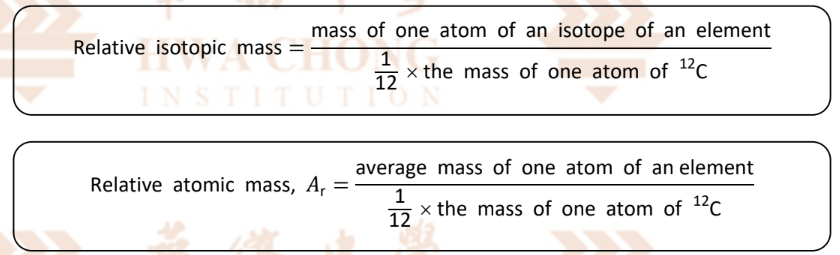
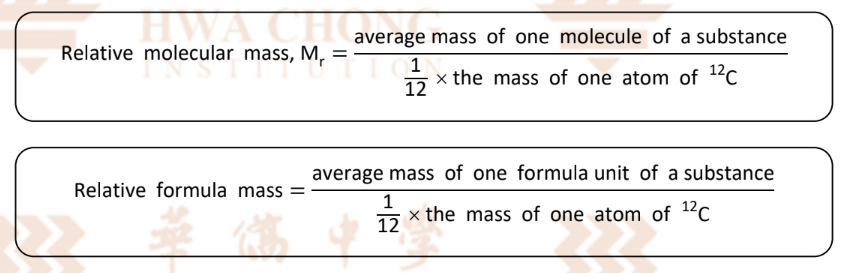
Relative molecular mass
*average → important!
*relative masses → no units
*relative formula mass → used for ionic compounds
*Mr = sum of all Ar → remember to add the water (of crystallisation) in to the Mr too!
Percentage Composition by Mass
Percentage Composition by Mass = Ar of element / Mr of compund x100%
Empirical Formula
Definition:
The empirical formula of a compound is the simplest formula which shows the ratio of the atoms of the different elements in the compound
Molecular Formula
The molecular formula of a compound is the formula which shows the actual number of atoms of each element in one molecule of the compound.
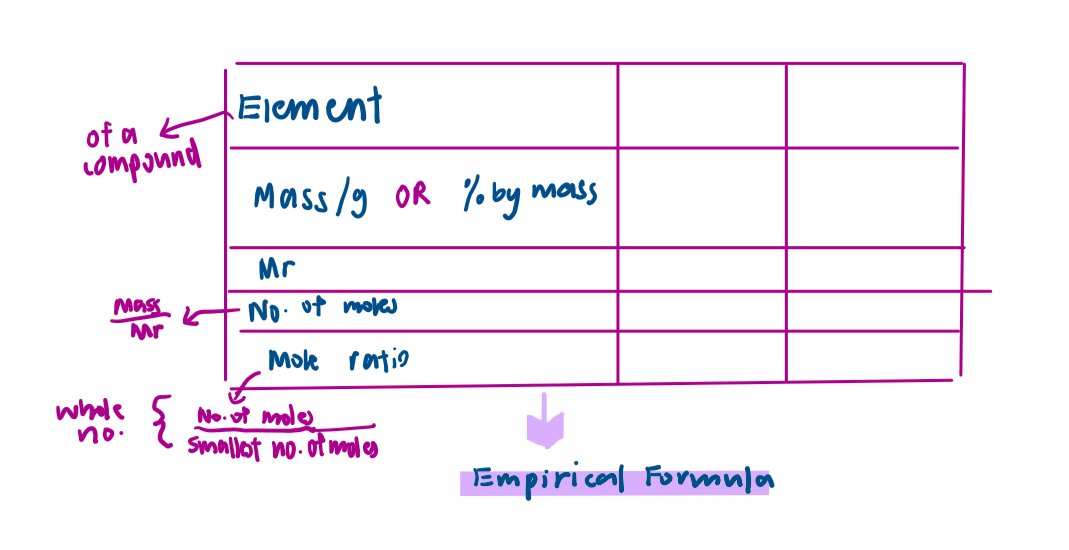
Derivation of Empirical Formulae
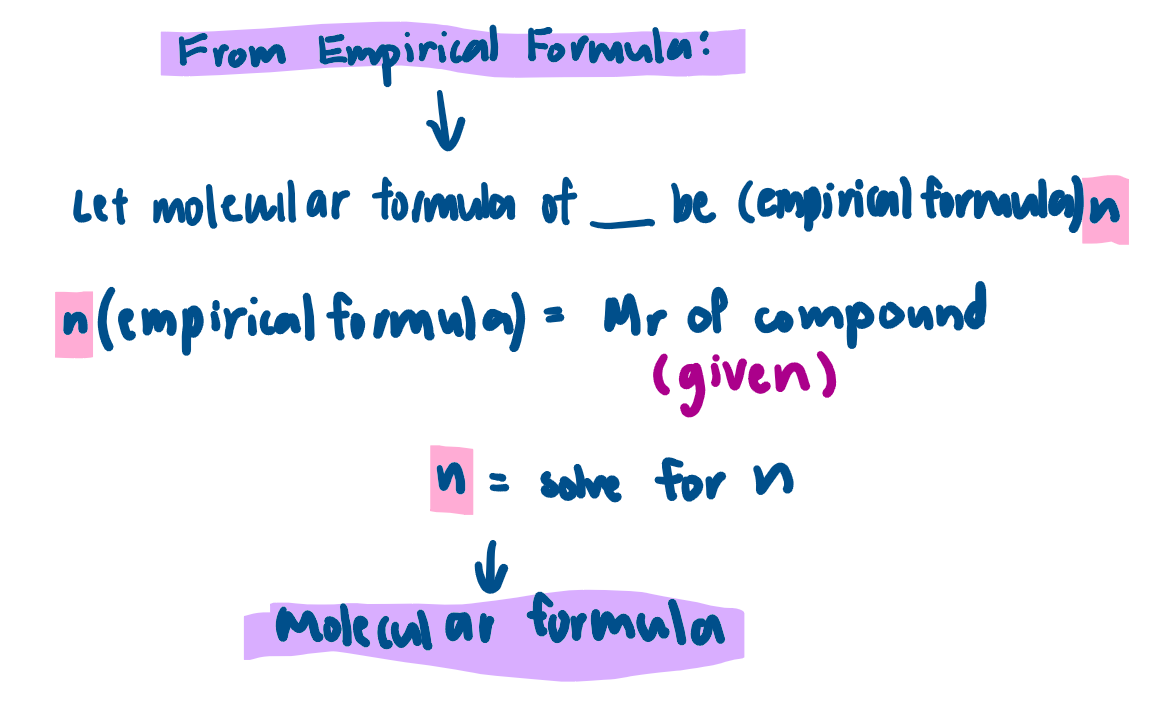
Derivation of Molecular Formulae
There’s also a ratio method (more useful when solving for unknowns)
Derivation of Formulae using Combustion Data
Complete combustion → Form CO2 + H2O
Steps (common):
Find the mass of C in CO2 using % by mass
Find the mass of H in H2O using % by mass
Draw the table to find mole ratio → Empirical formula
Then find molecular formula
Percentage yield

Calculations involving Volumes of Gases
Avogadro’s Law:
Equal volumes of all gases, under the same temperature and pressure, contain the same number of particles
Hence:
Volume (of gas) ratio = Mole ratio (of gas)
Eg: 2CO (g) + O2 (g) → 2CO2 (g)
20cm3 of CO will react with 10cm3 of O2 to give 20cm3 of CO2
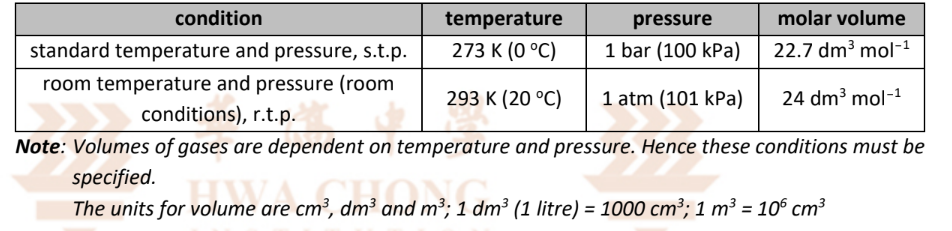
Molar Volume (for gases)
Molar volume, Vm, of any gas is the volume occupied by 1 mole of the gas at a specified temperature and pressure.
Volume of gas = n x Vm
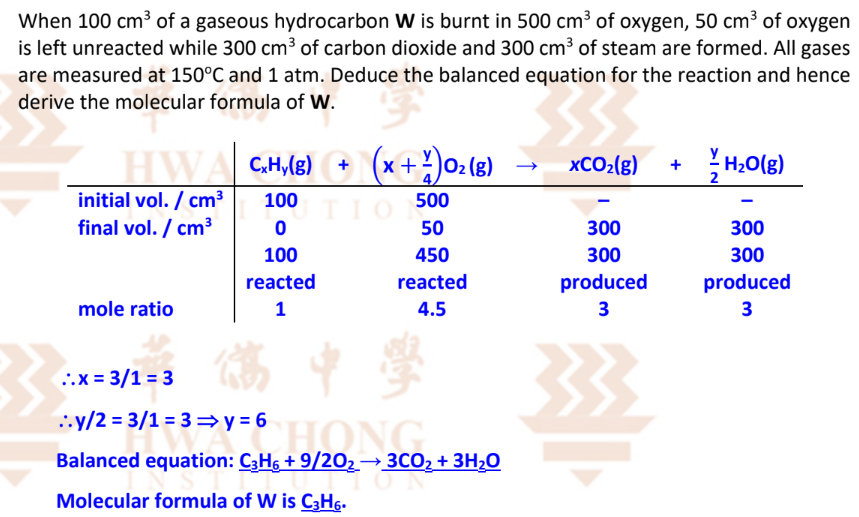
Question Solving Technique
Note:
At room temperature, H2O formed is in LIQUID state (usually just take H2O as liquid, unless question specifically say steam, then it will be gas)
CO2 is acidic → It gets absorbed by alkali
O2 is neutral → Will not be absorbed by alkali
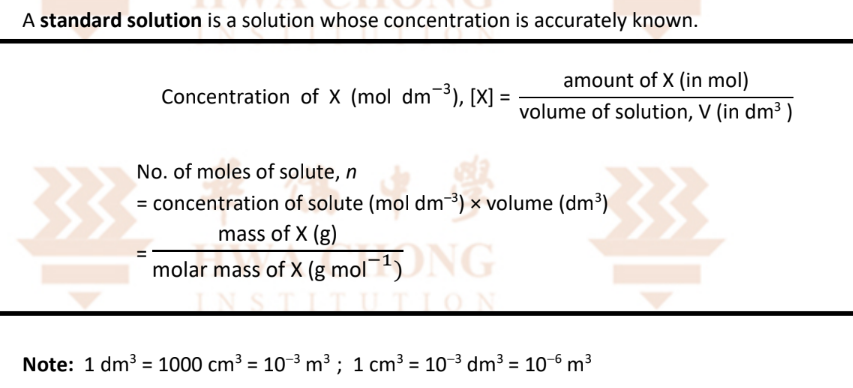
Concentration
Other formulae:
Mass concentration = Molar concentration x Molar mass
C1V1 = C2V2
Dilution:
When solution is diluted by adding more solvent, the concentration of solution decreases, but the number of moles of solute remains the same
Types of Reactions
Precipitation reaction
Thermal decomposition
Acid-base reaction
Redox reaction
Acid-base reactions
3 theories:
Arrhenius Theory
Bronsted-Lowry Theory
Lewis Theory
Acid-base reactions → Arrhenius Theory
Definition of Acid:
An acid is a substance that dissociates in water to produce H3O+ (aq) / H+.
Note: H3O+ → Hydronium / Hydroxonium ion → H+ is used interchangeably
Definition of Base:
A base is a substance that dissociates in water to produce OH− (aq).
Acid + Base:
H+ ion reacts with the OH− ion to produce a molecule of water, and undergoes neutralisation, according to Arrhenius Theory
Uses:
To describe whether isolated substances are acids, bases or neither.
Limitation:
Restricted to only aqueous solutions
Acid-base reactions → Bronsted-Lowry Theory
Definition of Acid:
An acid is defined as any species which donates a proton, H+
An acid must contain H in its formula (eg: HNO3)
Definition of Base:
A base is defined as any species which accepts a proton, H+
A base must contain a lone pair of electrons to bind to the H+ ion (eg: NH3, F-)
Acid + Base:
Involves the transfer of a proton from an acid to a base
Occur in aqueous solution / non-aqueous solution / gases
Uses:
To describe specific acid-base reactions
Limitation:
Cannot explain why substances like BF3 or AlCl3 which do not contain any hydrogen atom but are yet known to behave as acids
Acid-base reactions → Lewis Theory
Definition of Acid:
An acid is defined a species that accepts an electron pair (eg: BF3)
Definition of Base:
A base is defined a species that donates an electron pair (eg: NH3)
Acid + Base:
Involves the transfer of a pair of electrons from the base to the acid
Uses:
To describe specific acid-base reactions
Limitation:
Too general
Better to use the Bronsted-Lowry theory whenever possible for acid-base reactions, and apply Lewis theory only if the reaction does not involve proton transfer.
Note
H2O is amphoteric → Can act as acid or base, depending on the other substance present
Titration
Aliquot:
Solution measured with a pipette and placed in a conical flask
Standard solution:
One of the solution must be of a known concentration
This solution is known as the standard solution
Placed in the burette
Phrasing:
Titrate (solution in flask) against (solution in burette)
Equivalence point:
Occurs when the reactants in the two solutions react according to the stoichiometry of the reaction.
Titre volume:
Volume of solution added from the burette
End point:
The point where the indicator changes colour
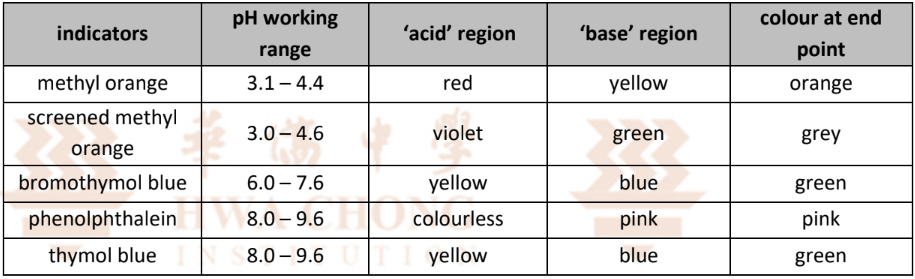
Indicators
pH working range → Range of pH where there would be colour change
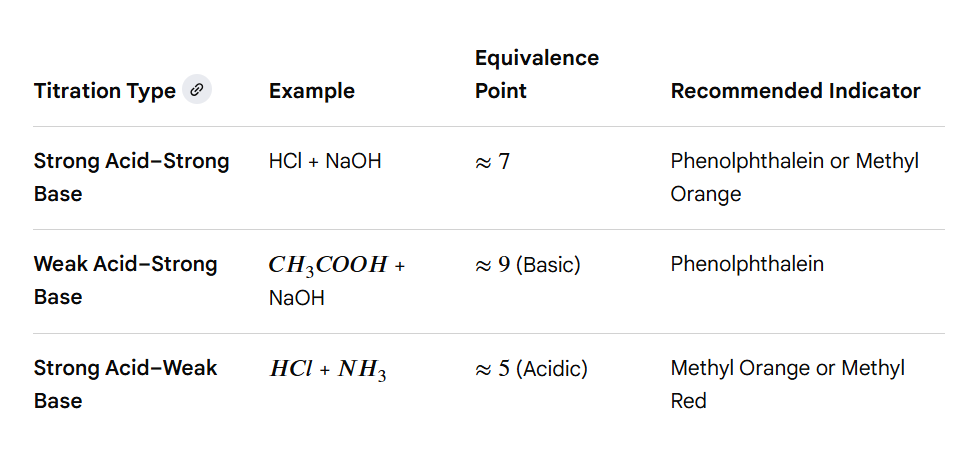
Back Titration
A known excess of one reagent A is allowed to react with an unknown amount of B.
The amount of unreacted A is then determined by titration with a reagent C of known concentration.
From the titration results, the amount of unreacted A and the amount of B can be found by simple stoichiometric calculations.
Steps:
Reagent A (known concentration, excess) → React with B (unknown, limiting)
Unreacted A → Titrate against C (known concentration)
Back Titration

Back Titration → General steps to solve questions
1) Determine the amount of C required in the titration.
2) Using stoichiometry, find amount of A that reacted with C in the titration.
[Amount of A that reacted with C = Amount of A that did not react with B earlier]
4) Amount of A that reacted with B
= Total amount of A added – Amount of A that reacted with C
5) Use stoichiometry, find the amount of B
Redox Reactions
Definition of Redox Reaction:
A reaction that involves reduction and oxidation simultaneously.
Reduction:
Gain H
Lose O
Gain electrons, which results in
Decrease in oxidation number
Oxidation:
Lose H
Gain O
Lose electrons, which results in
Increase in oxidation number
Reducing agent:
Reduces other substances (gives electrons)
Itself is oxidised
Oxidising agent:
Oxidises other substances (takes in electrons)
Itself is reduced
Disproportionation:
A redox reaction in which the same substance is both oxidised and reduced.
E.g. 3Cl2 + 6OH− → 5Cl− + ClO3− + 3H2O
Oxidation number / state:
The total number of electrons that an atom either gains or loses in order to form a chemical bond with another atom.
Same atoms in a compound can have different O.S.
Oxidation State
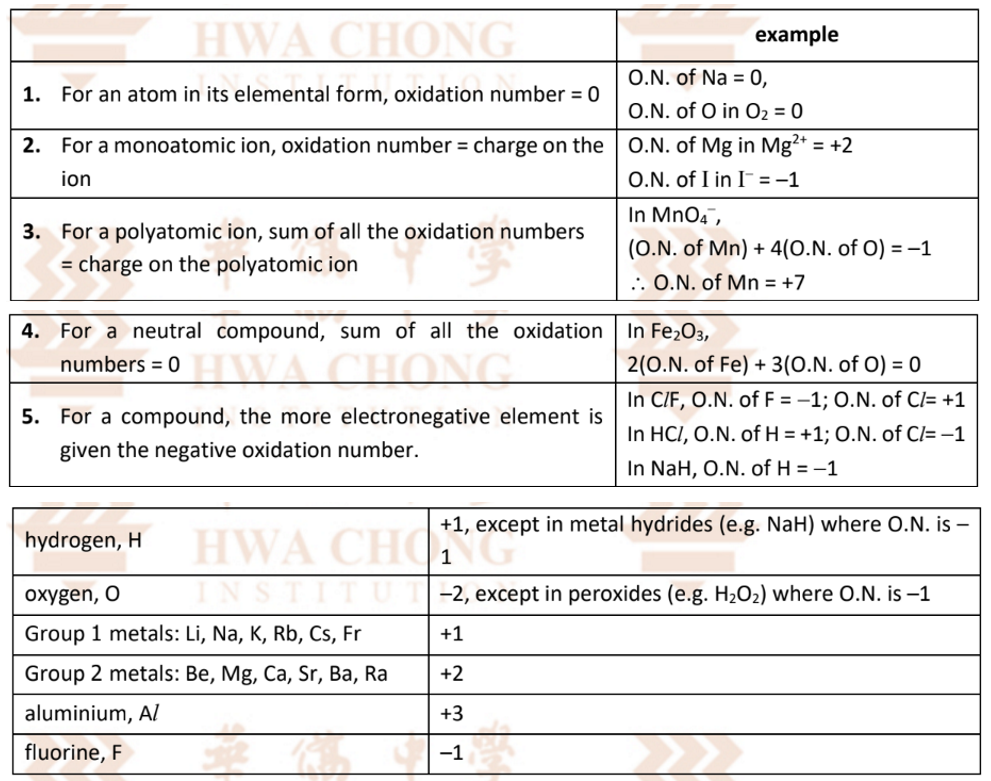
Balancing Redox Equations
*Electron lost by reducing agent = Electron gained by oxidising agent
Method 1: Balancing redox equations using half equations (ion-electron method):
Divide the unbalanced redox equation into two half-equations
An oxidation half-equation
A reduction half-equation
If the equation is written in the molecular form, re-write it as an ionic equation before splitting it into half-equations.
Balance each half-equation as follows:
Balance the element undergoing oxidation or reduction in the reactant and product.
Work out the oxidation number of the relevant elements
Balance the O (or H) atoms by adding H2O on the appropriate side.
Balance the charges on both sides / Balance H of the half-equation by adding the appropriate number of H+ (under acidic conditions) or OH− (under alkaline conditions). Under neutral conditions, either H+ or OH− can be used (H+ is always added to the side with ELECTRONS ; OH− is always added to the side without electrons)
Add the appropriate number of electrons according to the change in oxidation numbers of elements, taking into account the number of each element in the formula unit.
Multiply each balanced half-equation by an appropriate integer, if necessary, to make electrons lost = electrons gained (i.e. total number of electrons lost by reducing agent = total number of electrons gained by oxidising agent).
Add the half-equations together (electrons on both sides must cancel out each other).
Simplify by cancelling any extra species appearing on both sides.
Make a final check that the redox equation is balanced in terms of atoms and charge.
Balancing Redox Equations
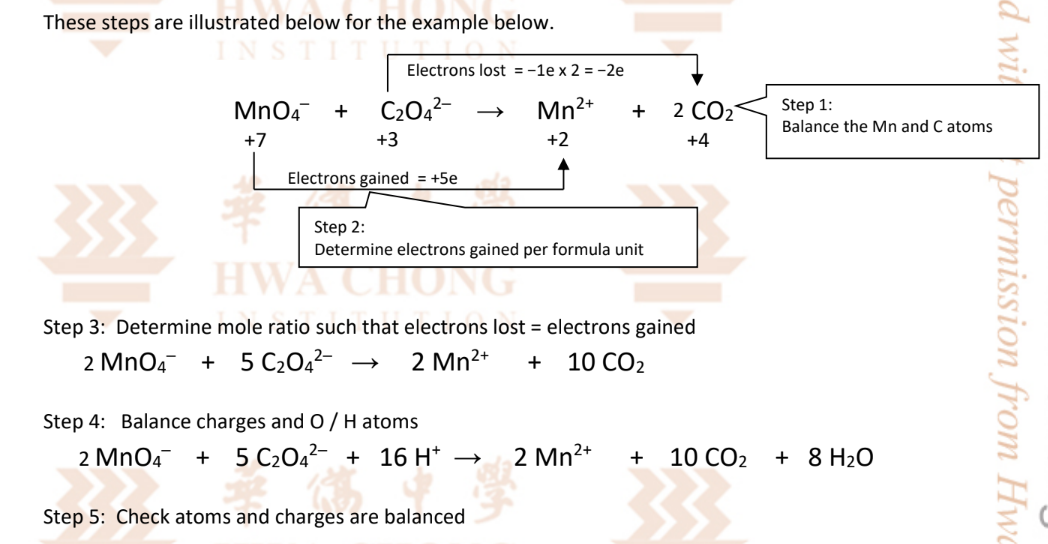
Method 2: Balancing redox equations without splitting into half equations:
Write the unbalanced redox equation with the two reactants and their corresponding products on the same line (with some spaces on top and below for working). Balance the element undergoing oxidation or reduction in the reactant and product.
Determine the number of electrons gained / lost by each element undergoing reduction / oxidation, according to the change in oxidation number of the element, and then determine the number of electrons gained / lost per formula unit of the two reactants, taking into account the number of each element in the formula unit.
Determine the correct mole ratio of the two reactants, such that electrons lost = electrons gained (i.e. total number of electrons lost by reducing agent = total number of electrons gained by oxidising agent).
Complete the balancing of charges and O (or H) as in the ion-electron method.
Make a final check that the redox equation is balanced in terms of atoms and charge.
Redox Titration
A known concentration of oxidising agent is used to find an unknown concentration of reducing agent (or vice versa).
Redox titrations are also used to establish the stoichiometry of redox reactions. The calculations involved are based on the mole concept, similar to acid-base titrations.
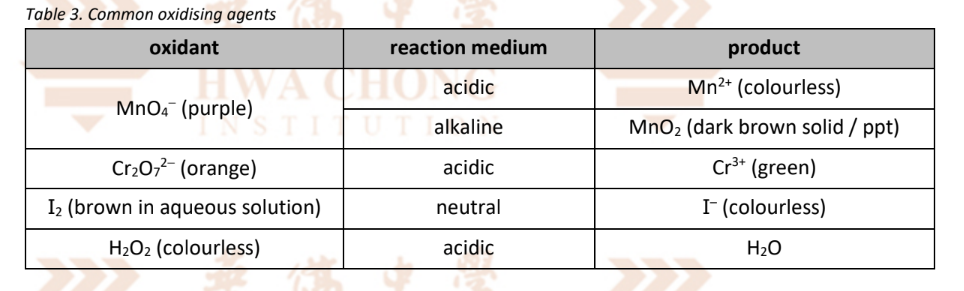
Oxidising Agent
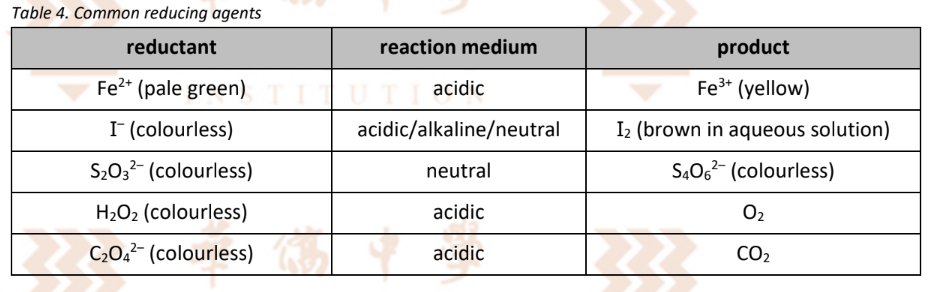
Reducing Agent
Potassium Manganate(VII) titration
The KMnO4 solution (oxidising agent) is usually placed in the burette
Conical flask contains the reductant (e.g. Fe2+ determination)
Typical reducing agents that can react with KMnO4: Fe2+, C2O42−, H2O2 and I−
Manganate(VII) titrations are usually carried out in acidic conditions. The acid used is sulfuric acid (usually at 1 mol dm–3) and added into the conical flask.
Note: Nitric acid and hydrochloric acid are both not suitable as nitric acid is itself an oxidising agent while hydrochloric acid can be oxidised by manganate(VII) ion to give chlorine.
During the titration, the purple MnO4– turns colourless as it is reduced to Mn2+ ions (colourless / pale pink).
MnO4− + 8H+ + 5e− → Mn2+ + 4H2O
When all the reductant is used up, the first extra drop of KMnO4 makes the solution in the conical flask turn permanently pink. This sharp colour change indicates that the end-point is reached. Hence no other indicator is required.
Iodometric titrations – Iodine / Thiosulfate titration
2S2O32− + I2 → 2I− + S4O62−
The thiosulfate solution (reducing agent) is usually placed in the burette
The brown iodine solution is usually in the conical flask.
During the titration, the thiosulfate is added from the burette into the flask and reduces brown iodine into colourless iodide ions.
The solution gradually fades to pale yellow.
At this point, starch indicator is added into the flask.
Solution turns blue-black as starch forms an intense blue-black complex with the remaining iodine.
Titration then continues till all iodine is used up. Colour change at the end-point is from blue-black to colourless.
Things to note:
The iodine solution should be titrated as soon as possible once it is prepared. Why?
Iodine is volatile and will vaporise easily at room temperature hence titration must be carried out as soon as possible.
If this is not possible, cover all flasks containing iodine.
Why is the starch indicator added only towards the end of titration when the iodine solution is pale yellow, instead of right at the start?
Starch forms a blue-black water-soluble complex with iodine in which the iodine is trapped within the starch molecules.
Hence, starch should not be added at the beginning of the titration when there is a high concentration of iodine since some iodine may remain trapped in the starch even at the equivalence point.
After titration is complete, a slow return of the blue colour is observed. Why is this so? Should we continue our titration?
This is due to atmospheric oxidation of I− back to I2.
Ignore any slow return of blue colour after the titration is done.
Iodometric Back Titrations
Used to analyse redox reactions involving some other oxidants (e.g. H2O2) that can oxidise iodide to iodine.
A known excess of potassium iodide solution is added to the unknown concentration of oxidant in a conical flask to liberate (release) iodine.
Excess I− ensures all the oxidant is reacted and serves to dissolve iodine in aqueous solution
Example: H2O2 + 2I– + 2H+ → 2H2O + I2
The iodine liberated is then titrated with standard thiosulfate solution from a burette. From the titration results, the amount of iodine liberated, and hence the amount of oxidant can be determined.
2S2O32− + I2 → 2I− + S4O62−
Things to note
When H2O2 is oxidised: H2O2 → H2O2 → O2 + 2H+ + 2e−
Potassium dichromate (VI): KCr2O7 / Cr2O72−
When Cr2O72− is reduced: Cr2O72− + 14H+ + 6e− → 2Cr3+ + 7H2O
2S2O32− + I2 → 2I− + S4O62−
CO2 / SO2 → Acidic
Application of Oxidation Number and Electron Transfer
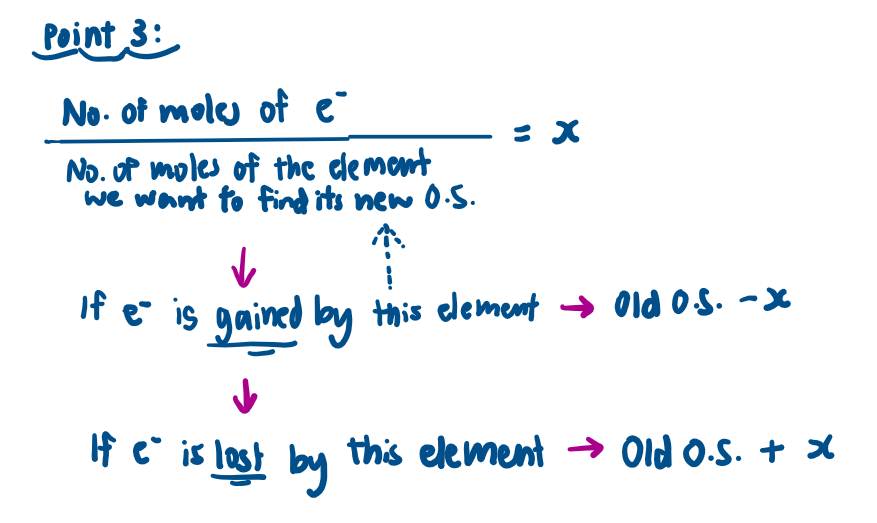
To determine the change in oxidation number of B when a known amount of A reacts with stoichiometric amount of B in a redox reaction, the following steps can be taken:
Construct the half-equation for A, the reactant whose initial and final oxidation numbers are known.
Calculate the number of moles of electrons lost (or gained) using amount of A. Equate this to the number of moles of electrons gained (or lost) by the other reactant (B). (ne lost = ne gained)
Determine the mole ratio of B and the electrons gained (or lost) by B. This gives the number of moles of electrons transferred for 1 mol of B.
Hence determine the new oxidation number of B.