Infancy and Childhood, Exam 4
 Call Kai
 Learn
Learn Practice Test
 Spaced Repetition
 Match
Match Flashcards
 Knowt Play
1/38

There's no tags or description
Looks like no tags are added yet.
Name | Mastery | Learn | Test | Matching | Spaced | Call with Kai |
|---|
No analytics yet
Send a link to your students to track their progress
39 Terms
How does language develop?
Some of it has to come from environmental experience
You’re not born knowing English or Japanese
Pragmatics differ cross-culturally
We listen, interact with, and imitate the communication/language of those around us
How much older people talk to, read to, and listen to babies/little kids dramatically influences their language development
But a lot of language ability seems to be an innate part of our human biology: nativist perspective
All humans seem to do it in the same way
Sensitive period for it
We are good at it despite bad environmental input
Kids often ignore environmental input
We’re the only species with syntax/infinite generativity
Interactionist approach
The human brain is prewired/genetically prepared to learn language, but you need specific environmental input for the brain to “work on” and the amount and quality of that input matters a lot
Every child will learn to speak their native language; question is how long will it take and how good they will be at it
Early stages of language development
Cooing
2-4 months
All vowels
Easiest sounds to make
Babbling
4-8 months
Vowel + consonant sounds
Gradually focuses on sounds in baby’s language
Early babbling sounds the same across different languages, then shifts toward sounds in native language
Early babbling is not communication, just practicing vowel/consonant sounds in order to learn how to talk
Increased social/pre-linguistic interactions
8-12 months
Pointing/peek-a-boo
Social turn taking
Babbling sounds very language like
One word stage
12 months
Single spoken words
Lots of meaning
Two word stage
18-24 months
Focus on content words
Importance of word order
Start of significant increase in vocabulary
10-20 words a week
Language explosion - happens at 2 years
Realize there’s a word for everything
Basic emotions
Happy
Social smile from around 2 months of age
Laugh around 3-4 months
General distress/anger
Distress is from birth
Anger is about 4-6 months
Requires cognition/thought - need to be angry at something
Sadness/distress - not empathy
2-7 months
Fear
6-12 months
Fear of strangers - 8-12 months
Babies aren’t afraid of anything - heights, fires, snakes, etc, bc fear requires cognition; if you’re scared, you’re scared about something
Not afraid of anything bc they haven’t been hurt yet
Physical + emotional - once they can crawl, they move around and get hurt
Understanding others emotions
Emotional contagion - one kid starts crying and other kids in the room start crying; early
Interpreting facial expression - 7-10 months
Social referencing - knowing how to act based on how other people act
Ex: Kid is playing chase and falls down - if parent acts like they’re fine, they act like they’re fine, if parent runs over and asks if they’re hurt, they cry and act hurt
Self-conscious emotions
Shame - you are something bad; leads to belief that they can’t do anything about it, no chance for improvement
Guilt - you did something bad, but you are a good person; can take accountability
Embarrassment
Envy
Pride
Show up around 24 months
Kids need help figuring out how to deal with self-conscious emotions
Babies do not try and “push your buttons”
Attachment vs temperament
Attachment
Attachment - a close emotional relationship between the infant and the caregiver
Develops over time through daily/frequent interaction
Not bonding
Bonding - feeling/emotional shift that some moms feel and others don’t; about the mom, not the baby
Not based on feeding
Social
Erikson trust vs mistrust
First stage in Erikson’s theory is trus vs mistrust
Are they taken care of consistently? If they are, baby develops trust. If they are not, baby develops mistrust.
Biological basis
Baby and caregiver wired to do this
Attachment is social, but does have a biological basis
Every baby gets attached
Usually attached to more than 1 person
Attachment hierarchy
Attachment hierarchy
One primary caregiver at the top, usually the mom. The person the baby prefers over everyone else. Then all other caregivers in decreasing order of preference:
Dad
Siblings
Grandparents
Babysitter/nannies/daycare providers
What does attachment measure/predict?
Internal working model of social relationships
Can I trust you to take care of me?
Am I a person worthy of care?
Later social relationships/social ability and self concept
Strong data into preschool
Some data into middle childhood
People care about attachment bc 1) it happens to everyone and 2) it’s the first social relationship
The strange situation
Strange situation - a structured observation that measures attachment
Chairs and toys in a room baby has never been in
Baby and mom come into room. What does baby do?
What does baby do if mom leaves?
What does baby do if stranger comes?
Looks at 3 main points:
Secure base - use mom as a secure base to explore the environment
Separation - how child reacts when mom leaves
Going to be upset, question is how much
Reunion - how child reacts when the mom comes back
Primary measure of attachment
Attachment classifications
Secure
60% of North American infants
Use mom as secure base
Cry at separation
Comforted quickly at reunion
Insecure
15% of North American infants
Mostly ignore mom, play alone, do not use mom as secure base
Significantly less upset at separation
Little contact seeking at reunion
Disorganized/disoriented
About 15% of North American infants
Flat or inappropriate affect
Dazed and confusing behavior
Every kid gets attached; type of attachment is different
All attachment are normal development except disorganized/disoriented
Culture and attachment
Broadly western countries - secure
How common each insecure style is varies
Germany vs Japan
Germany - more insecure avoidant → independent; order-driven parenting and focus on following the rules
Japan - more insecure resistant → interconnected; mom and baby are always together
Infant temperament
Stable individual differences in quality and intensity of behavior
Some genetic basis
Some link to adult personality
Measuring temperament
Reactivity
Activity level
Attention span persistence
Fearful distress
Irritable distress
Positive affect
Self-regulation
Temperament classifications
Easy child
Difficult child
Slow to warm up
Less intense version of difficult
Not classified
Mixture of characteristics
Behavioral pattern is determined by situation
Chart
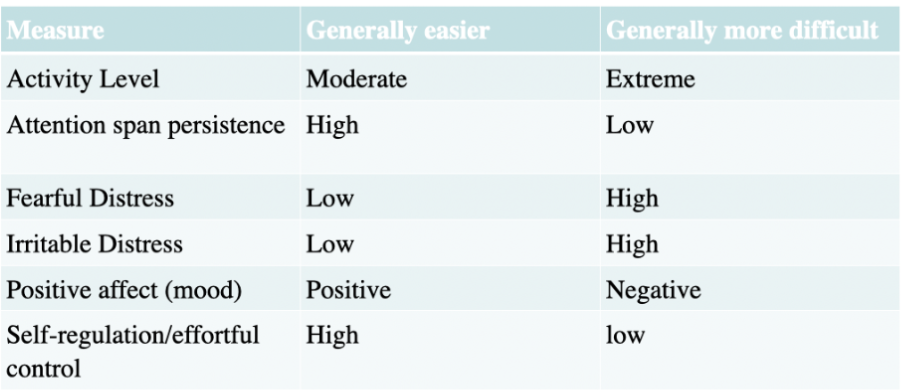
Goodness of fit model
Does the care-giving style match the child’s social interactional style?
Easy and difficult children need a certain type of caregiving
Difficult needs patience and consistency + quiet, predictability, and know what’s going to happen
Importance of continuity and sensitivity of caregiving over time
Need to change as the kid changes
Figure out who you are, who your kid is, and how your needs fit together/meet in the middle
Don’t worry about temperament and attachment classification, worry about goodness of fit
Broad trends - physical development in early childhood
Getting bigger, stronger, faster
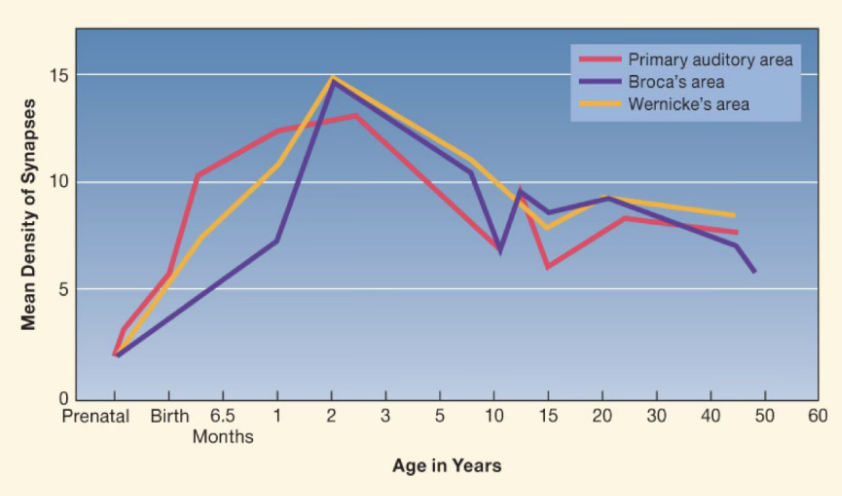
Brain growth
Significant brain growth between ages 2 and 6
Grows to 90% of adult weight
Connections
Reshaping and refining due to environmental experience
Overabundance of synaptic connections need to be pruned and refined
Cortex is using more energy than any other point in development
Reduces to adult levels by about age 10
Cognitive skills also increase
Physical coordination, perception, attention, memory, language, logical thinking, and imagination
Example again of interrelatedness of different aspects of development
Handedness
90% of people are right-handed worldwide, with some variability across cultures
Reflects brain lateralization - most people are left-hemisphere dominant
Lefties are right hemisphere dominant or evenly split between hemispheres
Some evidence of slightly higher incidence of problems like intellectual disabilities and mental illness in lefties, also evidence of more flexible thinking and greater verbal/math skills
Sleep
Sleep issues are now more social than biological, since sleep/wake cycle is established
Adequate sleep is crucial to development
Amount needed:
2-3 years old: 11-12 hours
4-6: 10-11
Fair amount of individual variability
Naps
2-3 year olds need a nap, older preschoolers may not
Possible use of “quiet time” vs. a nap for older kids
Family/shared beds
Most kids will want their own space by about age 7
Sleep “problems”
Routine is good: stable routine, no electronics, appropriate time
Often caused by other underlying issues in family
Kids may need less sleep than you would like
Individual difference
Changes with age
Food
Parents worry and fight with their preschoolers a lot about food. Don’t - if you turn food into a battle, you will lose.
Preschoolers appetites generally decrease bc of slowed physical growth
They are wary of new foods bc this is both evolutionarily adaptive and an example of developing agency and a sense of self
Do not pressure kids to eat more or less
Kids told to eat less are more likely to be overweight; kids pressured to eat more are more likely to be underweight
Don’t:
Pressure kids to try new foods
Use sweets as rewards
Do:
Eat what you want your kids to eat
Provide new foods several times in a low pressure manner
Keep mealtimes happy.stress free
Provide smaller portions and allow them to determine to a reasonable extend what they eat
Childhood injuries
Individual differences
Gender: boys 1.5x more likely to be injured than girls, and their injuries are more severe
Mothers judge chances of preventing injury in sons to be lower, a belief that might keep them from exercising proper controls
Temperament
Risk factors
Poverty, single parenthood, low parental education
Societal conditions in developing nations
Poverty, childcare shortages, teen parents in the US
Childhood injuries: prevention
Laws prevent many injuries (safety seats, helmets, flameproof clothing)
Many parents and children still behave in ways that compromise safety
Safety seats - 27% of parents don’t place their children in child safety seats, and of those that do, 84% either install them or use them incorrectly
Parents expect small children to recall safety rules, rather than monitoring and controlling access to hazards
Fine and gross motor skills - chart
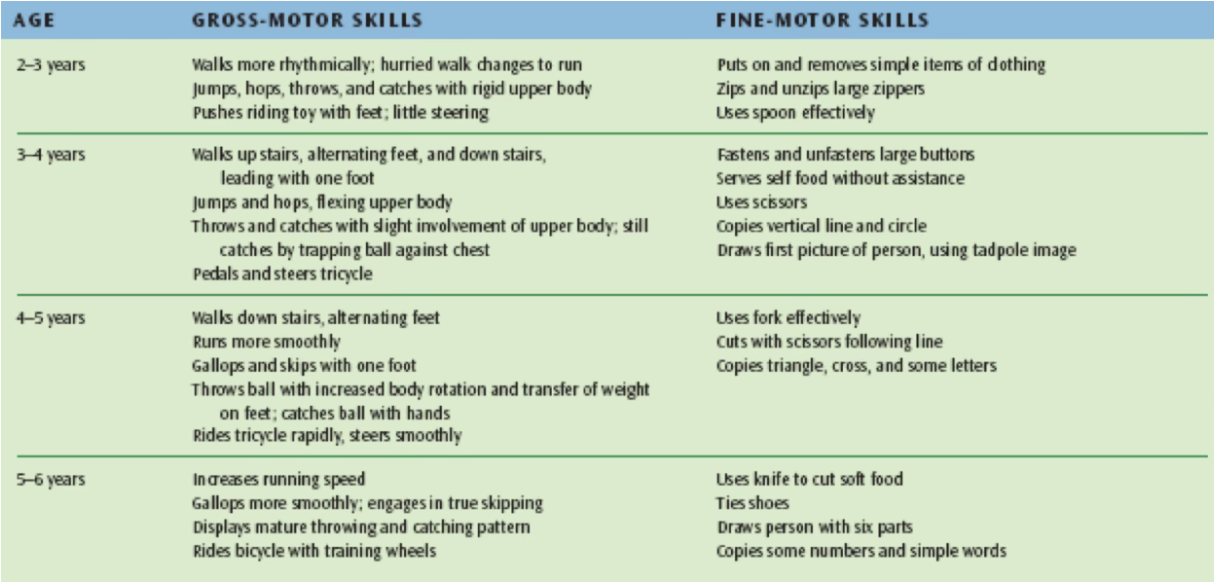
Motor skills: individual and sex differences
Body build
Taller and more muscular bodies move more quickly, acquire skills faster
Sex
Boys: better at power and force
Girls: fine motor skills, balance, foot movement
Social pressures help channel activities
Enhancing motor skill development
Mastered through everyday play
Formal lessons have little impact
Preschoolers should have at least 60 minutes of unstructured physical play every day
Daily routines support fine motor development
Provide appropriate play space and equipment
Promote fun and positive attitude
Cognitive development in early childhood: intro
Age 3 to 6/7
Dramatic advances and limitations
The first time that most adults will begin to deal with kids as real human beings
You can converse and reason with a 4 year old
A 4 year old can think about and grasp a great deal of their world in more adult-like terms
Piaget
Called this point the pre-operational stage
Argued that these kids are not capable of logical, adult-like reasoning
Underestimated what these kids could do
Preschoolers are better thinkers than Piaget believed and adults are worse
Pre operational
Piaget thought that adults and older kids reasoned using formal logic
Preschoolers are pre (formal) logical
Pre operational = pre logic
Piaget and limitations on early childhood cognition
Egocentrism
Appearance vs reality
Centration
Animism
Irreversibility
Classification
Cause and effect reasoning
Egocentrism
The inability to see the world from another person’s perspective; belief that what you think, believe, and know is what everyone believes, thinks, and knows
Cognitive limitation, not selfishness
Ex: 4 yo gets mom a firetruck as a bday present bc from their POV, that is the best present in the world
Can’t consider that their mom’s wants/likes are different from theirs
Test of egocentrism
3 mountains task
Ask child to pick their own perspective
Then ask them to identify the doll’s perspective
3 year olds generally can’t, 4 year olds generally can
Results indicate decline or egocentrism between 3 and 4
Conservation
The ability to understand that the essential nature of an object in the world has remained the same (been conserved) despite changes in some (often striking) properties of that object
Just because something looks different does not mean that it is different
Piaget thought that preschoolers did not understand conservation and were too focused on object appearance in their (illogical) reasoning
Piaget thought that preschoolers had 3 consistent logical reasoning problems that caused their conceptual difficulty with conservation:
Centration - preschoolers can only focus on one primary object property at a time when making conservation judgments
Irreversibility - preschoolers are cognitively unable to mentally undo a physical/appearance change to an object
Appearance vs reality - preschoolers believe that appearance determines reality - what you see is what is
Conservation of liquid experiment/explanation
Experiment
Beakers A and B are identical, while beaker C is thinner and taller
A and B are filled with the same amount of colored liquid
In front of the child, pour liquid from B into C
They are asked if there is more/less liquid in A vs C
Explanation
If the child responds that there is more liquid in beaker C this indicates an inability to understand conservation
Centration: child is wrong bc they focus (centrate) on beaker C’s height and ignore its narrower width
Irreversibility: child is wrong bc they are unable to mentally reverse the pouring of liquid from B to C
Appearance/reality: beaker C appears to have more so it must have more
Same logic/lack of conceptual understanding can be applied to all the conservation tasks
Other conservation tasks
Conservation of number - quarters
Conservation of mass - graham crackers
Limitations on Piaget
Again similar to the babies
Underestimation of capabilities
Piaget results are due in part to:
Task complexity
Content familiarity
Heavy reliance on language
Cognitive development IS much more continuous than stage-like