Echinodermata I Bio 2 I Exam 4
 Call Kai
 Learn
Learn Practice Test
 Spaced Repetition
 Match
Match Flashcards
 Knowt Play
1/35

There's no tags or description
Looks like no tags are added yet.
Name | Mastery | Learn | Test | Matching | Spaced | Call with Kai |
|---|
No analytics yet
Send a link to your students to track their progress
36 Terms
Protostome or Deuterostome?
Deuterostome
Deuterostome
mesodermal cells form pockets that pinch off, or bud, from the endodermal lining of the primitive (embryonic) gut to create the coelom cavity. Anus forms first then the mouth forms second.
Symmetry
larvae are bilateral but adult are pentaradial symmetry (divided into 5 parts on the central axis)
Coelom absent or present
present- this is because echinoderms have a true coelom, that is, they are triploblastic (3 germ layers: endoderm, ectoderm, mesoderm)
Degree of cephalization (distinct- present; indistinct; absent)
absent, their symmetry prevents this
Eumatazoa
true tissues
How is echinodermata classified under bilateria if they’re adult form is in pentaradial symmetry?
larvae starts of bilaterial
How does the blastopore form
blastula formation begins with radial cleavage of the zygote into a solid ball of cells (morula). As cells continue to divide, they migrate to the outer edge, leaving a fluid-filled central cavity called the blastocoel. This hollow sphere becomes a single-layered, ciliated blastula
How does blastapore formation differentiate clades/groups/domains/protostome vs. deuterostome
During gastrulation, the blastopore is the first opening that forms in the embryo; its fate—whether it becomes the mouth or the anus—determines the animal's developmental pathway and evolutionary classification
Examples of Echinodermata
Starfish, sea urchins, sea cucumbers
Classes of Echinodermata
Asteroidea, Crinoidea, Ophiuroidea, Echinoidea, Holothuroidea
Unifying traits of Class Asteroidea- specific to just this class
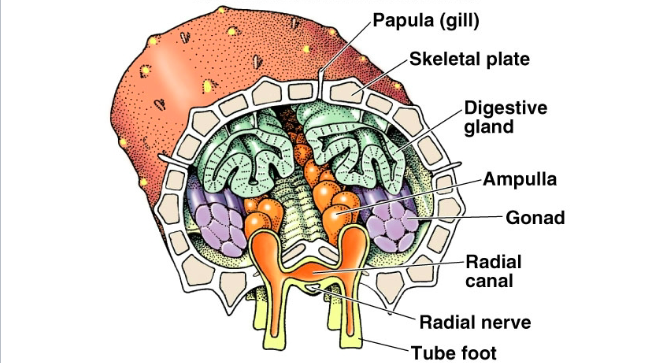
have gonads and gut in arms
suckered tube feet used for locomotion
individual control of tube feet
evertible stomach (ability for stomach to leave arm, digest food, and then return back into the arm)
Open Ambulacral Grooves: The ambulacral grooves, which contain the tube feet, are wide open along the oral surface of the arms (uncovered by ossicles)
Marginal Anus and Madreporite Location:The anus is generally located on the dorsal (aboral) surface, and a single, often conspicuous, madreporite (the water inlet for the vascular system) is located aborally, typically on the edge of the disc
Pentaradial is a specialized form of
radial symmetry
Pentaradial symmetry is specialized to
Echinodermata
Echinodermata have bilaterial symmetry just like their
common ancestors
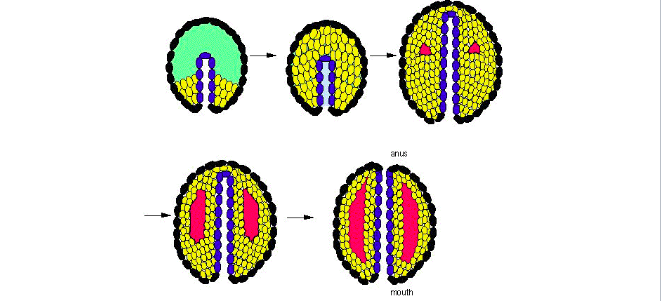
Protostome or Deuterostome Body Plan
Protostome
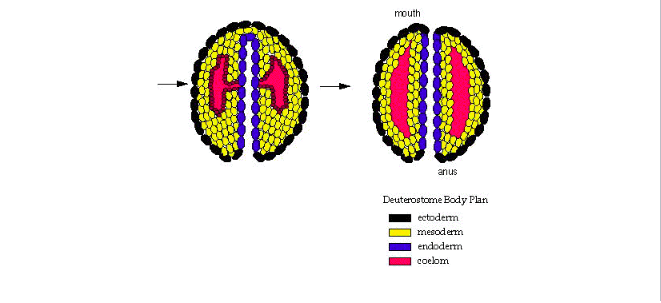
Protostome or Deuterostome
Deuterostome
Unifying traits of Echinodermata - ONLY echinodermata have these unique traits
ability to regenerate limbs
calcium carbonate plates= spiny skin “ossicles”
water vascular system with madreporite and tube feet
Pentaradial Symmetry in Adults: Adult echinoderms possess a body arrangement based on five parts (or multiples of five) surrounding a central axis. Note: Larvae are bilaterally symmetrical..
smart connective tissue liquifies under neural control
ambulacral zones where tube feet emerge from body wall
loss of cerebral ganglion
Aboral Madreporite: A sieve-like plate located on the aboral (upper) surface that acts as the entrance to the water vascular system
Unifying traits of Class Crinoidea
tube feet lack suckers
madreporite absent
Unifying traits of class Ophiuroidea
articulated arms
no anus
madreporite on oral side
loss of suckers
tube feet lack suckers
ambulacral grves are completely closed and covered by bony plates (c/e lack of suckers on tube feet)
tube feet are significantly reduced (small), lack suckers, and function primarily as sensory organs that detect light and odors instead of locomotion
Unifying traits of class Echinoidea
moveable spines used for defense, locomotion, and camouflage.
Aristotle’s Lantern: Most echinoids feature a complex, five-toothed chewing structure located on the underside of their body for scraping algae and food
fused calcium carbonate plates forming a test
tube feet with suckers
presence of an anus
Unifying traits of the class Holothuroidea
retractable oral tentacles
internal madreporite
reduced endoskeleton
elongated body
Many can eject sticky filaments or expel their internal organs (evisceration) as a distraction when threatened
can regrow digestive tract
how are sea urchins and sand dollars related
have no split appendages so tube feet are on the outside of ball/urchin (sand dollars appendages are just squished)
A unique trait of echinoidea is that they are negatively phototaxic meaning they
move away from light to avoid predators
Traits of Eukaryotes
linear DNA, endoplasmic reticulum
How do tube feet and appendages separate each class of Echinodermata
Asteroidea
tube feet: along ambulacral grove, oral side (which is aboral), suction cups on end for locomotion
appendages: small, snapper-like, jaw-like structures called pedicellariae on the skin surface, used to keep the surface clear of debris and small settlers
Crinoidea:
tube feet: Located on the pinnules (side branches) of the arms and are used solely for feeding
appendages: feathery arms are lined with extensions called pinnules.Feather stars have small, flexible, hook-like appendages called cirri at their base, allowing them to cling to the substrate or move around
Ophiuroidea:
tube feet: pointed, tentacle like projections that lack suction cups. Used for feeding
appendages:often have movable spines along their thin, jointed, snakelike arms to help anchor in crevices
Echinoidea:
tube feet:end in suction cups for climbing and holding onto surfaces
appendages:They possess numerous long, movable spines articulated on the test, which are used for protection and locomotion
Holothuroidea:
tube feet:tube feet on the dorsal side are reduced, while those on the ventral side are used for crawling
appendages: tube feet surrounding the mouth are highly modified into feeding tentacles (ranging from 10 to 30) that catch food particles in the water or deposit feed on the sand.Some species can expel sticky threads called Cuvierian tubules from the anus for defense
Draw and Label Asteroidea Anatomy
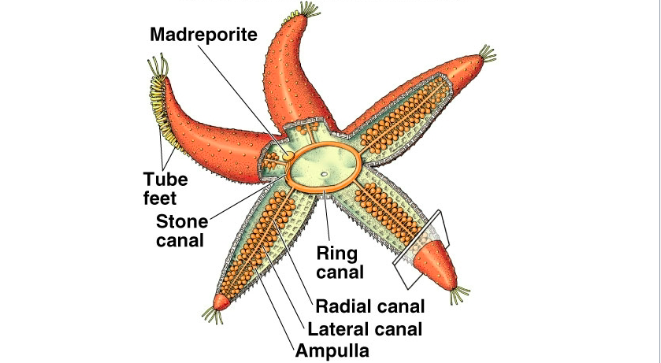
Draw and label Asteroidea larva
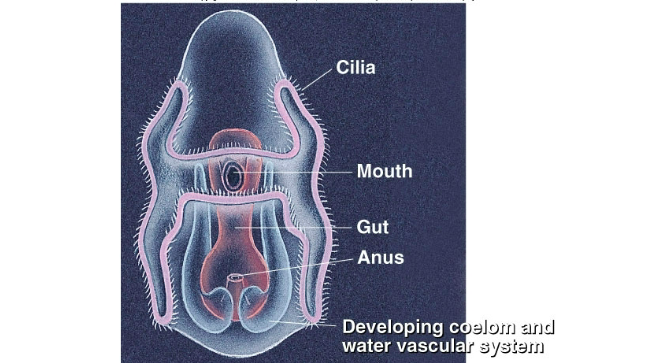
Draw and label arm anatomy of adult Asteroidea
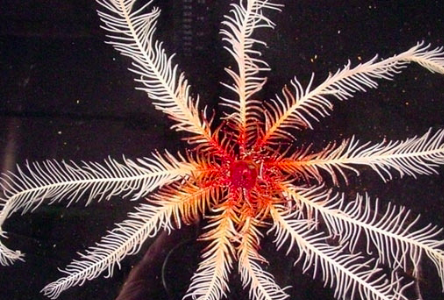
Identify
Crinoidea
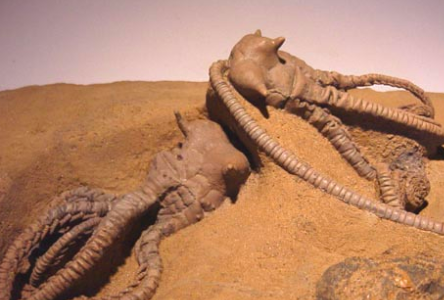
Identify
Crinoidea
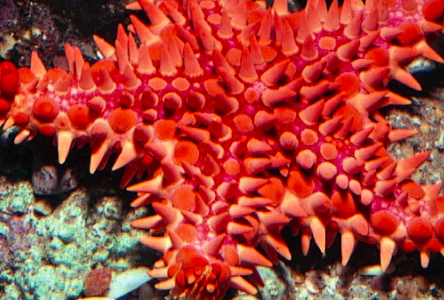
Identify
Asteroidea
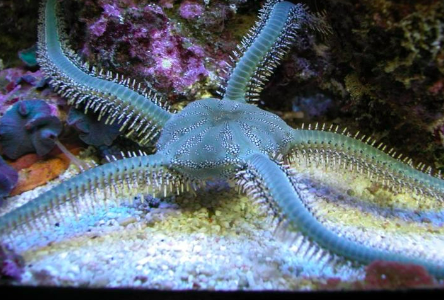
Identify
Ophiuroidea
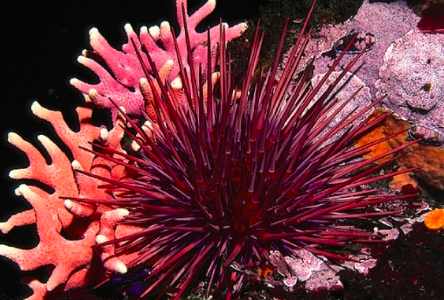
Identify
Echinoidea
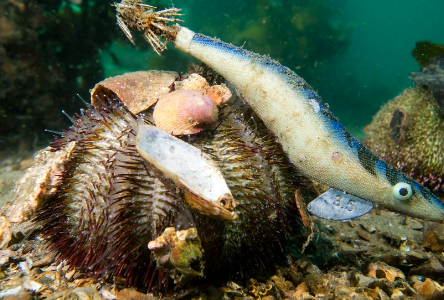
Describe this image
tube feet and clamer claw have allowed an echinoidea to grab objects and use attach them to its body for protection
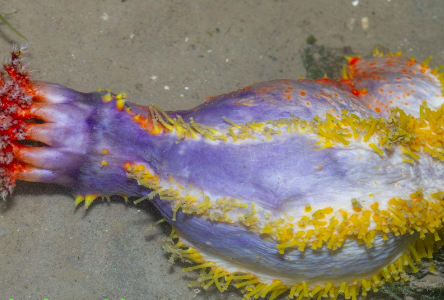
Identify
Holothuroidea