LSB142 ANATOMY Week Muscular systems
 Call Kai
 Learn
Learn Practice Test
 Spaced Repetition
 Match
Match Flashcards
 Knowt Play
1/20

Earn XP
Description and Tags
Skeletal muscle fibre structure and contraction – including sliding filament theory Neuromuscular junction and excitation–contraction coupling Motor units and muscle fibre types Connective tissue associated with skeletal muscle Major skeletal muscles and movement in anatomical planes
Name | Mastery | Learn | Test | Matching | Spaced | Call with Kai |
|---|
No analytics yet
Send a link to your students to track their progress
21 Terms
How do skeletal muscles generate force?
Skeletal muscles generate force through contraction.
The two types of contraction for skeletal muscles
Concentrically (shortening), Eccentrically (lengthening)
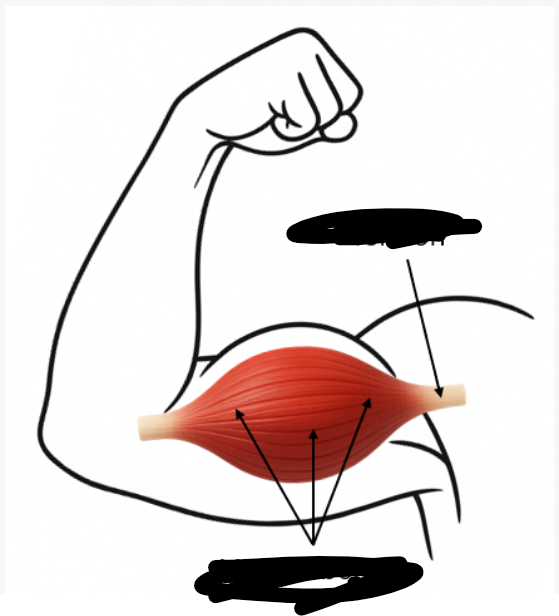
Common structural organisation for skeletal muscles, define
Muscle Belly, the thick central region that contains the muscle fibres and is the primary site of contraction
What is attached to either end of the muscle belly? how are they formed?
Tendons, formed by connective tissue layers that encase muscle and its subunits. Attaches muscle to bone at each end.
Attachment points of tendons to bones are called?
The origin and insertion
What is the origin in terms of the type of attachment?
Origin is the more stable attachment,
What is insertion in terms of the type of attachment?
The insertion is the attachment that moves when muscles contract, drawing the insertion towards the origin to produce movement at the joint.
Skeletal muscle is made up of multiple bundled subunits, surrounded by what?
connective tissue and interlace with nerves and blood vessels.
Structural hierarchy of skeletal muscles begins with?
Whole muscle (biceps brachii), enclosed by a connective tissue layer called the epimysium.
What is each whole muscle composed of
smaller bundles called muscle fascicles, which are surrounded by perimysium.
what are fascicles further subdivided into?
myocytes (muscle fibres).
Muscle fibres are enclosed by?
Cell membrane Sarcolemma and is surrounded by connective tissue layer endomysium.
Organelles of muscle fibres?
Nuclei, mitochondria and ribosome. As well as myofibrils (occupies most of cell volume)
Myofibrils are composed of?
Contractile units called sarcomeres, responsible for muscle cntraction
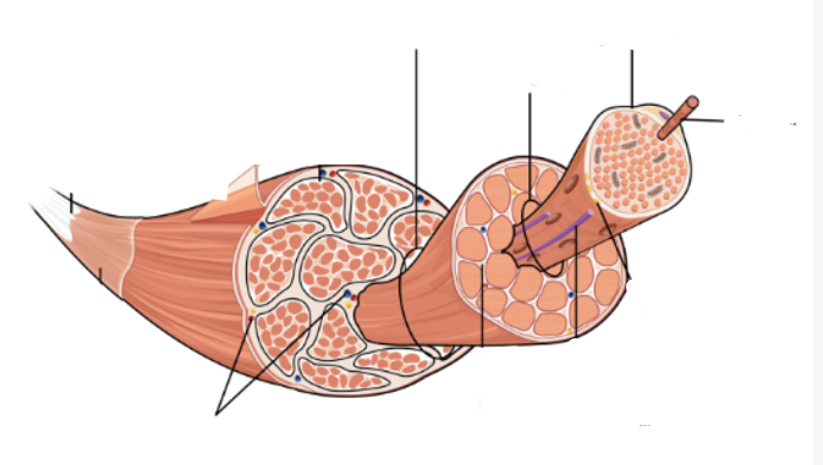
What is the structural hierarchy of skeletal muscles?
Whole muscle (e.g. biceps brachii) surrounded by epimysium (connective tissue) → Muscle fascicles - bundles within the whole muscle surrounded by perimysium (connective tissue) → Muscle fibres (Myocytes) - muscle cells enclosed by sarcolemma and surrounded by endomysium (connective tissue).
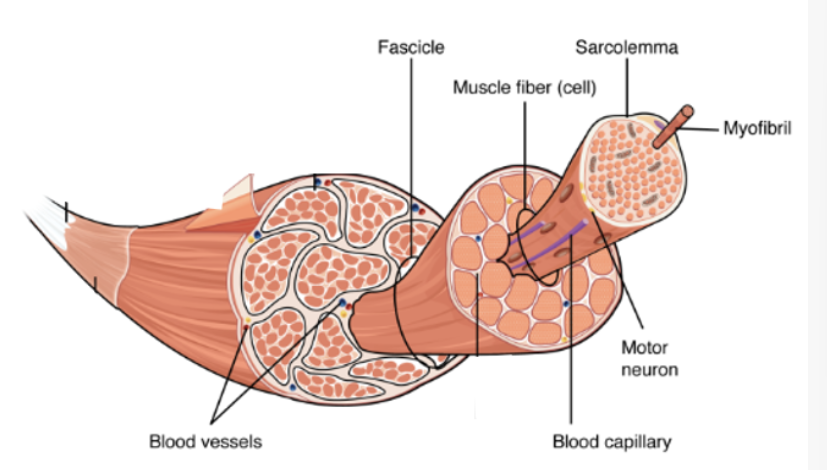
why do epimysium, perimysium, and endomysium extend beyond the muscles, fascicles, and muscle fibres that they encase?
to form tendons at either end of the muscle belly
How does tendons create allow for movement
Tendons formed at both ends of the muscle belly whether by perimysium, epimysium or endomysium attach skeletal muscles to bones and transmit the forces made in muscle contraction to generate movement.
What do connective tissues around skeletal muscle do?
Protect muscle from friction, maintains shape and structural integrity
What are skeletal muscles surrounded by apart from connective tissue layers? What is it
fascia, a connective tissue sheet that encloses and separates muscles and muscle groups in the body.
location of fascia
lies external to the epimysium
fascias function
provides support and organisation.
allows muscles to move smoothly against surrounding tissues
provides pathways for nerves and blood vessels,
Helps maintain the structural arrangement of muscles in body