Language & Development - Block 4
 Call Kai
 Learn
Learn Practice Test
 Spaced Repetition
 Match
Match Flashcards
 Knowt Play
1/100

There's no tags or description
Looks like no tags are added yet.
Name | Mastery | Learn | Test | Matching | Spaced | Call with Kai |
|---|
No analytics yet
Send a link to your students to track their progress
101 Terms
Yes (Response to auditory stimulus from 25-29 weeks)
Can babies hear in utero?
Filtered
What can babies hear in utero? Sounds are ______ as they pass thru the mothers body. this dampens frequencies above 1000 hz (speech can be anywhere from 100-10,000 hz)
BUT preserves pitch, loudness, and rhythm: PROSODY
DeCasper et al. (1994)
Method: Pregnant women repeated a rhyme 3 times a day for 4 weeks Rhyme read at 37 weeks Results: Fetal heart rate decreased with familiar rhyme
Partanen et al. (2013)
Exposure to a musical melody 5x a week in last trimester (test group) vs no exposure (control) Test: ERP recorded after birth and again at 4 months in response to original and changed melody Results: Significant difference in brain responses between control and test groups with original melody but not with changed melody
DeCasper and Spence (1986)
Similar logic to Partanen study but with a spoken story(also before birth)
Infants in test group showed preference for familiar story thru preferential sucking
Mehler et al (1988)
Found that four day old French babies increased their sucking rate on a dummy, showing interest or recognition, when they heard French as opposed to Russian also, unable to distinguish two non-native languages
Non-nutritive sucking
Infants given a dummy / pacifier Sucking indicates interest for novelty (usually) Sucking recorded while repeated sounds play Reaches a steady-state sucking rate: Habituation Introduction of a new sound What happens to the sucking rate? Increase => dishabituation (perception of novelty) No change →> unable to perceive the difference
DeCasper and Fifer (1980)
Preference for mothers voice over unknown female voice immediately after birth
Mampe et al. (2009)
Newborns cry with an "accent" of their native language
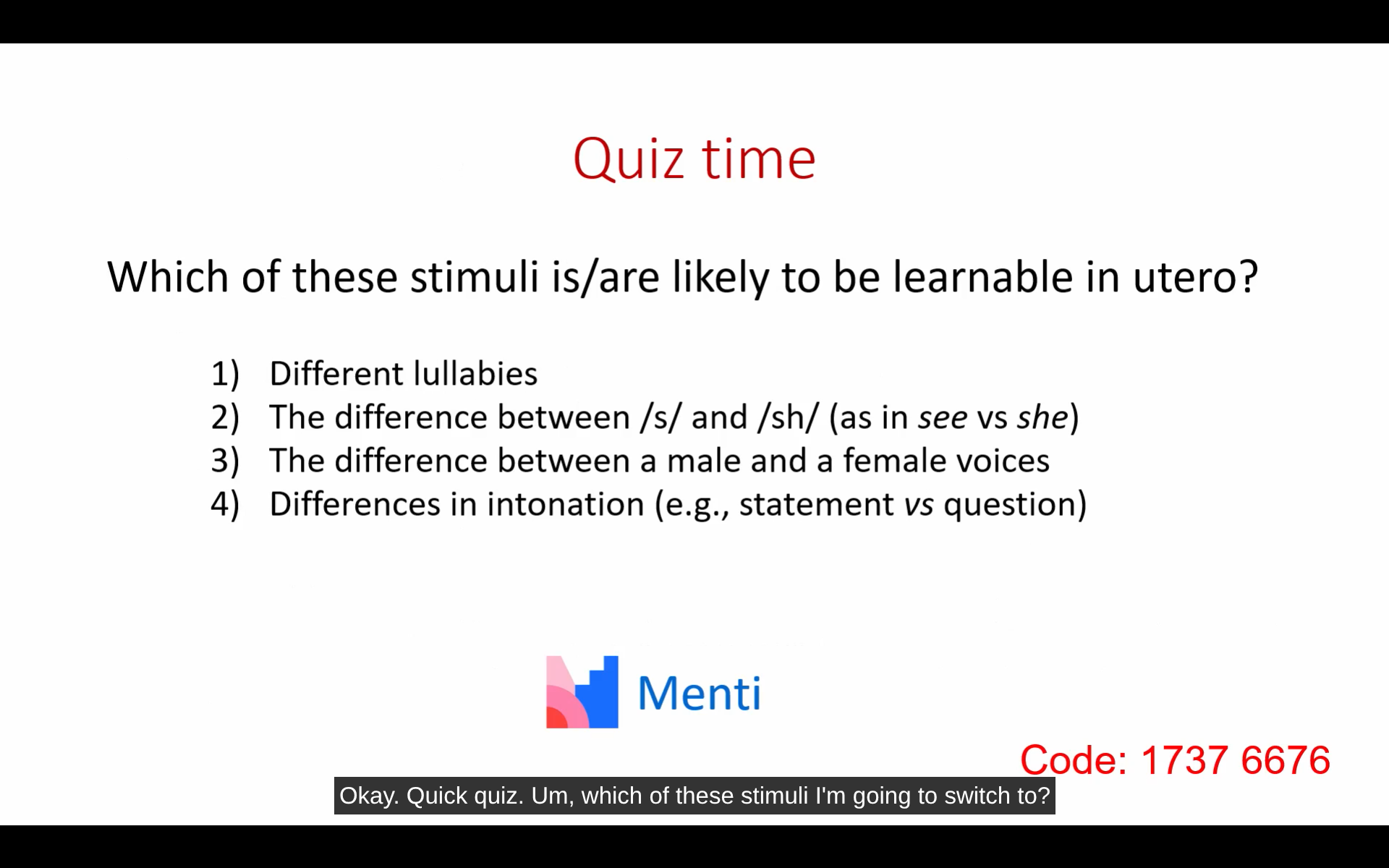
1,2,4
Picture from menti
Syllables
Prosody is carried by ________ Phonological building blocks Must contain a vowel Unit of rhythm
Phonemes
Classes of sound in a language potential to affect meaning (ten vs den) Vowels and consonants
Vowels
Voiced (vocal cords vibrating) allows production and perception of pitch ad intensity (key elements for prosody)
Testing the logic
IF infants need prosody to distinguish speech sounds and prosody is carried by syllables….
THEN infants should NOT be able to distinguish speech sounds if don't correspond to syllables
AND given that syllable need to contain a vowel, the absence of a vowel should make it impossible to distinguish speech sounds
Bertoncini and Mehler (1981)
Pst vs. tsp = no discrimination upstu vs utpsu and pat vs. tap = discrimination (logic worked!)
Not a language specific skill
Prosody is useful for language acquisition but it _ ___ ________ _________ as it is also a characteristic of non-speech behaviour like music
Voice Onset Time (VOT)
In speech production, the time delay between the beginning of a sound and the beginning of the vibration of the vocal chords.
voiceless stops
Consonants produced without vocal cord vibration. (P, t, k)
voiced stops
with vibration of the vocal cords /b,d,g/
Phoneme identification task
Categorical perception of speech sounds can be demonstrated using a:
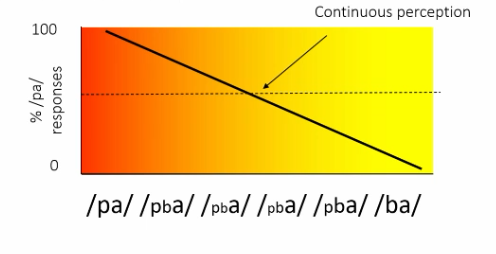
Categorical perception
the perception of speech sounds as belonging to discrete categories Very adaptive for language
is this mode of treatment present at birth?
If so, does this tell us that humans are born with a predisposition for language?
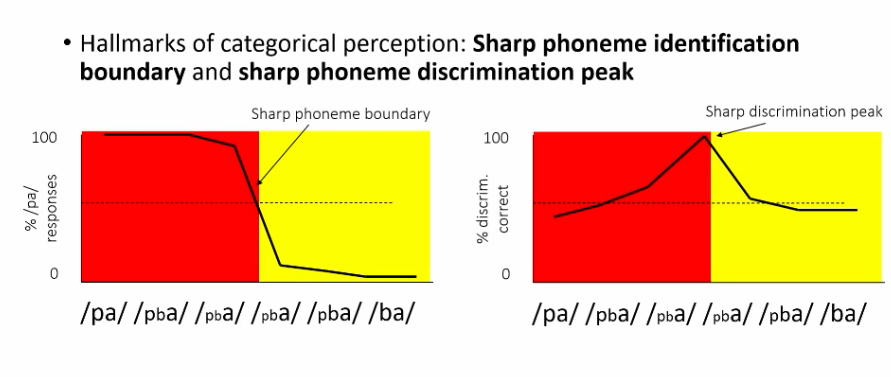
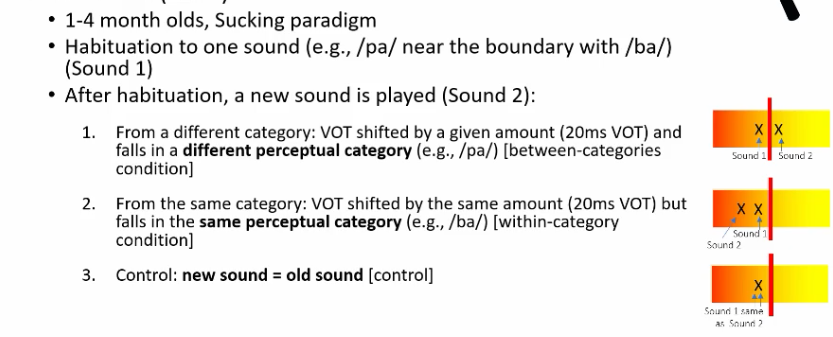
Eimas et al. (1971)
High amplitude sucking - 1 and 4 mth old infants control the presentation of a synthetic speech syllable by sucking on a pacifier. These finding favour the notion that infants are born with the ability to discriminate sound contrasts, even those they are not exposed to. So yes to question 1! This mode of treatment is present at birth
No
Is categorical perception human specific?
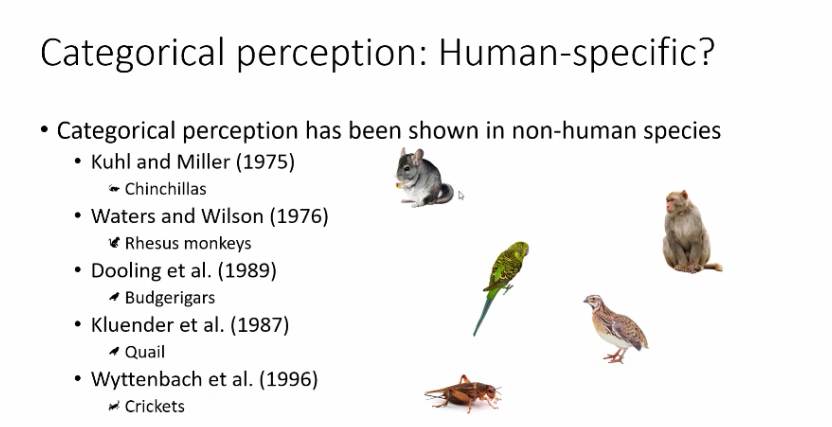
Kuhl and Miller (1975)
Continuum of /t/ to /d/ (VOT) Training: chinchillas taught to discriminate endpoints of continuum — conditioned to respond to a perfect /d/ or /t/ Test: presented with tokens on full continuum
equally spaced along continuum Chinchillas and humans performed similarly! They both responded in a categorical way rather than continuous
No (vowels are perceived continuously)
Is categorical perception seen for all language sounds?
1 and 2
Categorical perception is:
Coarse grained
Functional
Absolute pre-requisite for language acquisition
Necessity for music perception
Yes
Can deaf babies babble too? (Orally and manually)
Petitto & Marentette (1991)
Deaf children showed a greater proportion of manual babbling than hearing children and this difference increased with age. therefore, babbling is automatic and amodal. It is hardwired in development
Discontinuity hypothesis
States that babbling is NOT a precursor of language.
Babbling is not a proto-language
Babbling is simply a pre-programmed, muscular exercise
Some evidence that there is a silent period between babbling and onset of real words
No obvious correlation between extent of babbling and language onset
Continuity hypothesis
States babbling IS a precursor for language
Babbling is a proto-language
Commonalities between babbling and native language —- Perceptual (discrimination above chance) —- Acoustic (native prosody and phonemes)
Correlations between babbling and language onset are detectable
Babbling has neuro-linguistic manifestations — next study in next flashcard
Holowka & Petitto (2002)
Babbling shows neuro-linguistic characteristics similar to adult language use, which suggests it is a precursor to language. However, it's not arguing that it's a "necessary stage"
Right
Babbling usually happens on the ____ side of the mouth if not on both sides hint: controlled by left hemisphere
also
Earliest produced consonants in similar words are ____ consonants produced during babbling. Onset age for each consonant depends on both the frequency of use in the ambient language and articulatory complexity
Tincoff & Jusczyk (1999)
Used the preference looking paradigm An indirect way to measure earliest word understanding Hear "mummy" — look longer at pic of mom (not just any woman) than the dad Earliest word understanding happens at 6 months (classic method of parents subjective measures usually states 9 months)
Bortfield et al. (2005)
Head turning preference procedure The group of infants who heard the "mommy" passage showed a preference for "feet" over "cup" (they've heard the word feet many times before) The group that heard the "Tommy" passage didn't show preference for either Conclusion: lexical knowledge can help segment and learn adjacent words. Also, shows phonological specificity of existing lexical knowledge
Reference problem
Child holding duck in bath says 'bear' thinks a duck is a bear? doesn't know the word for 'duck'? pretends the duck is a bear? names the duck 'Bear'? Difficult to infer intention through behaviour.
• Some semantic mapping errors are easy to spot (child says 'bus' when sees a car) others less so (child says 'bus' only when sees yellow buses).
Reference problem continued
Things get easier 18-24 months, but still ambigious
juxtaposition of 2 words
no function words, no inflexion or real syntax
example: "no eat" — does that mean he doesn't want to eat? He has nothing to eat? I don't want you to eat?
Substages of reference problem
Random arrangement, followed by more syntax like constructions
Segmentation
Less than 10% of infant-directed speech consists or isolated words Ambient speech is usually continuous/no clear word boundaries
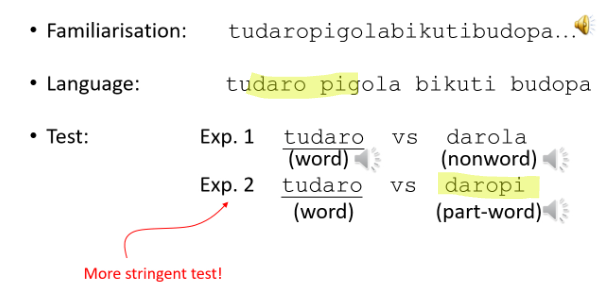
Saffran, Alsin, and Newport (1996)
8 month-old infants Head turn procedure look at slide statistical learning!! results: in BOTH experiments, infants can discriminate familiar from novel items. (They listen longer to novel items) infants can use "statistics" (transitional probabilities between syllables) to spot regularities in the speech stream. They associate high transitional probabilities between syllables as likely words (points of cohesion) and low transitional probabilities between syllables as likely word boundaries (points of separation)
Prerequisite
Productions lags behind comprehension because comprehension is a _________ for production. In addition, a lot of external factors can hinder production (shyness, lack of reinforcement). So, production counts are NOT always a good estimate of known vocabulary
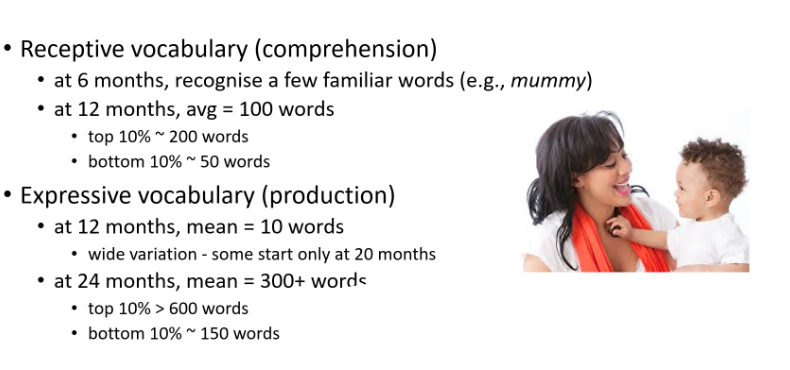
2 years
At this age, there is a sudden word learning spurt/lexical explosion. Initially explained by qualitative changes in learning mechanisms:
Naming insight (onset of symbolism)
Syntactic development —> word categories
Improved cognition (working memory, attention control, processing speed) IMPORTANT: it happens at different times for different children and sometimes, not at all so it might not be necessary stage for vocab acquisition
Alternative explanation for lexical explosion
The lexical explosion does not required a discrete trigger. Computational simulations can account for an exponential growth without postulating qualitative changes in learning mechanisms. both explanations are reasonable
Exponential learning is observed if:
Words can be acquired in parallel
Words vary in complexity (easy words are few and can be acquired quickly, whereas complex words are numerous and require more time to be acquired) summary: specialized processes are unnecessary to explain the lexical structure explosion. Acceleration is an unavoidable by product of parallel (learning many words at same time) leading and variation in difficulty
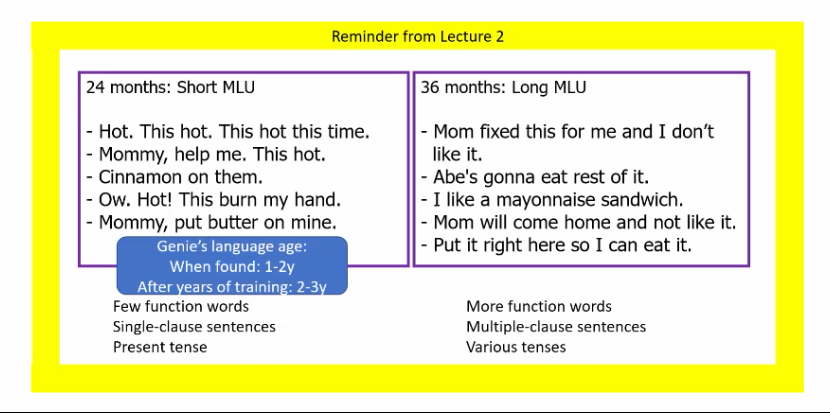
Mean length of utterance (MLU)
As vocab increases and children start producing sentences, a useful metric is ____, expressed as avg number of words per utterance — whether or not the utterance is a syntactically correct sentence increase in this metric is not determined by age but is consistent after starting time
Syntactic bootstrapping
semantic development - Knowing what a word actually means Can be inferred from syntactic context — this is called:
Markman and Wachtel (1988)
Study revealing whole object bias and mutual exclusivity
whole object bias
an assumption made by language learners that a word describes an entire object rather than just some feature of it
mutual exclusivity
a concept that refers to an infant's assumption that any given object has only one name
Infant-directed speech (IDS)
It plays a pivotal role in emphasizing novel words. It can also help learning about syntax and therefore semantics includes exaggerated prosody, shorter MLUs, slower, single-clause, concrete, repetition
Smith, Yu & Pereira (2011)
-Mothers taught new object-word pairings, new meaningless objects and words-exposure phase. -One object presented at a time. -They play with the infant, using the new words they've learned (18-24 months). -Infant wearing a headband with a camera, children were filmed interacting with their mothers. -Headband with a camera was meant to capture what the children were paying attention to at any one point in time. Assume whatever is ahead of the child's face is what they're paying attention to at that one point in time. -Infant tested on the new words-test phase. -Proportion of field of view predicts learning as long as object continues to occupy scene after utterance (how long before doesn't matter). -Important-at the time the object is named, and a pairing is possible, child is 1-looking at the object and 2-continuing to look at the object after the naming event. -Visual attention is critical-got to happen when the object is introduced for the first time and also has to be given a bit of time to stick in a way to be consolidated. -Visual attention-important and powerful device for semantic mapping.
Hebbian learning
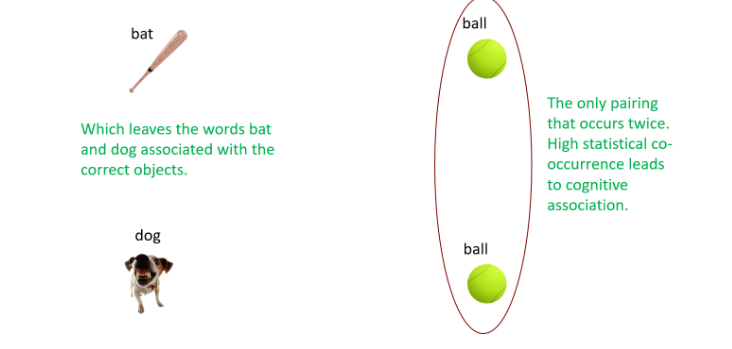
associative mechanisms are sufficient (look at diagram) **Unlike statistical learning, this is NOT passive. It involves competition between options and suppression of unsupported/unconfirmed associations. Analogy to neural pruning: "use it or lose it" the only construct this illustrates is the mutual exclusivity principle
Syntax
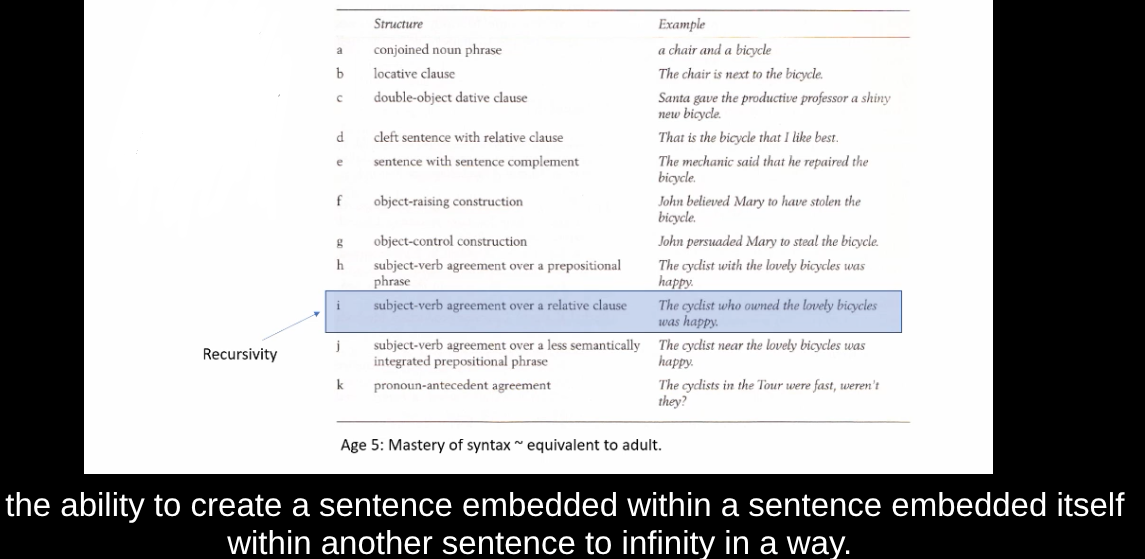
Set of rules/conventions for ordering words in ways that change meaning of an utterance Finite number of words + finite number of rules = infinite number of sentences It is generative and it generates semantics
Kanzi
Male bonobo. There was clear evidence that he learned words (symbolism, association). He showed some understanding of word order in generating meaning, but limited relative to humans/children. Output relatively poor given extensive explicit training
Features of syntax
Word order
Syntactic categories (verbs, nouns, etc)
Abstract rules (conjugation)
Hirsh-Pasek and Golinkoff (1993)
Tested comprehension of word order in 19 month old with sentence "Big Bird is tickling Cookie Monster" Two videos with an action playing simultaneously — one is correct action and one is showing the reverse infants looked longer at correct video! They have understanding of word order
Mintz (2006)
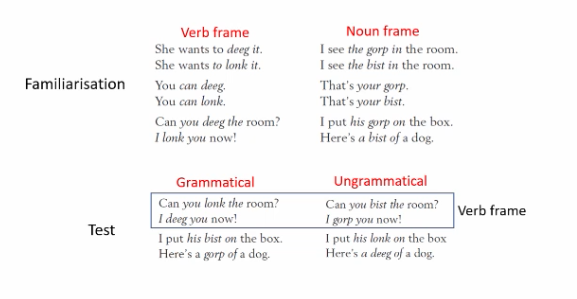
Infants can infer syntactic categories after only a few examples. Head turn procedure on 12 month olds. Use the correct verb vs a noun instead and see which one they look at longer
Gomez & Gerken (1999)
At 1 year old, abstract rule learning is present. Head turn preference procedure Exposed to 10 grammatical "sentences" Test: with new grammatical sentences and non-grammatical sentences Conclude: Sensitivity to how sequences of syllables tend to pattern according to "rules" in place Note: The past few flashcards prove that 2 year olds are more than capable of all of these syntax rules.
3, 4, 5
Which 3 of these facts are problematic for the claim that Kanzi posses the ability to understand syntax?
He only knows 300 word symbol combos
His best sentences are equivalent to a 3 year old child
He shows no ability in the use of function words (for, by, to, but)
He shows no ability in the use of inflections (banana —> bananas)
He does not show recursivity
Vygotsky, Skinner, Piaget
The 3 psychologists who proposed approaches to language learning
Vygotsky's language learning
Mastery of language emerges through practical activities in the "zone of proximal development" (ZPD) and, more generally, in a social environment
ZPD: The gap between what a learner can do on their own and what they can do with guidance or support from someone more knowledgeable
Interacting inside the ZPD allows the child to progress from: things children can do but only with help
Skinner's language learning
Children imitate what they see and hear. Associations are fine-tuned by positive and negative reinforcement (Hebbian learning?)
Emphasis on linguistic environment
Both his and Vygotsky'a principles are domain-general.
Piaget's language learning
Language development is connected to (= conditioned by) cognitive development Cognitive prerequisites —> language (STAGES)
Syntax is not learned through imitation or reinforcement. It is an emergent property (almost a by-produce) of cognitive development, e.g., symbolism, object permanence, causality, working memory
Not mutually exclusive
Vygotsky's, Skinner's, and Piaget's approaches are ___ _______ ________. They are all almost certainly correct to some extent but they focus on different driving forces, none of them language-specific. Overall, all three claim that language is "learned" The next group of researchers claim that language is "acquired"
Chomsky's syntactic development
The child's language input is poor (poverty of stimulus) and contains limited negative evidence. —- Children are rarely exposed to UNgrammatical sequences as counterpoints. —- Parents do not tend to correct the child's syntactic errors
Therefore, children MUST have a hard-wired ability to learn and process abstract rules (like how to turn active sentences into passive ones)
Chomsky's argument
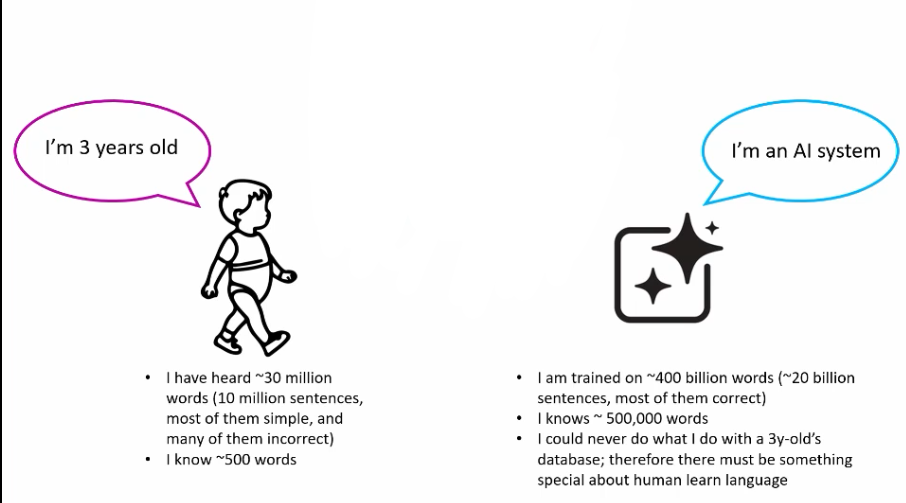
Wait! AI systems don't have any explicit knowledge of syntax and yet they master the language very well…. is Chomsky's argument flawed??
Not really! The databases of children and AI are on a completely different scale
Recursivity
Ultimate hallmark of syntax it can generate meaning to infinity "The boy who saw the dog that chased the cat that scratched the girl left"
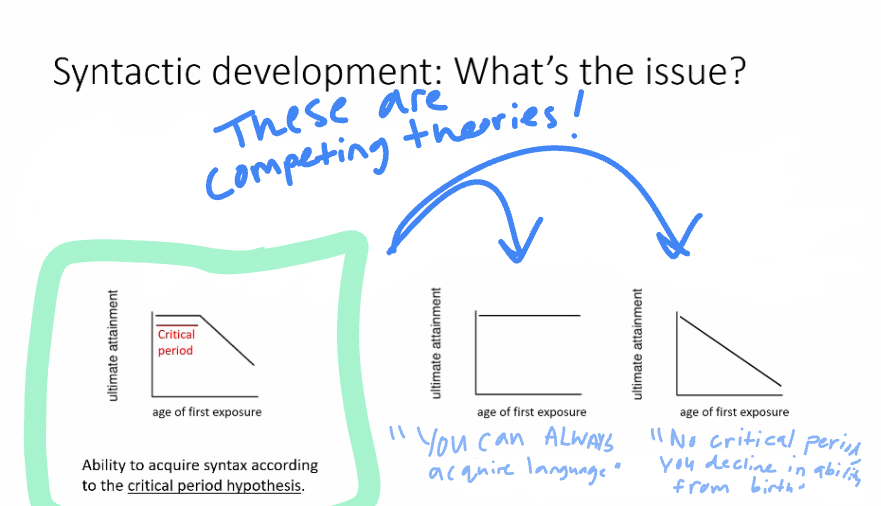
Critical period
Chomsky nonetheless agrees that the linguistic environment is important. But only insofar as it is needed to trigger an innate syntax-acquisition device. This must happen during the first few years of life which is called the ______ ______.
Genie
A girl who was locked up for 13 years and when she was found, she had missed the critical period where she could have learned language so she could not speak and was extremely socially retarded. She understands sentences but NOT syntax, even after years of training. supports Chomsky's claim of critical period.
Important to note
Although nowadays people largely agree that language development must be studied formally (as opposed to being viewed as a by product of environment or cognitive development), not everybody agrees on the extent to which language requires social mechanisms
Dominant view of syntactic development
Chomsky (1965). Children come equipped with a biological endowment for language processing (poverty of stimulus and limited negative evidence). Children come into the world knowing that languages take certain limited forms. They are born with the knowledge of a universal grammar (UG).
Universal grammar principles
Three principles:
Continuity of linguistic representations
Parameter setting
Modularity
Continuity of linguistic representations
Language is acquired and all the representations that have to do with it are there at birth. Unlocking something that was there to start with. Nothing changes from birth to adulthood except for the expressions of language. Children's innate linguistic knowledge does not change qualitatively but QUANTITATIVELY as they receive more linguistic input from infancy to adulthood.
Parameter setting
UG is not entirely fixes. It has a few parameters that vary from language to language. One of these is word order. Subject —> object —> verb Subject —> verb —> object German vs English
Modularity
Language is a stand-alone, human-specific faculty. Encapsulated from the rest of cognition. It is "modular" Syntax is the defining core of that module. Example: developmental language disorder (DLD) only impacts language and all of cognition is intact
Pinker's view
A slightly different view from Chomsky. Like Chomsky, he believed that infants have an innate capacity for language. HOWEVER, this researcher is more open to the idea that additional mechanisms contribute to syntactic development too.
A theory of language acquisition
For Pinker, _ ______ __ ________ _________ must take into account:
A "language instinct" (Chomsky & Fodor)
The linguistic input (Skinner & Chomsky)
the cognitive ability of the child (Piaget) — like object permanece, working memory, etc — this is where pinker departs from Chomsky
What pinker has to say about Chomsky
It's difficult to test existence of UG
We need to soften the poverty of input/stimulus claim
Innate predisposition for grammar-like computation
Semantic bootstrapping
(Pinker, 1984) There are regularities in the observable word. Children have pre-conceptions about links between roles (semantic) and grammatical position (Mintz experiment). not necessarily the word order that matters, but the situational reinforcement syntactic knowledge can emerge from the innate ability to compute co-occurrences between language and the environment
Seidenberg et al. (2002)
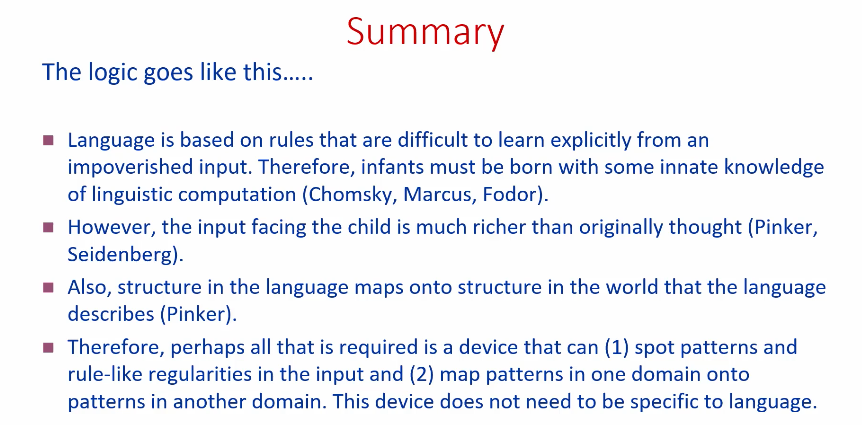
A more radically different view Syntactic knowledge is not innate. it is represented in the input. The input is much richer than previously believed. (adjectives usually precede nouns certain verbs predict certain nouns - "the sun will shine" -ing is associated with end of verb, etc.) This shows similarities with Skinner's view as both emphasize the dominant role of the linguistic environment. However, the learning mechanisms are different : Skinner = imitation/external reinforcement Seidenberg = implicit internal computation (~ statistical learning!)
Marcus's theory
But back to the dominant view: is syntax simply algebra? The input is structured but complicated. An innate mechanism is needed in order to detect structure in the input. Innate ability to compute not syntax as such but, rather, any open ended abstract relationship (NOT statistical learning)
Marcus et al. (1999)
Study: Can infants pick up on new grammatical patterns? -Preferential listening paradigm
Habituated to a list of 3-"word" sequences in which second "word" is repeated (ABB structure) E.g. : "le di di", "wije je", "de li li"
Test: Presented with new sentences with same structure (ABB) or with a different structure (ABA) • ABB: "ko ga ga" vs. ABA: "ko ga ko"
Results: 8 month oldslook longer in direction of sentences with different structure Evidence that infants can pick-up on grammatical pattern
Summary
Photo
5
In typically developing children, key milestones for language understanding and use are reached by this age:
Developmental Language Disorder (DLD)
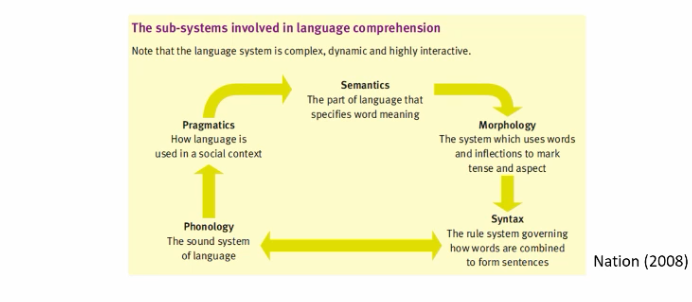
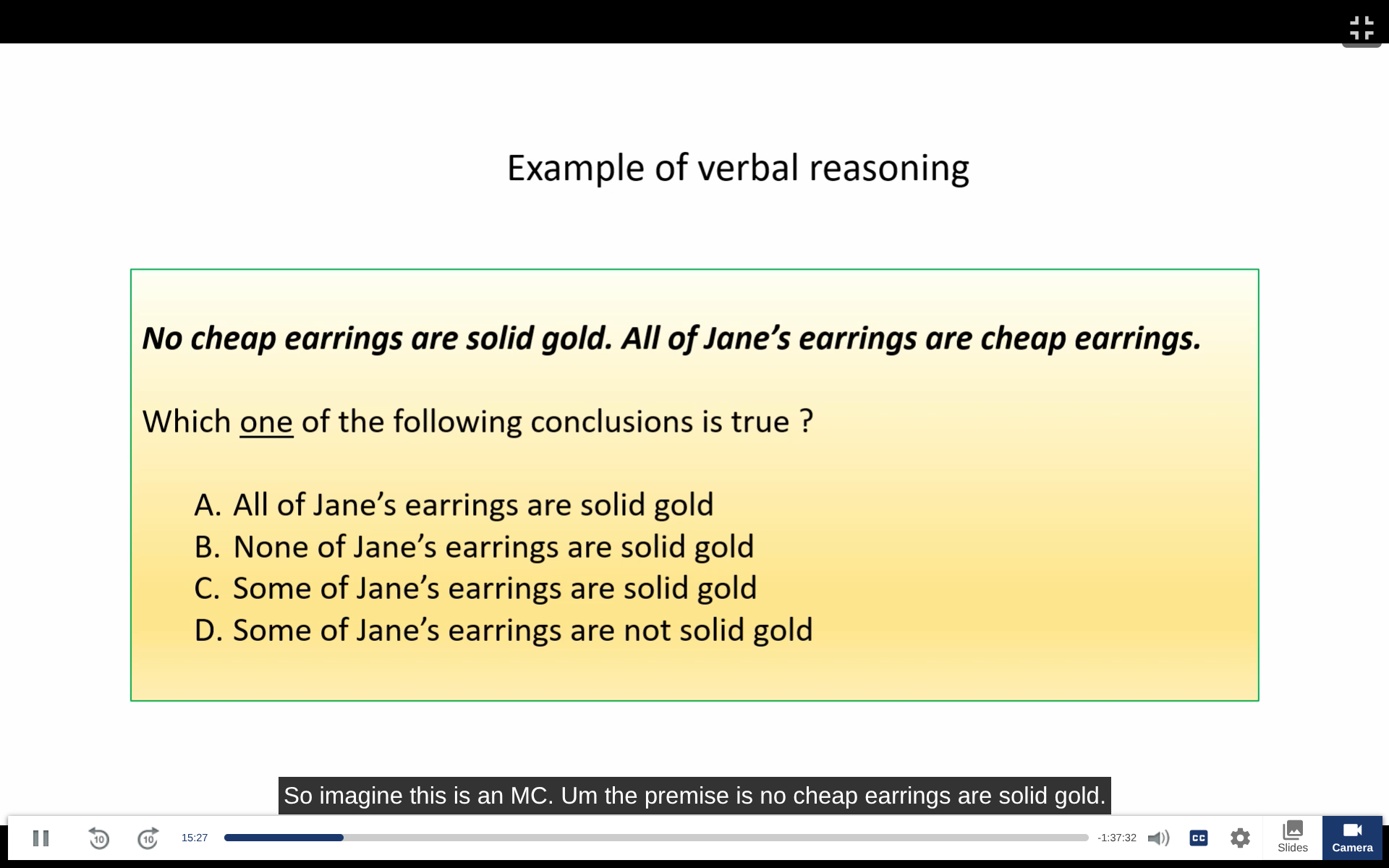
formerly referred to as Specific Language Impairment (SLI) Selective problem with language development (quiet child, word finding difficulties, linguistic immaturity, challenged language comprehension) Unlikely to be resolved by age 5. Poor verbal reasoning but non-verbal reasoning is intact. Other aspects of development like motor skills are fine! (Modularity)
majority improve over next few years but rarely completely
Autism Spectrum Disorder (ASD)
Sometimes DLD is difficult to distinguish from this other disorder due to symptom like
Impaired communication
Limited social interaction
Repetitive and restricted behavior/interests
Causes of DLD
Biological factors (60% have an affected family member) - CAUSAL
Socio-environmental factors (associations with low language exposure or less interactive environments) - MODERATING
Cognitive factors (this is based on piaget's view that DLD is not a linguistic disorder, but a secondary consequence of cognitive deficits like in working memory) - ASSOCIATED
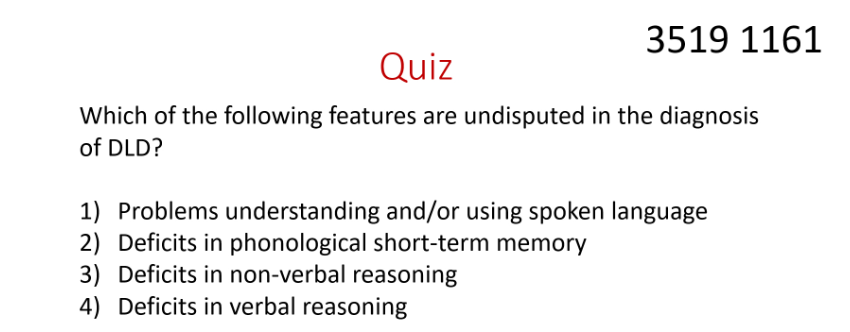
1 and 4
Menti
Auditory processing disorder (APD)
Like DLD, it leads to communication problems but the problems are purely receptive not linguistic
Child reports listening problems but passes hearing test — not a peripheral hearing impairment
Common complaint: difficulties understanding fast speech or in noisy situations
Has similar symptoms to hearing impairment, learning disabilities, ADHD, depression, DLD
Auditory temporal processing is impaired. Children with it struggle with rapid changes in sounds, gap detection, and fast frequency modulations. This matters because many sounds differ on a fine temporal contrast (pat vs bat)
Tallal et al. (1996)
Auditory temporal discrimination training leads to improvements in speech perception and language comprehension. So, the temporal processing hypothesis has some support BUT not all children with APD struggle with temporal processing and other disorders may also include it as a symptom.
1st Argument of APD cause
Problem IS auditory: higher level brain abnormalities. — Problem is beyond auditory nerve —-> brainstem, subcortical and cortical structures —— That is where info about sound features, like pitch, loudness, location is extracted and interpreted
2nd argument of APD cause
Problem is NOT auditory. — Poor auditory performance might arise because of limitations of attention, memory, or language: so APD would be reducible to a problem of cognition — Many children who do poorly on APD tests often have poor language or literacy. So maybe APD is just a consequence or correlate of language delays — could APD simply be a feature of DLD? Or is it a distinct disorder? Answer: we don't know :/ although it isn't in the DSM like DLD is but they're both in the ICD
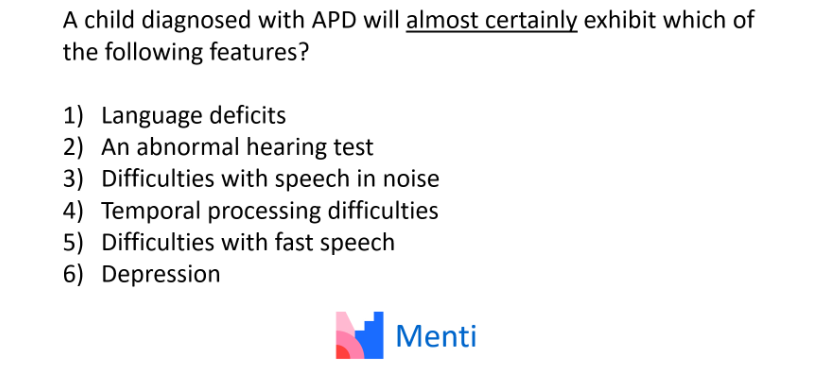
3 and 5 (Tallal would want you to say 4 but it's not "almost certain")
Menti
Speech disorders
Speech production deficits that result from impairment of motor system or of phonological planning
They are NOT language impairments per se, but they may co-occur with them. ("COMORBIDITY")
Other oral movements like chewing and smiling may be impaired as well
Two types of speech disorders
Apraxia of speech and Phonological impairment
Apraxia of speech
Impairments of motor control of articulators. Problems with movement programming/planning. Inability to transform intact phonological representations into coordinated movements. Muscle physiology is intact. Characteristics: slow speech rate, sound distortions, prolonged sound duration, reduced prosody, difficulties imitating speech
Cause of apraxia of speech
Neurological damage to the left frontal cortex surrounding Broca's area — due to stroke, brain injuries, illness, or infection
phonological impairment
Impairment of phonological planning or representations Articulation itself is intact — no problems with motor control More common than apraxia Characteristics: sound substitutions (cat > tat), systematic omissions (cat > caaa) pronounced sounds are more accurate, speech rate and prosody are unimpaired, errors are more consistent and predictable and easier to correct
Treatment of speech disorders
Slowing down speech (rate control)
Exaggerated movement of lips and tongue
Saying same target sounds in words and sentences
Increasing loudness: Using more breath to be louder (LSVT LOUD)
LSVT LOUD
Provides speech treatment for people with Parkinson's and other neurological conditions involving motor speech disorders — APRAXIA! Results: it's more effective than conventional articulatory training. Data also show evidence of long-term benefits.