NVSC 401 Exam 2 (From Quizlet!)
 Call Kai
 Learn
Learn Practice Test
 Spaced Repetition
 Match
Match Flashcards
 Knowt Play
1/39

There's no tags or description
Looks like no tags are added yet.
Name | Mastery | Learn | Test | Matching | Spaced | Call with Kai |
|---|
No analytics yet
Send a link to your students to track their progress
40 Terms
What affects the speed of sound in water?
Temperature
Pressure
Salinity
All of these increase the speed of sound in water.
Order changes after 1000 ft
What are the propagation paths in water?
- Direct Path
- Half Channel
- Surface Duct
- Convergence Zone (CZ)
- Bottom Bounce (BB)
- Sound Channel
Be able to draw the picture from slides
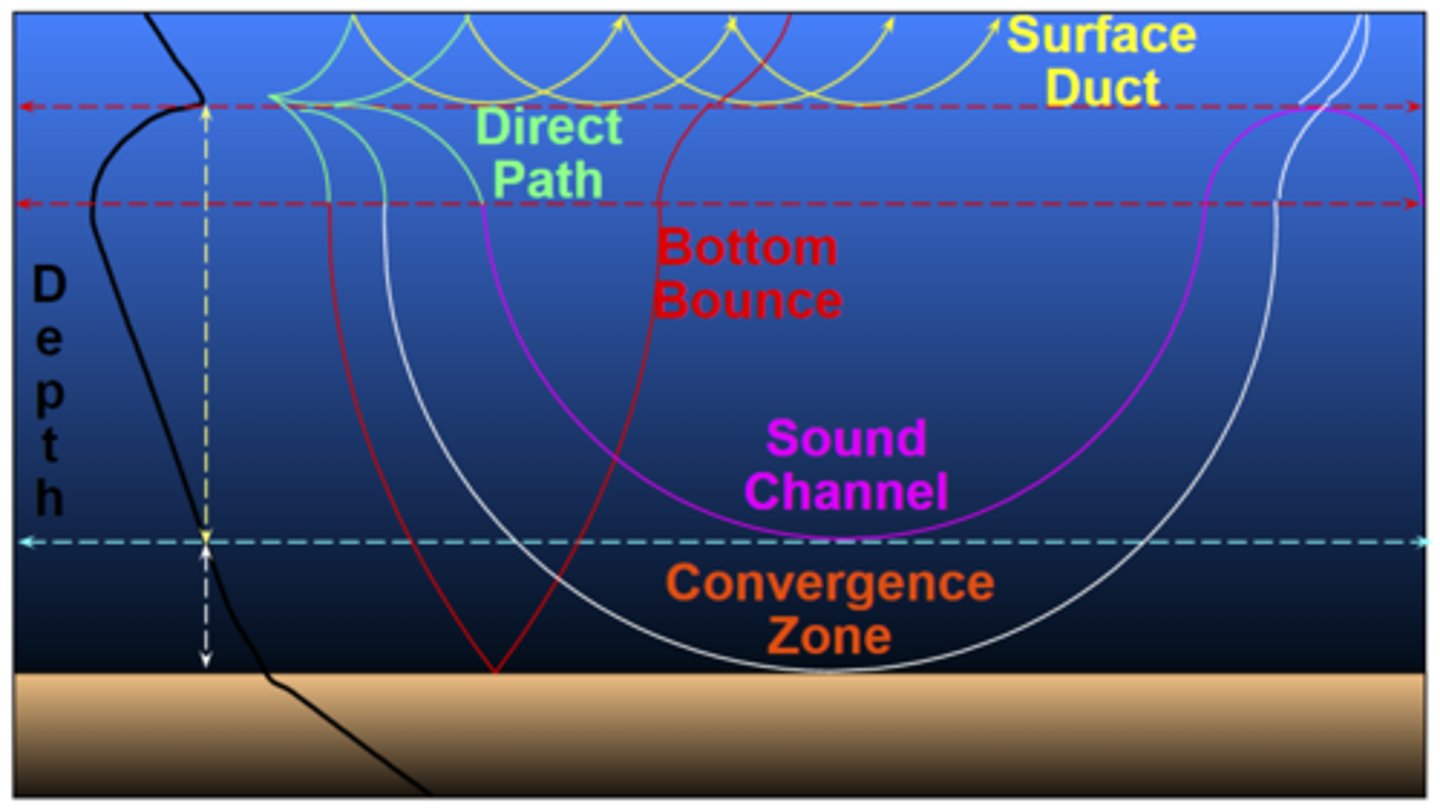
What is a Direct Path?
Direct contact, close ranges, “straight” line
What is a Bottem Bounce?
Beam bounces back towards surface
Needs relatively smooth, hard bottom
What is a Surface Duct?
Beam gets trapped near surface because of positve gradient
What is a Half Channel?
Pretty much just a surface duct all the way to the bottem
What is a Sound Channel?
Longest range transmission possible avaliable
Only loss is absorption
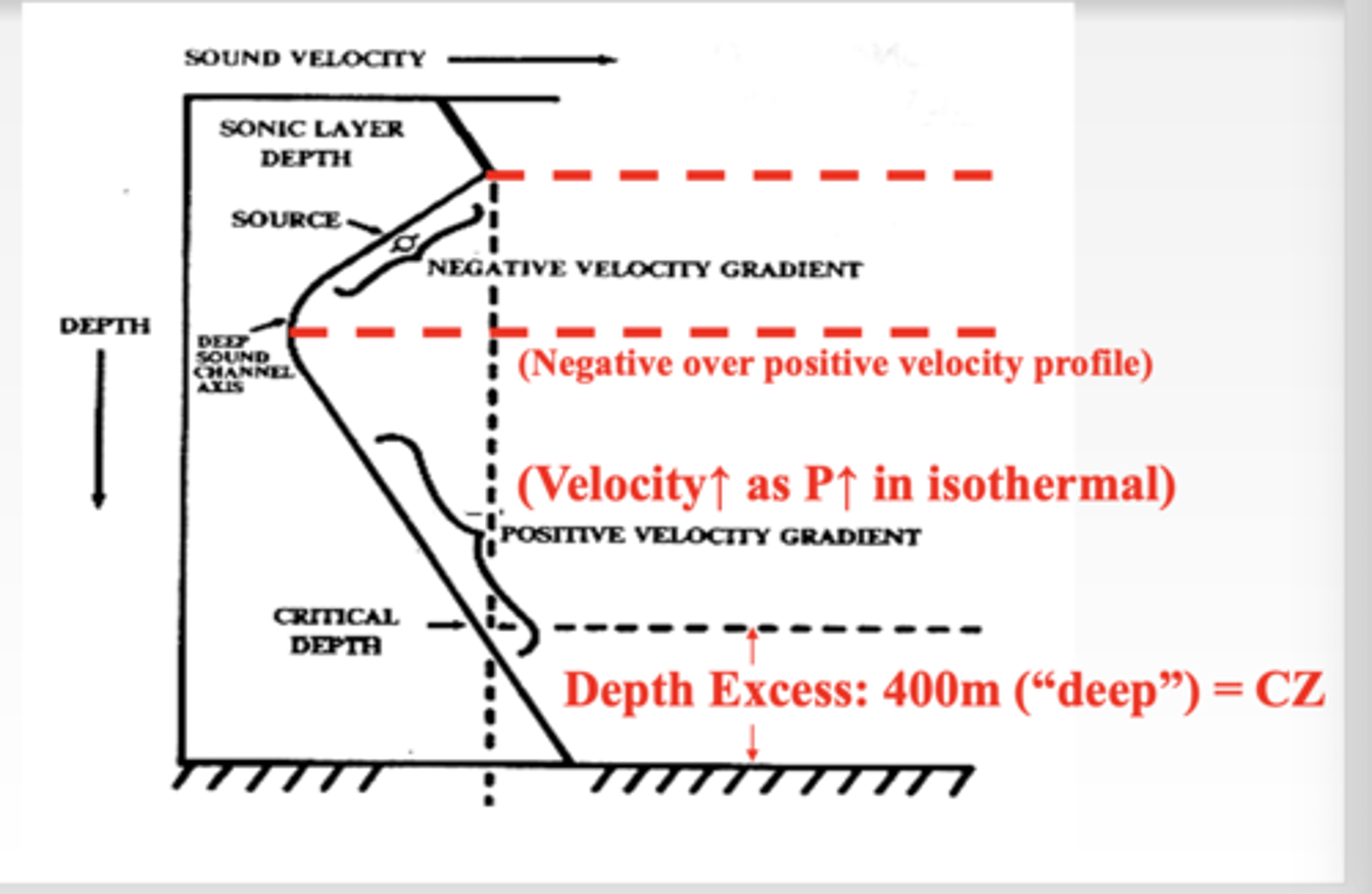
Negative over positive gradient
What is a Convergance Zone?
Needs greater than 200 m depth excess
Sound beam goes so deep that it bends back up
What is a negative gradient & what does it cause?
SVP bent backwards like /
Causing sound to travel down & create shadow zones
What is a positive gradient & what does it cause?
SVP bent backward like this \
Causing sound to travel up & create shadow zones
Draw an SVP (Sound Velocity Profile)
Picture!
What are broadband and narrowband?
Broadband: wide range of frequencies, noise we think we can hear (propellers/shafts, flow of water over a ships hull, propulsion system, etc)
Narrowband: composed of specific frequencies or ranges, noise you don't generally hear (pumps, motors, dolphins)
What is Self-noise?
Noise generated by own ship:
Machinery noise (hull noise, narrowband)
Flow noise (water over hull, broadband)
Cavitation.
What is Ambient-noise?
Noise generated by external and environmental factors:
Currents
Hydrodynamic (storms)
Ocean traffic/operating environment
Biological noises
Seismic
Due to the doppler effect, a target approaching you will have __________ frequency.
Higher
What are the signal terms for active sonar?
- Source level: your sonar's sonic transmission (SL)
- Target strength: based on the "strength" of the reflected sound, same as radar cross section, MASS = material, aspect angle, size, shape (TS)
What are noise limited and reverb limited?
Noise limited: return of sonar ping is masked by self and ambient noises
Reverb limited: reverberation of target is masked by reverberations surrounding the submarine
Draw a picture
How is a submarine vulnerable to detection from non-acoustic sources?
Know and give explanations:
- visual = scope sighting, wade
- infared detection = IR "Wake", diesel exhaust
- radar = periscope, sail "broach"
- magnetic anomaly detection = subs disturb magnetic field underwater
Propellant Types
- progressive: burning surface area increases with time, rocket
- neutral: burning surface area stays constant, rifle
- regressive: burning surface area decreases with time, pistol
What are the five exterior ballistics?
gravity, drag, wind, drift, coriolis effect
What are the three types of launchers?
gravity, impulse, reaction
What are the types of reaction launchers?
rail, zero length, canister
How can you reduce recoil?
- recoil/counter recoil systems: gun after firing moves back
- soft recoil systems
- muzzle braking: baffles attached to end of barrel
- recoiless system: shoulder launch rocket
Three phases of weapons guidance?
- boost: when weapon recieves launch signal to flight
- midcourse: missle en route/course, longest phase
- terminal: high accuracy, fast responses to evasive manuvers
What are the types of self-contained guidance?
- Preset: path is predetermined prior to weapon launch
- GPS: global positioning system, satellite based navigation system
- Celestial: references position to fixed stars and adjusts (ICBM)
- Inertial: senses weapon movement and makes adjustments
- Terrestrial: compares actual terrain with predicted flight path and adjsuts accordingly
Semi-active homing uses?
uses the active homing from another active source to find the target, SPARROW
What are the 4 steps of a jet engine?
intake, compression, combustion, exhaust
Explain the difference between fuze and fuse
Fuse: a cord or tube that transmits flame or explosion
Fuze: a device with explosive components designed to initiate a main charge
List the components of the HE train in order
detonator -> booster -> main charge
What is safing & arming device? What does it do?
Physically isolates the detonator from the high explosive train
Prevents unintentional warhead detonation
List and describe the five types of fuses
- Impact/Contact: senses physical contact, must impact to detonate, found on point of projectile/bomb, can have a built in delay
- Ambient: senses changes in environment, depth charge
- Timer: detonates after preset elapsed time (hand grenade),
- Command: waits for a signal from control station
- Proximity: actuated by some influence of target = electromagnetic, magnetostatic, acoustic, electro-optical, (missiles use radar)
What are the three types of explosives?
- Mechanical: over-pressurized container
- Chemical: change in chemical bonds
- Nuclear: change nucleus of atoms (fission and fusion)
How would you increase fragmentation in a warhead?
more fragmentation pieces, higher pressure inside the warhead, softer warhead shell to explode outward
How are mines delivered?
- air-delivered mines
- surface-delivered mines
- submarine-delivered mines
- asymmetric (civilian)
- asset protection: impeding/defeating enemy attacks
- interdiction: obstructing shipping lanes, critical areas, etc
- attrition: attempting to trap enemy HVUs into an area
- force multiplication: influencing movement of enemy to select locations so as to engage with other weapons
- terrorism: disruption of commerce, political motives
What are the types of mine sweeping/clearance?
hunting = searching, sweeping = activate them
Mine clearing: cable cutting, detonation by towed sled, remotely operated robotic vehicles
Mine sweeping = cut cables then activate to destroy, use acoustic/magnetic noisemakers to activate
Mine hunting = search and neutralize individual mines, use sonar then investigate every possible target
What are the six pillars of cybersecurity?
Confidentiality
Integrity
Availability
Non-repudiation
Authenticity
What is required for a convergence zone?
> 200m depth, sound beam will bounce off of bottom of seafloor and back up to the surface after 50km, depth excess determines zone width
Range is directly impacted by __________ when firing a projectile
muzzle velocity
What is functional reliability and how do you increase it?
the confidence that your system will detonate when intended, increase using parallel connections
NORFOLK TO NORFOLK
atlantic ocean - Gibraltar strait - Mediterranean sea - Sicilian channel - Suez Canal - red sea - BAM - Indian ocean - strait of malacca - south china sea - Luzon strait - philippine sea - pacific ocean - Panama canal - gulf of America - back to atlantic