Art and Power Exam
 Call Kai
 Learn
Learn Practice Test
 Spaced Repetition
 Match
Match Flashcards
 Knowt Play
1/22

There's no tags or description
Looks like no tags are added yet.
Name | Mastery | Learn | Test | Matching | Spaced | Call with Kai |
|---|
No analytics yet
Send a link to your students to track their progress
23 Terms
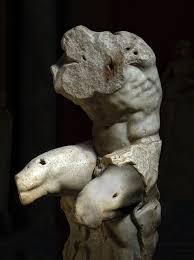
The Belvedere Torso
1st century BCE, Apollonios of Athens, Vatican Museums, Rome
Mr and Mrs Andrews
1750, Thomas Gainsborough, National Gallery, London
Bathers at Asnières
1884, Georges Seurat, National Gallery, London
The Wilde Woman of Aiken
1882, James A. Palmer, The Metropolitan Museum of Art, New York
Thirteen Most Wanted Men
1964, Andy Warhol, Originally at the 1964 NY World's Fair Pavilion
Carving: A Traditional Sculpture
1972, Eleanor Antin, The Art Institute of Chicago
Mining the Museum
1992, Fred Wilson, Maryland Historical Society, Baltimore
Comedian
2019, Maurizio Cattelan, Debuted at Art Basel Miami Beach
The Unburied Sounds of a Troubled Horizon
2022, Tuan Andrew Nguyen, Various (Video Installation)
Unmade Drone
2025, Kara Walker, Contemporary Exhibitions / Artist's Studio
Aesthetics vs. Aestheticism
Aesthetics is the broad philosophical study of art, taste, and beauty. Aestheticism is the late-19th-century 'art for art's sake' movement prioritizing sensual appeal over moral agendas.
Representation vs. Visual Objectivity
Representation views images as constructed, subjective translations of reality. Visual Objectivity is the flawed assumption that images provide a neutral, unmediated, and purely factual view of the world.
Beauty vs. Morality
The tension over how art should be judged: strictly by its formal, visually pleasing qualities (beauty), or by its ethical message, virtue, and social impact (morality).
Genius vs. Gender
The critical examination of how the romanticized concept of the 'solitary genius' was historically constructed as an inherently male trait, systematically excluding women.
Political Rationale of the Museum
Built on permanence, archiving history, defining the canon, and nation-building (often reflecting and preserving colonial power structures).
Political Rationale of the Exhibition
Temporary, thematic, and curated to make a specific critical, aesthetic, or market-driven statement at a moment in time.
Political Rationale of the Biennial
Globalized, recurring mega-events focused on contemporary networking, international dialogue, and city-branding.
Adorno, 'Culture Industry Reconsidered'
Mass culture is a standardized industry producing predictable goods designed to pacify the masses and maintain capitalist control, destroying true artistic autonomy.
Azoulay, 'The Shutter'
Critiques imperial photography. The 'shutter' separates plundered objects (documented in museums) from the colonized people they were stolen from (left undocumented).
Battersby, 'The Clouded Mirror'
Traces the history of 'genius,' arguing that male philosophers deliberately shaped the concept to exclude women by associating creative greatness strictly with masculinity.
hooks, 'On Being the Subject of Art'
Examines the representation of Black individuals in visual culture, advocating for a shift from passive, objectified spectacles to empowered, active subjects.
Mitchell, 'Imperial Landscape'
Argues that landscape painting is not merely an art genre, but a medium of cultural power and imperialism that naturalizes ownership, colonization, and territorial control.
Nochlin, 'Women, Art, and Power'
Analyzes how visual representation historically reinforces patriarchy. Women in art are often depicted as passive and available, naturalizing their subordination.