Introduction + review of binary analysis
 Call Kai
 Learn
Learn Practice Test
 Spaced Repetition
 Match
Match Flashcards
 Knowt Play
1/29

There's no tags or description
Looks like no tags are added yet.
Name | Mastery | Learn | Test | Matching | Spaced | Call with Kai |
|---|
No analytics yet
Send a link to your students to track their progress
30 Terms
Why do you need to understand exactly how a system works?
Understanding exactly what rules it follows and how they are enforced allows you to understand the system better than the people that made it and find incorrect assumptions that can be exploited
Why do multi layered systems make exploitation easier?
People make assumptions about the layer below
Binaries are written in
assembly
What level of code are binaries written in?
Much lower level than Java byte code
Assembly compiled for one type of machine
won’t run on another
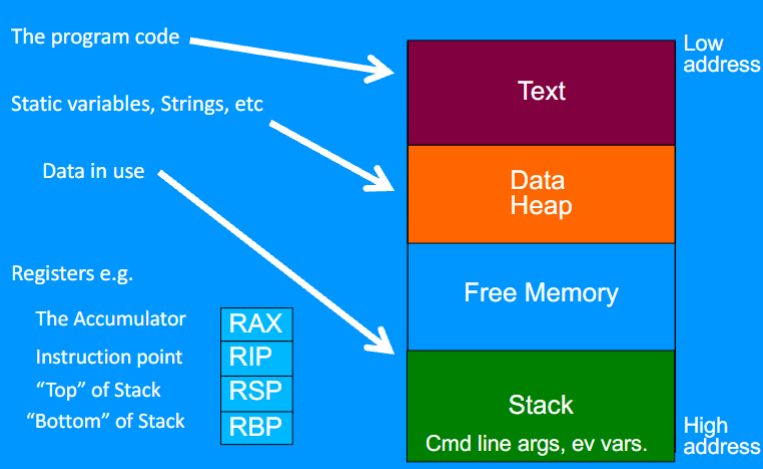
The x86-64 architecture
The stack
Last in, first out
Can read and write to the top of the stack
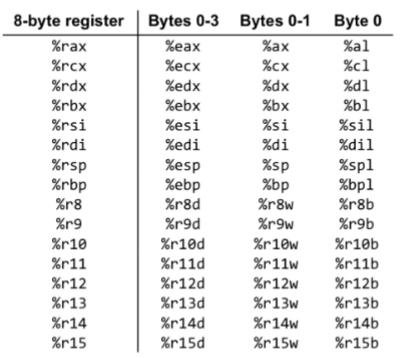
Sub parts of registers can be addressed
directly
x86 to x86-64 (x64) is a size difference of
32 to 64 bit (x64 is twice as long)
x86 to x86-64 (x64) registers have
a range of different names
In x86, function arguments are passed
onto the stack
Arguments in x64
The first 6 are passed into registers
The rest are passed onto the stack
Command: MOV
Move value between registers
Command: MOVxy
Move value of different lengths
Command: CALL
Execute a function
Command: RET, RETN, RETF
End a function and restart calling code
Command: CMP, TEST
Compare two values
Command: JE, JNE, JLE
Jump based on comparison
Command: LEA
Like MOV, but can evaluate arguments
Command: [ ]
Value at a memory location
MOV RAX RBX
Move value in RBX to RAX
MOV [RAX] RBX
Move value in RBX to address RAX points at
MOV RAX [RBX]
Move value RBX is pointing at to RAX
MOV [RAX] [RBX]
CPUs are physically unable to do this
Linux function calling conventions: Arguments
Put into registers:
RDI, RSI, RDX, RCX, R8, R9, and then stack
XMM0, XMM1, …, XMM7 for floating point numbers
Linux function calling conventions: Results
Return in RAX (and RDX) or XMM0 and XMM1
Linux function calling conventions: fow does the Function called makes new stack space?
Updating RSP and RPB, the instruction pointer and old RBP are stored on the stack for when the function returns
Windows function calling conventions: Registers
Arguments are in:
RCX, RDX, R8, R9
XMM0, XMM1, XMM2, XMM3
Patching
Changing values or commands in a binary
While patching, commands must be overwritten
in place - space cannot easily be added