Halogenoalkanes
 Call Kai
 Learn
Learn Practice Test
 Spaced Repetition
 Match
Match Flashcards
 Knowt Play
1/57

Earn XP
Description and Tags
Name | Mastery | Learn | Test | Matching | Spaced | Call with Kai | Chat |
|---|
No analytics yet
Send a link to your students to track their progress
58 Terms
What are halogenoalkanes?
Alkanes containing one or more halogen atoms.
How do you name a halogenoalkane?
1) Name the longest carbon chain in the molecule.
2) Number the position of the halogen with the smallest number possible.
3) Add the prefix fluoro-/chloro-/bromo-/iodo- depending on the halogen.
How do you order the prefixes if the halogenoalkane contains more than one halogen?
Order the halogens in alphabetical order (bromo-/chloro-/fluoro-/iodo-).
Describe the trend in boiling points of halogenoalkanes.
Boiling point increases going down group 7.
Explain the trend in boiling points of the halogenoalkanes.
Going down group 7, the number of electrons in the atoms increases, this means there are stronger Van der Waals intermolecular forces between molecules. More energy (higher temperature) is required to overcome these intermolecular forces, so higher boiling point.
True or false? The bond between a carbon atom and halogen atom in a halogenoalkane is non-polar.
False. THE BOND BETWEEN A CARBON ATOM AND A HALOGEN ATOM IN A HALOGENOALKANE IS POLAR.
True or false? Halogenoalkanes are attacked by nucleophiles due to their polar bond.
True.
Why is the carbon-halogen bond in halogenoalkanes polar?
The halogen atom is more electronegative than the carbon atom meaning the halogen atom pulls the electrons in the bond further towards itself, making a delta + carbon and a delta - halogen.
What is a nucleophile?
A species that is an electron pair donor and is attracted to positively charged species.
Name three examples of nucleophiles.
Ammonia.
Hydroxide ions.
Cyanide ions.
Draw the displayed formula of ammonia. Why is ammonia a nucleophile?
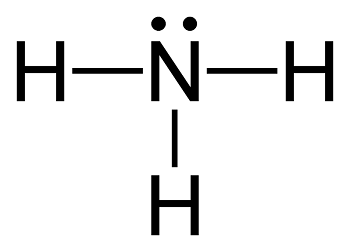
Ammonia has a lone pair of electrons meaning it will be attracted to positively charged species.
Draw a hydroxide ion. Why are hydroxide ions nucleophiles?
Hydroxide ions are negatively charged meaning they will be attracted to positively charged species.

Draw a cyanide ion. Why are cyanide ions nucleophiles?
Cyanide ions are negatively charged meaning they are attracted to positively charged species.

What do curly arrows show? In what direction do they always move?
Curly arrows show the movement of electrons. They always go FROM the electrons.
Name the mechanism in which halogenoalkanes react with nucleophiles.
Nucleophilic substitution.
What conditions are needed when reacting halogenoalkanes with hydroxide ions?
Warm, aqueous sodium hydroxide as source of hydroxide ions.
Reflux.
Give the word equation for the reaction between a halogenoalkane and warm, aqueous sodium hydroxide.
Halogenoalkane + sodium hydroxide → alcohol + sodium halide
Draw the mechanism for the reaction between chloroethane and aqueous hydroxide ions.
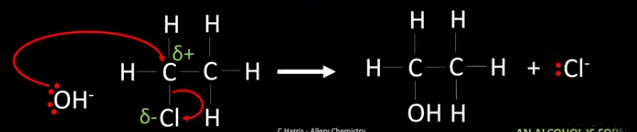
Give the general symbol equation for the reaction between a halogenoalkane and warm, aqueous sodium hydroxide.

What conditions are needed for the reaction between halogenoalkanes and cyanide ions?
Warm, ethanolic potassium cyanide (source of cyanide ions).
Reflux.
Give the general word equation for the reaction between halogenoalkanes and warm, ethanolic potassium cyanide.
Halogenoalkane + potassium cyanide → nitrile + potassium halide
Draw the mechanism for the reaction between chloroethane and cyanide ions.
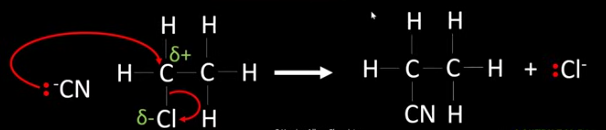
Give the general symbol equation for the reaction between halogenoalkanes and warm, ethanolic potassium cyanide.

What conditions are needed for the reaction between halogenoalkanes and ammonia?
Heat with ethanolic ammonia.
Ammonia in excess.
Give the general word equation for the reaction between halogenoalkanes and ammonia in excess.
Halogenoalkane + ammonia → amine + ammonium halide
Draw the mechanism for the reaction between a halogenoalkane and ammonia in excess.
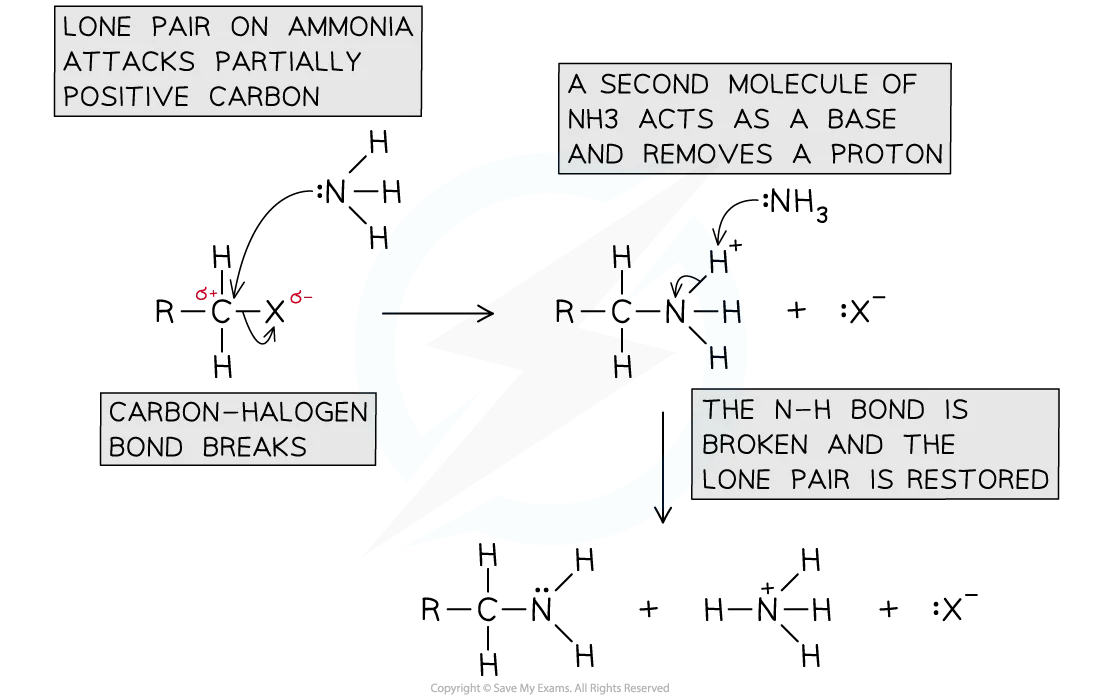
Give the overall symbol equation for the reaction between halogenoalkanes and ammonia in excess.
R-X + 2NH3 → RNH2 + NH4+X-
Describe the trend in reactivity of the halogenoalkanes.
Reactivity increases as you go down group 7.
What determines the reactivity of the halogenoalkanes?
The bond strength/bond enthalpy in the halogenoalkanes.
Explain the trend in reactivity in the halogenoalkanes.
The further down group 7, the lower the bond carbon-halogen bond enthalpy meaning it is easier to break and therefore the halogenoalkane is more reactive.
What type of reaction takes place when halogenoalkanes react with an ethanolic (NOT AQUEOUS!!!) source of hydroxide ions?
Elimination.
What conditions are needed when reacting halogenoalkanes with ethanolic hydroxide ions?
Warm, ethanolic sodium hydroxide (source of hydroxide ions).
Reflux.
How do hydroxide ions act differently when they are aqueous to when they are ethanolic?
When they are aqueous they act as nucleophiles and attack the delta + carbon bonded to the halogen. When they are ethanolic they act as bases (proton acceptors) and attack a hydrogen that is bonded to a carbon adjacent to the carbon bonded to the halogen.
Give the general word equation for the reaction between halogenoalkanes and warm, ethanolic sodium hydroxide.
Halogenoalkane + sodium hydroxide → alkene + water + sodium halide
Draw the mechanism for the reaction between 2-chloropropane and ethanolic hydroxide ions.
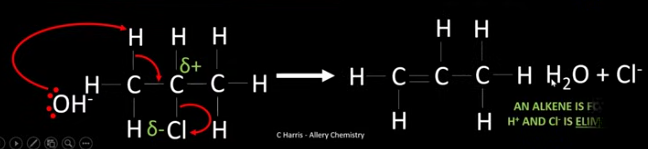
How can you form a mixture of alcohol and alkene when reacting halogenoalkanes with sodium hydroxide?
Dissolve the sodium hydroxide in a mixture of water and ethanol as the solvent.
What do CFCs stand for?
Chlorofluorocarbons.
True or false? CFCs break down ozone in the atmosphere.
True.
Give the formula of ozone.
O3
Give three uses of CFCs.
Solvents.
Refrigerants.
Propellant in deodorant.
What are CFCs?
Hydrocarbons that have had all their hydrogens replaced by chlorine and fluorine that are stable, unreactive, and non-toxic.
True or false? CFCs are unstable molecules.
False. CFCs ARE STABLE MOLECULES.
True or false? CFCs are broken down by UV light.
True.
Describe how CFCs are broken down by UV light.
UV light breaks C-Cl bonds.
What is the product of the breaking down of CFCs by UV light?
Free radicals.
Why are C-Cl bonds more likely to be broken by UV light than C-F bonds?
C-Cl bonds have a lower bond enthalpy than C-F bonds so require less energy to break.
Which free radicals from the breaking down of CFCs catalyse the break down of ozone?
Chlorine free radicals (Cl.)
What happens in the initiation step of the break down of ozone?
UV light breaks a C-Cl bond in a CFC, forming two free radicals.
Give the balanced symbol equation for the initiation step of the break down of ozone with trichlorofluoromethane.

What two things happen in the propagation step of the break down of ozone with trichlorofluoromethane?
Chlorine free radical reacts with ozone to form oxygen and chlorine monoxide free radical.
Chlorine monoxide free radical reacts with ozone to make oxygen and chlorine free radical.
Why are chlorine free radicals catalysts in ozone depletion?
They are reformed in the propagation steps of ozone depletion.
Give both balanced symbol equations showing what happens during the propagation step of ozone depletion.
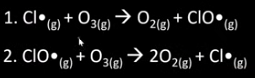
Give all the possible symbol equations for the termination step in ozone depletion.
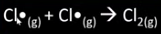


Give the overall balanced symbol equation for the depletion of ozone.

True or false? You are still allowed to use CFCs.
False. CFCs ARE BANNED.
Why is ozone depletion bad for life on Earth?
Ozone absorbs harmful UV radiation (that causes skin cancer).
What alternative to CFCs do we use today?
HFCs (hydrofluorocarbons).
Why were CFCs banned?
The risks they caused outweighed their benefits.