Chapter 15 - GENETICS CAN BE USED TO UNDERSTAND THE TRAITS OF INDIVIDUALS AND FAMILIES
 Call Kai
 Learn
 Practice Test
 Spaced Repetition
 Match
 Flashcards
 Knowt Play
1/29

There's no tags or description
Looks like no tags are added yet.
30 Terms
phenotype
The phenotype is the physical appearance of a trait as determined by the genotype, the combination of alleles. If the alleles are the same, the genotype is homozygous; if the alleles are different, the genotype is heterozygous.
Gene
The factor that determines an inherited characteristic; located in the chromosomes
Allele
An alternative form of a gene (e.g. the gene for pod colour in peas has two alleles, green and yellow)
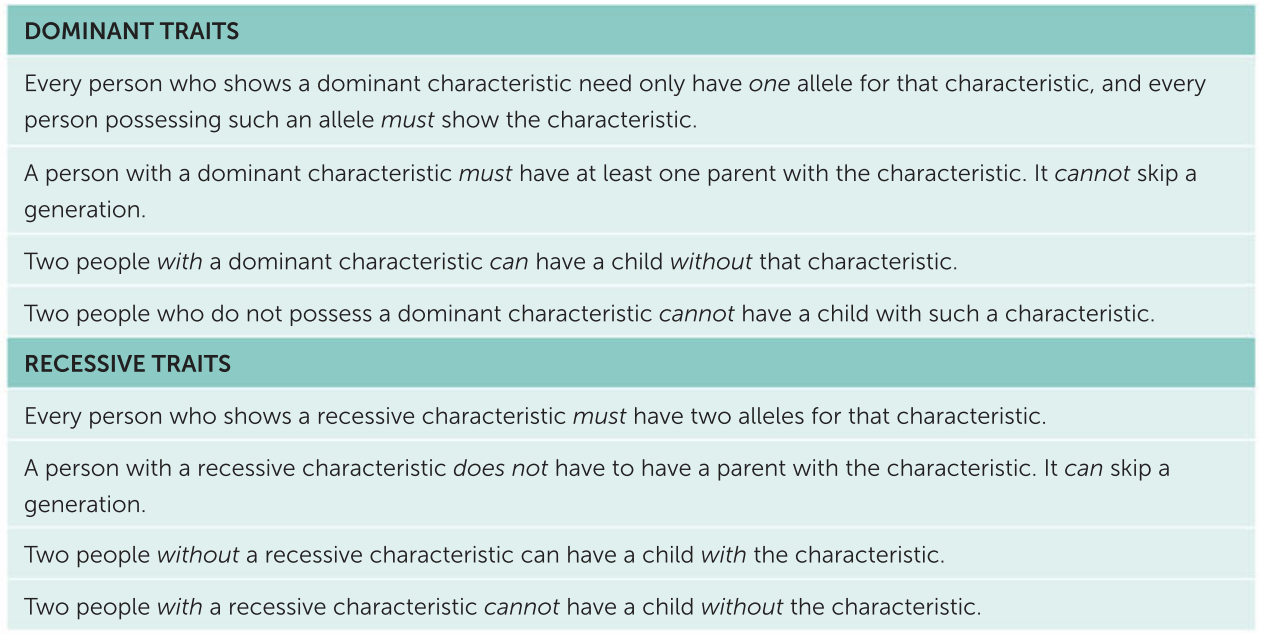
Dominant
An allele that masks the effect of another allele (e.g. a pea plant with alleles for green and yellow pods will produce green pods because green is dominant to yellow)
Recessive
An allele that is masked by the alternative, dominant allele (e.g. the allele for yellow pod colour is masked by the allele for green pod colour)
Homozygous
The situation where an individual has the same alleles for a particular characteristic; also called pure-breeding (e.g. a pea plant with two alleles for green pod colour is homozygous green)
Heterozygous
The situation where an individual possesses different alleles for a particular characteristic; also called hybrid (e.g. a pea plant with alleles for both green- and yellow-coloured pods is heterozygous)
Phenotype
The physical appearance of an individual as determined by the expression of the alleles for that characteristic (e.g. a pea plant with alleles for green-coloured and for yellow-coloured pods will have the phenotype green pods)
Genotype
The genetic make-up of an individual as determined by the alleles for the characteristic being considered (e.g. a pea plant with one allele for green-coloured pods and one for yellowcoloured pods will have the heterozygous genotype)
Hemizygous
Having no allelic counterpart; occurs with alleles in the X chromosome in males
Heterozygous
Possessing different alleles for a given characteristic
Homozygous
Possessing the same alleles for a given characteristic
Phenotype
The appearance of an individual as determined by their genetic constitution
Autosomal inheritance is based on two main principles
Autosomal inheritance is based on two main principles
1.Heredity traits are controlled by pairs of alleles (2 alleles make up 1 gene)
2.When gametes form, the gene pairs segregate so that each gamete only receives one set of alleles.
At fertilisation, the gametes unite and the offspring now has one set of single alleles from each parent, creating genes.
Different combinations of genes occur in the offspring – creating variation,
Monohybrid crosses
A cross considers
§The possible gametes produced by the parents
§The possible genotypes of the offspring
§The possible phenotypes of the offspring
§The mathematical probabilities of these outcomes occurring.

AUTOSOMAL (SIMPLE) INHERITANCE
Traits are located on the autosomes (non-sex chromosomes)
Disease examples
§Huntington’s Disease (Autosomal Dominant): Death of brain cells, causing tremors, uncoordinated movement etc.
§PKU: (Autosomal recessive): Inability to convert amino acid phenylalanine to tyrosine
§Cystic fibrosis(Autosomal recessive) Chest infections, lack of digestive enzymes and increased salt loss. 1 in 25 are carriers in Aus.
Autosomal diseases – punnett squares
The results of crosses can be modelled using a Punnett Square
1.The gametes are segregated and then crossed.
2.Four squares of offspring are shown
3.Mathematical predictions are made
4.Each square has a 25% chance of occurring
Autosomal inheritance
Autosomal inheritance refers to the transmission of genetic traits or disorders located on one of the 22 numbered, non-sex chromosomes (autosomes)
Sex-linked inheritance / X-linked inheritance
the genetic transmission of traits or disorders whose genes are located on a sex chromosome





Autosomal Genes

Sex-Linked Genes

X-Linked recessive inheritance patterns
