2.8 Market failure, Negative and positive externalities
 Call Kai
 Learn
Learn Practice Test
 Spaced Repetition
 Match
Match Flashcards
 Knowt Play
1/33

There's no tags or description
Looks like no tags are added yet.
Name | Mastery | Learn | Test | Matching | Spaced | Call with Kai |
|---|
No analytics yet
Send a link to your students to track their progress
34 Terms
market failure
in the free market when resources are missallocated or inefficiently allocated in the best way for society.
MSC /= MSB
Main causes of market failure
externalities
public goods
common pool or resources
merit and demrit goods
externalities deinfiton
external impact on a thrid party not involved in the economic transaction between the buyer and seller
→ third party effect from production or consumption
2 types of externalities and how do they cause market failure
negative externalities - over production/consume of goods with negative externalities
positive externalities - underproduction/ consumption of goods with positive externalities
how do common pool resources cause market failure
they are non-excludable
rivalrous
people overuse cause if they dont someone else will as there is no ownership of the goods
→ over - allocation of resources meaning that too many is used now and not enough left for future
→ overuse of finite resources
how are merit and demerit good market failure
→ from consumer perspective/behaviour
demerit goods are over consumed
merit goods are underconsumed
→ people dont realise full benefits and full harm
MPC
The extra cost to YOU (individual/firm) of producing or consuming one more unit
MPB
The extra satisfaction YOU get from consuming one more unit
MSB
Total benefit to society of one more unit
private benefit + external benefit
MSC
Total cost to society of one more unit
private cost + external cost
When talking about market failure and analysing it what you should mention and why?
the level of output (quantity)
how resources are allocated
→ because market failure is about producing the wrong quantity
steps to explain tax on cigarettes
smoking causes negative externalities
the market over produces → market failure
tax on cigarettes → cost of production → reduces production and consumption → corrects overconsumption
what are negative externalities of production
are negative external costs created during the production of a g/s
why and how do these negative extrenalities of production cause market failure
over-provision - too much is produced because external costs are ignored
costs are higher than benefit
misallocation of resources for harmful production
not at MSB=MPC which is the social optimal output
Diagram analysis negative externalities explain
MSC>MPC causing welfare loss, negative externalities
gap between MSC and MPC causes negative externalities
market produces at (Pe and Qe) - MPB = MPC
Analysis points for negative externalities - chain of events
self - interest
price too low
too much produced and cosnsumed
missallocation of resources
explaining self-interest point
firms want to maximise profit and consumers want to maximize satisfaction
both ignore harm to others
only MPC and MPB are considered
explaining prices are too low points
because external costs are ignored firms costs seem lower than they are
supply is higher
price falls
→ doesnt reflect true cost to society
explaining over-production and over-consumption
overproduction because costs look too low so they overproduce leading to output Qe>Qopt
overconsumption because price is low they buy more → they dont see the negative externalities
explaining missallocation of resources
too many resources go into harmful production
not enough resources go into beneficial goods
→ resources are wasted
negative externalities of consumption
occur when the consumption of a g/s impose negative externalities on third parties not involved in a transaction
why is there market failure due to negative externalities of consumption
overconsumption of g/s as only private costs are considered and not external costs
if external costs were considered demand would decrease and they would be sold at lower prices
analysis of negative externalities of consumption
self-interest
over-consumptiona and production
misallocation of resources
Why do positive externalities of production cause market failure?
undersprovision of g/s with positive extrnal benefits
producers consider private benefit and bot the external benefit
if external benefit were considered the supply would increase as they would be sold at a lower price
Positive externalities of consumption definition
Positive externalities of consumption occur when consumption results in benefits to third parties.
EX: Healthcare/vaccines, Education (productivity, spending, more tax revenue), Exercise and healthy eating (limits healthcare costs, producity)
Why is MSB greater than MPB in positive externalities of consumption?
Because society receives external benefits in addition to the consumer’s private benefits.
MSB > MPB
SB = PB + EB
DIAGRAM POSITIVE EXTERANLITIES OF CONSUMPTION
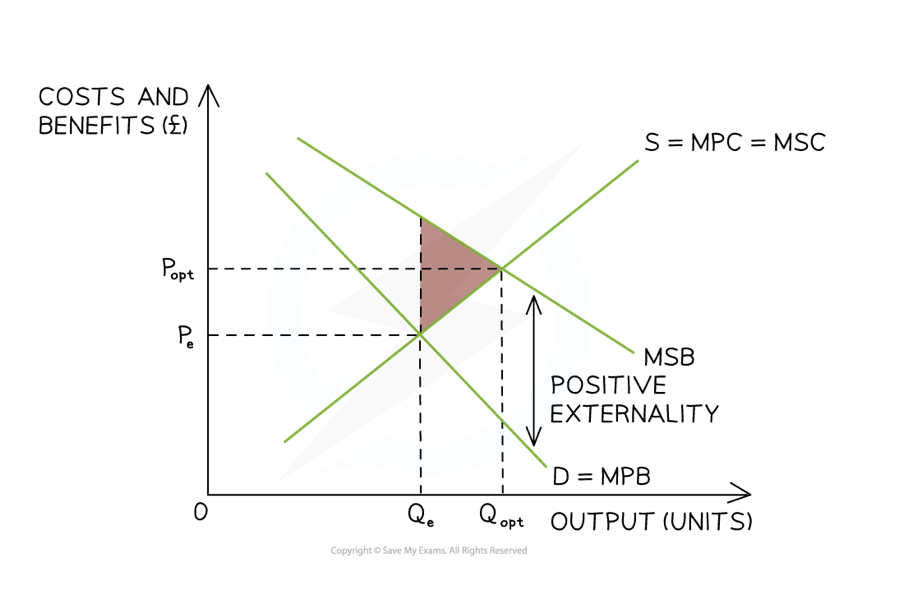
Diagram description for positive externalities of consumption
In the free market, scarce resources are allocated where:
MPC = MPB
Society would prefer allocation at:
MSC = MSB
this is the social optimum
There is:
under-consumption
under-production
a gap in quantity (Q)
This causes:
misallocation of resources
allocative inefficiency
welfare loss
Welfare loss due to positive externalities of consumption
Welfare loss occurs because:
benefits are greater than costs
extra units are not produced/consumed
society loses the extra benefits that could have been gained
Analysis - positive externalities of consumption
Consumers act in self-interest
They only consider private benefits
External/social benefits are ignored
Scarce resources are allocated at the private optimum instead of the social optimum.
Positive externalities of production definition
Positive externalities of production occur when production creates benefits for third parties.
ex:
Worker training (other firms can poach trained workers, those firms benefit without paying training costs themselves)
Research and development (R&D) (firms create new technologies, other firms are able to copy/use these technologies)
DIAGRAM - POSITIVE EXTERNALITIES OF PRODUCTION
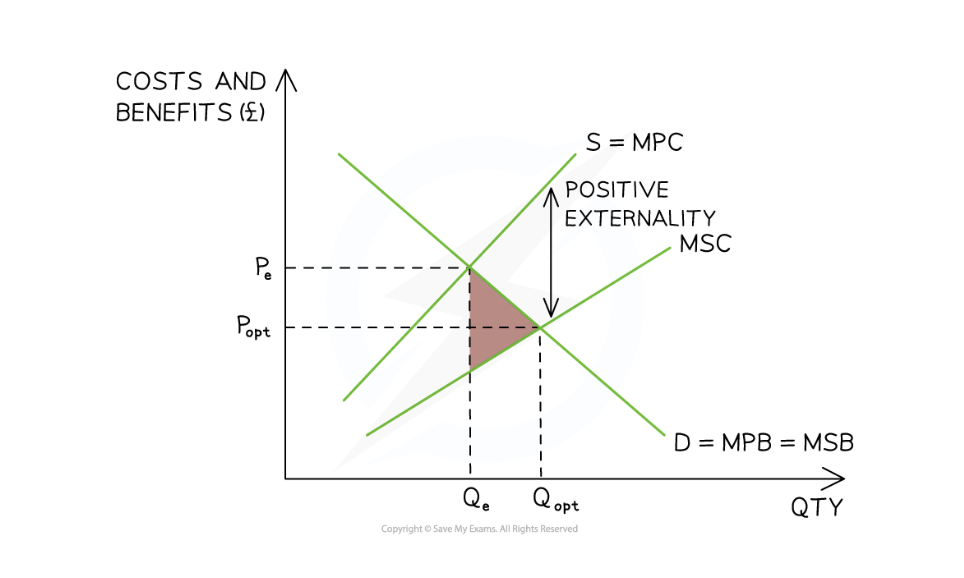
Diagram description for positive externalities of production
MSC < MPC
Social costs are lower because there are external benefits
SC = PC + EC
External costs are negative, reducing social costs
The market allocates scarce resources at the private optimum where:
MPC = MPB
Society would prefer allocation at:
MSC = MSB
this is the social optimum
There is:
under-production
misallocation of resources
welfare loss
The gap between Q1 → Q2:
could have been produced where benefits are greater than costs
society loses extra welfare/benefits
Analysis of positive externalities of production
Producers act in self-interest
They only consider private costs and private benefits
External benefits are ignored
Due to self-interest:
resources are allocated at the private optimum instead of the social optimum
leading to under-production
causing allocative inefficiency and welfare loss