Parasites in exotic species
 Call Kai
 Learn
Learn Practice Test
 Spaced Repetition
 Match
Match Flashcards
 Knowt Play
1/23

There's no tags or description
Looks like no tags are added yet.
Name | Mastery | Learn | Test | Matching | Spaced | Call with Kai |
|---|
No analytics yet
Send a link to your students to track their progress
24 Terms
What is Cheyletiella parasitovorax?
Non-burrowing mite
Rabbits
Life cycle 14-21 days
Waisted mite with hooked palms and combed tips to legs
Visible with the naked eye “Walking Dandruff”
Often carried sub-clinically
Zoonotic potential
Can infest other species
Clinical signs
• Dorsal scaling, crusting
• Variable pruritus
• Partial alopecia
What is Psoroptes cuniculi?
Non-burrowing mites
Rabbits
3 Week life cycle
Visible with naked eye
Oval shaped mites
Transmission via infected rabbits or fomites
One of the most common causes of rabbit dermatoses
Rabbits may develop immunity
Clinical signs
• Pruritic otitis externa
• Thick pinnal crusts and ulceration
• Neurological signs w/ otitis media/TM perforation
What are the types of fleas found in rabbits?
Spilopsyllus cuniculi
• Rabbit flea
• Most commonly seen on wild rabbits
• Important vector for myxomatosis
Ctenocephalides felis/canis
Cat/Dog flea more commonly found on pets
Clinical signs:
• Pruritus, poor coat
• May be clinically normal
Treatment of rabbit, in contacts and environment
What is Myiasis in Rabbits?
Fly strike- usually Lucilia app. (Greenbottles)
Summer months
Usually primary with underlying cause
Eggs can hatch within 12hrs to L1 (non pathogenic)
Within 3 days L1 → L2 and L3, cause tissue damage
Larval Cuterebra spp can cause
• subcutaneous infections
• aberrant intracranial migration → neurological signs
What are common nematodes in rabbits?
Passalurus ambiguus
Oxyurid worm ‘pinworm’
Found in caecum and large intestine More common in wild rabbit populations Usually non-pathogenic
Obeliscoides cuniculi
Stomach worm - occasionally found in wild rabbits
Not reported in pet rabbits in UK
Trichostrongylus retortaeformis
Intestinal worm- Europe and Australia- not USA
What causes coccidiosis in Rabbits?
Protozoan parasites
Intestinal coccidiosis:
Various including E.manga and E.irresidua
Clinical signs variable:
. Weight loss, abdominal distension, diarrhoea, anorexia, depression
Hepatic coccidiosis:
Eimeria steidae
Epithelial cells of bile ducts
Clinical signs:
.Weight loss, ascites, jaundice, diarrhoea, hepatomegaly
What is Encephalitozoon cuniculi?
Obligate intracellular protozoal parasite
Widespread in rabbit population
Zoonotic:
. Potentially life-threatening in immunocompromised humans
Infective spores shed in urine
Infection via ingestion of spores or vertical transmission
Parasite primarily attacks CNS, kidney and eye
What type of mites are commonly found in guinea pigs?
Trixicarus caviae
Sarcoptid mite
10-14 day life cycle
Asymptomatic carriers common
Lesions usually dorsal neck and thorax may become generalised
Clinical signs:
Intense pruritus
Self trauma
Seizures
Foetal resorption in pregnancy
Zoonotic potential
What lice are common in guinea pigs?
Gliricola porcelli and Gyropus ovalis
Common
Biting lice
Mild dermatitis
Heavy infestations can lead to alopecia and crusty lesions
Trimenopon hispidum
Rare biting louse hat W
What are common ectoparasites in myomorphs?
Fur mites in rats and mice
• Radfordia ensifera (rats), Myocoptes musculinus, Myobia musculi, Radfordia affinis (mice)
• Ulcerative, crusty lesions over head and shoulders
• Classic patterns of distribution for different mites
Notoedres muris – burrowing mite
• Pruritic, warty papular lesions on extremities
• Parasitic otitis in mice
• Diagnosis by skin biopsy or clinical response to tx
Demodex
• Immunosuppressed hamsters, concurrent disease eg cutaneous lymphoma
• Seizures
Fleas rare – usually from household contacts
What are common endoparasites in myomorphs?
Oxyurid Pinworms
• Syphacia obvelata
• Some other spp not associated with clinical disease but affect growth
• Diagnosis on tape strip microscopy S. obvelata or faecal flotation microscopy (banana shaped eggs)
• Heavy infections can lead to rectal prolapse
Cestodes (Rodentolepis nana & Hymenolepis diminuta)
• Rat is definitive host but can infect mice
• Disease only with heavy burdens
! Zoonotic potential
• Hymenolepis nana most significant endoparasite of hamsters (dwarf tapeworm)
Protozoa
• Pathogenic flagellates Giardia muris & Spironucleus muris
• Eimeria
What are common endoparasites in ferrets?
Endoparasites are rare in ferrets
Protozoa:
Coccidia- Isopora and Eimeria spp, generally subclinical except shelter and breeding groups, GI signs
Cryptosporidium spp- Raw feeding a risk factor, usually self limiting in healthy individuals, signs of gastroenteritis, zoonotic potential!
Giardia- uncommon
What are common mites in ferrets?
Sarcoptes scabei
• Direct contact with other animals
• Generalised alopecia and pruritus
• Localised lesions of toes and feet
! Zoonotic potential
Otodectes cyanotis
• Ear mite (as per cats and dogs)
• Can be asymptomatic
• Severe crusting and pruritus → secondary bacterial otitis
Lynxacarus mustelae (rare)
• Fur mite
• Ulcerative facial lesions in kits, immunosuppressed individuals
Demodex spp (rare)
• Secondary?
What are common fleas and ticks in ferrets?
Fleas
• Ctenocephalides felis, C. canis, Pulex irritans
• Mild to intense pruritus – usually around neck
• Flea bite hypersensitivity reported
Ticks
• Ixodes ricinus
• Common in hunting and stray ferrets
• Rare in pet ferrets
• Lyme disease not reported
• Can lead to anaemia in heavy burdens
What are the most common types of ectoparasites in reptiles?
Mites
What is Ophionyssis natricis?
Affects all reptilian taxa
Red, brown, black or grey mites
7-16 day life cycle
May be observes on the reptile or in the environment
Can occasionally affect humans
Clinical signs:
. Behaviour changes
. Dysecdysis
. Dehydration
. Anaemia
How common is coccidia in reptiles?
Common
Agamids, Chameleons, Geckos are most represented
Eimeria, Isospora, Sarcocystis, Caryospora spp
Direct life cycle- poor hygiene/overcrowding implicated
Clinical signs (usually GI):
. Often sub-clinical
. Enteritis, anorexia, lethargy, weight loss, prolapse, death
What are common cryptosporidium for reptiles?
Common cause of gastrointestinal disease
C. serpentes, C. saurophilum
Faeco-oral transmission
Treatment not effective
Clinical Signs:
• Sporadic regurgitation of typically mucus covered prey (snakes)
• Gastric mass may be palpable
• Diarrhoea (lizards) with mucosal thickening of intestine
• Weight loss, debilitation, death
What are common flagellates in reptiles?
Common finding
Trichomonads, Giardia, Hexamita spp
Intestinal disease
High numbers associated with anorexia, weight loss and diarrhoea
Desiccate and die quickly
What is Entamoeba invades?
Protozoa
Commensal in herbivorous reptiles
Invade intestinal mucosa and cause disease in carnivorous reptile (snakes)
Mixed collection is a major risk factor
Direct lifecycle- transmission through direct contact with cyst form
Clinical signs:
Anorexia, Weight loss, regurgitation, constipation, diarrhoea, neurological signs, death
What are common nematodes in reptiles?
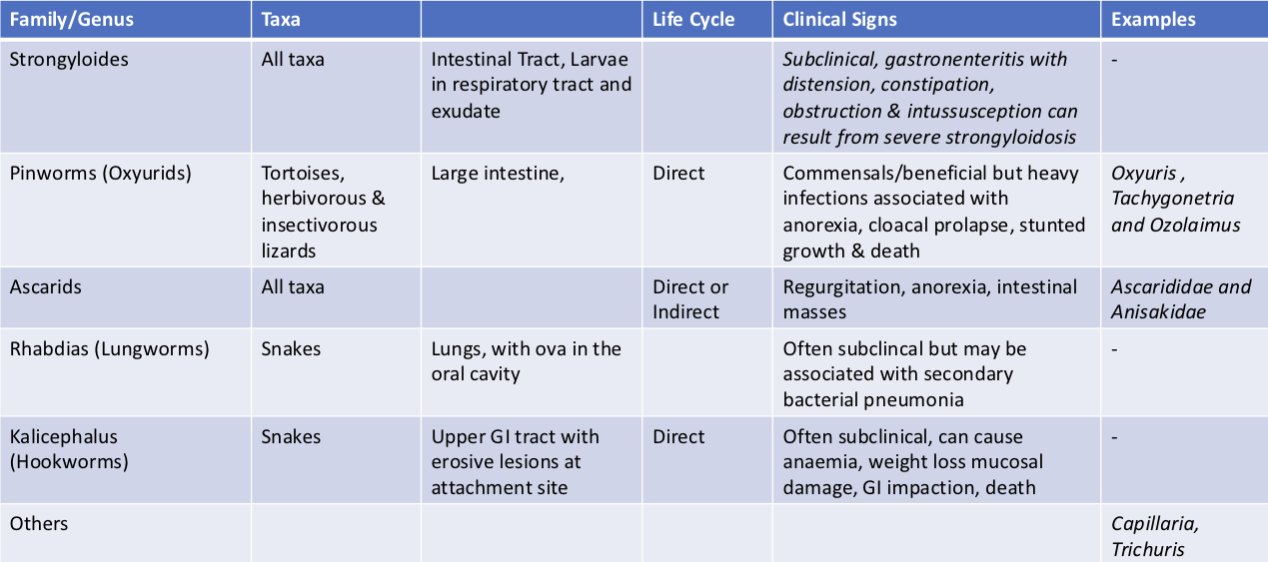
How are cestodes found in reptiles?
Found in all orders of reptiles
May be definitive, paratenic or intermediate host
Many spp non pathogenic
May see proglottids around cloaca
Ova in faeces
How are trematodes found in reptiles?
Wild caught reptiles esp aquatic
Most require aquatic molluscs, fish or amphibians as intermediate hosts
Rare in captive reptiles
Generally non pathogenic
Spirorchiids pathogenic in turtles
• Live in heart and blood vessels
• Can cause ischaemia, necrosis and organ failure
What are common parasites in wildlife?
Species specific examples
• Lungworm complex in Hedgehogs
• Acariasis/Ticks in Hedgehogs
• Trichomoniasis in Columbiformes and Raptors
• Sarcoptic mange in Foxes
• Hippoboscids in wild birds
Generally an indication of debilitation and chronic injury or disease
Don’t just treat the parasites
Consider spread between wild and domestic animals
Challenges of treatment (duration, FPA, administration, license)