ANS 124: Pathways, Oxytocin, Secretion
 Call Kai
 Learn
Learn Practice Test
 Spaced Repetition
 Match
Match Flashcards
 Knowt Play
1/124

There's no tags or description
Looks like no tags are added yet.
Name | Mastery | Learn | Test | Matching | Spaced | Call with Kai |
|---|
No analytics yet
Send a link to your students to track their progress
125 Terms
What is Hydrostatic Pressure?
pressure of fluid
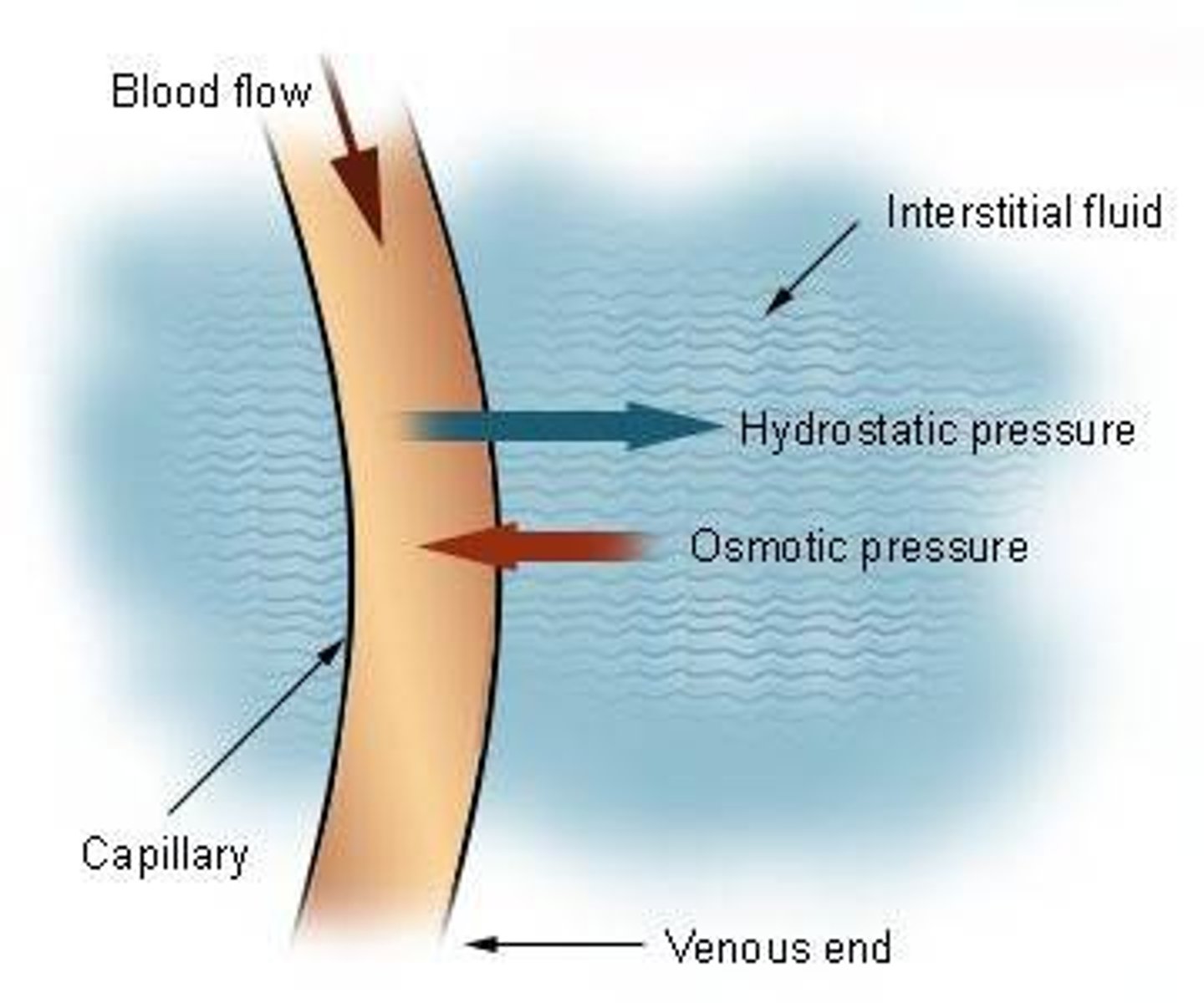
What is Osmotic Pressure?
More salt, more water wants to more there → defined as Osmotic Pressure.
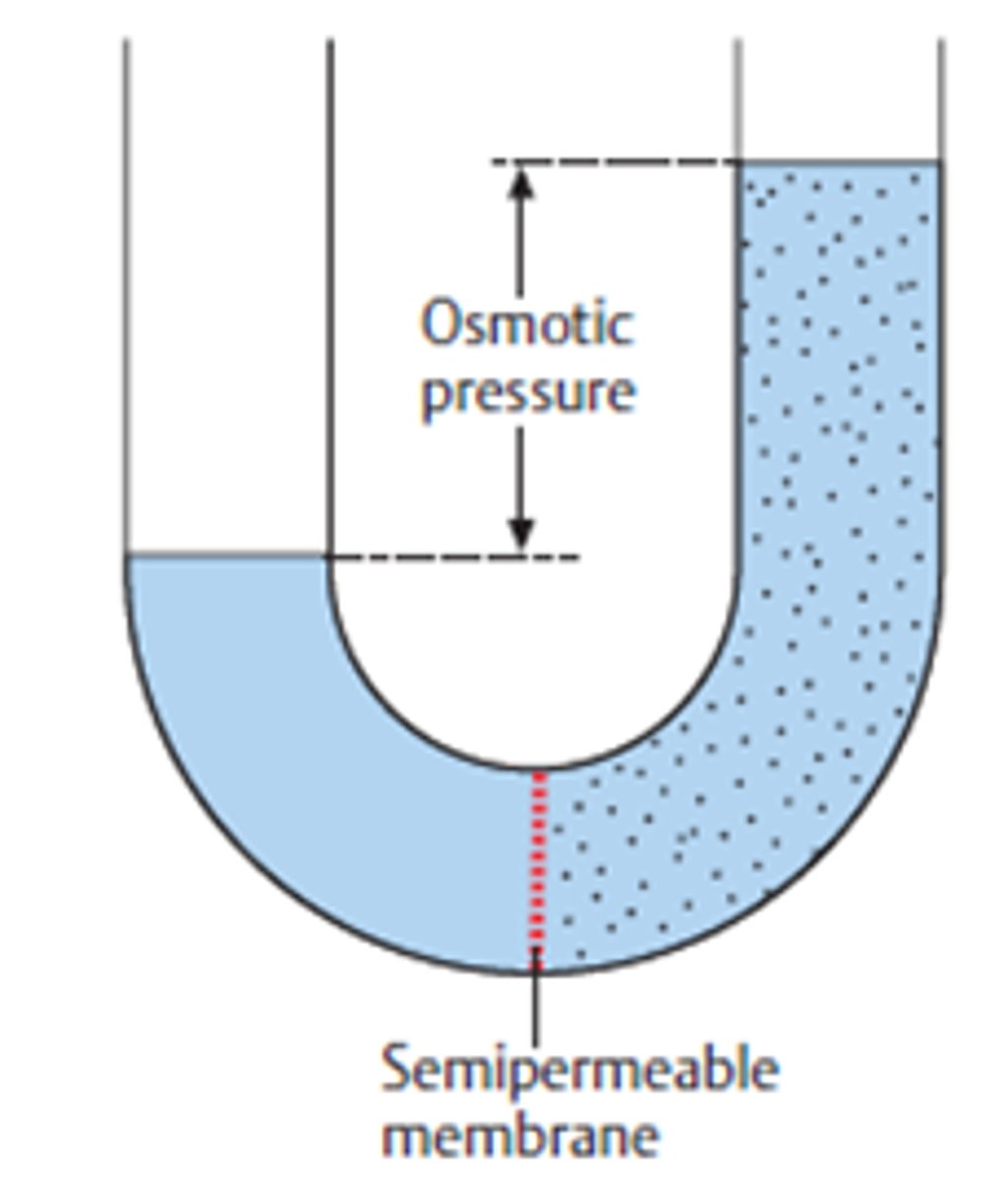
Osmotic Pressure involves what gradient?
the Osmotic Gradient
(water goes from low solute concentration to high solute concentration)
Describe the Hydrostatic Pressures of the alveoli Arterial System.
35 mm Hydrostatic Pressure push out from blood to ECS.
5 mm Hydrostatic Pressure push back from ECS to blood.
Describe the Osmotic Pressures of the alveoli Arterial System.
28 mm Osmotic Pressure push from ECS to blood.
8 mm Osmotic Pressure push from blood to ECS.
What is the net filtration pressure of the alveoli Arterial System?
Net Filtration Pressure = 10 mmHg (push from blood to ECS)
Describe the Hydrostatic Pressures of the alveoli Venous System.
16 mm Hydrostatic Pressure push from blood to ECS.
5 mm Hydrostatic Pressure push from ECS to blood.
Why is the Hydrostatic Pressure pushing from blood to ECS smaller in the venous system (16mm) compared to the arterial system (35mm)?
The arteries have arterial blood pressure from the heart, and also muscular walls. The veins are floppy, elastic, with no muscular walls, so there is less pressure inside.
Describe the Osmotic Pressures of the alveoli Venous System.
28 mm Osmotic Pressure push from ECS to blood.
8 mm Osmotic Pressure push from blood to ECS.
What is the net absorbing pressure of the alveoli Venous System?
Net Absorbing Pressure = 9 mmHg (push from ECS to blood)
What is the OVERALL net pressure of the alveoli?
Net Pressure = 1 mmHg (push from blood to ECS)
Where is the positive net pressure of 1 mmHg located?
in the extracellular space around the alveoli and the capillaries/lymph ducts.
Why do you want to have a little bit of positive pressure in the ECS?
To help push nutrients and fluid to epithelial cells for milk synthesis.
What happens to milk synthesis if there was negative net pressure?
It would be hard to make milk since there is no little force that pushes towards the epithelial cells.
What is an example of a condition where the osmotic gradient is a little messed up in the mammary gland?
Edema
Edema is excessive _________ accumulation.
lymph
In edema, when does excessive lymph accumulation happen?
accumulates before birth
In cows with edema, why is there excessive lymph accumulation before birth?
Close to calving, all capillaries are pushing blood actively because heart rate increases. There is a lot of fluid movement into the udder and the capillaries start to leak. The extra fluid turns the ECS +1 mmHg pressure into +3-5 mmHg pressure. The excess fluid that accumulates is edema.
In cows with edema, what happens to the pressure over time?
Over time, the pressure normalizes and drops in the ECS, so the fluid can escape.
How does high salt intake lead to Edema?
It changes the osmotic potential within the ECS and makes fluid want to stay in ECS.
In Lymphedema, does the pressure of the ECS change (like in edema)?
No, the +1 mmHg doesn't change. The accumulation of fluid is due to the fluid not being able to drain away due to previous removal of the nearby lymph node.
When a cow's teat is stimulated, that stimulates what type of reflex?
a neural reflex
In the neural reflex after a cow's teat is stimulated, describe where the signal travels and what that triggers.
Signal travels fast to ganglia of spine and then the brain to trigger release Oxytocin into the blood at the posterior pituitary.
Oxytocin has how many amino acids?
9 AA protein (small)
Insulin has how many amino acids?
50 AA
What is the half-life of Oxytocin in the body? Is it slow or fast?
Half-life of 2-3 minutes, which is a very short half-life in the body.
Why does Oxytocin have a very short half-life?
Smaller molecules (like Oxytocin) tend to breakdown quicker.
Blood circulates through the body about ___ times per minute.
8 times per minute
Since blood circulates through the body 8 times per minute, how does that affect the way Oxytocin acts on the udder?
When OT is released into circulation, it goes to the udder and passes out of the udder. It might go around the body and come back, but at a lower concentration the next time.
If there are 8 circulations per minute, there will be waves of pulsation in alveoli as it is stimulated by the OT traveling around.
Oxytocin has a role in what type of behavior in moms?
maternal behavior
Oxytocin is also referred to as the ________ hormone.
trust hormone
Why is OT referred to as the trust hormone?
Because OT helps moms relax, which helps with better milk production.
There is lots of research in the role of OT in how it changes the way the brain responds to what type of situations?
stressful/threatening situations
Describe the setup of a study done researching how OT changes the way the brain responds to stressful/threatening situations.
Researchers did an MRI on people and showed them scary pictures. Some of them got OT when they were shown the pictures.
For the people in the study that were administered OT, explain their MRI compared to the placebo group when they were shown the pictures.
People that were administered OT didn't have the degree of brain excitement/activity that those with placebo had.
For modern dairy animals with large udders, what is one downside (related to OT) that we've selected for?
we've probably selected animals to be a little less responsive to OT than wild predecessors
For modern dairy animals with large udders, does OT release still depend on tactile stimulation? What is different?
Still depends on tactile stimulation, but the amount of OT that the posterior pituitary releases varies.
What is the main tactile stimulation that induces OT release?
Milking
Up to ___% of cows and goats don't increase blood OT levels at milking.
40%
What are 3 other tactile stimulation that induces OT release in dairy animals?
Udder Prep (stripping the teat)
Nuzzling
Sucking Stimulus
With tactile stimulation, the stimuli travels via what nerves?
Afferent Nerves
With tactile stimulation, the stimuli travels via afferent nerves to input to where?
input to the dorsal root ganglia in the spinal cord
Besides tactile stimulation, what is another type of stimulation that can activate release of OT?
Environmental Stimulation
What are 4 examples of Environmental Stimulation that induce OT release?
Presence of a calf
Someone else's baby
Music
Emotions
For environmental stimulation, these can develop as ________________ responses.
conditioned responses
Describe an example of a conditioned response to an environmental stimulation of OT release for dairy cows.
Cows that know they will be milked twice a day will have a conditioned response when they know it's time. Oftentimes they will initiate OT release and you will see milk letdown (accumulation of a little milk droplet at the teat) at the parlor before being milked.
What is Incontinentia lactis?
premilking leakage of milk
What is the downside to Incontinentia lactis?
it is associated with an increased incidence of mastitis
Describe how Incontinentia lactis is associated with an increased incidence of mastitis in dairy cows.
When cows are waiting to be milked and they have a little milk droplet accumulate at the teat, their streak canal is relaxed a little. If a fly lands on the milk drop and goes to another teat (on either same cow or different cow), it can increase the spread/risk of mastitis.
How can we try to prevent mastitis caused by Incontinentia lactis? (3)
Prevent by trying to not have cows wait too long before getting milked, keeping the udders clean, or even singeing the hair on the udder to keep it as clean as possible.
What is one main thing that can impair milk letdown in both cows and humans?
Stress
What are 2 reasons for why stress impairs milk let down?
Could be due to hormonal changes (ex. cows in heat will not let their milk down very well) or reduced blood flow to the capillaries during stress (so less OT).
Why do we not want stress impairing milk let down on dairy farms? (what is the consequence of retaining milk?)
If milk is retained in the udder, there is a decreased rate of milk synthesis and the cows won't make as much milk overall.
In one study on dairy cows, it was found that ___% of milk was ejected in unfamiliar surroundings.
9%
In one study on dairy cows, it was found that ___% of milk was ejected in familiar surroundings.
79%
Where is Oxytocin released?
Posterior Pituitary
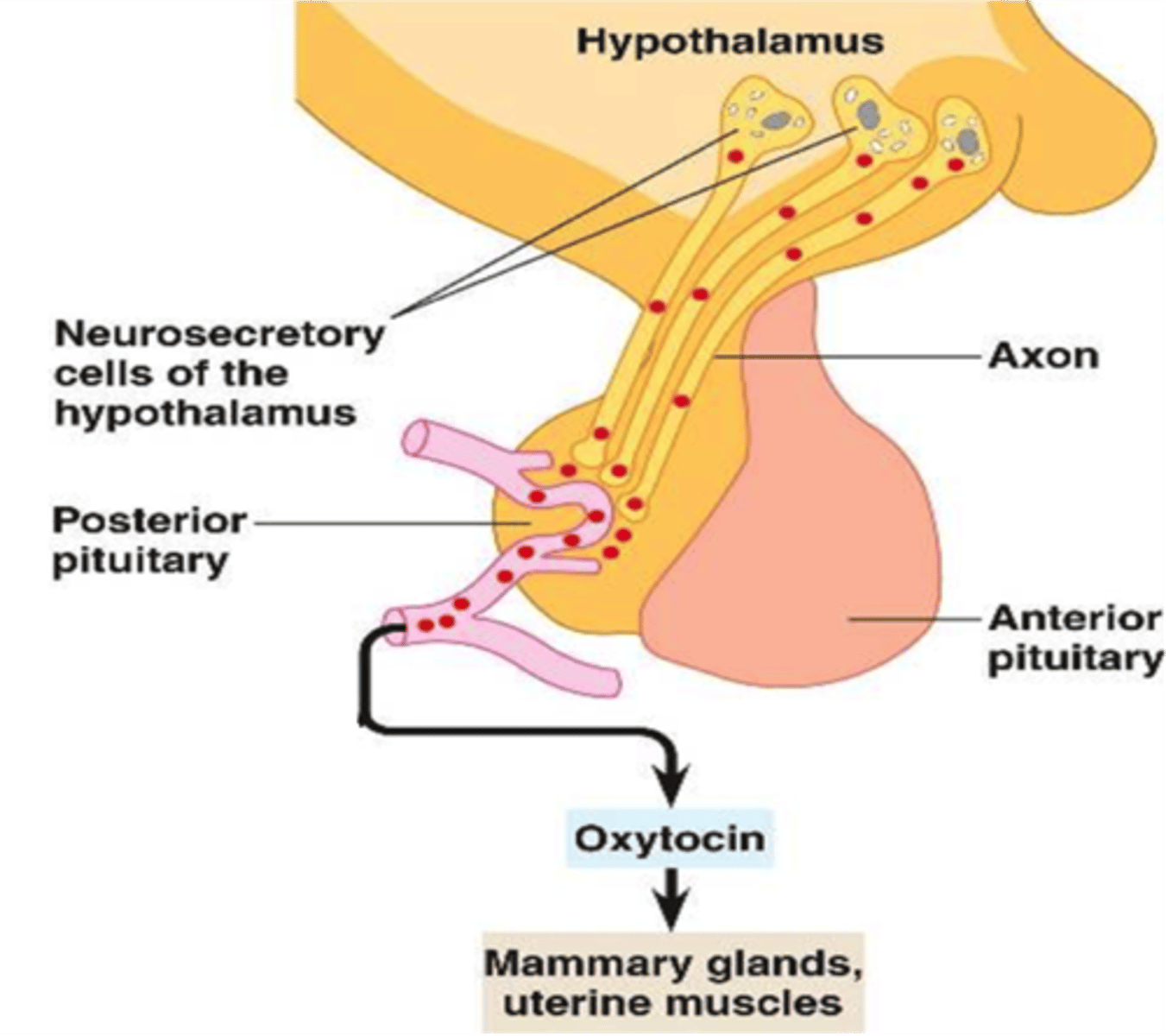
The release of OT is sensitive to the _____________.
environment
What in the body is one of the key coordinators of all signals in the environment?
Hypothalamus
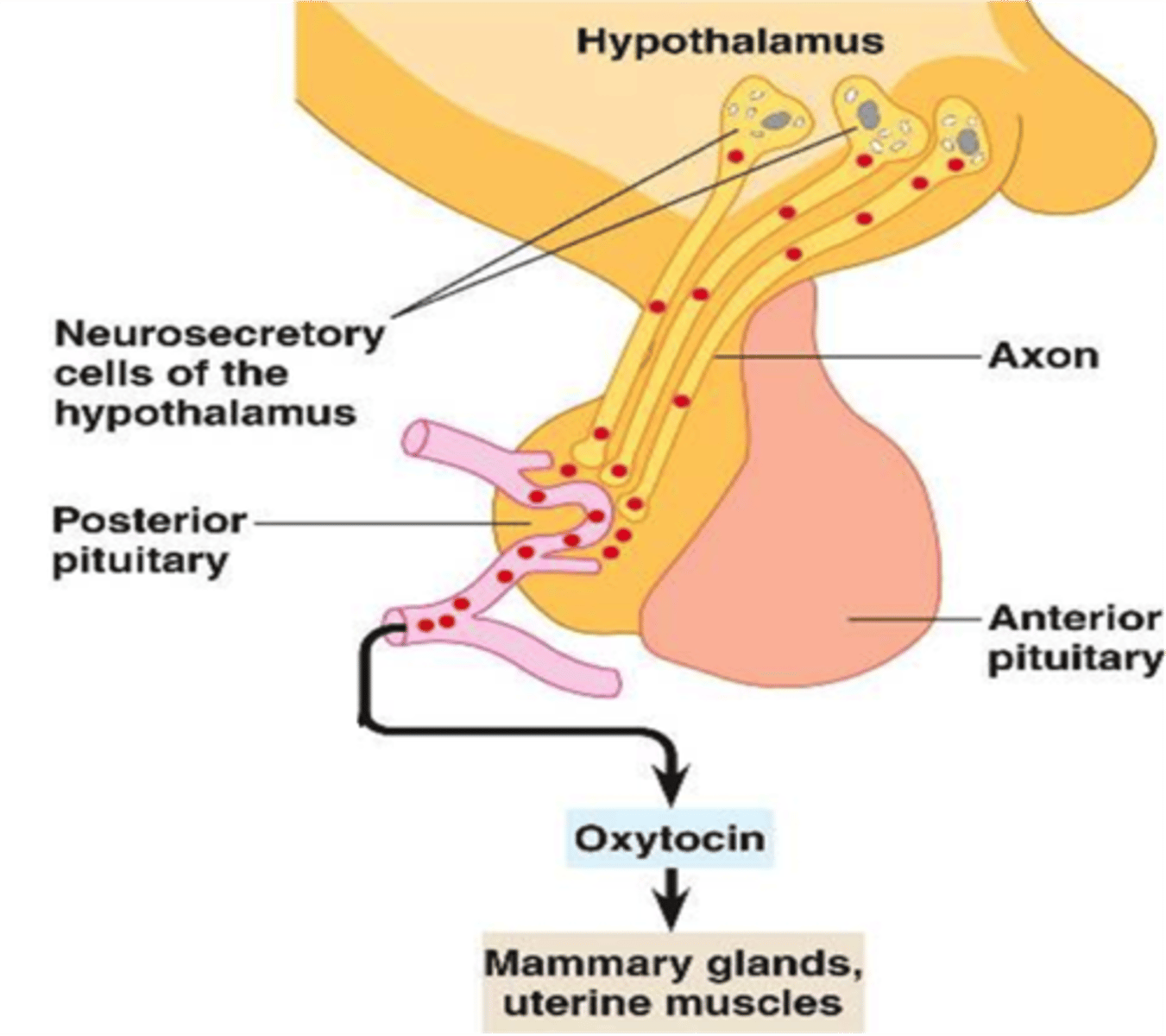
Where is Oxytocin produced? (where in the brain, in what neurons, in what cells?)
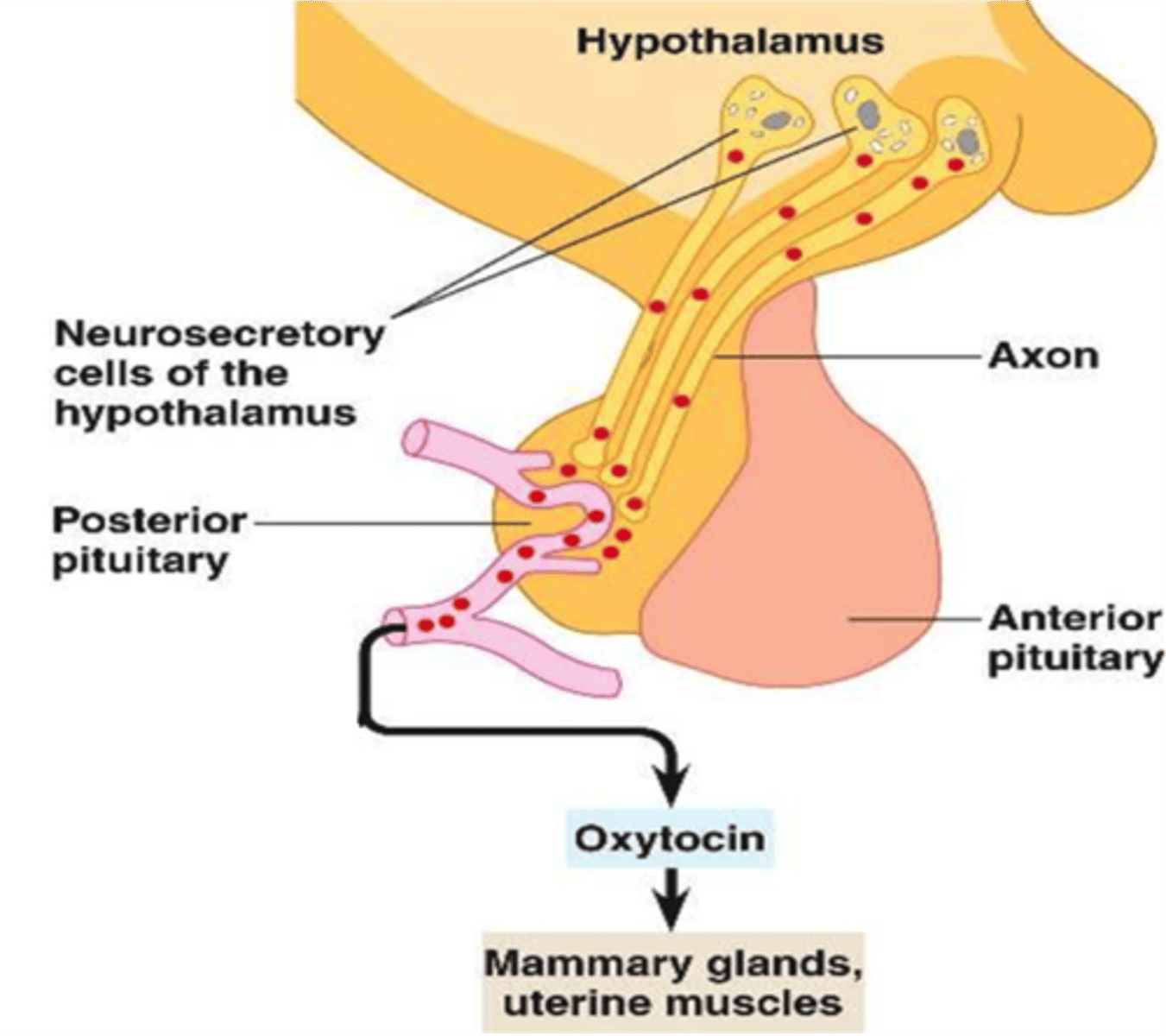
Produced in the hypothalamic magnocellular neurons. Specifically, in the neurosecretory cells of these magnocellular neurons.
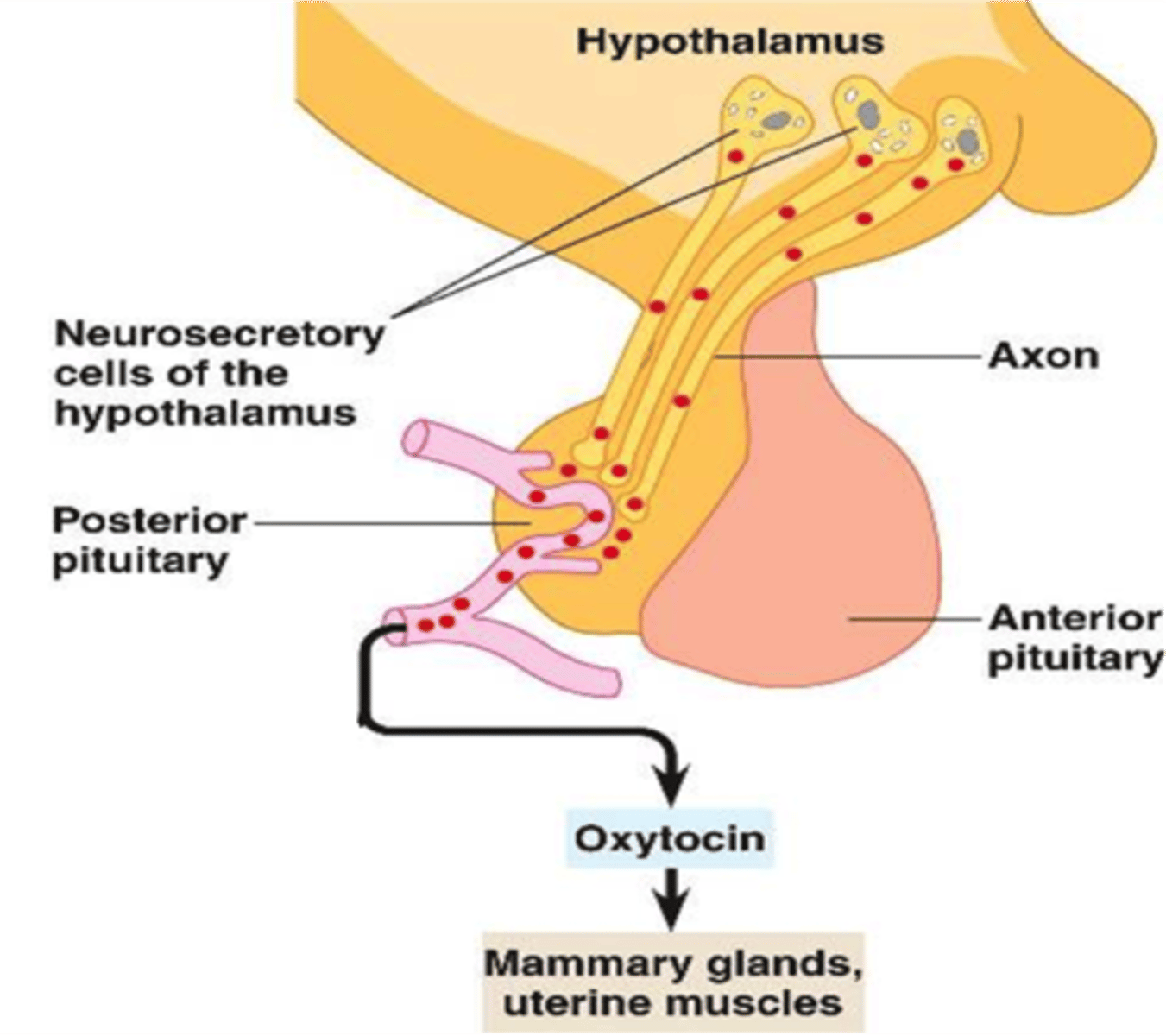
In the neurosecretory cells, Oxytocin is "packaged" with what carrier protein?
neurophysin
Oxytocin, once produced, is stored where?
in the terminals of the neurosecretory cells passing from the hypothalamus to the posterior pituitary
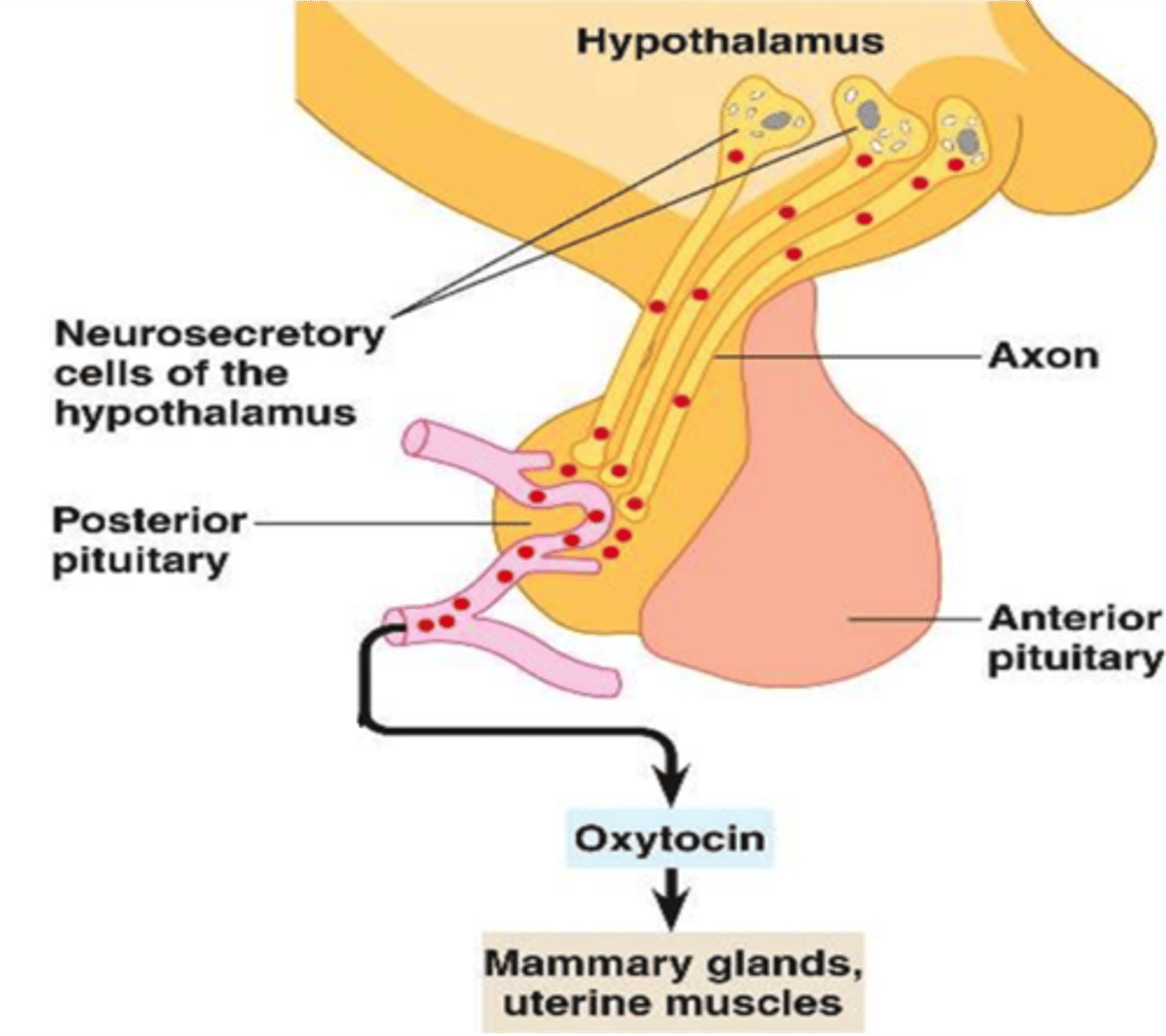
What leads to the release of Oxytocin into the blood at the posterior pituitary? (general)
Neural stimulation
Describe the structure of how myoepithelial cells surround alveoli.
Myoepithelial cells surround alveoli in a crisscrossed fashion.
Describe the structure of how myoepithelial cells surround the epithelial ducts.
Myoepithelial cells around the ducts are longitudinally arranged.
How does myoepithelial cells being longitudinally arranged around the ducts help with expelling milk?
When OT acts on the ducts, the ducts shorten in length a little to help move milk down through the tubes.
How can "residual milk" left behind in the alveoli influence productivity of a dairy cow?
because "residual milk" will send signal to the cells to stop making more milk.
How can using OT to milk out the udder benefit milk production long-term?
It continues to stimulate even more milk production day in and day out. Cows that "milk out" very effectively and leave little residual milk in the udder have a greater production.
Describe how much "residual milk" there is in young vs. older cows.
Older cows have more residual milk than young cows.
Myoepithelial cells in the mammary gland have a specific form of _____ in their cytoskeleton.
actin
Is the actin in skeletal muscle cells and the actin in myoepithelial cells the same?
They are different forms of actin.
Describe the difference between mice pups that have moms with MG actin KO and pups from normal moms.
Pups from moms with actin KO had nothing in their belly, were starving, and didn't grow much.
Pups from normal moms had milk patches (full bellies).
How does continued use of OT affect a cow's lactation yield? Why?
It increases a cow's lactation yield because the cow can make more milk when it squeezes out the hind milk each time.
What is the optimal time after dairy cow teat stimulation before putting milking machines on?
around 90 seconds after stimulation, there is peak milk letdown
(timing OT release, milk letdown and putting the machine on at just the right time together)
What happens if you put the milking machines on too early or too late?
The milk flow will be minimal/none if you put the milking machine on immediately after stimulation or too late after stimulation.
There was a period of time in the US where OT wasn't available at all, why was that?
because farmers were using OT to inject all their cows with OT during milking to get the hind milk out.
What did the FDA do when they realized the OT was all gone because farmers were injecting their cows with it?
they put a stop to it
Currently, is OT allowed by the FDA to be used in dairy cows?
It is regulated/controlled. The FDA does not allow a regular practice of injecting OT to dairy cows. The use of OT has to be under the guidance of a vet.
Describe udder pressure from hour 0 to hour 40 since last milking.
Udder pressure low at first since they just got milked, and then increases as milk starts to accumulate. The pressure reaches a peak and then plateaus when it can't fill anymore.
When the udder pressure reaches a plateau, describe what the Tight Junctions are like there.
Tight Junctions are leaking during that time.
Tight Junctions start to leak ____ hours since last milking.
20 hours
Describe the secretion rate (milk synthesis) from hour 0 to hour 40 since last milking.
Cells make the most milk right after milking, since the gland is empty. Milk synthesis rate slows down after a bit and drops gradually to zero as the udder is full and the cells can't make any more milk.
In a graph plotting udder pressure and secretion rate based off of hours since last milking, what does the intersection of udder pressure and secretion rate represent? At what hour is it at?
It represents the maximum period we should let milk accumulate in the udder. If we want maximum milk production, we should not let the cow go longer than 16 hours without being milked.
Standard practice on dairy farms is to milk cows ___ times a day.
2 times a day
Why is it that some dairy farms have started shifting to milking their cows 3 times a day?
As we select for animals for more milk production, the curve/intersection has shifted. The udder pressure increases faster, so that the maximum time we should let milk accumulate changes from 16 hours to 10 hours and the frequency of milking becomes 3x a day every 8 hours.
In a study looking at how different frequencies in milking leads to increased Tight Junction leakiness, describe the setup.
Take blood samples of cows and measure lactose in the blood to see how leaky tight junctions are if you milk a cow either once a day or twice a day.
Describe what happened to lactose levels in the blood samples of cows milked twice a day. What does that indicate about the tight junctions?
Low lactose in blood, tight junctions are sealed.
Describe what happened to lactose levels in the blood samples of cows milked once a day. What does that indicate about the tight junctions?
High lactose in blood, tight junctions are leaky.
What did the study looking at how different frequencies in milking leads to increased Tight Junction leakiness conclude?
That Tight Junctions are flexible, they can leak and reseal. Internal alveoli pressure influences leakiness of TJ and presence of lactose in blood.
What are 5 things that likely control a slowing in milk synthesis as milk accumulates?
TJ Leakage
Cell Stretch
Reduced Capillary Blood Flow/Permeability
Unknown/Known Components in Milk
Hormonal Environment
How could TJ leakage and cell stretch control a slowing in milk synthesis as milk accumulates?
TJ leaky or stretched cells lose connections with their neighboring cells, which indicates too much pressure, so they slow down milk production.
How could Reduced Capillary Blood Flow/Permeability control a slowing in milk synthesis as milk accumulates?
Less nutrients are delivered to make milk.
How could Unknown/Known Components in Milk control a slowing in milk synthesis as milk accumulates?
Perhaps there is something in the milk, that as the alveolus fills, it creates a feedback mechanism to the cells to slow down milk production?
How do components of milk get into milk? (general)
by being secreted from epithelial cells in different secretion pathways
How many pathways do epithelial cells use to export things into the milk?
5 pathways
Transepithelial transfer of various molecules into the alveolar lumen is either through what 2 categories of transport?
Transcellular
Paracellular
Transcellular
goes through epithelial cell
Paracellular
goes between the epithelial cells
Normal milk secretion occurs via which route? Transcellular or Paracellular?
Transcellular
Secretion from epithelial cells is either what 2 ways?
Apocrine Secretion
Merocrine Secretion
What happens in Apocrine Secretion? Give an example of a molecule that uses this form of secretion.
it spits out products as well as a little bit of apical membrane (ex. fat droplets)