Day 3: Neural Circuits in Hypothalamic Control of Feeding
 Call Kai
 Learn
Learn Practice Test
 Spaced Repetition
 Match
Match Flashcards
 Knowt Play
1/14

There's no tags or description
Looks like no tags are added yet.
Name | Mastery | Learn | Test | Matching | Spaced | Call with Kai |
|---|
No analytics yet
Send a link to your students to track their progress
15 Terms
What is in the diencephalon
Hypothalamus and pituitary are in the diencephalon
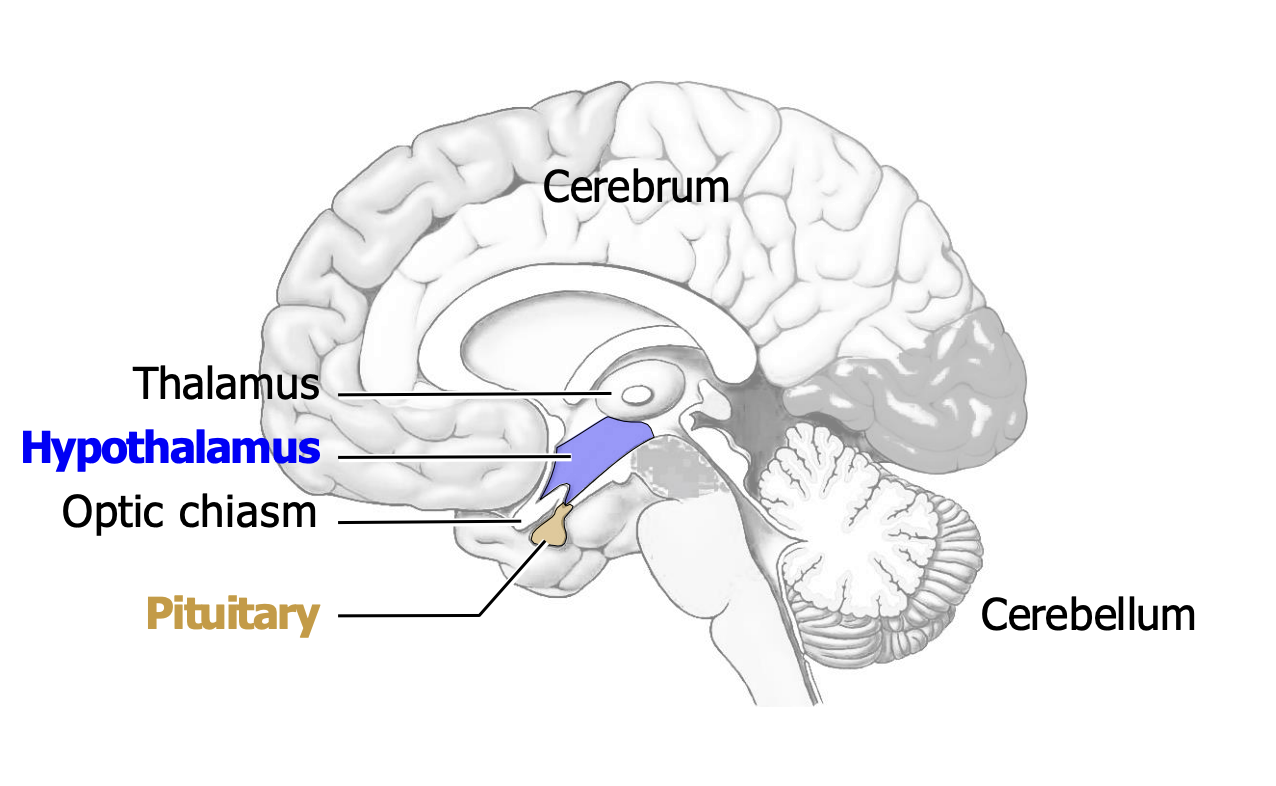
The hypothalamus contains control centers for many biological systems
what does it help control
What type of feedback involved
What do some of them maintain
It is crucial to the control of feeding, plasma osmolality, body temperature, and sexual and stress responses.
That control always involves negative feedback, i.e. processing chemical and neural signals from the body to monitor how well things are working and to detect disturbances.
Some control systems maintain homeostasis — keeping some aspect of the internal environment (e.g. osmolality) roughly constant despite disturbances. Other control systems vary things through time, e.g. in circadian rhythms.
The hypothalamus exerts its influence neurally and hormonally
what does the nuclei do
Hormones, where does the hormone from the hypothalamus go to?
two different locations
For one of them, what is the system called
Anterior pituitary
what three neurons involved
goes to what? (vessel or tract?) - what is it called
explain the capillaries involved or viens (and name them)
Posterior pituitary
Explain the two nucleus involved
Goes to what (vessel or tract?) - what is it called
Explain the capillaries involved or veins?
Name of the neuron
What does the neuron have and why is it important?
Nuclei within the hypothalamus send neural signals to each other and to other parts of the brain.
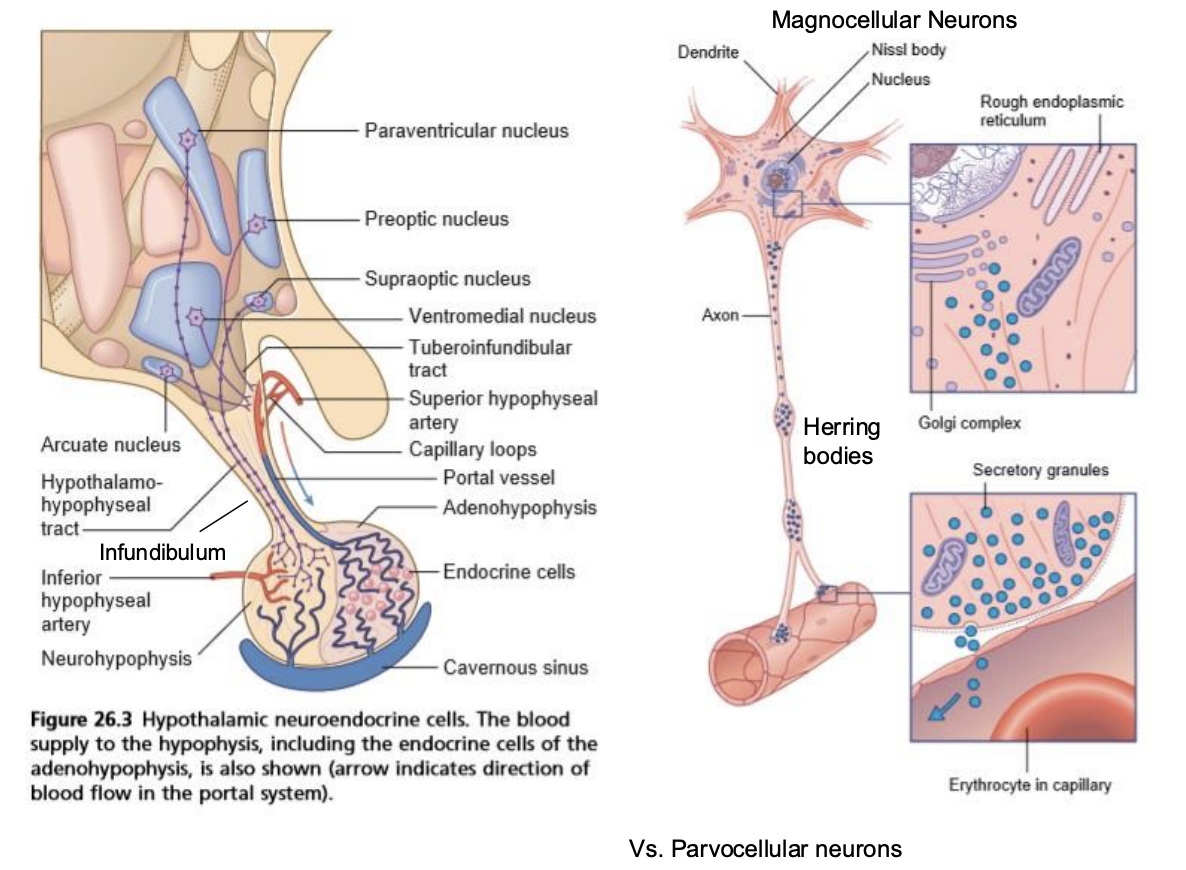
The hypothalamus also synthesizes hormones which it transports down axons to the posterior lobe of the pituitary, where they are released into the blood.
And the hypothalamus makes releasing hormones that travel through capillaries (the hypophyseal portal system) to the anterior pituitary, where they trigger the release into the blood of other hormones, made in the pituitary.
Anterior pituitary
Regulated by the parvocellular neurosensory neurons
Includes the ventromedial nucleus, preoptic nucleus and the arcuate nucleus
Axons from the nucleus goes to the median eminence to the primary capillary plexus
The capillary is supplied by the superior hypophyseal artery
The blood is drained into the portal vein
Goes into the secondary capillary plexus in the anterior pituitary
Posterior pituitary
Direct neural extension of the hypothalamus
Involves the paraventricular nucleus and the supraoptic nucleus
These nucleus have axons passing through the infundibulum forming the hypothalamohypophyseal tract
Axons end at the inferior hypophyseal artery in the posterior pituitary
Magnocellular neurons
Have herring bodies - buldges that store the hormone material
Therefore when AP is trigger will cause the rapid release of hypothalamus hormones directly into the blood stream
Feeding is tightly controlled
Two types of lesions
Two different locations
What occurs when the lesion occurs
What nucleus involved for both
What type of cell affect for each case
Mice fed solutions with different concentrations of nutrients adjust their eating to keep their caloric intake consistent, e.g. if the nutrient concentration is halved, they eat twice as much.
The hypothalamus is crucial to this control, e.g. mice with lesions in the ventromedial hypothalamus overeat and become obese; those with lesions in the lateral hypothalamus get thin.
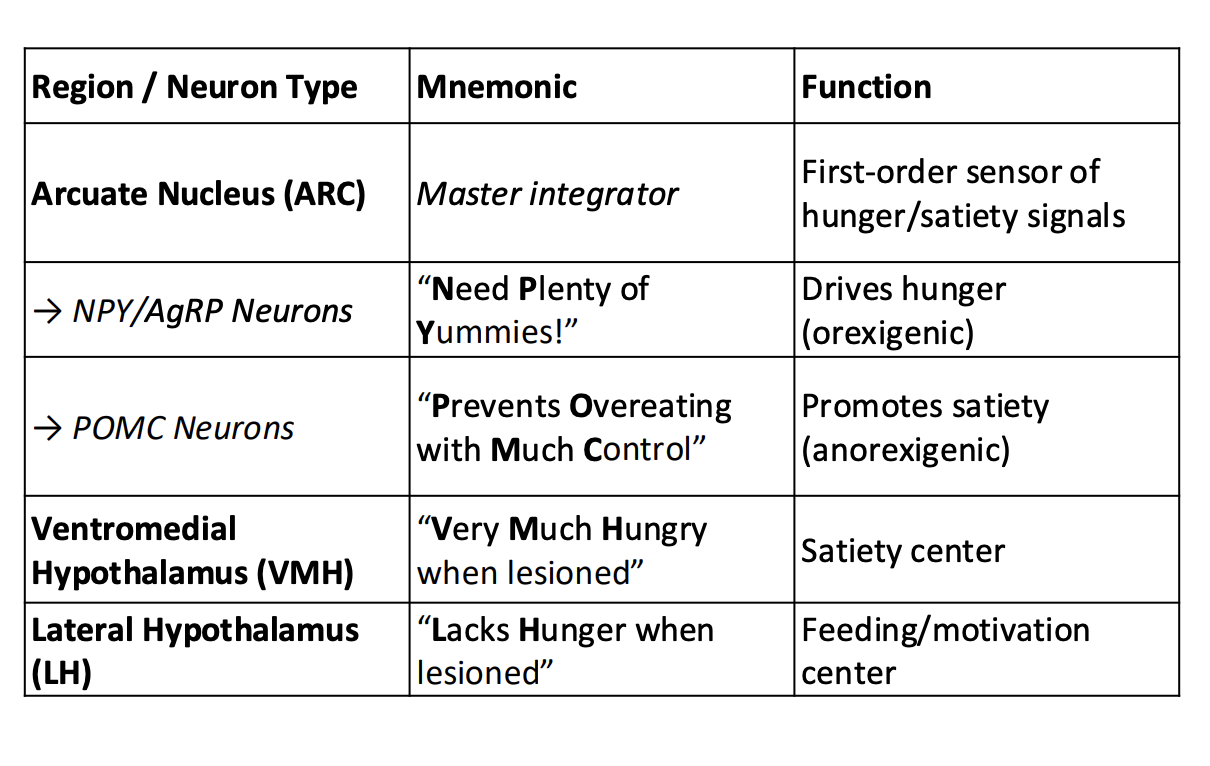
These areas are in turn controlled by two groups of neurons in the arcuate nucleus of the hypothalamus: arcuate NPY cells drive feeding, while arcuate POMC neurons inhibit feeding.
Chirag’s Study Pneumonics
arcuate nucleus
NPY/AgRP neurons
POMC neurons
Ventromedial hypothalamus (VMH)
Lateral hypothalamus (LH)
DMH
PVN
DMH: drives me hungry
PVN: past tense very not hungry
What occurs in the fasting state
overall what occurs
DRAW A DIAGRAM INSTEAD (so you don’t need to memorize) and then explain everything on that diagram
what neurons activated
what do they do?
What three things are released by the neurons
What does the neurons and their hormones do in the hypothalamus?
two hypothalamus affect
What nucleus in the hypothalamus would be inhibited - what type of center is this
What nucleus in the hypothalamus would be excited - what type of center is this
What happens after each hypothalamus section?
The section when it decreases activities affects what else (what system of the PNS)
How does this affect feeding?
The section where it increases activity what does the hypothalamus secrete what hormone
What two things does it affect
overall increases feeding
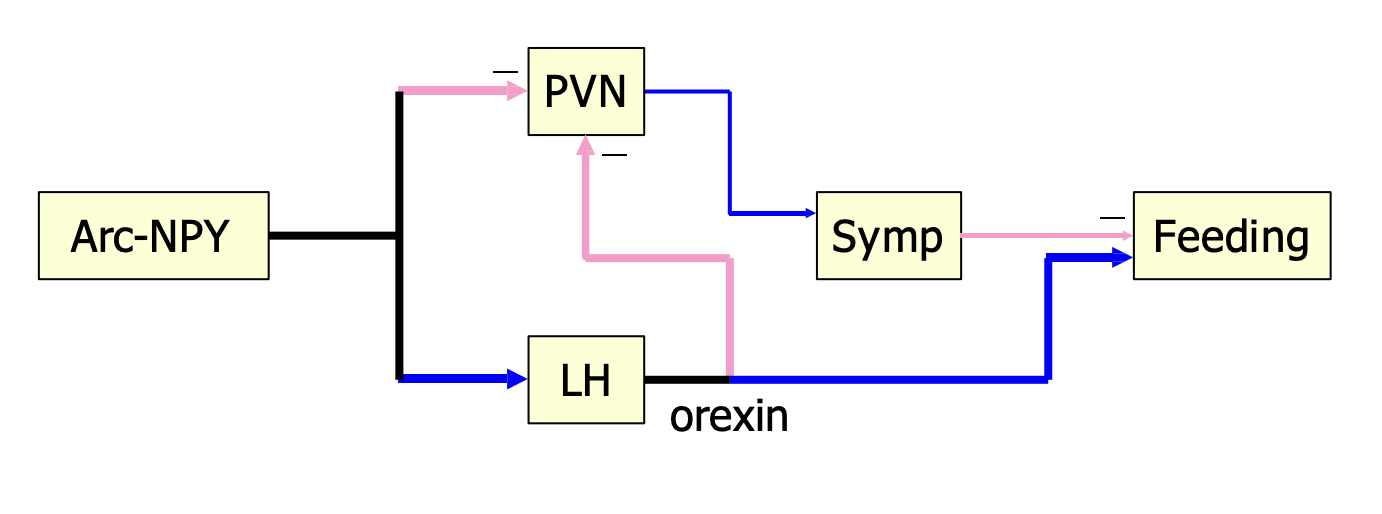
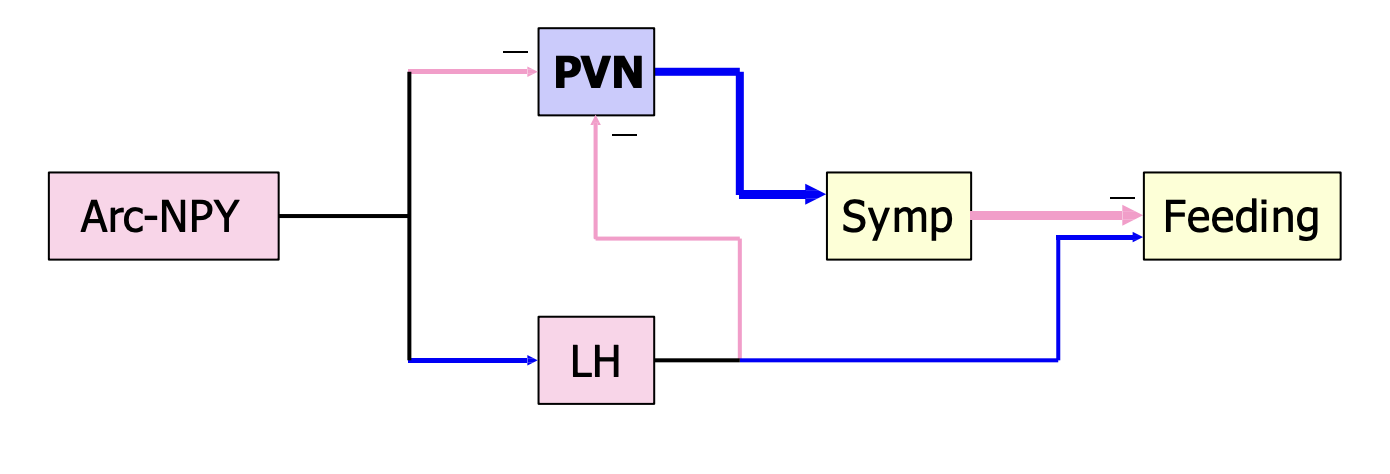
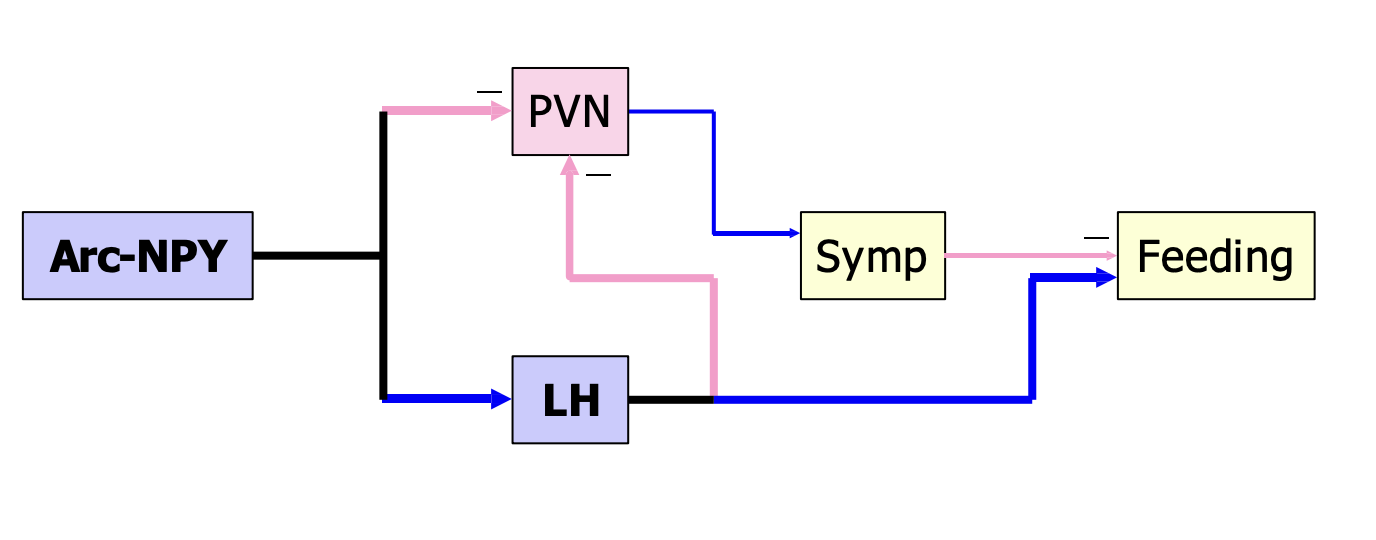
These are neurons in the arcuate nucleus of the hypothalamus which release neuropeptide Y (NPY), GABA, and (in the case of some cells) also agouti-relatedpeptide (AgRP).
Signals from Arc-NPY cells inhibit neurons in the paraventricular nucleus of the hypothalamus (PVN), a satiety or anorexigenic center, i.e. a center that quells your appetite for food.
Arc-NPY signals excite neurons in the lateral hypothalamus (LH), a feeding center.
High activity in the PVN would excite the sympathetic system, but Arc-NPY inhibits PVN, so the sympathetic system receives very little excitation from there,
i.e. Arc-NPY acts via PVN to decrease sympathetic activity.
High sympathetic activity would inhibit feeding, but Arc-NPY inhibits those sympathetic actions, i.e. Arc-NPY disinhibits feeding behavior.
Projections from LH release orexin at their synapses, inhibiting PVN and stimulating feeding behavior, though the mechanisms by which orexin affects feeding are not understood in any detail.
What is the postprandial state
briefly explains what happens in this state
What neurons are affected in this state
What are in these neurons
What do they do?
What is secreted
the secreted hormone what three things it does
Three parts of the hypothalamus
Does it excite or inhibit the neurons in each section
What does each affect part of the hypothalamus affect the sympathetic nervous system
overall decreases feeding
These are another group of neurons in the arcuate nucleus, containing not NPY or AgRP but pro-opiomelanocortin (POMC).
They cleave POMC to make α-melanocyte stimulating hormone (αMSH), which they release at their synapses.
α-MSH is released from the synapses of POMC cells and excites neurons in the PVN and the ventromedial hypothalamus (VMH).
It inhibits neurons in the dorsomedial hypothalamus (DMH).
PVN and VMH excite the sympathetic nervous system.
Activity in DMH inhibits the sympathetic system, but Arc-POMC inhibits DMH, so the net result is that sympathetic activity is disinhibited, i.e. increased.
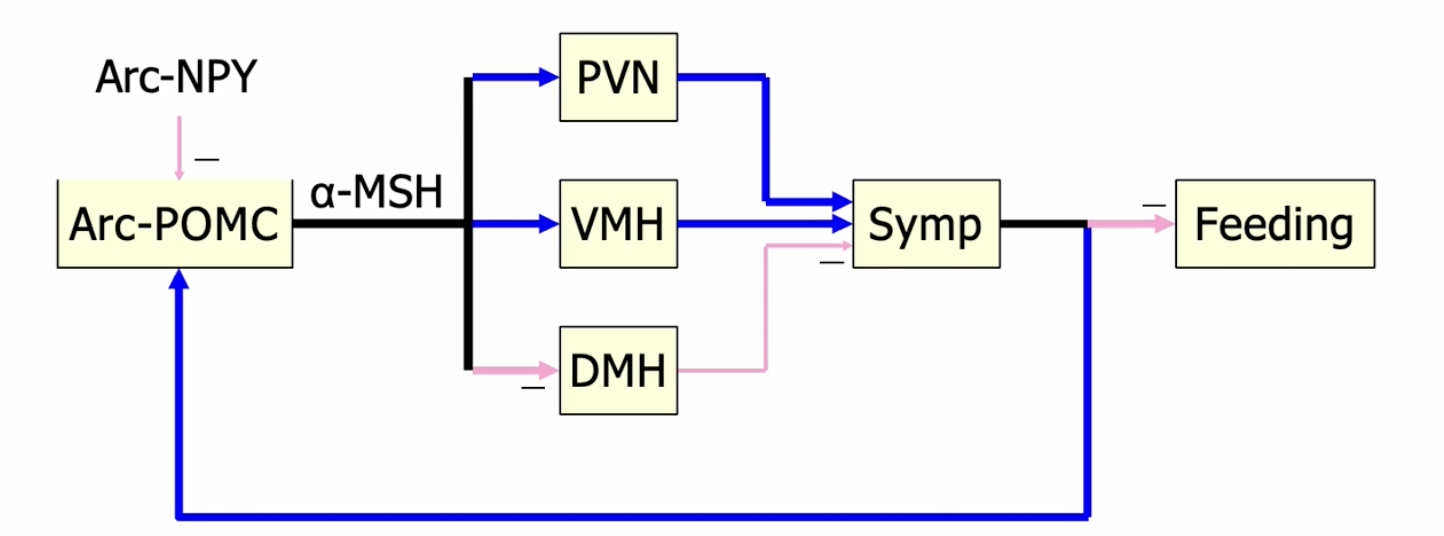
Hypothalamic feeding and anorexigenic centers receive feedback
Control of feeding, like most control systems in the body, works based on negative feedback, i.e. on signals that tell the control center how close the system is to some goal state, or set point.
In feeding, the set point defines a target body weight. Rats with VMH lesions don’t get fatter and fatter for ever, but level off at a new set point above their original weight; and rats with LH lesions level off at a new, low set point.
So how do your feeding control centers in your brain know when you have reached your set point, i.e. how does your hypothalamus know your weight?
What are leptin levels?
what is leptin
Where is it secreted from what type of cells
Explain when it gets secreted
Where is leptin membrane receptors more commonly found in what type of cells
The hypothalamus infers body weight from leptin levels
Leptin is a protein released into the blood mainly by fat cells, so the more fat you have, the more circulating leptin.
Some cells in the body have membrane receptors for leptin, including especially cells in the feeding and anorexigenic centers of the hypothalamus.
Mutations in the genes that produce leptin or the leptin receptor cause obesity in mice and humans.
How does leptin affect three parts of the Arc-NPY system?
recall the issue of leptin if we don’t have enough
Then figure out what they do (and why we need it) (How does it affect each location)
Leptin inhibits the feeding centers Arc-NPY and LH, and excites PVN
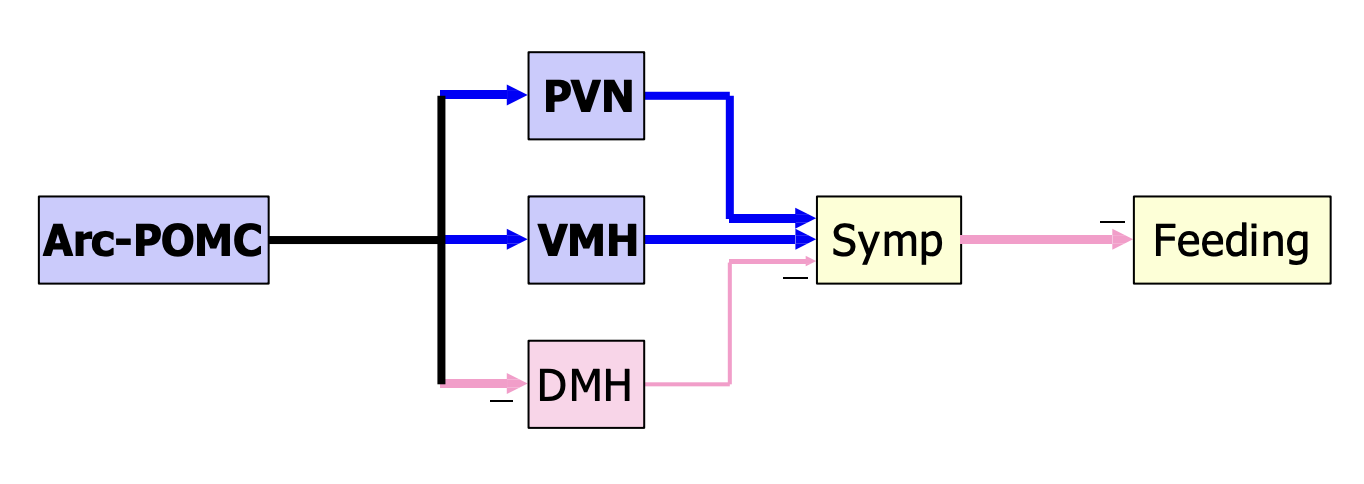
Pink boxes are brain areas directly inhibited by leptin; the blue box with boldface text is an area directly excited by leptin, e.g. PVN is directly excited, and PVN boosts sympathetic activity, but the latter influence is an indirect effect ofleptin.
How does leptin affect three parts of the Arc-POMC system?
Leptin also excites Arc-POMC and VMH and PVN, and inhibits DMH
How does your brain know when to end a meal?
How does blood glucose affect the arc-POMc and arc-NPY system
How does it overall affect your feeding? What happens when the blood glucose rises
What are some other mechanisms in the body
Not from leptin, because it is too slow: you don’t lay on much new fat during a single meal. The control system needs faster sources of feedback.
One of these faster signals is blood glucose: it increases as you eat, and its rising level excites Arc-POMC and inhibits LH, inhibiting further feeding.
Other mechanisms involve sensors in the walls of the stomach and intestines that measure nutrients and stretch, and respond by releasing hormones that act on the hypothalamus ...
How does gut hormones inhibit feeding
In what state does this occur
what does the small intestine detect what two things
What three hormones does it release
What three things does it do to the arc-POMC system
what nerve does it excite
What occurs after exiting this nerve (what part of the arc-POMC is affected and via through what neuron)
Occurs during the postprandial state
Sensors in the wall of the small intestine detect stretch and sugar and protein, leading to the release of cholecystokinin (CCK), peptide YY(PYY), and glucagon-like peptide 1 (GLP-1).
These hormones act via the blood to excite Arc-POMC, PVN, and VMH and to inhibit DMH. They also excite the vagus nerve (X), which excites VMH via the nucleus tractus solitarius, NTS (in the brainstem).
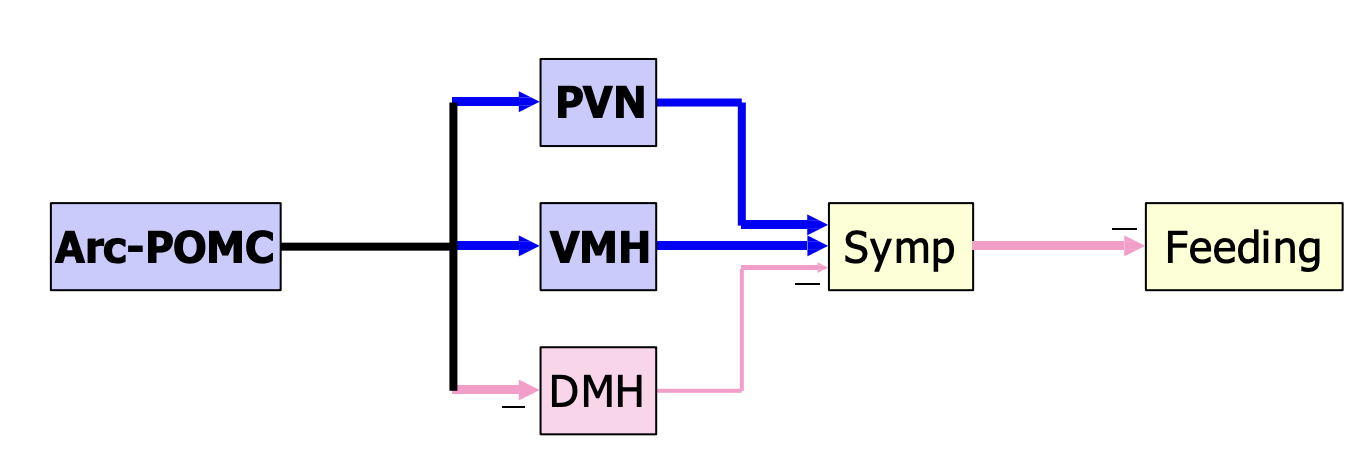
ghrelin hormone
in what state
What is this hormone known as
What does it help in feeding
Where is it released from and when is it released
How does gherlin affect the arc-NPY system (three things)
Ghrelin, the hunger hormone, is released into the blood by cells in the stomach wall when the stomach is empty; stretching the stomach stops ghrelin release.
Ghrelin acts directly on Arc-NPY and LH (exciting them) and on PVN (inhibiting it).
Drug treatments for obesity?
why is finding treatment for these difficult
Issues with amphetamines and fenfluramine
Issues with rimonabant
Issues with leptin hormone
Issues with GLP-1 agonist
Which is the bets option?
Many drugs suppress appetite, but they are dangerous, e.g. amphetamines and fenfluramine (an anti-obesity drug withdrawn in 1997 because of cardiovascular side effects).
Rimonabant, which blocks CB1 endocannabinoid receptors, can lead to moderate weight loss, but causes nausea, major depression, and suicide.
Leptin rarely helps, because fewer than 1% of humans with morbid obesity are leptin-deficient.
they are lepin-resistant
CCK and PYY agonists have been tested, without much success. A GLP-1 agonist called liraglutide may be better.