Chapter Six Test (Civics)
 Call Kai
 Learn
Learn Practice Test
 Spaced Repetition
 Match
Match Flashcards
 Knowt Play
1/101

There's no tags or description
Looks like no tags are added yet.
Name | Mastery | Learn | Test | Matching | Spaced | Call with Kai |
|---|
No analytics yet
Send a link to your students to track their progress
102 Terms
Public Opinion
Public Opinion is the preferences of the adult population on matters relating to government and politics at a point in time.
Beliefs
Beliefs are closely held ideas that support our values and expectations about life and politics.
Attitudes
Attitudes are a settled way of thinking or feeling about someone or something, typically one that is reflected in a person's behavior.
Political socialization
Political socialization refers to the process by which individuals develop political beliefs, values, opinions, and behaviors.
What are some of the most important agents iof political socialization
Family, schools, peers, media, and social environments (including civic and religious organizations) contribute to the development of an individual's political attitudes and beliefs through the process of political socialization.
What are the two major factors in person's political ideology
- Generational effects (experiences shared by people of a common age)
- Life cycle effects (experiences a person encounters during different life stages)
(Major political events can also influence the development of individual political attitudes, which is an example of political socialization.
Example: 9/11 and attitudes about Muslims, terrorism, and safety. )
Framing
The media socializes audiences through framing, or choosing the way information is presented.
Scientific polls
Scientific polls typically randomly select their samples and sometimes use statistical weights to make them representative of the target population.
Benchmark Poll
Often the first used, before a candidate has declared, to gather people's general opinions
Tracking Polls
Tracking Polls ask the same questions time and again to "track" subtle changes in opinion.
Entrance and Exit Polls
Entrance and Exit Polls are conducted outside a polling place on election day to predict the outcome of the election later in the news day.
representative sample
Pollsters take a representative sample, a group of people meant to represent the larger population (called universe).
random sample
Pollsters take a random sample - every member of the universe must have an equal chance of selection into the sample.
weighting or stratification
Pollsters can manipulate the sample to compensate for certain identifiable behaviors, and this is known as weighting or stratification.
Sampling Techniques (aka Methodology)
Pollsters take a representative sample, a group of people meant to represent the larger population (called universe).
Pollsters take a random sample - every member of the universe must have an equal chance of selection into the sample.
Pollsters can manipulate the sample to compensate for certain identifiable behaviors, and this is known as weighting or stratification.
Every poll has sampling error, referred to as the Margin of Error.
Margin of Error
Every poll has sampling error, referred to as the Margin of Error.
"non-attitudes"
MOST AMERICANS DO NOT HAVE STRONG OPINIONS ON A NUMBER OF ISSUES - called "non-attitudes"
Are the best political quizzes:
A. Democrat
B. Republican
C. Multiple Choice
D. Open-Ended?
E. Short-answer
D. Open-Ended
Good, reliable polls have open-ended questions that give the respondent a choice to voice their true opinion. This is to manage non-attitudes
The relationship between scientific polling and elections and policy debate is affected by the...
Importance of public opinion as a source of political influence in a given election or policy debate.
Reliability and veracity of public opinion data
Social-desirability bias
Respondents and voters declared voters told pollsters what they thought the pollster wanted to hear.
Undecideds breaking late
According to exit polling, in some races, the issues, candidates, and timing can affect sudden changes in behavior.
Biased pollsters (data versus fact)
Poll data is not always fact. Special interest groups, and political interests may suggest their polling data is fact, when their samples may not be representative.
How might politicians stay informed about public policies outside of voting season, and how might they use that or respond to it, especially if it shifts away from theirs?
Public opinion polling is prevalent even outside election season.
The public is not perfectly informed about politics, so politicians realize public opinion may not always be the right choice
Overall, the collective public opinion of a country changes over time, even if party membership or ideology does not change dramatically.
bandwagon effect
During presidential primary season, we see examples of the bandwagon effect, a shift in electoral support to the candidate whom public opinion polls report as the front-runner
horse race coverage
Polling is also at the heart of horse race coverage, in which, just like an announcer at the racetrack, the media calls out every candidate's move throughout the presidential campaign.
In horse-race coverage, modern journalists analyze campaigns and blunders or the overall race, rather than interviewing the candidates or discussing their issue positions.
(This means the story, not the ideas, matter).
How do polls affect donations?
Public opinion polls also affect how much money candidates receive in campaign donations. Donors assume public opinion polls are accurate enough to determine who the top two to three primary candidates will be, and they give money to those who do well.
Does public opinion apply to all parts of the government equally?
Public opinion of the president is different from public opinion of Congress. Congress is an institution of 535 members, and opinion polls look at both the institution and its individual members. The president is both a person and the head of an institution.
How does public opinion impact the president?
Presidents may also use their popularity to ask the people to act.
However, presidents do not consistently listen to public opinion.
How does public opinion impact the Supreme Court?
There is some disagreement about whether the Supreme Court follows public opinion or shapes it. The lifetime tenure the justices enjoy was designed to remove everyday politics from their decisions, protect them from swings in political partisanship, and allow them to choose whether and when to listen to public opinion.
They are connected to both the president and the senate because both are involved in appointment
Overall, however, it is clear that public opinion has a less powerful effect on the courts than on the other branches and on politicians. Perhaps this is due to the lack of elections or justices' lifetime tenure, or perhaps we have not determined the best way to measure the effects of public opinion on the Court.
Media
Media is a broad term for the main means of mass communication (broadcasting, publishing, and the internet) regarded collectively.
What are some positives of Media?
- watchdogs of society and of public officials.
- helps maintain democracy
- keeps the government accountable for its actions, even if a branch of the government is reluctant to open itself to public scrutiny.
- present us with information
- alert us when important events occur.
- offering a platform for public debate and improving citizen awareness.
- place pressure on government to act by signaling a need for intervention or showing that citizens want change.
agenda setting
The media also engages in agenda setting, which is the act of choosing which issues or topics deserve public discussion.
Before the Internet, traditional media determined whether citizen photographs or video footage would become "news."
The "gatekeeping" role of the media is one of its most controversial aspects. (Another is who OWNS and who FUNDS the media you see everyday).
Does everyone use the same media?
No- Each form of media (social media, cable television, professional news media) has its own complexities and is used by different demographics.
How does money impact media?
The media exist to fill a number of functions. Whether the medium is a newspaper, a radio, or a television newscast, a corporation behind the scenes must bring in revenue and pay for the cost of the product. Revenue comes from advertising and sponsors, like McDonald's, Ford Motor Company, and other large corporations.
But corporations will not pay for advertising if there are no viewers or readers. So all programs and publications need to entertain, inform, or interest the public and maintain a steady stream of consumers. In the end, what attracts viewers and advertisers is what survives.
What media do most people use nowadays for policial news?
Increasingly, folks are turning to social media and podcasts for political information.
party press era
The publication of the Federalist Papers, as well as the Anti-Federalist Papers, in the 1780s, moved the nation into the party press era, in which partisanship and political party loyalty dominated the choice of editorial content.
yellow journalism
The tabloid-style newspapers of the post-civil war era included editorial pages, cartoons, and pictures, while the front-page news was sensational and scandalous. This style of coverage became known as yellow journalism.
Evolution of Media
1. Party press era (1780s-civil war)
2. Yellow journalism (Post-Civil-War-1910s)
3. muckraking (1910s-today)
muckraking
With the arrival of the Progressive Era (1910s), the media began muckraking: the writing and publishing of news coverage that exposed corrupt business and government practices. It is an important part of print media today.
What is the impact of radio as a media on politics?
Radio brought communications to rural America. News and entertainment programs were also targeted to rural communities. As radio listenership grew, politicians realized that the medium offered a way to reach the public in a personal manner.
What is the impact of television as a media on politics?
With the invention of television, everyone can decode body language and tone to decide whether candidates or politicians are sincere. Presidents can directly convey their anger, sorrow, or optimism during addresses.
What is the impact of the internet as a media on politics?
The invention of cable in the 1980s and the expansion of the Internet in the 2000s opened up more options for media consumers than ever before.
The availability of the Internet and social media has moved some control of the message back into the presidents' and candidates' hands.
citizen journalism
Social media, like Facebook, also placed journalism in the hands of citizens: citizen journalism occurs when citizens use their personal recording devices and cell phones to capture events and post them on the Internet.
What do younger viewers prefer in their programming?
Another shift in the new media is a change in viewers' preferred programming. Younger viewers like there to be humor in their news.
What role does Freedom of the press play in general freedom?
Freedom of the press (1st amendment right) plays a strong role in keeping democracy healthy. Without it, the press would not be free to alert citizens to government abuses and corruption.
libel
print false information with an intent to harm a person or entity.
slander
speak false information with an intent to harm a person or entity
What are the limits of the press?
The media do not have the right to commit slander, speak false information with an intent to harm a person or entity, or libel, print false information with an intent to harm a person or entity.
The media have only a limited right to publish material the government says is classified. If a newspaper or media outlet obtains classified material, or if a journalist is witness to information that is classified, the government may request certain material be redacted or removed from the article.
They have to follow the FCC
FCC
With the advent of television, the FCC was given the same authority to license and monitor television stations. The FCC now also enforces ownership limits to avoid monopolies and censors materials deemed inappropriate. It has no jurisdiction over print media, mainly because print media are purchased and not broadcast.
The FCC also maintains indecency regulations over television, radio, and other broadcasters, which limit indecent material and keep the public airwaves free of obscene material.
Broadcasts
(TV open or general airwaves, Radio); follows the FCC
Subscriptions
(Newspapers, Magazines, Cable TV, Youtube TV, subscriptions to Paramount, HBO, etc.); not as much subject to the FCC
How does media impact how you think?
The media's primary duty is to present us with information and alert us when important events occur. This information may affect what we think and the actions we take.
The media choose what they want to discuss. This agenda setting creates a reality for voters and politicians that affects the way people think, act, and vote.
Even if the crime rate is going down, for instance, citizens accustomed to reading stories about assault and other offenses still perceive crime to be an issue.
How and why do candidates try to speak directly to voters?
Due in part to the lack of substantive media coverage, campaigns increasingly use social media to relay their message.
Candidates can create their own sites and pages and try to spread news through supporters to the undecided.
What are America's core values?
Individualism
Equality of Opportunity
Free Enterprise
Rule of Law
Limited Government
Create a chart with:
1. Low economic liberty, high individual liberty
2. Low economic liberty, low individual liberty
3. High economic liberty, high individual liberty
4. High economic liberty, low individual liberty
1. Liberalism
2. Communitarianism
3. Libertarianism
4. Conservativism
Keynesian Economics
The central tenet of this school of thought is that government intervention can stabilize the economy and protect consumers and producers.
Tends to be Liberal
Keynesian Examples
FDR: New Deal
Obama: Recovery Act
Biden: American Rescue Plan
Laissez Faire
The market should be completely free to be led by the natural laws of supply and demand for greater efficiency and prosperity.
Tends to be Conservative
Social policy
Social policy is concerned with the ways societies across the world meet human needs for security, education, work, health and wellbeing. (Education, Welfare, Health, etc.)
Policy trends
Policy trends concerning the level of government involvement in social issues reflect the success of conservative or liberal perspectives in political parties.
What do liberal ideologies tend to focus on?
- personal privacy (areas Gov't should not intrude) extends further than conservatives. (except in areas involving religious and educational freedom)
- advocates for equality in individual outcomes.
- favor more government regulation of the marketplace. (Keynesian Economics)
What do conservative ideologies tend to focus on?
- favor less government involvement to ensure social equality.
- seek to protect tradition, morality, and traditional social organization.
- favor little or no regulation of the marketplace beyond protection of property rights and voluntary trade. (Laissez-Faire)
How did the two-party system come into being?
The two-party system came into being because the structure of U.S. elections, with one seat tied to a geographic district, tends to lead to dominance by two major political parties.
first-past-the-post elections
The US generally uses first-past-the-post elections. It is based on the principle that the individual candidate with the most votes wins, whether or not they gain a majority (50% + 1 vote or greater) of the total votes cast.
winner-take-all system
An electoral system in which legislative seats are awarded only to the candidates who come in first in their constituencies. (And none to the losers)
What role do third parties play in the election?
They typically steal votes (So that voters don't have to necessarily face a "lesser-of-two-evis" situation) or tell parties what is important for voters
Even when there are other options on the ballot, most voters understand that minor parties have no real chance of winning even a single office. Hence, they vote for candidates of the two major parties in order to support a potential winner.
Is party membership the same as party identification?
Strictly speaking, party identification is not quite the same thing as party membership. Many identify with but are not members of a party.
What does registering to vote do to people's views on parties?
The actual act of registering to vote and selecting a party reinforces party loyalty.
What do Parties do?
Create platforms that keep voters informed about the issues that are important to them
Mobilize voters to influence the government through winning election
Recruit Candidates
Campaign Management, including fundraising and media strategies
National Committee and Party Leadership in Legislature
the precinct
The smallest unit of election administration; a voting district
county-level organization
While the lowest level of party organization is technically the precinct, many of the operational responsibilities for local elections fall upon the county-level organization.
Most of the county organizations' formal efforts are devoted to supporting party candidates running for county and city offices. But a fair amount of political power is held by individuals in statewide office.
National organization
National organization is that it usually coordinates the grandest spectacles in the life of a political party. National party conventions culminate in the formal nomination of the party nominees for the offices of president and vice president, and they mark the official beginning of the presidential competition between the two parties.
Why do public policies change?
Public policies reflect the attitudes and beliefs of citizens who choose to participate in politics at that time.
Democracies, like the US, are responsive to public opinion.
Liberal Internationalism
Advocates a foreign policy approach in which the United States becomes proactively engaged in world affairs. Its adherents assume that liberal democracies must take the lead in creating a peaceful world by cooperating as a community of nations and creating effective world structures such as the United Nations.
Neoconservative Preemption
Believes the United States should aggressively use its might to promote its values and ideals around the world. The aggressive use (or threat) of hard power is the core value.
Neo-Isolationism
Advocates want to keep free of foreign entanglements. Yet no advanced industrial democracy completely separates itself from the rest of the world. Foreign markets beckon, tourism helps spur economic development at home and abroad, and global environmental challenges require cross-national conversation. So 21st century isolationists want to distance the United States from the United Nations and other international organizations that get in the way.
candidate-centered campaigns
Election campaigns and other political processes in which candidates, not political parties, have most of the initiative and influence.
Parties have adapted to candidate-centered campaigns.
The parties have less power over the nominating process (i.e. Donald Trump)
How are some ways parties have adapted to get more votes?
- adapted to candidate-centered campaigns.
- modified their policies and messaging to appeal to various demographic coalitions.
- used communication tech and voter data to disseminate, control, and clarify messages.
- often employ and depend on professional consultants.
- marked by significant campaign costs and intensive fundraising efforts.
- have started earlier and lasted longer into each election cycle (no "off" season)
professional consultants
Campaigns hire managers and experienced professionals to assist in every aspect of the campaign
Modern campaigns hire these consultants to gain an advantage and win elections
Modern media includes (four):
Social Media
Legacy Media
Advertising campaigns
Mudslinging (attack ads)
Interest Groups
groups of people who organize in order to seek to influence a political outcome or seek to alter public policies on the basis of a common interest or concern.
Interest groups also include associations, which are typically groups of institutions that join with others, often within the same trade or industry, and have similar concerns.
Ex: NRA
trade associations
organizations made up of professionals in a specific industry
inside lobbying
AKA direct lobbying
takes the interest group's message directly to a government official such as a lawmaker.
outside lobbying
AKA indirect lobbying
the interest group attempts to get its message out to the public.
While influencing policy is the primary goal, interest groups also:
1. monitor government activity,
2. serve as a means of political participation for members,
3. provide information to the public and to lawmakers.
Collective Action
A group's decision to forgo individual action for an agreed-upon policy direction
As less people join less interest groups, interest groups have less impact on politics.
How do unions help the greater community?
The benefits sought by unions, such as higher wages, collective bargaining rights, and safer working conditions, are often enjoyed by all workers regardless of whether they are members.
Therefore, free riders can receive the benefit of the pay increase without helping defray the cost by paying dues, attending meetings or rallies, or joining protests.
Free rider problem
Free riders can receive the benefit of a union's work for a pay increase without helping defray the cost by paying dues, attending meetings or rallies, or joining protests. This result is often termed the free rider problem
Why do interest groups form?
Single-issue groups, ideological/social movements, and protest movements form with the goal of impacting society and policy making.
I.G.s often help mobilize voters and have occasionally contributed to political realignments of voting constituencies.
What is one of the biggest interest group intrests?
The federal budget process often has a great deal of interest group lobbying and activism (remember pork-barrel from Unit 3?)
Is participation in politics equal?
Participation in the United States has never been equal; wealth and education, components of socioeconomic status, are strong predictors of political engagement.
Efficacy
Efficacy refers to the conviction that you can make a difference or that government cares about you and your views. People with higher education and wealth tend to have higher efficacy.
Grass-Roots
arising from the ground, bottom-up, local organizing. Not directed by some large national organization.
Often done by interest groups and parties
"Get Out the Vote"
Door Knocking
Canvassing
Interest groups exert influence by (BONUS POINTS):
1. working within party coalitions,
2. through iron triangle policies
3. can educate voters and office holders
4. conduct lobbying,
5. draft legislation,
6. mobilize membership to apply pressure on and 7. work with legislators and government agencies
political action committees (PACs)
Some interests groups form political action committees (PACs), groups that collect funds from donors and distribute them to candidates who support their issues.
PACs through which corporations and unions can spend virtually unlimited amounts of money on behalf of political candidates are called super PACs.
Why do interest groups support candidates? Why do candidates support them?
Interest groups support candidates in order to have access to lawmakers once they are in office.
interest groups and lobbyists provide politicians with information about the technical details of policy proposals, as well as about fellow lawmakers' stands and constituents' perceptions.
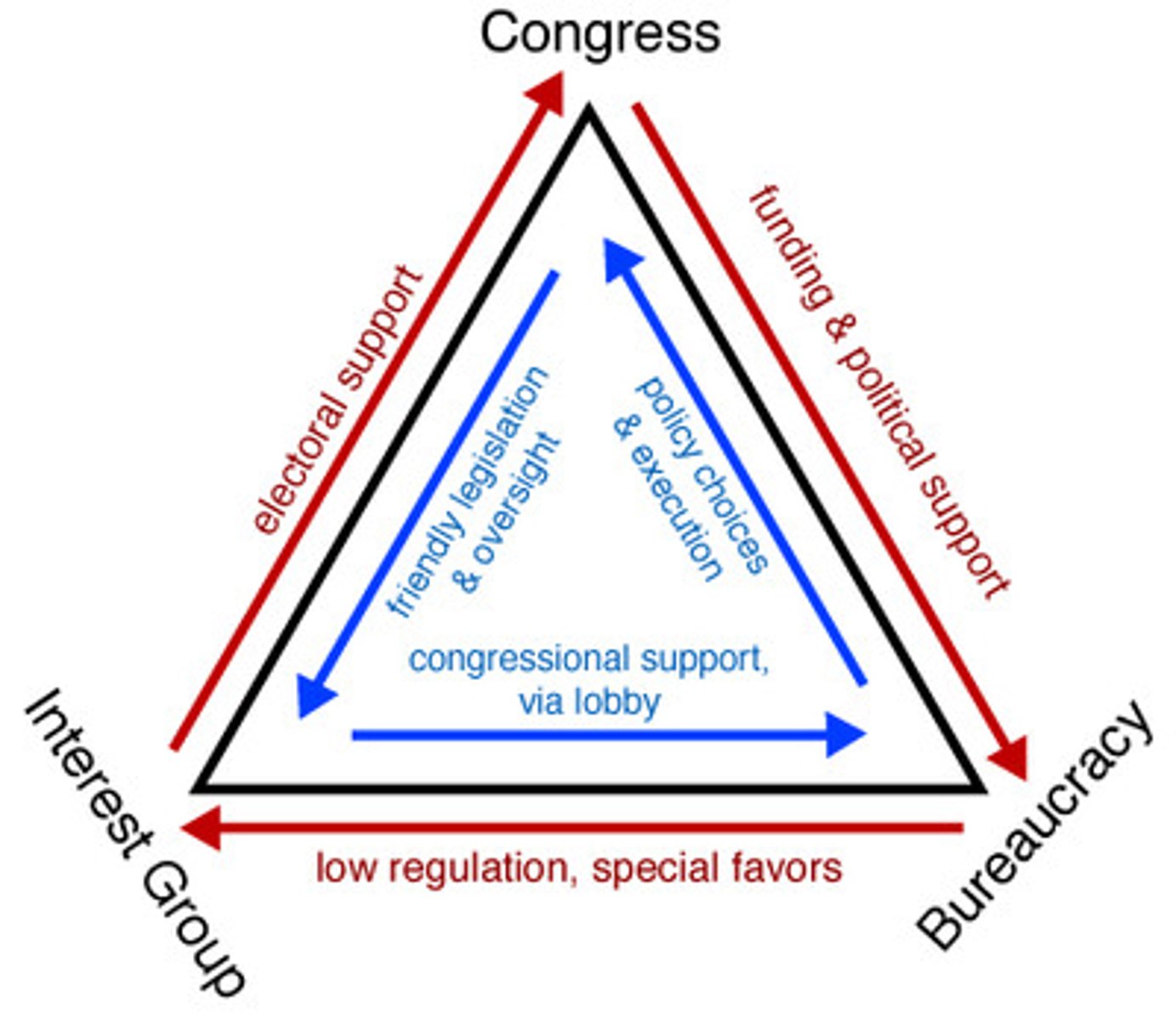
"iron triangle"
In United States politics, the "iron triangle" comprises the policy-making relationship among the congressional committees, the bureaucracy, and interest groups
Congress: provides funding/political support to Bureaucracy and follows interest groups; gets policy information and electoral support
Bureaucracy: Hires people from interest groups businesses and implements laws desired by Congress; gets budget approvals, lobbying support, jobs
Interest Groups: Provides electoral support to Congress and info/lobbying/jobs to Bureaucracy; gets influence over laws and enforcement
amicus curiae brief
Interest groups may also file an amicus curiae brief (a written document submitted as a "friend of the court" to provide additional information for justices to consider when reviewing a case)
Linkage Institutions
The channels by which citizens communicate and connect with the government, and seek to influence it. They are also important in allowing the government to communicate and connect with its citizens.
Parties
Interest Groups
Elections
Media
What is a debate about money and interest groups?
Today, the debate about interest groups often revolves around whether the First Amendment protects the rights of individuals and groups to give money, and whether the government can regulate the use of this money.
Money is a part of your speech
In 1971, the Federal Election Campaign Act was passed, setting limits on how much presidential and vice-presidential candidates and their families could donate to their own campaigns.
The law also allowed corporations and unions to form PACs and required public disclosure of campaign contributions and their sources.
Debates have increased over free speech and competitive and fair elections related to money and campaign funding (including contributions from individuals, political action committees [PACs], and political parties)