Consumer Behaviour Y2 Key Revision
 Call Kai
 Learn
Learn Practice Test
 Spaced Repetition
 Match
Match Flashcards
 Knowt Play
1/92

There's no tags or description
Looks like no tags are added yet.
Name | Mastery | Learn | Test | Matching | Spaced | Call with Kai |
|---|
No analytics yet
Send a link to your students to track their progress
93 Terms
Consumer Behaviour defintion:
Consumer Behaviour: “The study of processes involved when individuals or groups select, purchase, use or dispose of products, services, ideas or experiences to satisfy needs and desires - (Solomon, 2020, p.22)
Key 3 process issues of consumer behaviour:
Process issues of consumer behaviour
Prepurchase issues: e.g. decision, information, changing consumer attitudes
Purchase issues: utility, process, experience, reputation vs situational factors
Post-purchase issues: pleasure, utility, env. consequences vs repurchase, reputation, satisfaction
Marketing definition and process:
Marketing: Management process of identifying, anticipating and satisfying customer requirements profitably - (Chartered Institute of Marketing, 2009)
“The basic function of marketing is to attract and retain customers at a profit” - (Peter Ducker, 1954)
Customer perceived value formula and value:
Customer Perceived value = Perceived benefits - Perceived sacrifices
product benefits, service, psychological vs sacrifices like monetary cost, time cost, energy cost and negative consumption
Value: consumer’s overall assessment of utility of a product/service based on perceptions of what is received and what is given
Definition of value:
Value: consumer’s overall assessment of utility of a product/service based on perceptions of what is received and what is given
Utilitarian vs Hedonic Value:
Utilitarian value: Gratification derived because something helps a consumer solve a problem or accomplish a task, with rational intentions behind a purchase
provide a means to an end, objective and binary
Hedonic value: Value derived from immediate gratification, mainly with experience and emotions associated with consumption
emotional and subjective, not mutually exclusive with Utilitarian, not a means to an end
Consumption definition + needs vs wants:
Consumption: process by which consumers use and transform goods, services or ideas into value, involving interaction between marketer and consumer
based on image and personality; products can establish identity
Need: something a person must have to achieve and live vs Want: specific manifestation of a need that personal and cultural factors determine
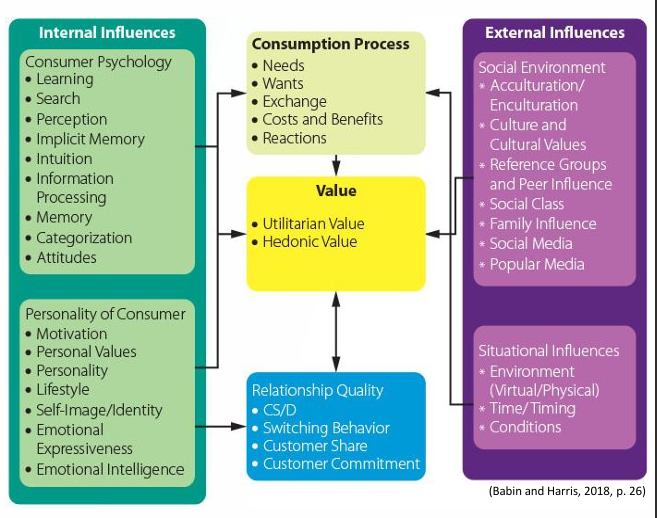
Consumer Value Framework:
Internal Influences:
Consumer Psychology: information, perception, intuition, attitudes
Consumer Personality: values, lifestyle, motivation and identity
Consumption Process: needs, wants, exchange, C&B, reactions
Utilitarian vs Hedonic Value
Relationship quality: switching, share, commitment, retention
External Influences:
Social Environment: class, media, values, family, culture, celebrities
Situational influences: Environment, timing, conditions like physical and economic
Study with survey for happiness and meaningfulness:
“Happiness was linked to being a taker rather than a giver, whereas meaningfulness went with being a giver rather than a taker” (Solomon, 2020, p.29)
Happiness - linked to satisfying wants and needs
Meaningfulness - linked to expression and positive impact, potentially derived from wants and needs
based on a survey asking about happy and meaningful lives
Consumer Culture Theory (CCT):
“Research that regards consumption from a social and cultural POV rather than more narrowly as an economic exchange” (Solomon, 2020, p.40)
Popular culture quote:
“Popular culture is both a product of and an inspiration for marketers” (Solomon, 2020, p.29)
Paradox of Choice:
Paradox of Choice: Too much choice can be demotivating (paralysing effect) and can decrease the likelihood of purchase (Lyengar & Lepper, 2000)
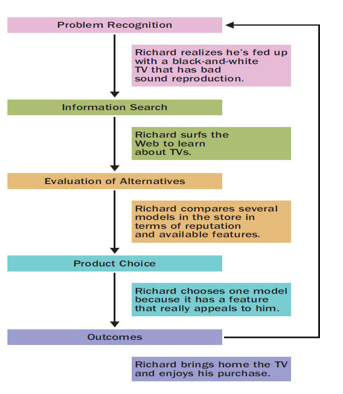
5 steps in consumer decision making:
Problem recognition
Information search
Alternative evaluation
Product choice
Outcomes
Step 1 of Consumer Decision Making - Problem Recognition:
Step 1 - Problem Recognition (example, wanting a new TV)
Occurs when we experience a significant difference between our current state of affairs and some state we desire (Solomon, 2020, p.342)
caused by opportunity recognition (ideal high actual normal)
caused by need recognition (ideal normal actual low)
“A study in Finland showed that when one of a person’s 10 nearest neighbours bought a car, the odds that the person would buy a car of the same make during the next week and a half jumped 86%” (Leonhardt, 2005)
Step 2 of Consumer Decision Making - Information Search:
Process by which we survey the environment for appropriate data to make a reasonable decision
Ongoing, prepurchase, internal ( knowledge retrieval) , external search
Factors influencing information search effort:
personal, perceived risk, situational factors, attitude, time
Step 3 of Consumer Decision Making - Evaluate Alternative:
Step 3 - Evaluate Alternative
known vs unknown, acceptable vs unacceptable, indifferent vs overlooked —> purchase
Step 4 and 5 of Consumer Decision Making - Product choice and purchase evaluation:
Consumer decision made, but choice does not necessarily mean choosing a particular alternative
Potential choice delay until future date, or forgo purchase
Step 5 - Purchase Evaluation
Occurs when we experience the product or service we selected and decided whether it meets our expectations (Solomon, 2020, p.345) —> Satisfaction level
Product categorisation:
Consumers acknowledge information and place it into familiar category
Knowledge structure, guiding expectations and attitudes to the new product
3 Levels of product categories:
Levels of product categories:
Superordinate category - abstract concepts e.g. dessert
Basic level category - useful, item commonalities, considering alternatives e.g. fattening vs non-fattening dessert
Subordinate level - specific, detailed, meaningful evaluations e.g. ice cream, pie, cake
Marketing implications of product categorisation:
Marketing implications:
Positioning product to target consumers
Identify competitors and substitutes
Create an Exemplar product
Store location and environment
Compensatory Rule:
Compensatory Rule: Allows a product to make up for its shortcomings in one dimension by excelling in another dimension
Simple additive —> option with most positive attributes
Weighted additive —> relative importance considered via weighting
Non-Compensatory Rule of produce choice:
Non-Compensatory Rule: If an option doesn’t suit on one dimension, we reject it and move on
Conjunctive rule of product choice:
Conjunctive rule: sets a minimum cut-off point for various features and rejects any features failing to meet this cut-off point
Lexicographic rule of product choice:
Selecting the product/brand they believe performs best on the most important attribute
Eliminations-by-aspects rule (EBA) of product choice:
Eliminations-by-aspects rule (EBA): Set cut-off points, begin with most important attributes and eliminate subpars and move on to subsequent evaluations
Mental accounting bias:
framing a problem in terms of gains/losses e.g. £50 bonus vs £50 loss
loss aversion
Sunk-cost fallacy
Loss aversion:
Loss aversion: emphasising losses more than gains
Sunk-cost fallacy bias:
Sunk-cost fallacy: reluctant to waste something we paid for e.g. finishing a bad movie you paid for
Priming decision-making bias:
Environmental cues that influence us e.g. classical music influences expensive purchases in stores
Default bias in decision making:
Default bias: tendency to comply with requirement rather than make effort not to comply e.g. pension enrolling because opting out requires effort
Changes to decision making in consumer behaviour:
online information search
Research online, purchase offline
Moments of Truth
Changes to Decision Making - Online information search:
With age comes reduced cognitive online capabilities ; diminishing working memory capacity
Products bought online induce more extensive information processing than printed advert products (Schlosser, 2003)
Consumers also requested more information when online
Search engine optimisation: Procedures companies use to design the content of websites to maximise the likelihood that their content will show up when someone searches for a relevant term (Solomon, 2020, p348)
Changes to Decision Making - Research online, purchase offline (ROPO):
Websites have strong search attribute advantage
Cross-channel synergy - online searching enhance in-person purchasing experience
Shops have strong purchase attribute advantage, whilst websites are unable to retain customers during the decision making process
(Verhoef, Neslin & Vroomen, 2007)
Consumer behaviour and process - Moment of Truth:
Moments that present an opportunity to delight the customer
e.g. finally finding a product on a website, being offered a bargain
First moment of Truth (shelf) : shoppers making up their minds in 3-7 seconds (Proceter and Gamble)
Second moment of Truth (experience ): consumer’s actual experience using the product, which shapes satisfaction and repeat purchase
Zero moment of Truth: All research consumer do online before purchased
Self concept and identity definitions:
Self-concept: Summarises the belief a person holds about their own attributes and how they evaluate the self on these qualities
Identity: Any category level with which a consumer self-associates that is amenable to a picture of what a person looks like, thinks, feels and does
Ideal vs Actual vs Avoidance self:
Ideal self: A person’s conception of they would like to be
Actual self: Refers to our more realistic appraisal of the qualities we do and don’t have.
People buy products that align with either who they are or who they aspire to be (Sirgy, 1985)
Avoidance self: Type of person we do not want to be; consumers avoid buying products associated with an avoidance self.
Extended self facets:
Self extends beyond the body and mind to include external objects, symbols and experiences
Objects and symbolic possessions: items, heirlooms and artefacts
Functional possessions: tools and devices that enhance capability
Symbolic possessions: family mementos and art reinforce meaning
Personality traits:
Personality traits: temporally and situationally invariant personal characteristics that distinguish individuals and lead to consistencies in behaviour (Baumgartner, 2002, P.286)
Big Five OCEAN model + examples:
Extraversion: social, expressive
Agreeableness: cooperation and trust
Use fewer swear words and expressive positive social media posts
Conscientiousness: organisation and detail-oriented
post less and engage less on social media
Neuroticism: emotional instability and stress
passive use of social media —> use negative words in posts
Openness to experience: creativity and adventurous
larger social media networks
Use of Big 5 OCEAN model in social media:
Big Five Dimensions can be predicted from consumer’s digital footprints e.g. on social media —> enhance and personalise consumer experience e.g. online ads and recommendation agents
Exploitation: e.g. political propaganda and ethical exploitation
Aaker’s Brand Personality (Aaker, 1997):
“Brand Personality is the set of human characteristics associated with a brand” (Aaker, 1997)
Competence —> responsible, reliable and dependable e.g. Maytag
Excitement —> daring and spirited e.g. monster energy
Ruggedness —> tough and strong e.g. ford trucks
Sincerity —> honest and genuine e.g. wrangler jeans
Sophistication —> glamorous and charming —> e.g. Cartier jewellery
Sirgy’s theory (Sirgy, 1982):
Meta analysis show that “value-expressive brands” success stems from self-congruity between their brand personalities and targeted consumer’s self-concepts (Aguirre-Rodriguez et al., 2012)
Consumers prefer brands whose personality matches their actual or ideal self
e.g. correlating creativity with Apple or Meta
Self congruity is about the extent to which consumers identify with the brand
Bourdieu’s Habitus (Bourideu, 2016):
Habitus: set of instincts you don’t experience as choices such as tastes and dispositions; taste functions act as a key individual-difference variable
e.g. working-class preference for utility, or a bourgeois orientation toward luxury
Luxury brand consumption is often about negative reference groups + positive ones
e.g. “I hate Walmart” = “I’m not the Walmart type shopper” (distaste for social identity rather than the store itself)
Individual differences are social patterned dispositions, shaped by class position, education and life trajectory
Personal background aspects impacting identity and behaviour:
Age: senior citizens have greater difficulty discerning misleading and non-misleading advertising claims (Gaeth and Heath, 1987)
Gender: sustainable consumption is stereotypically more feminine; fragile masculinity when threatened (Brough et al., 2016)
Body type: Stigmatisation of body weight, exacerbated by beauty norms and fashion systems, contribute to underserving of larger-sized women in fashion markets (Scaraboto and Fischer, 2013)
Race: Non white US loan seekers are treated more poorly by loan officers, in which they perceive a subordinated position that limits their ability to pursue goals —> diminished self-esteem and financial prospects harmed (Bone et al., 2014)
Status: demand for utilitarian “green” products is highest among middle class (Yan et al., 2021)
Sensation, stimuli and examples:
Sensation: The immediate response of our sensory receptors to basic stimulus (light, colour, sound, smell, texture) Consumers use sensations to interpret the surrounding world
Touch and haptics:
Haptic feedback, utilitarian functions, social presence, contamination effects
Vision:
product’s sensory qualities help it to stand out e.g. trademarked colours
Visual perception biases affect judgement of product sizes and of consumption
Attitude ambivalence (simultaneously desiring a food and perceiving it as unhealthy) enhances visual sensitivity to increasing portion sizes (Cornilet et al., 2014)
Smell:
pleasant scents like Cinnabon places improve product and store evaluation
Sound:
French wine outsold German wine when French music was played (vice versa)
Food sound during consumption impacts quality e.g. crackers, celery
Price and taste:
increased price —> flavour pleasantness increases in terms of wine
Perception and three stages names:
Perception: The process by which people select, organise and interpret sensations; what we add to raw sensations to give them meaning
Sensory stimuli —> sensory receptors —> Exposure —> Attention —> Interpretation
Stage 1 of Perception: Exposure
“Exposure occurs when a stimulus comes within the range of someone’s sensory receptors” (Solomon, 2020)
Exposure stage of perception: Absolute threshold, Differential Threshold and Just Noticeable differences + impacts:
Absolute threshold:
minimum intensity to detect a stimulus e.g. loudness of advert
“A highway billboard might have the most entertaining copy, but the genius is wasted if the print is too small for passing motorists to see it” (Solomon, 2020)
Differential Threshold (JND - just noticeable differences)
smallest change you can detect between two stimuli
JDN impacts:
Price increases:
shrinkflation works. 454 —> 420g pasts goes unnoticed
Gradual changes:
Netflix raises price $1/month at a time, instead of $5, less outrage
Quality improvements:
new formula? customers might not notice unless informed
Marketer’s Dilemma:
little changes may be unnoticed vs major changes will be noticed
Weber’s Law, as part of Perception:
Weber’s Law: The smallest noticeable change in a stimulus is a constant proportion of the original stimulus intensity
Sound: Increasing volume from 10 → 12 feels noticeable
Increasing from 80 → 82 often doesn’t—you’d need a bigger jump.
Price (economics/marketing):
A £0.50 increase on a £2 coffee is obvious
A £0.50 increase on a £500 phone is hardly noticed.
“Weber’s Law is a challenge to green marketers to try to reduce the size of their packages / products when they provide concentrated and more earth-friendly versions of their products” (Solomon, 2020)
e.g. makers of laundry detergent brands have to convince their customers to pay the same price for about half the detergent
Stage 2 of Perception: Attention + marketing strategies and modern challenges:
Attention: the extent in which processing activity is devoted to a particular stimulus
Modern challenge:
sensory overload, selective attention, ad overdose
Marketing strategies:
Perceptual vigilance: consumers are more likely to be aware of stimuli that relate to their current needs e.g. pregnancy x strollers or illness + lemsip
Perceptual defence: consumers may not process or distort the meaning of a threatening stimulus e.g. smokers ignoring lung cancer warnings
Adaptation: degree to which consumers continue to notice a stimulus overtime e.g. repeated adverts become invisible like Beta365 or Mcdonald’s
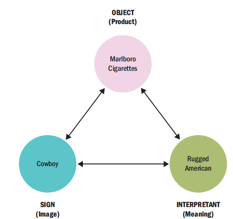
Stage 3 of Perception: Interpretation + Semiotics:
What we assign to a stimulus depends on the schema to which we assign it
Semiotics: the study of how signs and symbols communicate meaning
Signs: conveying meaning via visuals (logo) , verbals (name) , auditory (jingle) or physical
Influencing factors:
Prior associations e.g. red = danger / blood
Cultural background e.g. green = environment
Brand reputation e.g. nike swoosh = athletic excellence
Social context, personal beliefs and values
Semiotic Triangle:
Object = actual product e.g. Nike Shoes
Sign = sensory symbol e.g. swoosh logo
Interpretant = meaning you create e.g. athletic excellence, motivation
Interpretational Biases of Perception: (Solomon, 2020):
Interpretational Biases (Solomon, 2020)
Closure principle: people tend to perceive an incomplete picture as complete; we fill in the blanks based on our prior experience
Marketers encourage audience participation, increasing chance people will attend to the message e.g. words or letters missing
Figure-ground principle: One part of the stimulus will dominate and other parts recede into the background
eyes go straight to the dominant central object in a photo, so marketers make a stimulus the focal point of the message e.g. a person standing out from a group
Motivation ((Schiffman & Wisenblit, 2019)
Motivation: The driving force within individuals that drives them to act, being goal-orientated and aiming to satisfy a specific need (Schiffman & Wisenblit, 2019)
Marketers try to create products and services to help the consumer reduce this tensions (tension need —> consumer urgency to reduce it)
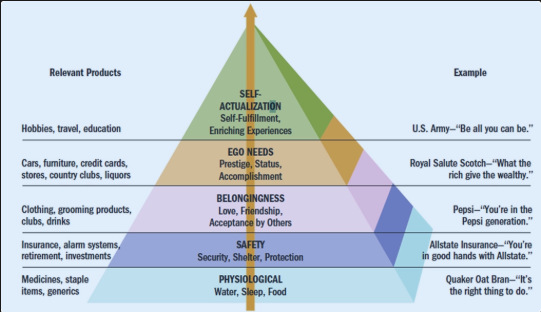
Maslow’s Heirarchy of Needs (Maslow, 1943)
How can organisations meet needs?
Physiol —> Money and conditions
Safety —> Practices and health, pensions
Social —> cohesion
Esteem —> responsibility and reward structures
Self Act. —> Creativity / Challenges?
Critical Evaluation
Popular in practice, however:
Down the heirarchy?, Time span? Do people share common needs? unclear connection between activities?
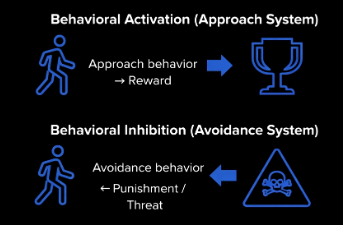
Behavioural Activation System (BAS) (Carver and White, 1994)
Initiate Behaviour toward goals and sensitive to reward
Positive feelings such as hope and happiness
High BAS Sensitivity —> higher P of impulsive purchase
e.g. jump on pre-orders of PS6, crypto
Behavioural Inhibition System (BIS) (Carver and White, 1994):
Behavioural Inhibition System (BIS) (Carver and White, 1994)
Inhibits behaviour that may lead to negative outcomes or punishment
Negative feelings such as sadness and anxiety (ANXIETYYY)
High BIS Sensitivity —> proneness to activity
e.g. stick with long-trusted brands like Waitrose Essentials
BIS/BAS helps explain risk-taking, impulsiveness and avoidance behaviour
Regulatory Focus Theory (Higgins, 2020), Promotion Orientation and Prevention Orientation:
Two coexisting regulatory systems that serve important yet different survival needs
Higgins higher-level motivation strategies
Promotion orientation:
growth, advancement, striving towards aspirations, presence and absence of positive outcomes (gains vs non-gains)
Consumers with strong promotion prefer products that offer an opportunity to grow and approach gains e.g. high-status or comfortable products
Prevention Orientation:
security, safety; presence and absence of negative outcomes (non-losses or losses)
Consumers with strong prevention prefer products that offer an opportunity to defend against threats and avoid losses e.g. reliable and safe products
Example of Regulatory Focus Theory (Solomon, 2020):
Consider the following two toothpaste brands:
White-Bright: White-Bright gives you an appealing white smile.
Drill-Not: Drill-Not is the leader in preventing tooth decay.
White-Bright appeals fit more with a promotion focus and achieving the ideal of a sexy, white smile
Drill-Not fits better with a prevention focus and trying to avoid the pain, discomfort, and inconvenience of tooth decay and related diseases
3 types of Consumption Motives:
Types of Consumption Motives
Utilitarian motives: efficiency, usefulness e.g. Lidl+ personalised savings
Hedonic motives: entertainment e.g. Taylor Swift Eras Tour spending surge
Symbolic motives: self-expression e.g. Stanley Cups, Starbucks Cups
Self-Determination Theory and Motivation (Deci and Ryan, 2000):
Customer’s preference for different product features depend on their motivation
Intrinsic Motivation: doing something because it is inherently enjoyable or interesting
Extrinsic Motivation: doing something because it leads to a desired outcome
“Crowding out” effects: Extrinsic incentives may crowd out the intrinsic motivation for good deeds.
For example, monetary incentives for blood donations can lead to a reduction of the willingness to donate.
reduced internal motivation, finance vs good deed,
Emotions and Moods:
“A mental state of readiness that….
arises from cognitive appraisals of events or thoughts
often expressed physically (e.g. posture, gesture)
accompanied by physiological processes
Moods: Involve temporary positive or negative affective states accompanied by moderate level of arousal
tend to diffuse, isolated from events, contagious
Types of emotional influence and anticipation:
Emotions inform consumer decision-making
Anticipated emotions:
For example, consumers may anticipate feeling regret for choosing the wrong option or wrong time to make a purchase (Simonson, 1992).
Anticipatory emotions:
For example, waiting for a vacation increases feelings of happiness compared to people not going on vacation (Gilbert & Abdullah, 2002).
Definition of Attitude (Cacipoop and Bernston, 1994):
Attitude: General and enduring favourable or unfavorable feelings about, evaluative categorisations of, and action predispositions towards stimuli (Cacioppo and Bernston, 1994)
Persuasion is an active attempt to change attitudes, which is the goal of marketing communication
ABC model of attitudes:
ABC model of attitudes
Affect: consumer feeling or emotion about something e.g. “I like Snapchat”
Behaviour: actions a consumer takes toward an attitude object e.g. “ I always look at Snapchats my friends send me”
Cognition: consumer thinking or belief about the attitude object e.g. “sending snapchat videos is a good way for me to stay connected”
Attitude strength and dimensions:
Attitude strength and dimensions:
Strength: durable, persist overtime, withstand persuasion, influence information processing
Dimensions of attitude strength: attitude extremity, attitude-related knowledge, beliefs about attitude object, attitude certainty, elaboration of attitude, ambivalence of attitude (-+)
Source characteristics (origin of communication) and Halo effect:
Source characteristics (origin of communication):
Credibility: how much we believe the communicator, highly dependent on risk / product e.g. experts excel when we want to change attitudes towards high performance risk utilitarian products such as medicine or cars
Attractiveness: how much we like the communication in terms of appearance, personality, status or similarity; needs of recipient should be matched to potential rewards
Halo effect: Persons of high rank on one dimension are assumed to excel on others
e.g. attractive models are often thought to possess desirable quantities e.g. intelligence and happiness (not always the case)
Message effects and characteristics:
Message effects: how the appeal and construction of a message affects persuasiveness including framing, emotional appeal and arguments
Characteristics: humour, fear and rationality used to appeal and persuade customers
dependent on marketer’s objectives, product nature and target market
Cialdini’s Influence: Six principles can help frame messages that affect behaviour after a request is made (Cialdini, 2011) RSACLC:
Reciprocity: We are more likely to give if first we receive
Scarcity: Creating scarce signals increases perceived value e.g. Prime
Authority: We believe an authoritative source > less authoritative
Consistency: People try not to contradict themselves in terms of what they say and do about an issue, prevalent in politics but also in marketer values and adverts
Linking: We agree with those we like or admire e.g. those with similar ethnicities or Spurs fans
Consensus: We consider what others do before what we decide to do e.g. fast food purchases
Message transmission via 3 mediums:
In store screens / point-of-sale displays: impulse purchases and influencing behaviour at moment of decision
Digital signage at the point of sale increases the likelihood of purchasing featured products (Herhausen et al. (2025)
Social media ads: Broad reach, demographic targeting and user engagement
Instagram or TikTok campaigns using videos and polls to shape attitudes towards lifestyle and healthcare brands
Mobile apps / push notifications: personalised communication, loyalty programs and driving repeat behaviour
Personalised push notifications significantly increase user engagement with mobile applications, validating the effectiveness of this channel for sustained interaction (Kim et al. 2025).
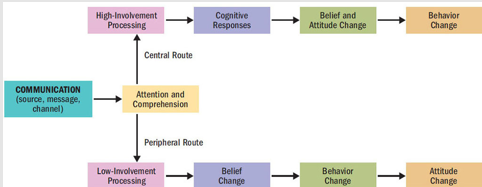
The Elaboration Likelihood Model (ELM) of Persuasion
High involvement → Central route: Consumers carefully evaluate the arguments and information in the message. This creates strong, lasting attitudes that influence behaviour.
Low involvement → Peripheral route: Consumers rely on simple cues (e.g., attractiveness of the source, packaging, visuals, endorsements) rather than analysing the arguments.
Higher product relevance —> higher consumer processing; less relevant requires cues and presentation
Attitude-Behaviour Gap (Mintel, 2023):
People’s stated attitudes often don’t match their actual behaviour
e.g. high rates of supporting sustainability, but fewer actually purchase
4/10 Americans prioritise sustainable living, despite concerns of climate change
Positive ideas =! real purchasing decisions (not always)
Cognitive Dissonance (Festinger, 1957):
When a person is confronted with inconsistencies among thoughts of behaviour, they will take action to resolve uncomfortable dissonance via coping and justification mechanisms such as:
Minimising personal responsibility (comparing action to governments / corporations)
Questioning effectiveness (Is climate change exaggerated?)
Behaviour reframing (I recycle and buy organically, so flying occasionally doesnt really matter)
Many individuals are environmentally conscious yet routinely engage in behaviors that contradict those beliefs
Framing, Priming and Nudging:
Framing: How we pose the question to people or what we ask them to do e.g. loss aversion
Priming: Environmental cues increase a certain reaction, while we are unaware of influences
For instance, people follow what others like them are doing
“Most customers choose this option” before promoting a product / The French music increased purchase of French wine.
Nudging: A deliberate change by an organisation that intends to modify behaviour, often exploiting cognitive biases
e.g. placing healthier foods at eye-level to encourage better eating choices
Consumer habit creation process (CRR) (Duhigg, C., 2013):
Stage 1 Cue: A trigger that tells your brain to go into automatic mode and which habit to use
Stage 2 Routine: Physical, mental or emotional action as a result
Stage 3 Reward: Helps brain figure out if particular loop is worth remembering
This loop becomes automatic, and the brain stops fully participating in decision-making
e.g. gaming, shopping, cooking
Zuboff’s Surviellance Capitalism (Zuboff, 2023) discussing tracking, regulatory limits and Instrumentalitarian power:
Surveillance capitalism: Companies collect and commodify human behaviour as raw material. Cognitive biases are leveraged to predict, nudge, and manipulate behaviour, often eroding privacy and autonomy (Zuboff, 2023).
Continuous tracking: Everyday actions are monitored to generate predictive data using facial recognition and illustrating commodification of behaviour
Instrumentalitarian power: Companies undermine autonomy and informed consent, turning “nudges” into coercive manipulations.
Regulatory limits: Clearview AI (2023) collected biometric data from social media images to build profiles that could shape decisions without consent (Reuters, 2023), highlighting unchecked surveillance and legislation dodging
Pokemon GO Footfall, linking to surveillance capitalism (+ Eval):
Collected and used player behaviour data; lures are in-game items that attract Pokémon to PokéStops, which players are drawn to, creating predictable movement patterns
Businesses could pay to place lures, increasing footfall in specific locations
Restaurants associated enjoyed a higher level of consumer engagement and positive perception (Pamuru et al., 2025)
Ethical issues, limiting user’s agency, privacy rights, surveillance capitalism
Utilitarian shopping value, personal shopping value and hedonic shopping value:
Utilitarian shopping value: Worth obtained when shopping task or job completed successfully e.g. this is useful
Hedonic shopping value: worth of a shopping activity when time spent doing the activity is personally gratifying e.g. this is fun or rewarding
Personal shopping value: Overall subject worth of a shopping activity considering all associated costs and benefits (Babin, Barry J., 2017)
Antecedent conditions and its economic resources:
Situational characteristics that a consumer brings to a particular information or consumption environment
Shapes value in a situation by framing events
Economic resources like buying power, 3-P payments and consumer budgeting, mood, security and emotion
Consumer Budgeting: Mental budgeting is a memory accounting for recent spending a consumer who overspends in one category will compensate through under-consumption in another category.
Mood: can impact spending and satisfaction; happy —> hedonic goods and sad —> necessities
Aspects of a consumer environment:
Physical elements: pricing signals, visual aids and aesthetics
Atmospherics: feelings created by aura of physical attributes that comprise of the physical environment
comprised of functional and affective quality
Smells: e.g. supermarkets place fresh bread near the entrance to trigger hunger and warmth association
Music: e.g. slow tempo increases shopping time; luxury associated with classical (wine experiment classical vs chart music)
Colour: e.g. blue environments increase perception of quality whilst warm colours with soft lighting create comfort
Lighting: soft warm —> premium and hedonics; harsh lighting —> low prices, discomfort and utilitarian goals (Aldi)
Congruity: how consistent the elements of an environment are with one another (Babin, Barry J., 2017)
Qualities of an Environment:
Functional Quality: low prices, selection, convenience, location, payment
Affective Quality: treatment, colours, lights, music, odours, other shoppers
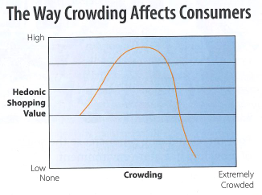
Social settings: shopper and product density, social comparison and mental comparison, crowding optimality
Merchandising:
Deliberate placement of products and fixtures to maximise purchase likelihood
Eye-level shelf placement for high-margin products in supermarkets
IKEA’s forced path layout with hidden shortcuts
Impulse products at checkout to exploit low resistance moments at the end of a shop such as gum or chocolate
Poor merchandising, including disorganisation, laziness and low effort, can increase the sense of crowding in a store environment, as well as reducing the sense of quality and professionalism (Babin, Barry J., 2017)
Temporal factors, time pressure and discretionary time:
Temporal factors: Situational, time-related factors that affect consumer’s thoughts, feelings and value perception
time pressure (Aldi), time of year (seasonal), time of day (5-Hour energy product dependent on circadian cycle)
Each time form represents valuable resource
Time pressure: represents an urgency to act based on some real or self-imposed deadline
Consumers process less information when time is scarce
Fear of missing out may create urgency e.g. ads with countdown timers and limited stock
Price-quality heuristic (more expensive = better) —> poor judgements about prices
Discretionary time: time not obligated toward some compulsory or time-consuming activity
Consumers feel a lack of spare time can be made up through convenient, personalised services such as Deliveroo —> increased hedonic value and instant gratification (vice versa e.g. cooking on free weekend)
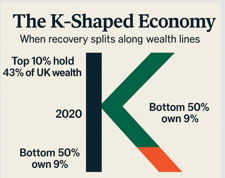
K-shaped economy linking value perception and income:
Higher income households continue spending on restaurants, travel and experiences; discretionary purchases retained
Lower income households face rising costs and social shifts; the same restaurant lunch shifts from treat to anxiety
Same economy and same products but value perception varies between affluence levels
Primark record revenues during cost of living crisis as value perception increases although price is low, having previously avoided discount retailers
Premium brands double down on luxury positioning, targeting value perception among high K consumers
4 types of shopping activities (AEEI):
Acquisitional Shopping: activities oriented towards a specific intended purchase e.g. food or device
Epistemic Shopping: activities oriented towards acquiring knowledge about products e.g. online research, website exploration
Experiential Shopping: recreationally oriented activities designed to provide interest, excitement or some other desired feeling e.g. games console or board game
Impulsive Shopping: Spontaneous activities characterised by a diminished regard for consequences and desire for immediate self-fulfilment e.g. meal deals, gum or vapes
usually associated with hedonic shopping value
Not synonymous with unplanned purchasing behaviour
Definitions of Ethics and Business Ethics
Ethics: Standards or Moral codes of conduct to which a person, group or organisation holds
Business Ethics: Rules of conduct that guide actions in the marketplace
Consumer Protection Legislation:
Legislation attempts to even the relationship between individual consumers and large corporations
Describes power and importance of consumers
Ensures protection, credibility, decency and protection of vulnerable communities
Recognition by producers of the importance of consumer satisfaction
Advertising Standards Authority (ASA) - codes and violations:
Advertising Standards Authority (ASA) - codes
Legal, honest, decent and truthful
Respectful to competition and must not cause offence
Responsible to society and should not bring advertising into disrepute
TV, magazine, radio, teleshopping, mail, online advertising, leaflets, posters, commercials
Sponsorship, packaging, calls, public notices, political adverts, press releases
Violators of ASA:
Ryanair (2020) Claimed to be “Europe’s lowest emissions airline” —> ruled misleading due to lack of sufficient comparative evidence.
KFC (2018) Ad implied meals were healthier than they actually were —> misleading nutritional impression.
Misleading Advertising and Green marketing:
Misleading Advertising:
Must be obviously identifiable, materially accurate, minimal omissions and consist of documentary evidence to support claims that are expected to be proven
Green Marketing and Greenwashing
Green marketing describes a strategy that involves the development and promotion of environmentally friendly products and stressing this attribute when the manufacturer communicates with customers
Consumer Misbehaviour and issues of Materialism:
Consumer Misbehaviour
Definition: behaviours that are some way unethical and that potentially harm the self or others
Materialism
“The importance a consumer attaches to worldly possessions” (Belk, 1984)
Highly materialistic people:
Tend to be less happy and exhibit fear of death
Tend to use their relationships with possessions to compensate for loneliness and a lack of affiliation with social networks (Lastovicka & Sirianni, 2014)
Form strong connection to brands via self-identity
Compulsive Consumption and Consumed Consumers:
Compulsive Consumption: Repetitive and excessive shopping performed to relive tensions, anxiety or boredom
Behaviour is not done by choice
Gratification of behaviour is short-lived
Experiences strong feelings of regret and guilt
“In the U.S. between 5.9% - 10% of consumers are estimated to exhibit compulsive shopping behaviou**r” (e.g. Faber & O’ Guinn, 1992; Trachtenberg, 1988)**
“Approximately half a million people in the UK suffer from compulsive buying behaviour*”* (Black, 1996)**
Consumed Consumers: Consumers that are used or exploited for commercial gain in the marketplace e.g. prostitutes and donors
Theft and fraud: shrinkage and countering, financial fraud, Wardrobers, counterfeit goods
Definition of CSR (Jobber & Ellis-Chadwick 2013. p196):
Corporate Social Responsibility: The ethical principle that an organisation should be accountable for how its behaviour might affect society and the environment’ (Jobber & Ellis-Chadwick 2013. p196)
Three themes of Sustainable Consumption + Stats:
Three themes of Sustainable Consumption
Dominant set of messages were concerned with encouraging customers to consume rather than restrain from consumption
All of the top ten food retailers used sales promotions extensively
Sustainable consumption theme are limited and less prominent messages
Lack of messages and information were available at sale point
91% of millennials would switch brands for one which champions a cause and 64% of global consumers say they choose brands because of their stand on social issues
Social Marketing and CDC’s 5 key stages:
Social Marketing
Social Marketing: process that applies marketing principles and techniques to create, communicate, and deliver value in order to influence target audience behaviours that benefit society” (Kotler and Lee ,2008)
5 aspects (CDC)
Behavioural change
accept new behaviour, reject potential behaviour, modify or abandon behaviour
Voluntary basis
achieve a level of understanding to discover motivation and personal benefits
Marketing principles
consumer orientation, appealing to motivations; planning and DM
Identifies and influences target audience
appealing to diverse populations, determining values of each audience, priority segments established
Benefits audience
Improvement of health, QoL and societal benefits
Product = benefits / change
Price = cost of stopping unhealthy behaviour
Place - opportunities and access to products
Promotion = Communicating via right channels