Conditions of the Cervical Spine
 Call Kai
 Learn
Learn Practice Test
 Spaced Repetition
 Match
Match Flashcards
 Knowt Play
1/19

There's no tags or description
Looks like no tags are added yet.
Name | Mastery | Learn | Test | Matching | Spaced | Call with Kai |
|---|
No analytics yet
Send a link to your students to track their progress
20 Terms
C1 Myotome
Chin tuck ; Resist superiorly
C2 Myotome
Protrusion ; Resist posteriorly (on chin and forehead)
Rotation ; Resist cheek (BOTH SIDES - resist in neutral)
C3 Myotome
Lateral Flexion ; Resist cheek (BOTH SIDES - resist in neutral)
C4 Myotome
Shoulder shrug ; Resist inferiorly on shoulders
C5 Myotome
Shoulder ABD ; Resist inferiorly above elbows
C6 Myotome
Elbow flexion ; Try to extend elbow
Wrist extension ; Try to fold wrist
****The ‘idk’ shrug*****
C7 Myotome
Elbow Extension ; Try to bend elbow
Wrist flexion ; Try to extend wrist
****Volleyball ready stance*****
C8 Myotome
Finger flexion ; Try to uncurl fingers
Thumb extension ; Try to bend thumb
****Monkey hand*****
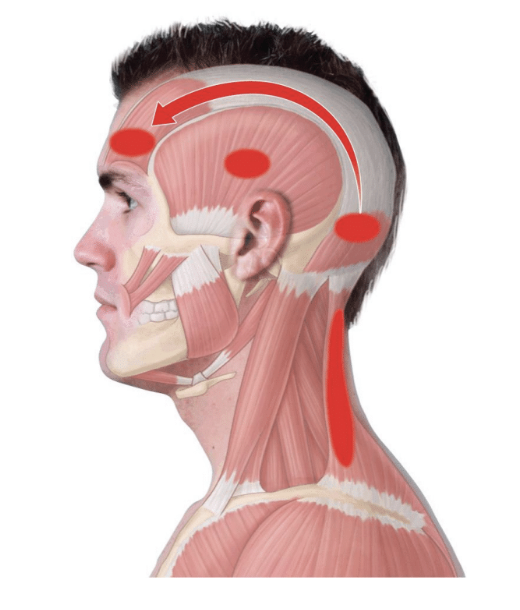
Cervicogenic Headache
Head pain from soft tissue disorders in the cervical spine
C1-C3 dysfunctions of facet joints = primary cause
Pain :
Localized : Neck/occipital region
Radiates : Forehead/temple, ears, eyes
Causes : trauma, posture, Women 4x : Men 1x
Symptoms : Consistent unilateral pain that starts in neck & spreads
Special Tests :
Cervical Flexion-Rotation Test
Craniocervical Flexion Test
Deep Neck Flexor Endurance Test
Cervical Flexion-Rotation Test
Position : Supine w/ AROM full neck flexion
Test : Rotate pt’s head bilaterally and compare sides
Positive : >10 difference OR pain
Testing For : Cervicogenic Headache
Craniocervical Flexion Test
COME BACK TO
Deep Neck Flexor Endurance Test
Position : Supine
Test : AROM tuck chin + lift head & hold
Positive : Less than average time
Females : 29-32 seconds
Males : 35-40 seconds
Testing For : Cervicogenic Headache
Whiplash
Injury to neck from rapid movement causing trauma to cervical soft tissue/bones
0-4 Grades:
No pain & no signs
Pain but no signs
- Small muscle lesions not significant enough to cause spasmsMusculoskeletal signs (causing limited ROM, spasms, swelling, tenderness)
- Sprained ligaments & muscles tearsMusculoskeletal & neurological signs (issues with reflexes, decreased usage dermatomes & myotomes)
- Usually have pressure on or irritation of nervesFracture or dislocation
Pain :
Localized : Neck &/or headaches
Causes : trauma
Symptoms : Depending on grades, could also have blurred vision, spinal instability, ears ring, fatigue
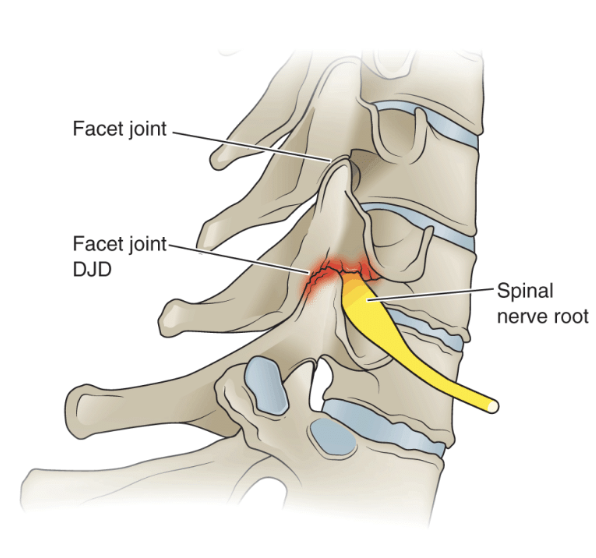
Facet Joint DJD
(Frequently due to DDD {disc degenerative disease}) - Disc deteriorates & facets have to bear more weight → DJD
Pain :
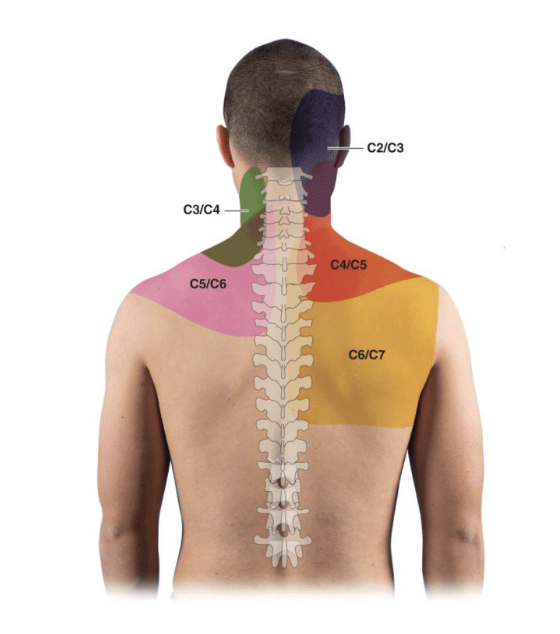
Localized : Neck to scapular region
Causes : aging & obesity
Symptoms : Pain that worsens with extension (could lead to cervicogenic headache) = limited extension ROM
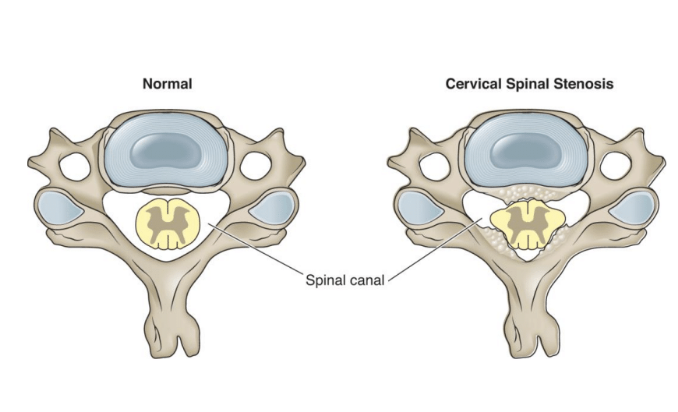
Spinal Stenosis DJD
Narrowing of the canal squeezes spinal cord (Normal spacing of canal and cord is 2.5mm on sides & 1mm front/back)
Pain : Bilateral arm pain
Causes : bony overgrowth from OA or aging, calcification of ligaments of the spinal canal, scoliosis, disc herniations
Symptoms : Bilateral arm pain, fatigue, numbness/tingling, weakness, abnormal reflexes/sensory loss
Cervical Myelopathy : Disruption of nerves impulses through neck & affects LE strength, gait, and bowel/bladder
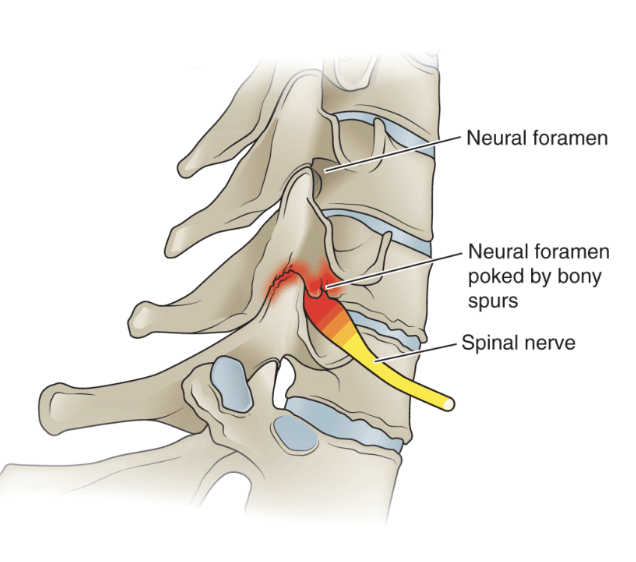
Foraminal Stenosis
OA or DJD in neural foramen with osteophytes overgrowing in foramen & constricting spinal nerve → causing radiculopathy (“pinched nerve”)
Pain :
Centralization : When distal pain moves closer to spine (GOOD!!!)
Peripheralization : When distal pain moves further down arm (BAD!!!)
Causes : Aging OR accelerated hyper- or hypo-mobility
Symptoms : Neck & UE pain, numbness/tingling, weakness, loss of reflexes
!! Usually decrease in pain with neck flexion & shoulder ABD (placing arm overhead)!!
Special Tests :
Spurling’s Compression Test
Cervical Distraction Test
Upper Limb Tension Test (ULTT)
Herniated Disc
Pain :
Localized :
Radiates :
Causes :
Symptoms :
Special Tests :
Spurling’s Compression Test
Cervical Distraction Test
Upper Limb Tension Test (ULTT)